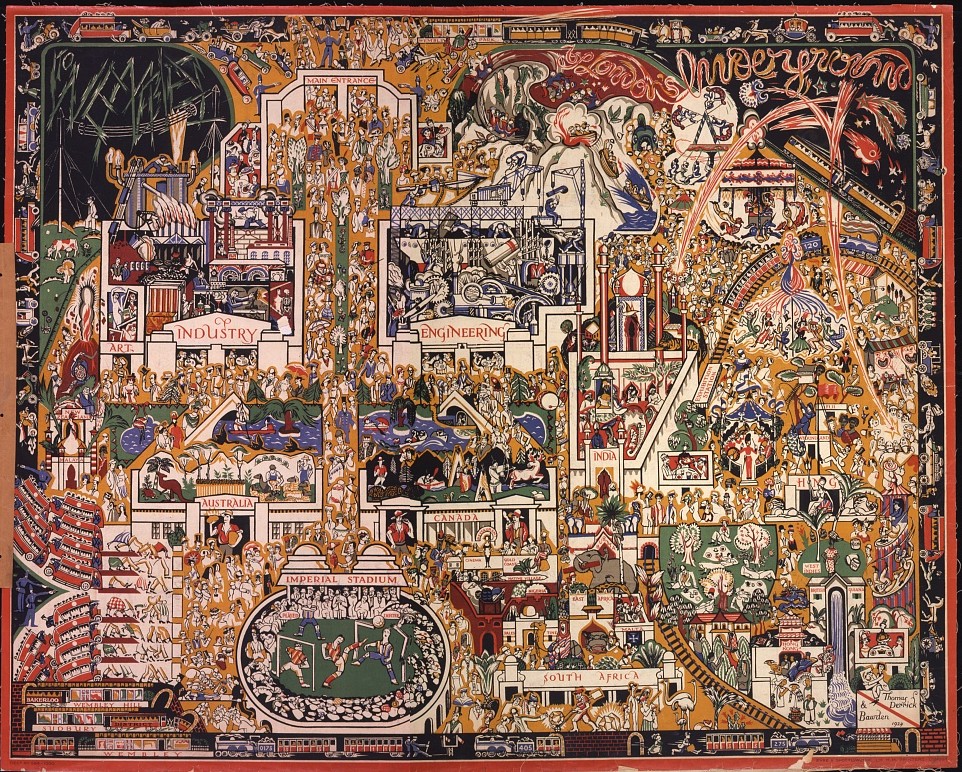
London's Underground to Wembley (British Empire Exhibition poster)
A dense pictorial plan of the 1924 British Empire Exhibition ground at Wembley: crowds pack the main entrance, the Palaces of Industry, Art and Engineering, the Imperial Stadium and the Australia, Canada, India, South Africa and other colonial pavilions, while Underground trains run round the border under the words 'London Underground'. The tell: the empire is drawn as a single festive throng that the viewer is invited to join by train, an appeal to popularity ('everyone is going').
- Date
- 1924
- Period
- Interwar
- Made by
- Underground Electric Railways Company of London Ltd, for the British Empire Exhibition, Wembley (signed 'Thomas Derrick & Bawden 1924', as read)
- Region
- Western and Central Europe
- Country
- United Kingdom
- Medium
- Poster
- Issuer type
- Corporation
- Regime
- Macdonald Government
- Leader
- Ramsay Macdonald
- Audience
- Domestic public
- Purpose
- Persuade or win support
- Theme
- Empire and colonialism
- Event
- British Empire Exhibition 1924
- Techniques
- Bandwagon
- Source
- Identified Openly sourced: the speaker is who they say they are
- Source
- Library of Congress, retrieved September 29, 2026
- Rights
- Public domain (published London 1924, before 1931; LOC: no known restrictions)
Underground Electric Railways Company of London Ltd, 1924; Library of Congress Prints and Photographs Division, LC-USZC4-14177 and LC-USZC4-14178.
Text on the object
WEMBLEY [stylised lettering, top left]
London Underground [stylised lettering, top right]
MAIN ENTRANCE
ART
INDUSTRY
ENGINEERING
AUSTRALIA
CANADA
INDIA
IMPERIAL STADIUM
SOUTH AFRICA
EAST AFRICA [small, partly legible]
WEST INDIES [small, partly legible]
[Hong Kong, partly legible]
[station names on train destination boards, lower left:] BAKERLOO  WEMBLEY HILL  SUDBURY  WEMBLEY
[signature, lower right:] Thomas Derrick & Bawden 1924
Many pavilion labels are very small; only those legible in the 962 px image are listed. The signature reading is uncertain. The title 'London's Underground to Wembley' comes from the Library of Congress record, not from a printed line.