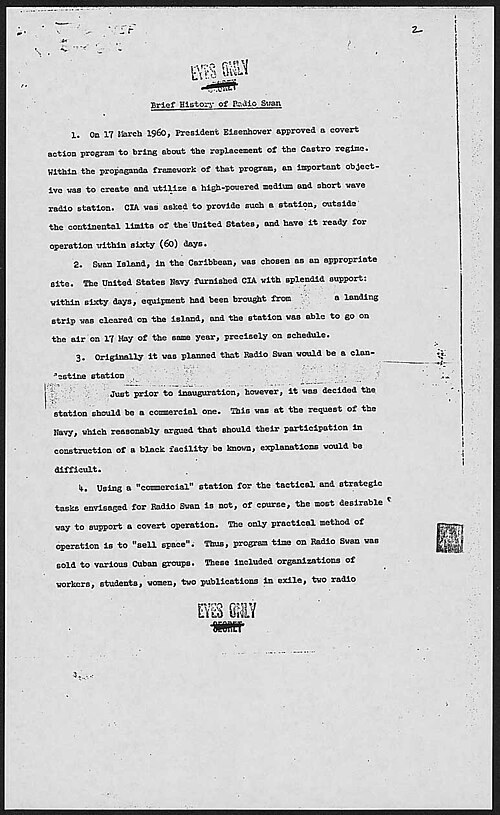
"Brief History of Radio Swan": annex to a 1961 memorandum
Typed page marked 'Eyes Only' and headed 'Brief History of Radio Swan'. Numbered paragraphs say a covert programme approved on 17 March 1960 included a high-powered radio station, ready within sixty days; that it was first planned as clandestine; and that it was made 'commercial' at the Navy's request and 'sold space' to Cuban groups. The tell: the government's own record that the commercial sponsor was a cover.
- Date
- 1961
- Period
- Cold War
- Made by
- U.S. government (unsigned internal annex describing a CIA radio station; held in the Office of the Special Assistant to the President, Kennedy administration)
- Region
- North America
- Country
- United States
- Medium
- Document
- Issuer type
- State
- Regime
- Kennedy Administration
- Leader
- John F. Kennedy
- Audience
- Own forces
- Purpose
- Warn or inform
- Event
- Bay of Pigs Invasion
- Techniques
- Narrative laundering
- Source
- Unidentified Source blurred: contractors, cutouts, buried disclosure
- Source
- John F. Kennedy Presidential Library, via the Digital Public Library of America and Wikimedia Commons, retrieved September 29, 2026
- Rights
- Public domain (U.S. federal government record; Commons tag PD-US)
Office of the Special Assistant to the President, John F. Kennedy Presidential Library, via DPLA.
Text on the object
2
EYES ONLY
[SECRET, struck through]
Brief History of Radio Swan

1. On 17 March 1960, President Eisenhower approved a covert action program to bring about the replacement of the Castro regime. Within the propaganda framework of that program, an important objective was to create and utilize a high-powered medium and short wave radio station. CIA was asked to provide such a station, outside the continental limits of the United States, and have it ready for operation within sixty (60) days.

2. Swan Island, in the Caribbean, was chosen as an appropriate site. The United States Navy furnished CIA with splendid support: within sixty days, equipment had been brought from [blank] a landing strip was cleared on the island, and the station was able to go on the air on 17 May of the same year, precisely on schedule.

3. Originally it was planned that Radio Swan would be a clan-destine station [blank] Prior to inauguration, however, it was decided the station should be a commercial one. This was at the request of the Navy, which reasonably argued that should their participation in construction of a black facility be known, explanations would be difficult.

4. Using a "commercial" station for the tactical and strategic tasks envisaged for Radio Swan is not, of course, the most desirable way to support a covert operation. The only practical method of operation is to "sell space". Thus, program time on Radio Swan was sold to various Cuban groups. These included organizations of workers, students, women, two publications in exile, two radio

EYES ONLY
[SECRET, struck through]
Read from the 500 px scan. 'clan-destine' is hyphenated across a line break in the original. Blanked or masked spaces are marked [blank]; handwritten and stamped marks at the top left are not transcribed. The page ends mid-sentence.




.jpg)