Ranger 7 moon pictures poster (Arabic, Beirut)
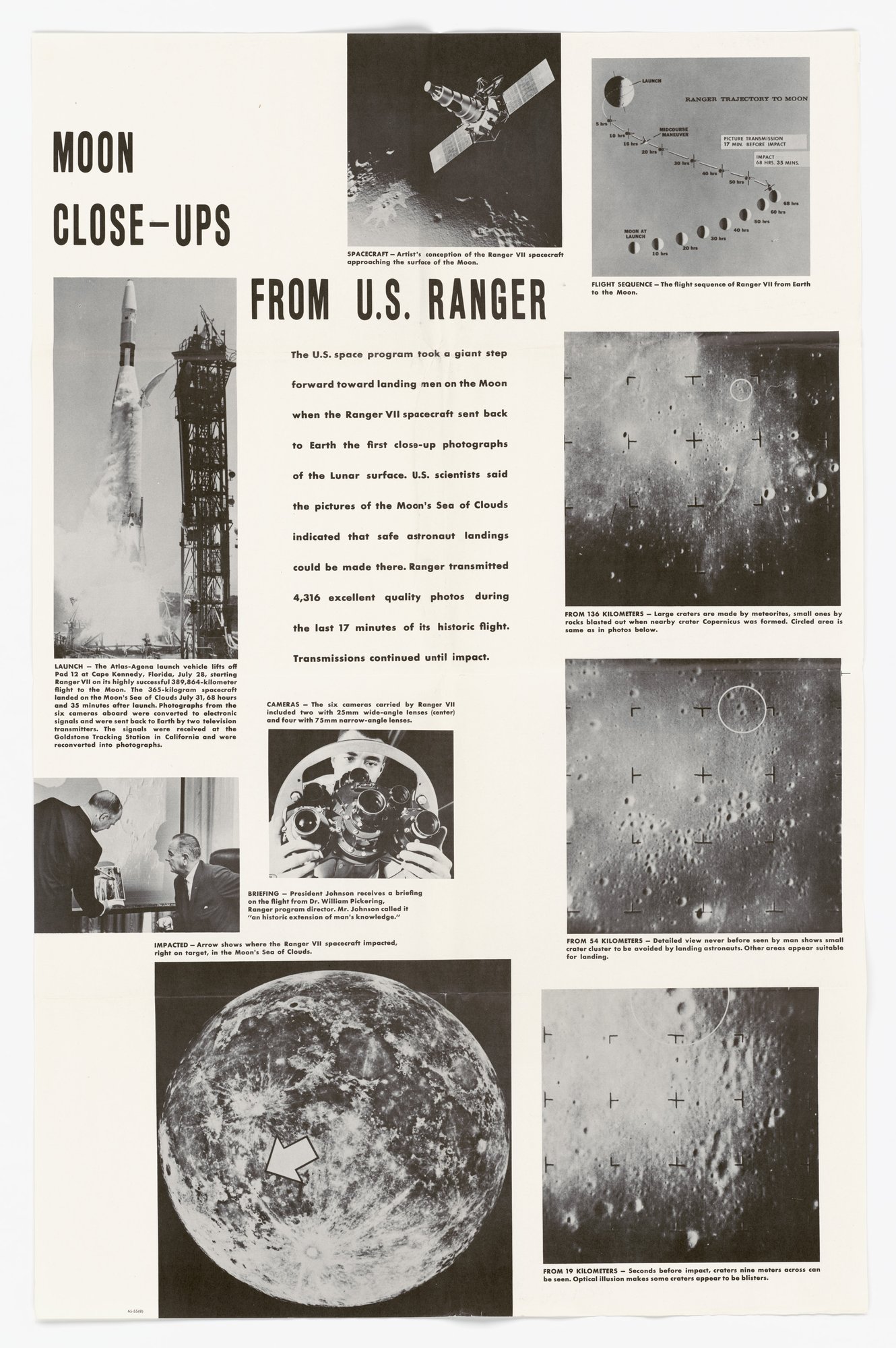
An Arabic-language A poster of lunar photographs from the U.S. Ranger VII probe: launch of the Atlas-Agena rocket, an artist's drawing of the spacecraft, a flight-path diagram, a six-camera array, President Johnson with Dr William Pickering, an arrowed full-Moon view of the impact point, and three close-ups from 136, 54 and 19 kilometres. The text says U.S. scientists judged the Sea of Clouds suitable for safe astronaut landings. The tell is glittering generalities and transfer: 'giant step' and 'historic flight' wording, and the presidential briefing scene, attach prestige to the program.
Propaganda techniques used in this poster
- Date
- September 24, 1964
- Period
- Cold War
- Made by
- U.S. Information Agency (Department of State program), Propaganda Posters Distributed in Asia, Latin America and the Middle East series (RSC Beirut)
- Region
- North America
- Country
- United States
- Medium
- Poster
- Issuer type
- State
- Regime
- Johnson Administration
- Leader
- Lyndon B. Johnson
- Audience
- Foreign public
- Purpose
- Persuade or win support
- Theme
- Science and technology
- Event
- Cold War
- Source
- Unidentified Source blurred: contractors, cutouts, buried disclosure
- Source
- U.S. National Archives (NARA), Record Group 306, Posters in Asia, Latin America, Middle East, retrieved October 4, 2026
- Rights
- Public domain (U.S. government work; NARA RG 306)
U.S. Information Agency / Department of State, September 24, 1964. National Archives, Record Group 306 (NAID 6949210, 306-PPB-286).
Text on the object
صور للقمر
من سفينة الفضاء
«رينجر ٧»

اجتاز برنامج الولايات المتحدة الفضائي خطوة جبارة الى الامام في محاولة انزال الانسان على سطح القمر، وذلك عندما بثت سفينة «رينجر ٧» الى الارض اول صور فوتوغرافية قريبة لسطح القمر. وقال العلماء الاميركيون ان الصور التي التقطت لبحر الغيوم تدل على انه بالامكان انزال الملاحين هناك بامان. وقد بثت سفينة الفضاء «رينجر ٧» ٤٣١٦ صورة ممتازة خلال الدقائق الـ١٧ الاخيرة من رحلتها التاريخية. واستمرت عملية البث الى ان ارتطمت السفينة بالقمر.

«رينجر ٧» — رسم من وضع احد الفنانين يبين شكل السفينة «رينجر» عند اقترابها من سطح القمر.

خط سير الرحلة — هذا هو خط السير الذي اتبعته سفينة «رينجر ٧» من الارض الى القمر.

[الرسم البياني: عناوين الساعات والمراحل مكتوبة بالعربية]

الاطلاق — صاروخ «اطلس - اجينا» يرتفع عن منصة الاطلاق رقم ١٢ في كيب كنيدي، بفلوريدا، في ٢٨ تموز (يوليو) حاملاً السفينة «رينجر ٧» في رحلتها الناجحة مسافة ٣٨٩٬٨٦٤ كيلومتراً. وقد هبطت السفينة البالغ وزنها ٣٦٥ كيلوغراماً في بحر الغيوم في القمر في ٣١ تموز (يوليو) بعد اطلاقها بـ٦٨ ساعة و٣٥ دقيقة. وقد حولت الصور الفوتوغرافية التي التقطتها ست كاميرات مثبتة على ظهر السفينة الى اشارات الكترونية واعيد بثها الى الارض بواسطة جهازي تلفزيون مرسلين. وتلقت هذه الاشارات محطة غولدستون للتتبع في كاليفورنيا حيث اعيد تحويلها الى صور فوتوغرافية.

الكاميرات — من بين الكاميرات الست على ظهر سفينة «رينجر ٧»، كاميرتان من ٢٥ ملمتراً عدسات متعرجة الزوايا (في الوسط) واربع كاميرات من ٧٥ ملم ذات عدسات ضيقة الزوايا.

ملخص الرحلة — الرئيس جونسون يستمع الى ملخص من الدكتور وليم بيكرنج، مدير برنامج رينجر، عن رحلة السفينة. وقد وصف الرئيس جونسون هذه الرحلة بانها «امتداد تاريخي لمعرفة الانسان».

الاصطدام — يشير السهم الى مكان اصطدام السفينة «رينجر ٧» بسطح القمر عند بحر الغيوم» وهو الهدف المقرر لها.

من على ١٣٦ كيلومتراً — هذه الفوهات البركانية الكبيرة تشكلت بسبب تساقط النيازك على سطح القمر. اما الفوهات الصغيرة فقد تشكلت بسبب تفجر الصخور لدى تكوين فوهة كوبرنيكس المجاورة. والمساحة ضمن الدائرة هي نفسها في الصور ادناه.

من على ٥٤ كيلومتراً — يظهر هذا المشهد التفصيلي لسطح القمر الذي لم تره عين انسان من قبل، كومة من الفوهات البركانية الصغيرة التي يجب تجنبها لدى هبوط الملاحين هناك. اما المناطق الاخرى، فيبدو انها مناسبة للهبوط.

من على ١٩ كيلومتراً — قبل ثوان من اصطدام السفينة الفضائية بسطح القمر. وفي الامكان رؤية بعض الفوهات على بعد ٩ امتار. خداع البصر يجمل بعض الفوهات تبدو كأنها قفافيق.

٦٥-٥٧(٨)
PICTURES OF THE MOON FROM THE SPACECRAFT 'RANGER 7'

The United States space program took a mighty step forward in the attempt to land man on the surface of the Moon, when the spacecraft 'Ranger 7' transmitted to Earth the first close photographs of the Moon's surface. American scientists said the pictures taken of the Sea of Clouds indicate that it is possible to land astronauts there safely. The spacecraft 'Ranger 7' transmitted 4,316 excellent pictures during the last 17 minutes of its historic flight. Transmission continued until the ship hit the Moon.

'RANGER 7' - A drawing by an artist showing the shape of the spacecraft 'Ranger' as it approaches the surface of the Moon.

COURSE OF THE FLIGHT - This is the course followed by the spacecraft 'Ranger 7' from Earth to the Moon.

[diagram: hour and stage labels written in Arabic]

LAUNCH - An 'Atlas-Agena' rocket rises from launch pad number 12 at Cape Kennedy, Florida, on 28 July carrying the spacecraft 'Ranger 7' on its successful flight of 389,864 kilometers. The 365-kilogram spacecraft landed in the Sea of Clouds on the Moon on 31 July, 68 hours and 35 minutes after launch. The photographs taken by six cameras mounted on the spacecraft were converted into electronic signals and re-sent to Earth by two television transmitters. These signals were received by the Goldstone tracking station in California, where they were converted back into photographs.

THE CAMERAS - Among the six cameras on board 'Ranger 7' are two 25-millimeter cameras with wide-angle lenses (in the middle) and four 75-mm cameras with narrow-angle lenses.

SUMMARY OF THE FLIGHT - President Johnson listens to a briefing from Dr William Pickering, director of the Ranger program, on the spacecraft's flight. President Johnson described this flight as 'a historic extension of man's knowledge'.

THE IMPACT - The arrow points to the place where the spacecraft 'Ranger 7' hit the Moon's surface at the Sea of Clouds, which was its intended target.

FROM 136 KILOMETERS - These large craters were formed by meteorites falling on the Moon's surface. The small craters were formed by rocks blasted out when the nearby crater Copernicus was formed. The area inside the circle is the same in the pictures below.

FROM 54 KILOMETERS - This detailed view of the Moon's surface, which no human eye has seen before, shows a cluster of small craters that must be avoided when astronauts land there. The other areas appear suitable for landing.

FROM 19 KILOMETERS - Seconds before the spacecraft hit the Moon's surface. Some craters can be seen from a distance of 9 meters. Optical illusion makes some craters look like blisters.

65-57(8)
Arabic body and caption text is small; some words may be misread. Printed code at lower left read as 65-57(8). The diagram's Arabic labels are not transcribed word by word.