Content note: Editorial describing the crowds as a 'Bacchanalia' and 'wild beasts half-tamed', with a passing reference to sexual licence. This object is shown as it was published. Why
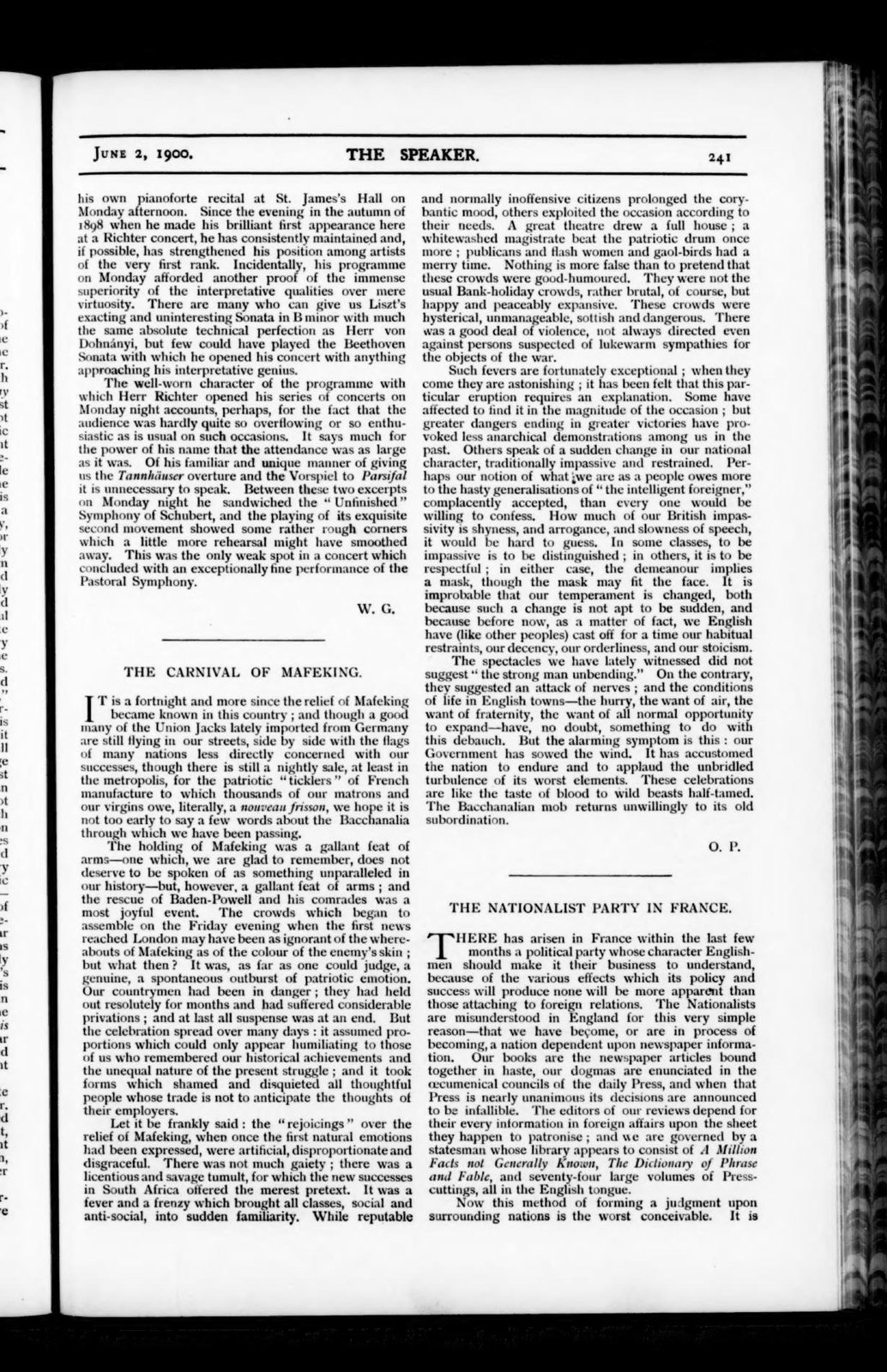
The Speaker, 'The Carnival of Mafeking', 2 June 1900 (p. 241)
A page of a Liberal weekly carrying an initialled editorial two weeks after the Mafeking celebrations. It calls the crowds a 'Bacchanalia', 'hysterical, unmanageable, sottish and dangerous', 'wild beasts half-tamed', and charges the Government with having 'sowed the wind'. Tells: stacked loaded labels for the crowd in place of an account of who did what.
- Date
- June 2, 1900
- Period
- Pre-1914
- Made by
- The Speaker: The Liberal Review, London (article signed O. P.)
- Country
- United Kingdom
- Medium
- Newspaper pages
- Issuer type
- Media
- Regime
- Salisbury Government
- Leader
- Robert Gascoyne Cecil
- Audience
- Domestic public
- Purpose
- Persuade or win support
- Event
- Second Boer War
- Techniques
- Name-calling
- Source
- Identified Openly sourced: the speaker is who they say they are
- Source
- Internet Archive (Serials in Microfilm, The Speaker), retrieved October 2, 2026
- Rights
- Public domain (published in London before 1931; US public domain by publication date)
Archive item carries no separate rights line. The Speaker: The Liberal Review, 2 June 1900, vol. 2, p. 241; digitised by the Internet Archive from microfilm
Text on the object
JUNE 2, 1900.   THE SPEAKER.   241

THE CARNIVAL OF MAFEKING.

It is a fortnight and more since the relief of Mafeking became known in this country; and though a good many of the Union Jacks lately imported from Germany are still flying in our streets, side by side with the flags of many nations less directly concerned with our successes, though there is still a nightly sale, at least in the metropolis, for the patriotic "ticklers" of French manufacture to which thousands of our matrons and our virgins owe, literally, a nouveau frisson, we hope it is not too early to say a few words about the Bacchanalia through which we have been passing.

The holding of Mafeking was a gallant feat of arms—one which, we are glad to remember, does not deserve to be spoken of as something unparalleled in our history—but, however, a gallant feat of arms; and the rescue of Baden-Powell and his comrades was a most joyful event.

Let it be frankly said: the "rejoicings" over the relief of Mafeking, when once the first natural emotions had been expressed, were artificial, disproportionate and disgraceful. There was not much gaiety; there was a licentious and savage tumult, for which the new successes in South Africa offered the merest pretext. It was a fever and a frenzy which brought all classes, social and anti-social, into sudden familiarity.

Nothing is more false than to pretend that these crowds were good-humoured. [...] These crowds were hysterical, unmanageable, sottish and dangerous. There was a good deal of violence, not always directed even against persons suspected of lukewarm sympathies for the objects of the war.

[...] But the alarming symptom is this: our Government has sowed the wind. It has accustomed the nation to endure and to applaud the unbridled turbulence of its worst elements. These celebrations are like the taste of blood to wild beasts half-tamed. The Bacchanalian mob returns unwillingly to its old subordination.

O. P.
Read from the OCR layer and checked against the rendered page; ellipses in square brackets mark omitted passages. The column of music criticism on the left of the page and the start of the next article are not transcribed.