How to Tackle a Fire Bomb
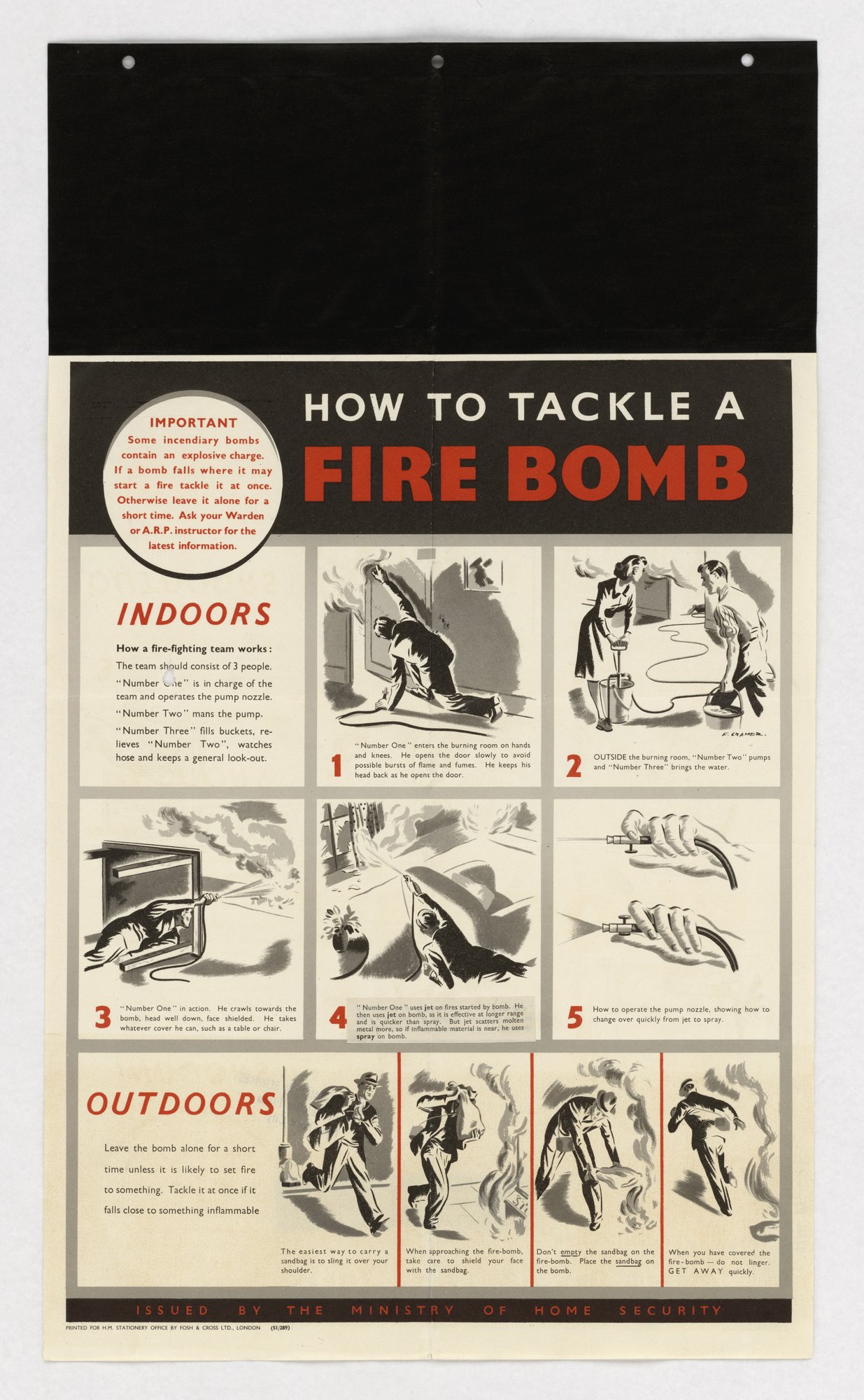
A panelled instruction sheet shows ordinary householders, a man and a woman with a stirrup pump and buckets, tackling an incendiary bomb indoors and with a sandbag outdoors. The tell is the use of everyday civilians as the models for a civil-defence task; the content is practical safety instruction.
Propaganda techniques used in this poster
- Date
- 1939
- Period
- Second World War
- Made by
- Ministry of Home Security; artist F. Cramer; printed for H.M. Stationery Office by Fosh & Cross Ltd., London
- Region
- Western and Central Europe
- Country
- United Kingdom
- Medium
- Poster
- Issuer type
- State
- Regime
- Churchill Government
- Leader
- Winston Churchill
- Audience
- Domestic public
- Purpose
- Warn or inform
- Themes
- Home front, Security and surveillance
- Event
- World War II
- Leader
- Winston Churchill
- Source
- Identified Openly sourced: the speaker is who they say they are
- Source
- U.S. National Archives and Records Administration, Record Group 44, World War II Foreign Posters, retrieved October 3, 2026
- Rights
- Public domain (UK Crown copyright, 50 years from publication, expired before 1996; no URAA restoration)
Ministry of Home Security, artist F. Cramer, printed by Fosh & Cross Ltd., undated (WWII). US National Archives, NAID 44266652 (44-PF-226).
Text on the object
HOW TO TACKLE A
FIRE BOMB
IMPORTANT
Some incendiary bombs contain an explosive charge. If a bomb falls where it may start a fire tackle it at once. Otherwise leave it alone for a short time. Ask your Warden or A.R.P. instructor for the latest information.
INDOORS
How a fire-fighting team works:
The team should consist of 3 people.
"Number One" is in charge of the team and operates the pump nozzle.
"Number Two" mans the pump.
"Number Three" fills buckets, relieves "Number Two", watches hose and keeps a general look-out.
1 "Number One" enters the burning room on hands and knees. He opens the door slowly to avoid possible bursts of flame and fumes. He keeps his head back as he opens the door.
2 OUTSIDE the burning room, "Number Two" pumps and "Number Three" brings the water.
3 "Number One" in action. He crawls towards the bomb, head well down, face shielded. He takes whatever cover he can, such as a table or chair.
4 "Number One" uses jet on fires started by bomb. He then uses jet on bomb, as it is effective at longer range and is quicker than spray. But jet scatters molten metal more, so if inflammable material is near, he uses spray on bomb.
5 How to operate the pump nozzle, showing how to change over quickly from jet to spray.
OUTDOORS
Leave the bomb alone for a short time unless it is likely to set fire to something. Tackle it at once if it falls close to something inflammable
The easiest way to carry a sandbag is to sling it over your shoulder.
When approaching the fire-bomb, take care to shield your face with the sandbag.
Don't empty the sandbag on the fire-bomb. Place the sandbag on the bomb.
When you have covered the fire-bomb - do not linger. GET AWAY quickly.
ISSUED BY THE MINISTRY OF HOME SECURITY
PRINTED FOR H.M. STATIONERY OFFICE BY FOSH & CROSS LTD., LONDON (51/289)