Area: Cognitive biases and heuristics · Evidence: strong (How we rate the evidence). Numbers people are asked to consider reliably pull their estimates in large multi-lab replications, though the effect of truly irrelevant, incidental numbers is smaller and less dependable.
In brief
Anchoring is the tendency for a number encountered first to pull later estimates toward it, even when the number is arbitrary. People start from the anchor and adjust, but usually not far enough. In politics, the first figure put on a cost, a crowd, a threat or a demand often sets the terms that every later figure is measured against.
What the research shows
Amos Tversky and Daniel Kahneman introduced the idea in 1974 [1]. In their best-known demonstration, participants watched a wheel of fortune stop at a number (10 for one group, 65 for another), said whether the percentage of African countries in the United Nations was higher or lower than that number, and then gave their own estimate. The median estimate was 25 percent for people who saw 10 and 45 percent for people who saw 65. A number that everyone could see was random still moved the answer. Tversky and Kahneman called the process "anchoring and adjustment": people begin at the anchor and adjust away from it, but stop too soon.

Median estimates of the share of African countries in the United Nations after seeing a wheel-of-fortune number of 10 (25 percent) or 65 (45 percent). Drawn by FRAME from Tversky and Kahneman (1974) [1]. CC BY 4.0.
Fritz Strack and Thomas Mussweiler offered a different account of why it happens [2]. Asking whether a quantity is higher or lower than an anchor leads people to test the possibility that the answer is close to the anchor, and that search brings anchor-consistent knowledge to mind. When they then give their own estimate, that knowledge is the most accessible. Consistent with this "selective accessibility" account, anchors had their strongest effect when the later judgment was about the same dimension as the comparison.
Anchoring also affects experts. Birte Englich, Mussweiler and Strack gave experienced German judges and prosecutors realistic criminal case files with a sentencing demand [3]. In one study the demand came from a journalist's phone call (a rape case); in another, participants set it by rolling loaded dice (a shoplifting case). Professionals who received a higher demand recommended longer sentences, even when they had just watched the dice produce it.
Negotiation research shows the same pull in bargaining. Adam Galinsky and Mussweiler found that whichever side made the first offer tended to get a better final outcome, because the first figure anchored the whole exchange [4]. The advantage disappeared when the other negotiator deliberately focused on information inconsistent with that offer, such as the opponent's alternatives or their own target price.
Has it held up?
The core effect is one of the most robust in judgment research. In the first Many Labs project, which repeated 13 classic findings across 36 samples and more than 6,000 participants, anchoring questions produced some of the largest and most consistent effects in the set [5].
The picture is weaker for incidental anchors, numbers that people are not asked to compare against. Noel Brewer and Gretchen Chapman found that this "basic anchoring effect" was fragile: small changes to the procedure, such as the order or choice of anchor numbers, made it disappear [6]. Zacharias Maniadis, Fabio Tufano and John List repeated a well-known study in which arbitrary numbers shifted people's valuations and found much weaker effects than the original [7]. A 2021 meta-analysis of 53 studies of anchoring on willingness to pay and willingness to accept found a moderate overall effect, smaller than early studies reported [8]. Anchors that looked informative, rather than obviously random, and studies run outside the laboratory showed larger effects.
That last point matters for politics. Political numbers are rarely presented as random. They arrive attached to a source and an argument, which is the condition under which anchors pull hardest.
How it shows up in political messaging
- McCarthy's list, 1950. In a speech in Wheeling, West Virginia, Senator Joseph McCarthy claimed to hold a list of communists working in the State Department. The figure most widely reported was 205, although in the following weeks he cited 57, 81 and other numbers, and whether he said 205 at all is disputed [9]. The large opening number set the scale of the debate before any names were checked.
- Vote Leave's £350 million, 2016. The Leave campaign in the UK referendum said Britain sent the EU £350 million a week. The UK Statistics Authority called this use of a gross figure, without the rebate or money returned to the UK, misleading [10]. In a June 2016 Ipsos MORI poll, 78 percent had heard the claim and 47 percent thought it true [11]. Rebuttals then had to argue down from the campaign's number.
- The Fight for $15, 2012 onward. Fast-food workers in New York walked out in November 2012 demanding $15 an hour and a union, at a time when the federal minimum was $7.25 [12]. The demand worked like a first offer in a negotiation, and later proposals were debated in relation to it.
- The Million Man March, 1995. The march's name set a figure before anyone counted. The U.S. Park Police estimated about 400,000 people, organizers disputed it, and the head of the National Park Service later conceded the crowd might have been larger [13]. Every estimate was reported against the million in the title.
- Suggested quotas, WWII. A U.S. Treasury poster asked workers to put "at least 10 percent" of pay into war bonds Let's Fly This Flag: Everybody at Least 10 Percent in War Bonds. A stated figure gives people a default to adjust from.
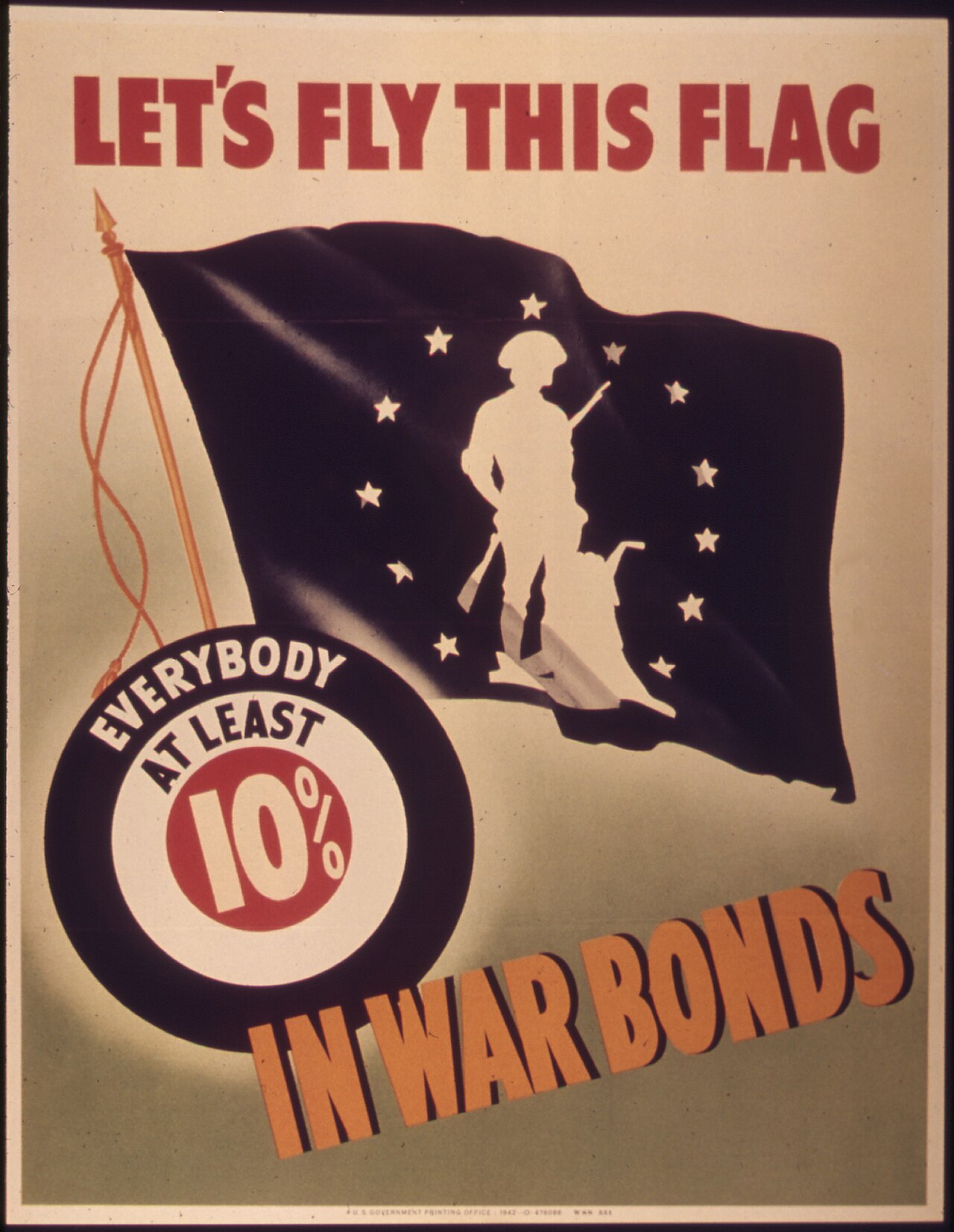
"Let's Fly This Flag: Everybody at Least 10 Percent in War Bonds," U.S. Treasury Department poster, 1943. From the FRAME gallery: Let's Fly This Flag: Everybody at Least 10 Percent in War Bonds
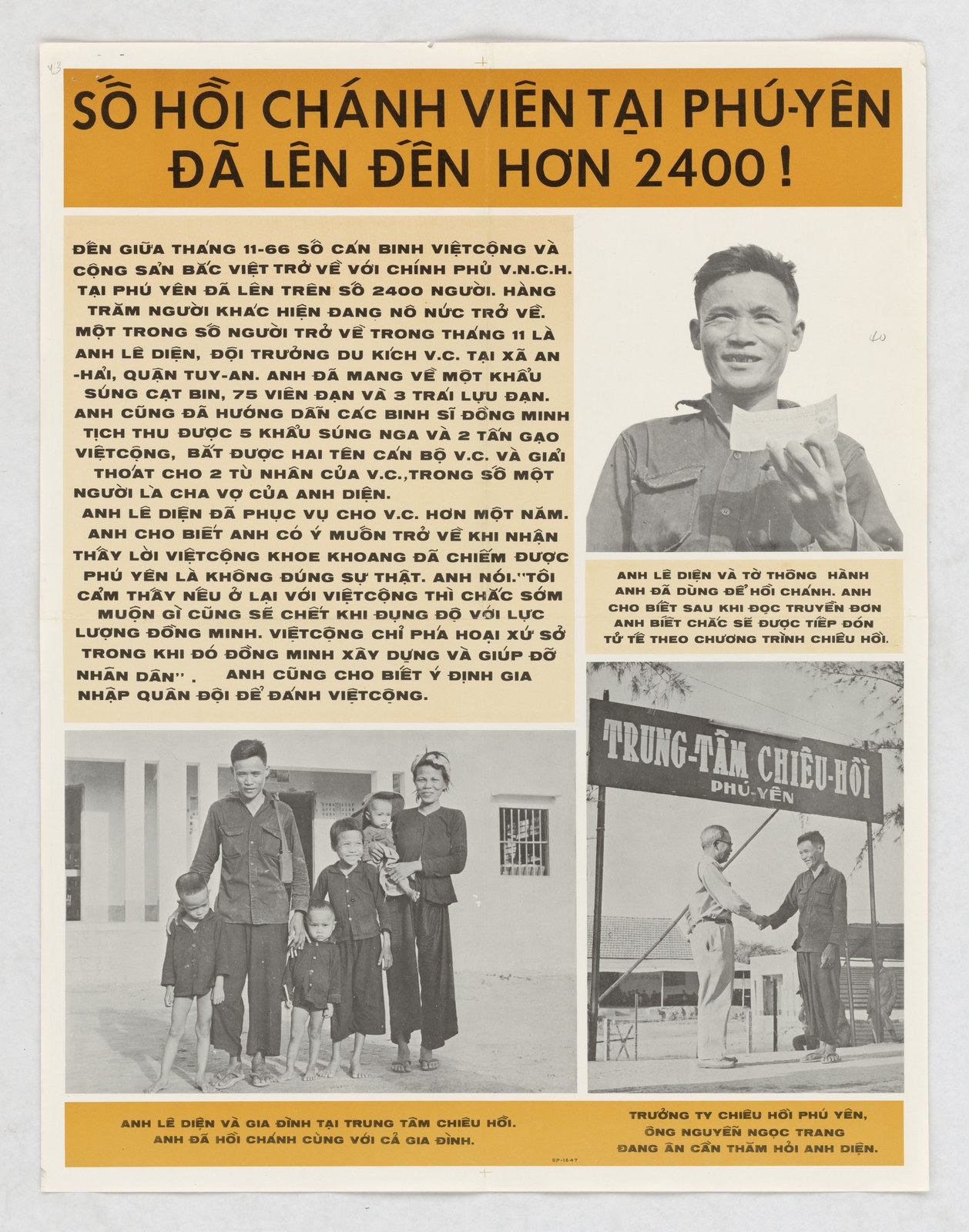
Chieu Hoi poster (code SP-1647) headed "Ralliers in Phu Yen Have Risen to Over 2,400!", Joint U.S. Public Affairs Office for the South Vietnamese Chieu Hoi programme, 1966. From the FRAME gallery: Số hồi chánh viên tại Phú-Yên đã lên đến hơn 2400! (Ralliers in Phu Yen Have Risen to Over 2,400!)
Opening with an extreme proposal so that a later one looks moderate is a common reading of Overton window shifting, and the anchoring research helps explain why it can work.
How to spot it
- A single striking number appears early and is repeated before any source or denominator is given.
- The number is gross when the question is net, a maximum when the question is typical, or a demand presented as an estimate.
- Counter-arguments are framed as "not quite that much" rather than starting from the evidence.
- An extreme opening position is followed by a "compromise" that is still far from where the discussion began.
- A useful check is to ask what estimate would seem reasonable if the first number had never been mentioned.
Persuasion or manipulation?
Leading with a number is not manipulative in itself. Honest material states a figure with its source, its denominator and its uncertainty, and a campaign that openly names an ambitious demand is making an argument in the open. It tips into manipulation when the anchor is chosen because it is misleading, such as a gross figure presented as net, a crowd count with no method, or a number repeated after an authority has shown it to be wrong, so that the audience's starting point is set by something it cannot check.
Archive techniques that lean on this
- Overton window shifting — Overton window shifting: an extreme opening position anchors the debate so later positions look moderate by comparison.
- Card stacking — Card stacking: choosing which number to lead with (gross rather than net, peak rather than typical) is selection that the anchor then carries.
Related topics
- Framing effect — Framing effect
- Availability heuristic — Availability heuristic
- Illusory truth effect — Illusory truth effect
- Base-rate neglect — Base-rate neglect
Sources
- Tversky, A., & Kahneman, D. (1974). Judgment under uncertainty: Heuristics and biases. Science, 185(4157), 1124–1131. https://doi.org/10.1126/science.185.4157.1124
- Strack, F., & Mussweiler, T. (1997). Explaining the enigmatic anchoring effect: Mechanisms of selective accessibility. Journal of Personality and Social Psychology, 73(3), 437–446.
- Englich, B., Mussweiler, T., & Strack, F. (2006). Playing dice with criminal sentences: The influence of irrelevant anchors on experts' judicial decision making. Personality and Social Psychology Bulletin, 32(2), 188–200. https://doi.org/10.1177/0146167205282152
- Galinsky, A. D., & Mussweiler, T. (2001). First offers as anchors: The role of perspective-taking and negotiator focus. Journal of Personality and Social Psychology, 81(4), 657–669. https://doi.org/10.1037/0022-3514.81.4.657
- Klein, R. A., Ratliff, K. A., Vianello, M., Adams, R. B., Jr., Bahník, Š., Bernstein, M. J., et al. (2014). Investigating variation in replicability: A "Many Labs" replication project. Social Psychology, 45(3), 142–152. https://doi.org/10.1027/1864-9335/a000178
- Brewer, N. T., & Chapman, G. B. (2002). The fragile basic anchoring effect. Journal of Behavioral Decision Making, 15(1), 65–77. https://doi.org/10.1002/bdm.403
- Maniadis, Z., Tufano, F., & List, J. A. (2014). One swallow doesn't make a summer: New evidence on anchoring effects. American Economic Review, 104(1), 277–290. https://doi.org/10.1257/aer.104.1.277
- Li, L., Maniadis, Z., & Sedikides, C. (2021). Anchoring in economics: A meta-analysis of studies on willingness-to-pay and willingness-to-accept. Journal of Behavioral and Experimental Economics, 90, 101629.
- Moore, Greg. "Joseph R. McCarthy's Wheeling Speech." e-WV: The West Virginia Encyclopedia. 8 February 2024. https://www.wvencyclopedia.org/entries/1557 ; see also Council on Foreign Relations. "TWE Remembers: Joseph McCarthy's Wheeling Speech." https://www.cfr.org/articles/twe-remembers-joseph-mccarthys-wheeling-speech
- Office for National Statistics. Leave campaign claims during Brexit debate (freedom of information release summarizing the UK Statistics Authority's April and May 2016 statements). https://www.ons.gov.uk/aboutus/transparencyandgovernance/freedomofinformationfoi/leavecampaignclaimsduringbrexitdebate ; see also Politics.co.uk. (2016, May 27). Leave campaign slammed by statistics watchdog for false EU cost claims. https://www.politics.co.uk/news/2016/05/27/leave-campaign-slammed-by-statistics-watchdog-for-false-eu-cost-claims/
- Ipsos MORI. (2016, June 16). Immigration is now the top issue for voters in the EU referendum. https://www.ipsos.com/en-uk/immigration-now-top-issue-voters-eu-referendum
- Mother Jones. (2013, December). How those fast-food strikes got started. https://www.motherjones.com/politics/2013/12/how-fast-food-strikes-started/
- The Spokesman-Review. (1995, October 21). How many men were there in the Million Man March? After threat of suit, Park Service concedes it may have been off by a couple hundred thousand or so. https://www.spokesman.com/stories/1995/oct/21/how-many-men-were-there-in-the-million-man-march/
Images
| Image | Source | Licence |
|---|---|---|
| Bar chart: wheel-of-fortune anchors and median estimates (Tversky and Kahneman 1974) | Drawn by FRAME from source 1 (make_cognitive_bias_diagrams.py) |
CC BY 4.0, FRAME |
| Let's Fly This Flag (1943) | FRAME gallery, Let's Fly This Flag: Everybody at Least 10 Percent in War Bonds | Public domain (U.S. government work) |
| Chieu Hoi poster, Phu Yen (1966) | FRAME gallery, Số hồi chánh viên tại Phú-Yên đã lên đến hơn 2400! (Ralliers in Phu Yen Have Risen to Over 2,400!) | Public domain (U.S. government work) |
Image gaps
Photographs of the 1995 Million Man March crowd (the Library of Congress Roll Call aerial view carries only a "no known restrictions" statement), of the Vote Leave campaign bus (the available photograph is non-free) and of the 1950 Wheeling speech were not verified as public domain or openly licensed, so they are cited, not hosted.