
Area: Group identity · Evidence: mixed (How we rate the evidence). The link between conservatism and "binding" values is fairly consistent in American data, but the measurement, the causal story and the cross-cultural picture are all disputed, and message-tailoring effects are modest.
In brief
Moral foundations theory proposes that people build their moral judgments on a handful of intuitive concerns, such as preventing harm, fairness, loyalty, respect for authority and purity, and that political groups weight these concerns differently. It has become an influential way to think about why partisans talk past each other, and it underpins "moral reframing," the idea of arguing for a position in the values of the audience rather than the speaker. The theory is useful as a vocabulary, but several of its stronger claims have not held up well.
What the research shows
Jonathan Haidt and Jesse Graham proposed five foundations: care/harm, fairness/cheating, loyalty/betrayal, authority/subversion and sanctity/degradation (often called purity). They argued that liberals build their morality mainly on the first two, sometimes called the "individualizing" foundations, while conservatives draw on all five, including the three "binding" foundations that hold groups together [1]. Haidt later popularized the framework in a book and added a sixth candidate, liberty/oppression [2].

Drawn by FRAME from Haidt and Graham (2007) [1]. CC BY 4.0 (FRAME).
The key early test was a set of four studies by Graham, Haidt and Brian Nosek. Using questionnaires, judgments about which acts people would refuse to do even for large sums of money, and a word-count analysis of sermons from liberal and conservative churches, they reported the same pattern: liberals weighted care and fairness above the binding foundations, and conservatives weighted the five more evenly [3]. The Moral Foundations Questionnaire (MFQ), published in 2011, became the standard measurement tool [4].
The theory's most practical offshoot is moral reframing. Matthew Feinberg and Robb Willer argued that political arguments usually appeal to the speaker's own values, which the other side does not share. In a series of experiments, they found that arguments reframed to match the audience's values were more persuasive: for example, a case for same-sex marriage framed in terms of patriotism and loyalty moved conservatives more than one framed in terms of fairness, and a case for military spending framed in terms of fairness and opportunity moved liberals more than one framed in terms of loyalty [5].
Has it held up?
Several parts of the theory have been challenged, some seriously.
- The political pattern. A 2021 meta-analysis by J. Matias Kivikangas and colleagues confirmed the direction of the differences: conservatism is associated with stronger endorsement of the binding foundations and weaker endorsement of care and fairness. But the pooled effects were smaller than originally reported, heterogeneity across studies was moderate, and results varied across samples and political cultures [6]. The basic direction holds, but the size of the left-right difference is smaller and less uniform than early summaries suggested.
- Text analysis. Jeremy Frimer re-ran the sermon analysis with much larger samples of text and extended it to political speeches. The original finding that liberals and conservatives use different moral vocabularies largely failed to replicate [7].
- Measurement. Kathryn Iurino and Gerard Saucier tested whether the original questionnaire measures the same five things across 27 countries and found that its five-factor structure did not fit well or consistently [8]. That makes comparing scores between cultures hard to interpret.
- A revised instrument. Mohammad Atari and colleagues, including Haidt and Graham, developed the MFQ-2. It splits fairness into equality and proportionality (reward in proportion to contribution), giving six foundations, and was built and tested with samples from many countries. They found that how the foundations relate to one another and to politics varies across cultures, so the American pattern should not be assumed elsewhere [9].
- Cause and effect. Using panel data that measured the same people repeatedly, Peter Hatemi, Charles Crabtree and Kevin Smith found that political ideology predicted later moral foundation scores better than foundations predicted later ideology [10]. Foundations may partly express political identity rather than cause it.
- Moral reframing in the field. Laboratory reframing effects are real but usually modest. In a preregistered field experiment by Joshua Kalla, Adam Seth Levine and David Broockman, canvassers who listened for each voter's moral values and tailored their abortion-rights appeal to them produced large effects on interest in taking action but only some evidence of attitude change [11].
Taken together, the foundations are a useful map of the values political messages appeal to, but they are not a settled account of why people hold their politics.
How it shows up in political messaging
Wartime and public-health material shows every foundation being used, by different actors:
- Care/harm. British recruitment through Remember Belgium — Enlist To-Day appealed to protecting fleeing civilians.
- Sanctity and care together. The American poster Destroy This Mad Brute — Enlist staged the enemy as a violating beast carrying off a woman.
- Loyalty. The German war-loan poster Helft uns siegen! Zeichnet die Kriegsanleihe (Help Us Win! Subscribe to the War Loan) and the American Let's Fly This Flag: Everybody at Least 10 Percent in War Bonds asked for money as an act of belonging.
- Sanctity in public health. The U.S. Food and Drug Administration's The Real Cost — "Your Skin" anti-smoking advertisement used bodily disgust rather than statistics.
- Across the modern spectrum. Feinberg and Willer's test messages ran in both directions, with loyalty framing aimed at conservatives on a liberal cause and fairness framing aimed at liberals on a conservative one [5]. Moral vocabulary is available to every side.
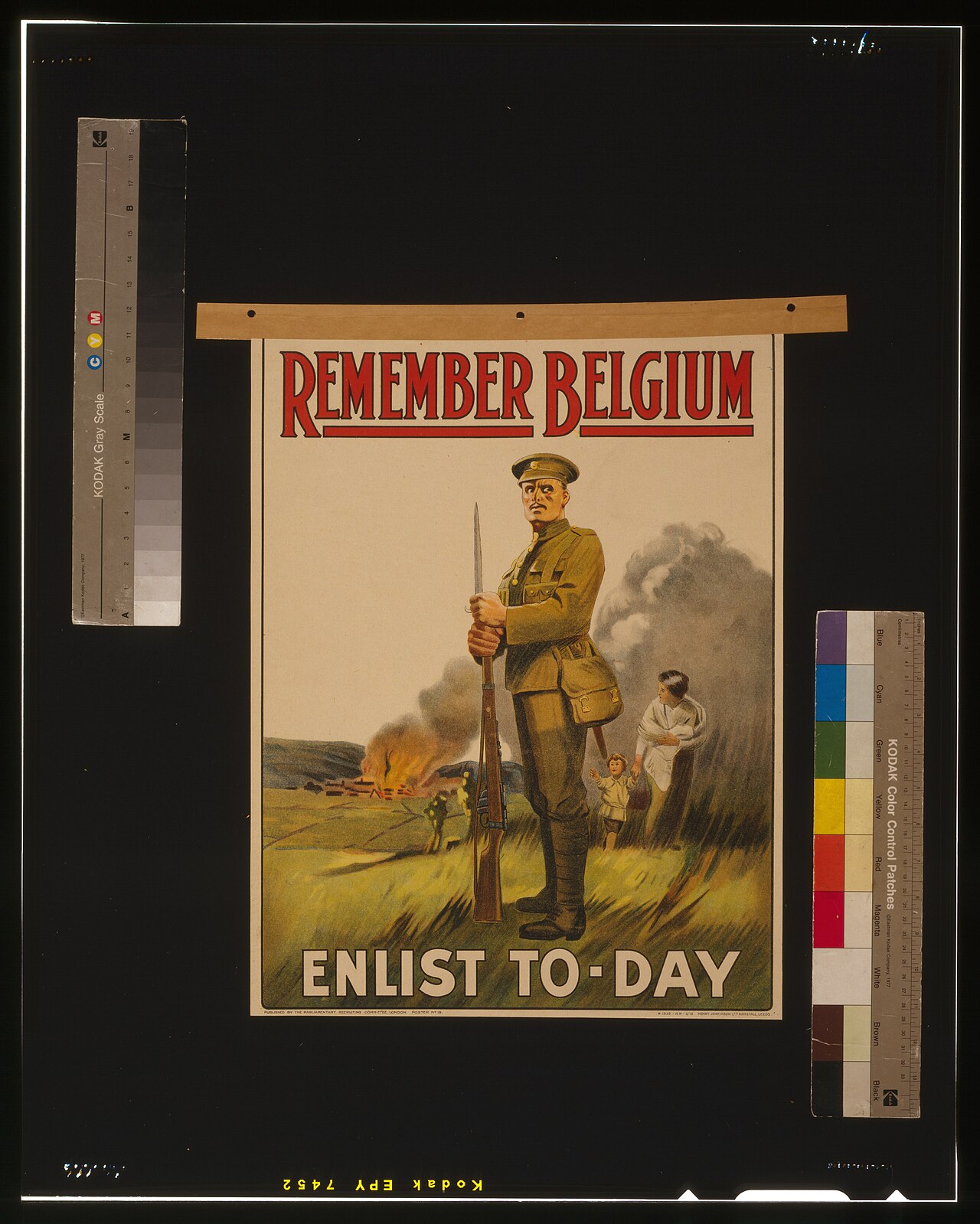
Remember Belgium — Enlist To-Day: "Remember Belgium — Enlist To-Day", Parliamentary Recruiting Committee (United Kingdom), 1915. A care/harm appeal. Public domain.
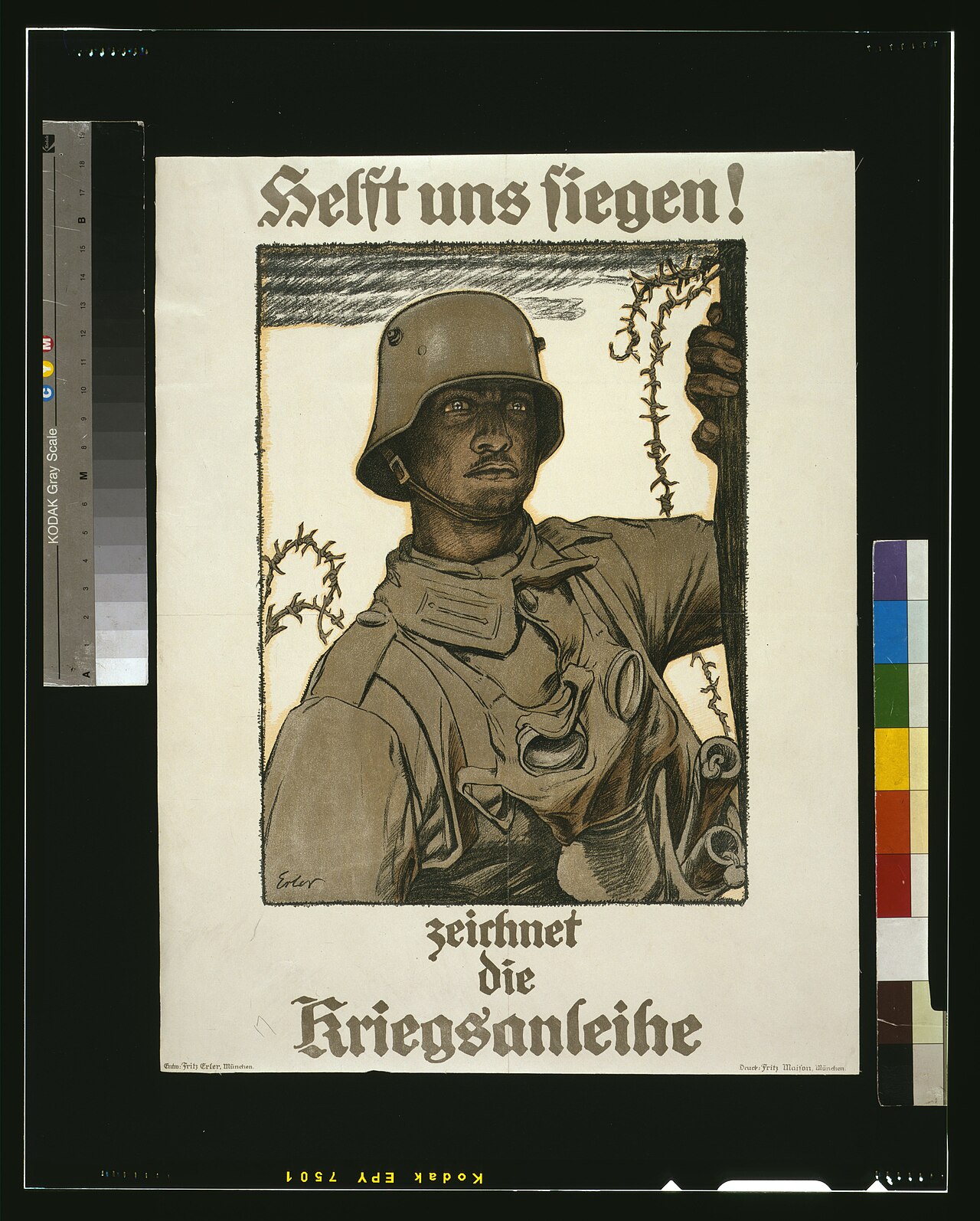
Helft uns siegen! Zeichnet die Kriegsanleihe (Help Us Win! Subscribe to the War Loan): "Helft uns siegen!" (Help us win!), Imperial German war-loan campaign, 1917, artist Fritz Erler. A loyalty appeal. Public domain.
The Real Cost — "Your Skin": "The Real Cost — Your Skin", U.S. Food and Drug Administration, Center for Tobacco Products, 2014. A sanctity/disgust appeal in public health. Public domain (U.S. government work).
How to spot it
- Count the value words: harm, fair, loyal, betray, respect, tradition, pure, disgusting, freedom.
- Ask which foundation a message leans on and whether it matches the intended audience rather than the speaker.
- Notice when a value word replaces a concrete claim (swap "betrayal" for the specific act and see if the charge still holds).
- Check whether an unfamiliar argument from the other side has been dressed in the audience's values without changing its substance.
- Be wary of claims that one side "has no morals" or cares about only one value; the evidence shows overlapping, not separate, moral worlds.
Persuasion or manipulation?
Explaining a position in values the audience already holds is a legitimate and respectful way to communicate, provided the argument underneath is the same one the speaker would make to anyone. It becomes manipulative when the moral wrapping misrepresents what a policy actually does, when different audiences are told contradictory things about the same proposal, or when a value word (loyalty, purity, fairness) is used to trigger a verdict in place of evidence. A good test is whether the reframed argument would still be accurate if the speaker's own side read it.
Archive techniques that lean on this
- Glittering generalities — Glittering generalities: foundation words such as freedom, fairness, loyalty or purity can be used as virtue labels that stand in for a testable claim.
Related topics
- Social identity — Social identity
- Moral outrage — Moral outrage
- Disgust — Disgust
- Framing effect — Framing effect
- Motivated reasoning — Motivated reasoning
- Group polarization — Group polarization
- Semantic hijacking — Semantic hijacking
Sources
- Haidt, J., & Graham, J. (2007). When morality opposes justice: Conservatives have moral intuitions that liberals may not recognize. Social Justice Research, 20(1), 98–116.
- Haidt, J. (2012). The righteous mind: Why good people are divided by politics and religion. Pantheon Books.
- Graham, J., Haidt, J., & Nosek, B. A. (2009). Liberals and conservatives rely on different sets of moral foundations. Journal of Personality and Social Psychology, 96(5), 1029–1046.
- Graham, J., Nosek, B. A., Haidt, J., Iyer, R., Koleva, S., & Ditto, P. H. (2011). Mapping the moral domain. Journal of Personality and Social Psychology, 101(2), 366–385.
- Feinberg, M., & Willer, R. (2015). From gulf to bridge: When do moral arguments facilitate political influence? Personality and Social Psychology Bulletin, 41(12), 1665–1681.
- Kivikangas, J. M., Fernández-Castilla, B., Järvelä, S., Ravaja, N., & Lönnqvist, J.-E. (2021). Moral foundations and political orientation: Systematic review and meta-analysis. Psychological Bulletin, 147(1), 55–94. https://doi.org/10.1037/bul0000308
- Frimer, J. A. (2020). Do liberals and conservatives use different moral languages? Two replications and six extensions of Graham, Haidt, and Nosek's (2009) moral text analysis. Journal of Research in Personality, 84, 103906.
- Iurino, K., & Saucier, G. (2020). Testing measurement invariance of the Moral Foundations Questionnaire across 27 countries. Assessment, 27(2), 365–372. https://doi.org/10.1177/1073191118817916
- Atari, M., Haidt, J., Graham, J., Koleva, S., Stevens, S. T., & Dehghani, M. (2023). Morality beyond the WEIRD: How the nomological network of morality varies across cultures. Journal of Personality and Social Psychology, 125(5), 1157–1188. https://doi.org/10.1037/pspp0000470
- Hatemi, P. K., Crabtree, C., & Smith, K. B. (2019). Ideology justifies morality: Political beliefs predict moral foundations. American Journal of Political Science, 63(4), 788–806. https://doi.org/10.1111/ajps.12448
- Kalla, J. L., Levine, A. S., & Broockman, D. E. (2022). Personalizing moral reframing in interpersonal conversation: A field experiment. The Journal of Politics, 84(2), 1239–1243.
Images
| Image | Source | Licence |
|---|---|---|
| Diagram: the moral foundations (Haidt and Graham 2007) | Drawn by FRAME from the cited paper (make_group_identity_charts.py) |
CC BY 4.0, FRAME |
| Remember Belgium (1915) | FRAME gallery, Remember Belgium — Enlist To-Day | Public domain (published before 1923) |
| Helft uns siegen! (1917) | FRAME gallery, Helft uns siegen! Zeichnet die Kriegsanleihe (Help Us Win! Subscribe to the War Loan) | Public domain (published before 1923) |
| The Real Cost — Your Skin (2014) | FRAME gallery, The Real Cost — "Your Skin" | Public domain (U.S. government work) |
Image gaps
Moral Foundations Questionnaire score distributions were not redrawn, because the published effect sizes are contested and could not all be verified here; only the theory's structure is drawn.