Content note: Quotes First World War atrocity stories and abusive wartime language about the enemy, including "Hun", and period terms for racial groups, as examples of propaganda. This object is shown as it was published. Why
Inside a democratic country there is a certain presumption against government propaganda. As Representative GiUett, commenting upon the Creel Bureau, said, admitting that it has not been conducted in a partisan spirit :
That is the great danger of such a bureau as this, because we must all admit that if any administration has in its power a Bureau of Public Information, as it is called, but really an advertising bureau, a propaganda bureau, a bureau of publicity, to exploit the various acts and departments of the Government, it is a very dangerous thing in a Republic ; because, if used in a partisan spirit or for partisan advantage of the administration, it has tremendous power, and in ordinary peace-time I do not think any party or any administration would justify it or approve it.*
The truth is that all governments are engaged to some extent in propaganda as part of their ordinary peace-time functions. They make propaganda on behalf of diplomatic friends or against diplomatic antagonists, and this is unavoidable. While, therefore, the presumption exists against propaganda work by a democratic government, this statement should not be taken too literally.
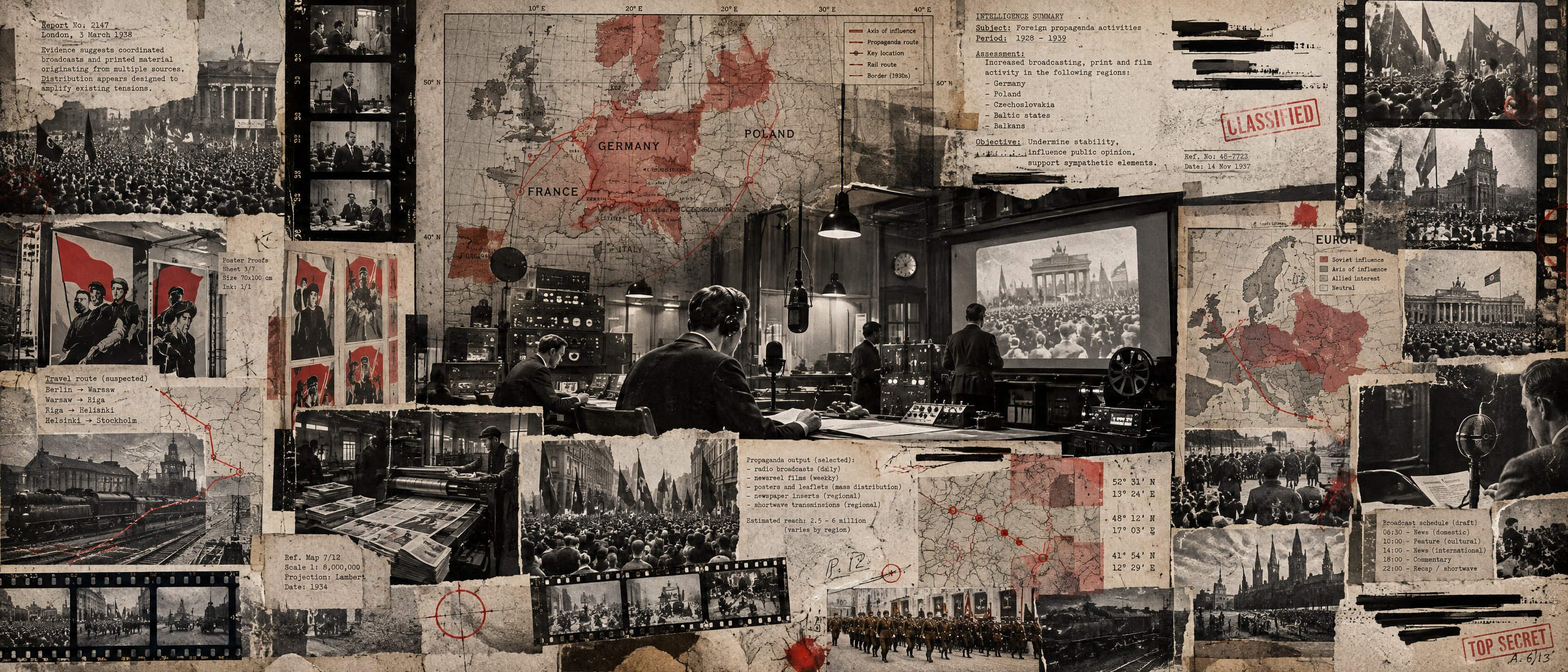
During the war-period it came to be recognized that the mobilizatioii^of men and means was not sufficient ; there must be a mobilization of opinion. Power over opinion, as over life and property, passed into official hands, because the danger from licence was greater than the danger of abuse. Indeed, there is no question but that government management of opinion is an unescapable corollary of largescale modern war. The only question is the degree to which the government should try to conduct its propaganda secretly, and the degree to which it should conduct it openly. As far as the home public is concerned, there is nothing to be gained by concealment, and there is a certain loss of prestige for all that is said, when secrecy is attempted. The carrying power of ideas is greatly increased when the authority of the government is added to them. With certain insignificant exceptions (the smuggling of propaganda material into adjacent enemy countries), nothing is lost, if all propaganda operations in neutral and allied countries are carried on openly. Otherwise, indeed, suspicion and distrust may exist where complete confidence and understanding are indispensable. The United States Committee on Public Information was undoubtedly correct in notifying neutral governments of what they wanted to do inside neutral borders.
^ C/.5. Cong, Rec., 65th Cong., 2nd Sess., p. 7915.
It is bad tactics, however, to announce blatantly to the enemy that a '' Director of Propaganda in Enemy Countries has been named. As Sir Herbert Samuel said in the House of Commons, when Lord Northcliffe was appointed to this post in 1918 :
Possibly the Germans may regard Lord Northcliffe, the proprietor of the Daily Mail and the Evening News, in much the same light as we may regard Count Reventlow. What should we think, if we heard that an official announcement had been made by the German Government, that they had appointed Count Reventlow as the Director to carry on propaganda in the United Kingdom, and in other Allied countries ? ^ Assuming, in principle, that propaganda should be conducted in the open by a belligerent government, the problem of organization presents itself. What agencies should carry on the work, and to what degree is unity of command practicable ? The work of carrying on the war brings several government services into the active control of certain streams of information, and international attitudes are to some degree involved with the rest. There is the Foreign Office at home, and the Diplomatic and Consular staffs abroad. There is the War and Naval Department at home, and the Military and Naval Attaches abroad. There is the General Staff and the Field Headquarters. There are the various service ministries engaged upon problems of supply and internal regulation. The mere enumeration of these agencies is sufficient to remind one of the evident proposition that the influencing of attitudes is implicit in every function, and that it is incapable of complete segregation in anything hke the degree to which, let us say, the purchasing of horses can be confined to a particular agency.
Disunity brings dangers. The Foreign Office and the Field Headquarters may hold out contradictory inducements to the enemy and cast the whole propaganda of demoralization into disrepute. The military people at home may announce the destruction of public buildings in the occupied zone, much to the consternation of the diplomatic representair tives in neutral countries. There is always the possibility that bad news of different kinds may break simultaneously and produce an unwonted state of depression if each service gives its own news to the public. The news of a naval loss, a military loss and an aviation loss may come when there is a shortage of flour, and when there is a prickly set of wage and price problems agitating the prints at home. If this news were handled through a central clearing house, it could be distributed over a period of time and nullified by the more favourable aspects of the general situation.
^ 103 H» C. Deb, 5s., col. 1410, 27 Februaiy, 1918.
Disunity leads to a considerable duplication of effort. If the mihtary people publish the same pamphlet that the diplomatic service publishes, and distribute it through the military attaches abroad when the diplomatic attaches have already doled it out, no good purpose can be served. It is difficult to work out a revision of general pohcy in the light of propaganda efforts, where there is no continuing mechanism for keeping Jab on the whole range of propaganda work. The backwardness of certain departments, which may be opposed to publicity, may produce a repercussion of uneasiness and distrust. There may be delay in shifting the personnel devoted to propaganda work to the sectors where the most effect can be secured.
Some of these dangers may be offset by the dangers of unity. Any scheme of unity runs the risk of antagonizing the amour propre of some service and of ruining moral. If the control of foreign and domestic propaganda were integrated too tightly in the hands of one man, the one or the other might suffer from the preconceptions of the responsible head. Their requirements are so different that only a rare combination of talents can be relied upon to develop both of them to the highest efficiency.
The. balance seems to point toward unity as more desirable than disunity, but it seems to justify a scheme of organization which preserves a considerable degree of autonomy to the constituent services. What are the possible forms of organization ? There might be a single propaganda executive. There might be a committee of executives, each responsible for some branch of propaganda work, such as propaganda against the enemy, propaganda in neutral and aUied countries, propaganda among civilians, and propaganda in the fighting forces. In any case, the propaganda work in training camps, at the front, in rest camps, on shipboard, and in transit, would vest largely in the military and naval authorities. A third method is to arrange a common Press conference for aU departments, but to leave aU other forms of effort to the regular agencies affected, which would especially be the Foreign Office, General Headquarters, the War Department, and the Ministry of the Interior. Broadly speaking, the United States adopted the first expedient in the last war. Great Britain, the second, and Germany, the third.
A Committee on Public Information was appointed, by order of the President, soon after the entrance of the United States into the War. It was composed of the Secretaries of the Navy and War Departments, the Secretary of State, and Mr. George Creel. This was equivalent to appointing a separate cabinet member for propaganda, in fact, and Mr. Creel was responsible for every aspect of propaganda work, both at home and abroad. One result of this method of organization was to confer upon the representatives of the Committee abroad something of the prestige of three great government departments, and to satisfy the self-esteem of each one.
While the American system sprang into existence at a single stroke, and remained substantially unaltered during the War, the British system went through a long and intricate series of changes. As Major-General Sir George Aston wrote :
Party politicians are suspicious folk, unwilling to trust any Government with money to spend on propaganda, for fear that they will spend it in their own interest rather than the country’s. So the Parliamentary War Aims Committee was established with representatives of all parties. The Committee was charged with Home Propaganda, and came in for much criticism.^
A small department was set up at Wellington House in the office of the Insurance Commissioners to prepare pamphlets and leaflets. Wellington House initiated the Bryce Report, which was one of the triumphs of the War, on the propaganda front, but most of its material was put out as though it were a private and not an official agency. A films and wireless committee was later set up under Mr. Mair, but its relation to the Home Office and the Foreign Office was uncertain. A Press Bureau was improvised in August, 1914, and was later adopted by the Home Office. The Foreign Office was meanwhile engaged in the following activities, according to a statement in Parliament by the Undersecretary of State for Foreign Affairs (Mr. Acland) : ; We are taking steps to see that there is supplied to the Press in neutral countries not only news strictly so-called, but also news which we take here to be rather commonplace, but which is of real interest to other countries, as to the condition of this country, and information with regard to trade, and with regard to employment, and with regard to recruiting, and with regard to all such matters as to which the condition of this country is really of interest to our friends.'
^ Propaganda and the Father of It/* Cornhill Magazine^ N.S., vi 48 : 233-241.
In January, 1917, the Department of Information was organized. Colonel Buchan had charge of four widely scattered services, and was responsible to the war Cabinet and the Prime Minister. An Advisory Committee was established, which consisted of Lord Northcliffe, Lord Burnham, Mr. Robert Donald, and Mr. C. P. Scott. When Lord Northcliffe proceeded on his mission to America, Lord Beaverbrook was appointed to this Committee, and later. Sir George Riddell was added. Things__were still at loosed ends under this system, and Sir E. Carson, a member of the War Cabinet, w’as asked to co-ordinate the various agencies. The War Department had organized a separate service for the purpose of conducting propaganda against the German Army, and the civilian peoples. Finally, in February, 1918, Lord Beaverbrook was made Minister of Information, occupying the post of Chancellor of the Duchy of Lancaster. At the same time Lord Northcliffe was named Director of Propaganda in Enemy Countries, and Directors were appointed for neutral countries for intelligence, and for cinematograph propaganda. Lord Northcliffe was technically responsible to Lord Beaverbrook in respect of finance, but, in fact, he had the right of direct access to the Prime ‘ 66 H, C. Deh, 5s., col. 549, 9 September, 1914, Minister and the War Cabinet. Confusion was worse confounded by locating the Enemy Propaganda Department in the British War Mission with which Northcliffe had been working for some months past. Informal conferences were inaugurated to co-ordinate efforts, and later a Propaganda Policy Committee was presided over by Lord Northchffe. A working unity was actually achieved, although at the expense of many weary months and years of bickering and duplication.* The Italians arrived at this same method of organization.
The most important difference between the American and the British plan was that the latter put foreign and domestic propaganda in the hands of co-ordinate officials. When the technicalities of the matter are allowed for, the British system clearly made no distinction between Northcliffe and Beaverbrook, for instance, who both had direct access to the Prime Minister and the War Cabinet. The British, in effect, laid equal emphasis upon the necessity for departmental autonomy in dealing with home, empire, neutral, allied, and enemy propaganda. The extraordinary diversity of foreign interests to which the British were appealing probably justified this procedure, because the problems which were presented were highly distinct.* The Americans came into the War, when it was neither their business to win the neutrals, nor to play one group against another. They had a very simple propaganda message to get across (American preparations ; a Wilsonian Peace), and it could be vested in one executive without much danger.
* The attitude of the Foreign Office clique toward the Beaverbrook ministry is reflected in the comments of the anonymous author of The Pomp of Power. He says that a group of experts on foreign affairs refused to work under the direction of Beaverbrook and migrated to the Foreign Office. Beaverbrook relied upon Canadians " whose experience of foreign affairs and whose knowledge of foreign languages was as hmited as his own.” Beaverbrook has told his own story in Politiciafis and the Press. Lord Bertie, British Ambassador to France, lamented that for two years (until 1917) the Foreign Office failed to establish a Press bureau in faris. {Diary, 1914-18, II : 203.)
* This will appear especially in connection with a later point.
It was the Germans who had a minimum of co-ordinated propaganda effort. Each Department went ahead in its own way, and the only formal co-operation was in the Press conference, which met two or three times a week. The War Ministry, the General Staff, the Navy Department, the District Military Authorities, the Colonial Office, the Post Office, the Interior Department, the Treasury Department, the Food Ministry, and eventually, the Foreign Office took part. The chairmanship was passed round in a rotating ', S5^tem, and the co-operating journalists chose a committee to speak for them.
The Military Authorities had to build their work from the ground up.* At the outbreak of the War there was but a single official who had contact with the Press. But they soon evolved an extensive Press service to report military operations, to edit the Field Press, to control the admission of home papers to the army, and to carry on propaganda against the enemy.
The Foreign Office was slow in clearing for action, but in October, 1914, when the check on the Marne had deferred the prospects for peace, a special Zentralstelle fur Auslandsdienst was created. This was a very busy bureau and / published an imposing array of propaganda material.
^ Nicolai complains that the Reichstag failed to vote them enough money to develop a satisfactory Press section before the war, because “ in peace times the Press was conceived as a partisan instrument/* Nicolai, Nachrichtendienst, Presse u. Volksstimmung, p. 53.
As the War developed, the conflict between military and civil authorities became more and more acute. The military men went into a paroxysm of rage when the peace resolution was moved by Erzberger in 1917, as they had when Bethmann-Hollweg held out the olive branch in 1916. The military authorities had no patience with palaver about peace ; they wanted a victorious peace of dictation. Ludendorff granted an interview to the Berlin Press in which these views were put before the people. Instantly the Left and Centre took up the challenge, and assailed the military for trying to interfere in politics. The Chancellor, to avoid being caught between partisan fires, refused, as had his predecessor, to create a separate Minister of Propaganda. The military authorities had proposed this on three different occasions, for they had already begun to feel the effects of Allied propaganda. At last the G.H.Q. tried to reach the home public directly by establishing a special Press service called the Deutsche KriegsnachricJiten, which, in spite of the opposition of the large papers, prospered. At the direction of General Ludendorff an elaborate plan of patriotic stimulation was drawn up. It was designed to reach the civilian and the fighting population.^ »
There were other tentative gestures toward the formation of a special propaganda agency to co-ordinate German efforts at home and abroad, but all of them failed. Private citizens organized the Wagner Culture Committee, to spread pro-German propaganda very early in the War, but its work lacked both prestige and deftness. Germany suffered from the overzealous efforts of private persons to fill the gaps left by Government omissions. Professor Lamprecht spoke with contempt of the educated man who " obtained the largest possible goose quill, and wrote to all his foreign friends, telling them that they did not realize what splendid fellows the Germans were, and not infrequently adding that, in many cases, their conduct required some excuses. . . . The consequences were gruesome.” In 1916, some of the civilian authorities commended the movement to form a Deutscher National- Ausschuss, but this was stiU a private venture. Chancellor Hertling at last took some steps toward unified control in August, 1918, but his measures were both inadequate and tardy.
^ The memorandum of July 29, 1927, is printed in Nicolai, p. 119 ff.
The French kept their propaganda in the hands of the established diplomatic, military and naval agencies. Occasionally they supplemented the work abroad by sending out a High Commissioner, who combined propaganda, economic and other functions, as did the temporary war missions of all the alhed powers. The Maison de la Presse had its agents attached to the legations abroad.*
When Allies are fighting together, the problem of co-ordinating their propagandas and their policies arises. Inter- Allied co-operation in the last War was in a rudimentary stage at the time of the Armistice. When Lord Northchffe became head of the British Enemy Propaganda Department in February, 1918, he called a preliminary conference on inter-Allied propaganda. One of the participating experts, Mr. Wickham Steed of The Times, writes that M. Henri Moysset, chief private secretary to the French Minister of Marine, spoke as a French representative, and insisted upon the imperative necessity for creating a Thinking General Staff to unify the effort exerted by the Allies in enemy and neutral countries. The Conference did actually appoint Professor Borghese (Italy), Mr. Steed and M. Moysset, with the expectation that they would co-operate in Paris, but jealousy of Moysset is said to have prevented the full development of the work. ^ The Allies conducted a formal conference in August, 1918, and their most successful common venture was a Permanent Inter- Allied Commission at the Italian G.H.Q.
^ A committee to conduct artistic propaganda abroad was formed in the spring of 1918 under the direction of the Minister for Education and Fine Arts. Besides the Maison de la Presse there. were unofficial members from organizations like the Chamhre syndicate de la haute couture. Journal Officiel, 8th March, 1918.
Although the problem of organizing international propaganda campaigns was not satisfactorily solved in the late War, the experience of the Allies in certain other projects was complete enough to reveal sound principles of administration. Sir Arthur Salter, who digested his experience with the Inter-Allied Shipping Control with such skill, has generalized the conditions of continuing co-operation upon executive matters between independent governments.
Contact, and indeed regular contact, must be established between the appropriate permanent officials of the several national administrations. It is important that these officials should (where possible) continue to exercise executive authority in their own departments and, where geographical reasons prevent this, that they should, at least, be specialists, and continue to exercise a decisive influence on them. The officials must enjoy the confidence of the respective ministers, must keep in constant touch with their policy, must, within a considerable range, be able to influence their action, and they must have an accurate knowledge of the limits of their own influence.^
^ Steed, Through Thirty Years, II : 196.
He declares that they must work together in sufficient intimacy to develop trust or knowledge of the limits within which they may trust one another, and that they must endeavour to develop such relations as will enable them, without disloyalty to their own governments, to discuss policy frankly in the earlier stages before it has been formulated in their own countries. The formal authority may best be supplied by the occasional meeting of the responsible ministers. Formal meetings of international representatives ought to be solely for the purpose of ratifying agreements already arrived at informally. Even minor negotiation should never be in the nature of a bargain.
Salter argues that the arrangement which he suggests, is an appropriate solution of the role of committees in administration.
Nothing is so ineffective as a committee which consists of persons, each of whom has no specialized function and no personal executive authority, and yet tries to direct executive action. But if a number of persons, each of whom has a direct executive authority, which he continues to exercise in his own special sphere, meet from time to time, in order to dovetail their common measures and adjust them to a common plan, and then return to their departments to put into effect what they have agreed the committee is an effective instrument of co-operative action.
Assuming that the problem of co-ordinating inter-ally propagandas can be satisfactorily disposed of, our attention
J. A. Salter, Inter- A Hied Shipping Control, P- 257. may revert to the problem of domestic organization. Once agreed that unity should be attained, the issue then arises as to whether the propaganda organization should seek to work through the existing diplomatic machinery abroad, or whether it should assemble separate staffs for that type of propaganda work. The late War seemed to show that special ad hoc agencies should be established abroad, even though the diplomatic staffs were often resentful of their new colleagues in the foreign field. Mrs. Vira B. Whitehouse, for instance, was sent to Switzerland by the Committee on Public Information. The Legation met her cordially, but, owing to the vagueness with which her instructions were defined, refused to give her the recognition and the facilities which were indispensable' to her work. It was only after a special trip to Washington that a long and vexatious campaign of polite sabotage was surmounted.'
The diplomatic service is less likely to possess the type of personnel necessary to cope with a new and experimental service, such as propaganda, than an agency whose staff is explicitly recruited for the purpose. In some cases, too, the gum shoe tradition is detrimental to efficiency. The tactics of the American Committee on Public Information, which explained its purpose to the neutral government in whose territory it wished to operate, shocked many diplomats, who were trained in stealthiness.
What about the personnel of the propaganda service ? The director of each major branch ought to be a man whose prestige equals that of the policy-determining officials. Now policy^and propaganda should work together, hand and glove. General Ludendorff, whose astute observations on propaganda have won general recognition, has written that " Good propaganda must keep well ahead of actual political events. It must act as a pace-maker to policy and mould pubhc opinion, without appearing to do so.” * The worst thing possible is for the propagandists and the diplomats to contradict one another openly. As a_jnember of the House of Commons declared in discussing the problem : “ Nothing can be more serious than a double voice in our Foreign Affairs.” ®
^ A Year as a Government Agent tells the story.
It is important to give the propagandist a place, not only in the actual execution of policy, but in the formation. Policies are not safely formulated without expert information on the state of that opinion upon which they rely for success. Those who are occupied with propaganda live under circumstances in which the daily balancing and weighing of delicate currents of public sentiment is their job. Now the full import of estimates of the state of public opinion cannot be realized unless they are urged by personalities whose prestige is at least the equal of those who have the deciding hand in matters of policy. It is not necessary that the heads of the propaganda services should formally occupy ministerial or cabinet posts, but they should have ministerial or cabinet influence, in fact.
This, I submit, is a legitimate inference from the r61e which Lord Northcliffe played in Great Britain. When he took over the Enemy Propaganda work, he quickly became aware of the crucial importance of forcing a decision upon certain hitherto uncertain and contradictory questions of policy. The British Government had joined others in making contradictory promises to the Italians, and to the South Slavs, and it was high time for the obscurity to be dispelled. He demanded prompt action by the Cabinet, and was so suc(^essful that the scruples of Downing Street and of Italy were swept aside in time for a great propaganda offensive, to be launched against the Austro-Hungarian troops, which had the effect of forcing the postponement of the Piave offensive. ^ '
' See Meine Kriegserinnerungen, pp. 284-313.
* 109 H. C. Deb, 5s., col. 987.
The offensive was timed for April, 1918, and, according to Wickham Steed and Sir Campbell Stuart it was postponed until the end of June, because of the demoralizing inroads of Allied propaganda on the Southern Slav regiments.
In the United States it was of no particular importance that Mr. Creel lacked prestige. The foreign policy of the country was made by President Wilson, and it happened to have great propaganda value.
Is it desirable for the leaders of propaganda to be recruited from among the most powerful newspaper proprietors and editors ? The selection of such a man is certain tQ, arouse nastj^insinuations in the legislature. After the announcement that a number of editors and proprietors had been appointed to posts in the British service, a member of the House rose to inquire :
Is it the intention of the Government to “ nobble ” every editor in London ? (The editors of the Express, Times, Daily Mail, Evening Post, Chronicle and certain other leading papers were involved.)
Mr. Austen Chamberlain put the criticism with less brevity and more wisdom.
As long as you have the owner of a newspaper as a member of your Administration, you will be held responsible for what he writes in the newspapers. You would not allow a colleague, not the owner of a newspaper, to go down and make speeches contrary to the policy of His Majesty’s Government, or to attack men who are sevi ng His Majesty’s Government. You cannot allow them, instead of making speeches, to write articles or to permit the articles to be written in their newspapers. My right hon. Friend and his Government will nevei;^stand clear in the*^ estimation of the public, and will never have the authority which they ought to have, and which I desire them to have, until they make things quite clear, open and plain to all the world and sever this connection with the newspapers.^
The Prime Minister, Mr. Lloyd George, minimized the force of this objection by directing attention to the fact that :
the rule which applies to all company directors and professional men joining the Government must be applicable also to newspapermen, and as soon as the two Ministers were appointed, they gave up all direction of their papers.®
To this, Mr. Chamberlain replied by denying that the analogy of a private company is applicable to the Press.
If its independence is supposed to have been sacrificed by the acceptance of Ministerial obligations, then the Press loses its freedom, and with its freedom loses its authority.
He deplored certain unfortunate coincidences. After an attack in the Press upon certain ministerial colleagues :
the Government finds it impossible, thereafter, to retain in office the officials who are specially attacked, and the people who are specially associated with those attacks . . . are shortly thereafter found, in this case, on their individual merits, and that alone, to be indispensable to the Government in particular offices. ‘
^ 103 H, C. Deb, 5s., col. 657.
® 104 H. C. Deb., 5s., col. 40.
Mr. Lloyd George replied to these insinuations by saying that he knew there would be a row about these appointments, and that he was right, but that he had found that only newspapermen could really do the job.
It is true that newspapermen are the most desirable, but it is not, therefore, necessary to choose one of the biggest owners and editors. If a less conspicuous man is selected, he is, however, liable to snubs, as a mere second-rater. England chose her Hearst to conduct propaganda against the enemy ; the United States chose a man of tremendous energy, but little reputation. Any proprietor who has had sufficient strength to make his mark has undoubtedly contracted enough animosities to impair his usefulness, and the same thing is true of a journalist or editor. The sticking point is the one to which Mr. Chamberlain referred, and the humbler journalist is free from objection on this count. It would, therefore, seem that the balance of the scale on this particular matter inclines toward the American practice.
There is no doubt about the superlative qualifications of newspapermen for propaganda work. The stars in the propaganda firmament during the world war were mostly journalists, though there were a few literary men, like H.G. Wells, and widely travelled and alert historians, like Seton-' Watson. And the journalists who delivered the goods were not, primarily, the editorial writers. They were men, whose primary business was reporting or editing the news. Northcliffe was essentially a reporter, and Steed had spent long years in the foreign service of The Times.
^ 104 H. C, Deb., 5s., col. 76.
Newspapermen win their daily bread by telling their tales in terse, vivid style. They know how to get over to the average man in the street, and to exploit his vocabulary, prejudices and enthusiasms. As Mr. Spencer Hughes remarked in the House of Commons, they are not hampered by what Dr. Johnson has termed " needless scrupulosity.” They have a feeling for words and moods, and they know that the public is not convinced by logic, but seduced by stories.
What not to do has been nowhere better illustrated than in Germany. The Prussian officer who had charge of the propaganda work for the General Staff was a most sincere and conscientious gentleman. He had, however, a singular unfitness for his job, as this story will show. An American newspaperman in Berlin had known him for some time. Shortly after the Allies had created a tremendous uproar about the execution of Nurse Cavell, the French executed two German nurses under substantially the same circumstances. Not a murmur in the German Press. The American saw the official shortly afterwards and asked —
Why don’t you do something to counteract the British propaganda in America ?
Why, what do you mean ?
Raise the devil about those nurses the French shot the other day.
What ? Protest ? The French had a perfect right to shoot them f Which, of course, was probably true, but utterly irrelevant to propaganda. A Prussian officer simply could not look at the situation with the naive indignation of an untutored civilian. But it was civilians whose opinions were ultimately deciding.
Propaganda personnel ought to be recruited from among those who possess intimate knowledge of the group to which they are supposed to appeal. " Hansi,” whose real name was Waitz, was an Alsace-Lorrainer, who had fled to France in the Summer of 1914, to escape punishment at the hands of the German authorities for his seditious propaganda. He organized the French propaganda against the Germans, and his beautiful and highly idiomatic German was buttressed by a complete knowledge of local allusions. He very properly lays it down that propaganda should be well written for whatever audience it is intended.
Bismarck’s sense of the important led him to take infinite pains in matters of style. Busch, his propaganda secretary, tells about an article which he read over to Bismarck.
It was to be dated from Paris, and published in the Kolnische Zeitung. He said, “ Yes, you have correctly expressed my meaning. The composition is good, both as regards its reasoning and the facts which it contains. But no Frenchman thinks in such a logical and well-ordered fashion, yet the letter is understood to be written by a Frenchman. It must contain more gossip, and you must pass more lightly from point to point. A Parisian Liberal writes the letter and gives his opinion as to the position of his party toward the German question, expressing himself in the manner usual in statements of that kind.”' Within recent years there has been a development which may transform the personnel question in the future. Propaganda has become a profession. The modern world is busy developing a corps of men who do nothing but study the ways and means of changing minds or binding minds to their convictions. Propaganda, as remarked in the opening pages of this study, is developing its practitioners, its professors, its teachers and its theories. It is to be expected that governments will rely increasingly upon the professional propagandists for advice and aid.
' Busch, Bismarck, 1:8.
Yet another question of propaganda organization is the problem of co-ordinating the efforts of central and local branches of the service. Ambassador Bernstorff complains of the inadequacy of the material sent to America by the German in Berlin, the Press-service (German) never succeeded in adapting itself to American requirements. The same may be said of most of the German propaganda which reached America in fairly large quantities wsince the third month of the War, partly in German and partly in not always irreproachable English. This, like the Press telegrams, showed a complete lack of understanding of American national psychology. The American character, I should like to repeat, is by no means so dry and calculating as the German picture of an American business man usually represents. The outstanding characteristic of the average American is rather a great, even though superficial, sentimentality. There is no news for which a way cannot be guaranteed through the whole country, if clothed in a sentimental form. Our enemies have exploited this circumstance with the greatest refinement, in the case of the German invasion of '' poor little Belgium,'' the shooting of the '' heroic nurse," Edith Cavell, and other incidents. Those who had charge of the Berlin propaganda, on the other hand, made very little of such occurrences on the enemy side, e.g., the violation of Greece, the bombing of Corpus Christi procession in Karlsruhe, etc. One thing that would have exerted a tremendous influence in America, if its publicity had been handled with only average skill, was the suffering of our children, women and old people, as a result of the British hunger blockade — that they have made no attempt to bring to the notice of the world. ^
He also complains that Berlin sent arguments instead of news.
Here was the opinion of the man on the spot. He felt that the men at the centre were messing their job. His own anxiety to take advantage of what he calls the '' sentimentality of the American mind, led him to encourage a movement which was ultimately ruined because the central authorities failed to support it. Bernstorff teUs the story thus :
Since the Lusitania catastrophe I had adopted the principle, and put it into practice as far as possible, of leaving the propaganda to our American friends, who were in a position to get an earlier hearing than we, and in any case understood the psychology of the Americans better than the Imperial German agents. Indeed, the words German propagandist had already become a term of abuse in America . . , a “ Citizen's Committee for Food Shipments ” was formed, whose activities spread through the whole country and were avowedly pro-German, A special function of the committee of Dr. von Mach as executive chief was a month of propaganda throughout the country with the object of obtaining the means to supply the children of Germany with milk. The English control of the post even led to the bold plan of building a submarine, to run the milk through the English blockade. The propaganda'was very vigorously attacked by the greater part of the American Press, but pursued its course unafraid, collected money, submitted protests to the State Department against the attitude of the Entente, and so on. Dr. von Mach succeeded in bringing the matter to the notice of the President, who actively interested himself in it, and promised to see that the milk should pass the English blockade and reach Germany in safety. Accordingly, the State Department instructed the American Embassy in Berlin to issue a statement. Meanwhile, the well-known American journalist, McClure, returned from a tour of investigation in Germany, where he had been supported in every way by the German Government Departments. He gave a very favourable account of the milk question, as of the feeding of infants in general, and this gave rise to the first disagreeable controversy. McClure took up an unyielding attitude. Unfortunately, however, the State Department then published an equally favourable report, which, coming from the American Embassy and published with the approval of the Foreign Office in Berlin, caused the complete collapse of Dr. von Mach. This incident made a most painful impression in America, and led to a series of bitter attacks on Dr. von Mach and the whole movement, which was thus exposed in a most unfortunate light. The favourable report on the milk question was drawn up by a Dr. E. A. Taylor, and definitely confirmed and, indeed, inspired by the German authorities.^^
1 My Three Years in America, p. 53.
The Ambassador related this incident to discredit the central authorities, but perhaps greater responsibility rested on him for pursuing a policy which he had reason to know was distasteful to those authorities. And in this case the better reason seems to be on the side of Berlin, for they knew that to advertise a milk shortage would be to encourage the tenacious fighting spirit of the Allies and, in particular, to tighten the economic boycott of Germany. The man on the spot, Bernstorff, knew the value of a sentimental appeal, and he was right in this ; but he was unwilling to bend his ' judgment to that of the central authorities and to refrain from encouraging a certain type of propaganda, which was likely to produce more harm than good. This incident illustrates the necessity for harmonious relations between the men at the centre and the men at the circumference, for Bemstorff was right in some particulars, and the central authorities were right in others. In most cases, Bemstorff was better advised than Berlin. Harmonious relations depend upon congenial personnel and can be but shghtly affected by the mechanisms of organization.
^ Bernstorff, p. 259.
While the discussion of propaganda organization had thus far dwelt upon problems of administration, there is no question of organization of more interest to the student of political science than the proper relation between legislative control and propaganda departments.
Propaganda is likely to be abused to promote personal and partisan ends, and the line of distinction between a private advantage which is incidental to a legitimate public advantage, and a private advantage which brings no overwhelming public advantage, is difficult to draw. A member of the British Parliament once called attention to a laudatory illustrated biography of the Prime Minister which was being circulated at public expense as part of British war propaganda.^ Of course, it could be said that confidence in the Prime Minister was peculiarly necessary to war moral, and that such an expenditure was fitting and proper. It could also be said that the tone of the book was too full of adulation to free it from partisan suspicion.
Mr. Creel once put his foot in it by thanking God that the United States had been unprepared for war. To the Republicans this seemed to be the baldest possible attempt to whitewash the Democratic administration, and a fiery controversy broke out on the floor of Congress. Mr. Rainey came to the aid of the besieged head of the Committee on Public Information, by reminding the House that the Republicans had possessed power for sixteen consecutive years, right down to the two years before the European War, and if the Chairman had returned thanks for unpreparedness, he was returning thanks for the Republicans even more than for the Democrats. ‘
^ 109 if. C. Deb., 5s., col. 978.
Sometimes it appears to be in the public interest, for current facts to be suppressed, but this is liable to the gravest abuse, for it is also to the interest of those in power, to suppress facts, in order to avoid criticism. Legislative bodies look with a suspicious eye upon any evidence of partisan concealment. During a time when the American* aviation programme was an object of uneasy attention, certain aeroplane photographs were released by the Committee on Public Information with sub-titles of this nature :
“ Though hundreds have already been shipped, our factories have reached quantity production, and thousands upon thousands will soon follow.” It was obvious that, if news of this character was circulated among the American people, the public would look with impatience upon the opposition Senators who were condemning the Administration for the inadequacy of its aviation policy. * The • Republicans in the Senate turned their heavy artillery on the Committee. The Committee claimed to have based its optimism upon authorized information from the aeroplane authorities. This appeared to be the truth, but there was no doubt that the report conveyed an exaggerated idea to the public.
In another case there was good prima facie evidence for suspecting that the Naval authorities had used the Committee to mislead the public. On the fourth of July, 1917, the public was congratulated upon the fact that our transports had arrived on the other side, although '' twice attacked by German submarines.'’ A correspondent of the Associated Press, who was reported to have been aboard the transports, sent back a story- to the effect that the sea had been smooth, and the voyage uneventful. Even such administration organs as the New York Times joined in the demand for an explanation. The Republicans launched into a terrific tirade against the Committee, the Navy Department and the whole Administration. It eventually appeared that the transports had gone over in four divisions, and that two of them had encountered no trouble, but that two had encountered submarines.^ Here was a case in which public sentiment was genuinely disturbed by an apparent fabrication, and Congress did right in ventilating its suspicions. But it did so in an insulting manner, which was well calculated to^ diminish public confidence in the integrity and competence of those responsible for conducting the War.
As Winston Churchill has agreed, the reasons certainly had weight which moved the censorship to discourage or forbid the '' writing up of any general other than the Commander-in-Chief in France and Britain. But the, unavoidable result was to entrench the Commander-in-Chief fil public esteem when good reason existed for removing him. The general public in ^ritain banked upon Kitchener^ ' long after the better informed were aware of the shortcomings of ** Lord K of Chaos.'" The French people relied upon Joffre long after the experts began to take his stolidity for stupidity and his equanimity for insensitivity. Legislatures and cabinets were highly taxed in inventing adroit means of kicking these leaders upstairs, and clearing the road for more capable chiefs. They had to reconcile the diverging claims of competence and public confidence.
^ U.S. Cong. Rec., 65th Cong., ist Sess., pp. 4811 ff.
^ Winston Churchill, The World Crisis, 1916-18, I: 12,
Still another danger of abusing propaganda agencies lies in the possibility that public propaganda may be misused for commercial and class purposes. An attack upon the British Ministry of Information was made in Parliament by Mr. Leif Jones, who pointed to suspicious circumstances. First he gave the business connections of the most prominent men in the Ministry :
Lord Beaverbrook ... is a director of seven companies (was said to have withdrawn from active control), . . . Mr. Snagge is Secretary to the Ministry. He is a director of nine companies, and chiefly interested in rubber. The Director of Information in Scandinavia and Spain is Mr. Hambro, a member of the House, a banker, a railway director. . . . Take the Director of Propaganda for Switzerland — Mr. Guinness, who is director of nine companies. . . . Colonel Bryan, who assists in American propaganda, is director of six companies, mainly interested in ships and ship-building. Colonel Galloway, Assistant Director of Hospitality, is a director of five or six companies. . . . Mr. Cunliffe Owen is a director of thirty-six companies. I understand they are all tentacles of a great tobacco trust, of which Mr. Cunliffe Owen is vice-chairman. This gentleman is placed in charge of propaganda throughout Asia and the Far East, including Japan.
He then proceeded to the point of his remarks :
I have a record of a very extraordinary film which is being performed now. . . . The title of the picture was Once a Hun, always a Hun.'' It first of all depicts two German soldiers in a ruined town in France. They meet a woman with a baby in her arms, and strike her to the ground. The two German soldiers then gradually merge into two commercial travellers, and are seen in an English village after the war. One of the travellers enters a small village general store, and proceeds to show to the shopkeeper a pan. The shopkeeper at the beginning is somewhat impressed by what is offered him for sale, when his wife comes in and, turning the pan upside down, sees marked on it Made in Germany." She then indulges in a good deal of scorn at the expense of the commercial traveller and calls in a policeman, who orders the German out of the shop. A final notice, flashed on the screen, was to the effect that there cannot possibly be any more trading with these people after the war, and under this statement were the words, " Ministry of Information." The question of the policy of trade after the war has got to be decided by this country, but I hope the Ministry of Information does not intend to decide it before we have an opportunity even of discussing the Government policy,^
The attack was much more than a bare insinuation that capitalistic interests had suborned national propaganda. It alleges that the Ministry of Information was committing the country in advance to a policy which the legislature had not yet decided upon. The famous pronouncement by Lord Northcliffe at the end of the War had something of
^ logH. C. Deb., 5s., cols. 95 5ff. the same significance. Northcliffe was a member of a committee appointed by the British Cabinet to develop a formula of peace terms (war aims). He met with the representatives of the War Cabinet, the Admiralty, the War Office, the War Aims Committee, and the Official Press Bureau. The agreed formula was first given out by Lord Northcliffe in an address before the United States' officers in London, on October 22nd, 1918. On the 4th of November they were published in The Times under the title “ From War to Peace,” from whence they were reproduced around the world.
It is always possible that propaganda will prejudice the position of a minority group in the community. The Irish members of Parliament protested against the Ministry on account of some aspects of its American propaganda. Mr. Devlin declared.
One of the books, which has been published in America, is called “ The Oppressed English,” written by Ian Hay. This is a book, paid for by the Ministry of Information. . . . Although it has been sent all round America, it has not been allowed in this country. (It is) a tissue of falsehoods from beginning to end.*
Since propaganda agencies on a large scale were novelties of the last war in democratic countries, the legislative control of their expenditures was poorly organized at first. The funds for British propaganda were mostly taken from the general vote of supply for “ His Majesty’s Foreign and other Secret Services.” The Creel Bureau was at first constituted by Executive Order and financed from the $100,000,000
^ log H. C. Deb., 5s., col. 1029. appropriation granted to the President for the general promotion of the defence of the country. When the abuse of the Creel Bureau reached the peak of insinuation and distrust, Mr. Creel decided to force an investigation by the Appropriations Committee, by applying to Congress for a specific appropriation. After a hearing, which consumed three days, the Committee endorsed an appropriation for a million and a quarter dollars, and commended the past record of the bureau.^ In the future it will probably be possible to provide for propaganda work by direct appropriation from the beginning.
The legislatures discussed the details of propaganda administration rather freely during the last War. Mr. T. P. O'Connor was anxious to remove the vexatious system of censorship, which had been introduced at the outbreak of the War, and which had aroused so much opposition from American newspapermen. In September of 1914 he declared.
There is no public opinion in the world which ought to be so well informed with regard to the causes of the War, or the incidents of this War, or the principles of this War, as the opinion of the United States of America.
Complaints were often made that the British propaganda was lagging behind the German propaganda in neutral countries.
Congress was far from reticent in criticizing the work of the Committee on Public Information. Senator Lodge uttered a solemn warning against German peace propaganda, and attacked a book entitled Two Thousand Questions and Answers about the War, which had been issued by the Committee with an Introduction by Mr. Creel. An officer of the National Security League had characterized it as a " masterpiece of German propaganda,” and Mr. Lodge called to it the attention of the Senate. The defence given by Mr. Creel was that he had written the preface without reading the book, which he received from Mr. Albert Shaw, who in turn had come into the possession of the manuscript from an Englishman of undoubted integrity ; that he had become uneasy about the document when his attention had been called to certain passages, and was revising it.‘
^ H, Doc., No. 1168, 65th Cong., 2nd Sess. ; U.S. Cong. Rec., 65th Cong., 2nd Sess., pp. 7910 ff.
^ 66 H. C. Deb., 5s., col. 759.
On another occasion. Senator Poindexter, who had acted as something of an atrocity hound during the War, accused the Committee of defending the Germans because a statement had been issued under its authority denouncing the story of an American sergeant, who had been crucified by the Germans.’ Senator Lenroot, of Wisconsin, defended the Administration, saying :
there was a general inference drawn that that (crucifixion and similiar atrocities) was a general practice. If it was not true, I think it is the duty of the War Department to deny it. The parents of these boys are suffering agonies enough now, without being led to believe that unspeakable outrages are being committed upon all of our American soldiers who may be captured.
The legislative proceedings are full of attacks upon the personnel of the propaganda services. The tenor of much of this criticism may be gathered by perusing these Congressional remarks upon Mr. Creel :
’ U.S. Cong. Rec., Cong., 2nd Sess., pp. 1037 if.
* Same, pp. 9056 ff. \
Mr, Penrose (Senator from Pennsylvania). I do not see why we should permit men like Mr. Creel, for instance, whose scurrilous and defamatory utterances on the Constitution of the United States were read in this body the other day, to be holding an office and publishing a publicity chronicle, when he is smeared all over with treason.^
Mr. Longworth (Representative from Ohio). Mr, Speaker, if I have any apologies to make to this House or anybody for the opinion that I enunciated about this man who, the day before yesterday, insulted the patriotism of the American people, and to-day insults the American Congress, it is that my language was far too temperate (applause). 2
Mr. Sherman (Senator from Illinois). Congress is stigmatized as a slum by a public officer created by an Executive Order, and paid by an appropriation made by the body he traduces. . , . After this, any servile deputy candle-snuffer is at liberty to revile us at pleasure. Any gangrened egotist afflicted with an ingrowing conceit may hereafter spurn Congress, and demand appropriations to feed him with the complacent assurance that precedent now justified everything,^
The immunities of Congress were used so recklessly that Mr. Creel was led to remark.
The heavens may fall, the earth may be consumed, but the right of a Congressman to lie and defame remains inviolate. *
Lord Northcliffe and the others in England came in for the severest censure, but Parliament conducted itself with more restraint and dignity than Congress. It is abundantly clear from this review of the relations between legislatures and propaganda bureaux that there is bound to be ample opportunity for misunderstanding, criticism and suspicion. Unless the legislature is informed and critical, the propaganda branches may be perverted to partisan, personal and class ends ; if the legislature is superfluously critical, the confidence of the public in its leaders may be destroyed, and moral impaired. It is humanly improbable that a satisfactory middle course can be steered, since this depends upon the voluntary restraint of the legislature. The only hope lies in confidential and informal relations between administrators and legislators, Supplemented by an appeal to publicity when the legislator can justify such conduct to his own conscience. Personal explanations at the dinner table, the clubhouse, the lounge, or the street corner, are the lubricants of the great and complicated machinery of government.^
^ U.S. Cong. Rec., 65th Cong., 2nd Sess., p. 4827.
2 Same, p. 4974. ® Same, p. 8990.
^ Creel, How We Advertised America, p. 52.
This completes our survey of the problem of organizing a war-time propaganda service to influence international attitudes. The succeeding chapters will outline the nature of the psychological appeals which appear to be necessary to accomplish the purpose of such a mechanism — the instigation of animosity toward the enemy, the preservation of friendship between allies and neutrals, and the demoralization of the enemy.
^ The problem of arriving at a financial estimate of what may be accomplished by propaganda is broached in a succeeding chapter.
Propaganda Technique in the World War, Harold D. Lasswell. Published in London and New York in 1927, more than 95 years ago, so in the public domain in the United States (works published in 1930 or earlier). Lasswell died in 1978, so the text may still be protected in countries that count the author's life plus 70 years; readers outside the United States should check their own law. Provenance and rights.