Alfred von Tirpitz
Illustration, not an archive object
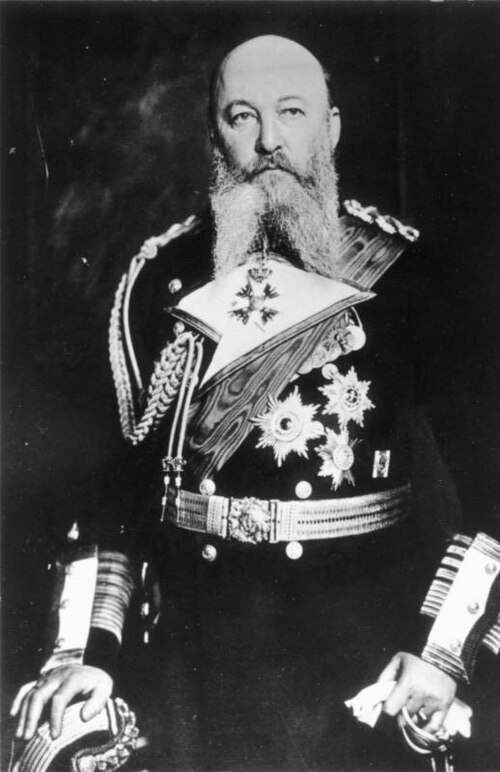

Grand Admiral; State Secretary of the Reich Naval Office, 1897-1916 · Germany
On the regime page: German Empire under Wilhelm II
6 quotes, oldest first. Filter with other speakers.
“On the other hand, what we aimed at was to be so strong that it would mean a certain risk even for the English fleet, with its enormous superiority, to pick a quarrel with us. Herein lay the political defensive as well as the tactical will to fight in a war of defence.”
English: Anonymous English translation (Dodd, Mead and Company, New York, 1919). Original-language text not found.
Memoir account of the aims of the 1900 Navy Bill, setting out the 'risk' idea: a German fleet large enough to make a British attack hazardous.
Alfred von Tirpitz, My Memoirs, vol. 1 (New York: Dodd, Mead and Company, 1919), chapter 11, "The Navy Bills", pp. 159-160 Source
“The Entente’s guilt is also established in its deeds. The Entente, which tore Alsace-Lorraine from the German motherland; which made the German people the hirelings of Anglo-Saxon capitalism, and wanted to dissolve the Austro-Hungarian Monarchy and annihilate the Turkish Empire; which fought with sword, hunger, internment, theft of trade, and moral poison, until the death of our nation was sealed; which translated immediately into fact the enmity that it had shown for decades, as soon as the negotiations of July, 1914, offered a particularly favourable opportunity,—this Entente will not be able, by hypocritically turning to advantage our unhappy policy, to avoid for ever the judgment of the history of the world upon the crime that it has committed on the spirit of humanity.”
English: Anonymous English translation (Dodd, Mead and Company, New York, 1919). Original-language text not found.
Memoir passage on responsibility for the outbreak of war in 1914, from a section arguing against German responsibility.
Alfred von Tirpitz, My Memoirs, vol. 1 (New York: Dodd, Mead and Company, 1919), chapter on the outbreak of the war, pp. 375-376 Source
Content note: Attributes civilian deaths to the passengers. The words are shown as they were said or written. Why
“American citizens who in wanton recklessness, and in spite of the warnings of our ambassador, had embarked in this armed cruiser, heavily laden with munitions, lost their lives in the sinking of the vessel.”
English: Anonymous English translation (Dodd, Mead and Company, New York, 1919). Original-language text not found.
Memoir account of the sinking of the Lusitania on 7 May 1915 and the American protest that followed.
Alfred von Tirpitz, My Memoirs, vol. 2 (New York: Dodd, Mead and Company, 1919), chapter on the submarine campaign, p. 155 Source
“One could regret the loss of life, but must insist on our clear rights. Our prestige would then be increased in America, and the danger of war thus most effectively diminished.”
English: Anonymous English translation (Dodd, Mead and Company, New York, 1919). Original-language text not found.
Memoir account of Tirpitz's telegram of 9 May 1915 to General Headquarters urging that Germany hold its legal position after the Lusitania sinking.
Alfred von Tirpitz, My Memoirs, vol. 2 (New York: Dodd, Mead and Company, 1919), chapter on the submarine campaign, p. 156 Source
“When the Northcliffe propaganda for the undermining of the German army had made full and successful use of the explosives thus supplied to it by the German democrats, Prince Max of Baden, Erzberger, and Scheidemann could not rest until they had tested their theory of the “peace of justice, not of force,” at the cost of our monarchy, our army, our honour, and our freedom.”
English: Anonymous English translation (Dodd, Mead and Company, New York, 1919). Original-language text not found.
Memoir passage on German politicians' calls in 1918 for democratisation and a peace of understanding, and on British propaganda directed at the German army.
Alfred von Tirpitz, My Memoirs, vol. 2 (New York: Dodd, Mead and Company, 1919), chapter "Main Questions of War", p. 45 Source