Erich von Falkenhayn
Illustration, not an archive object
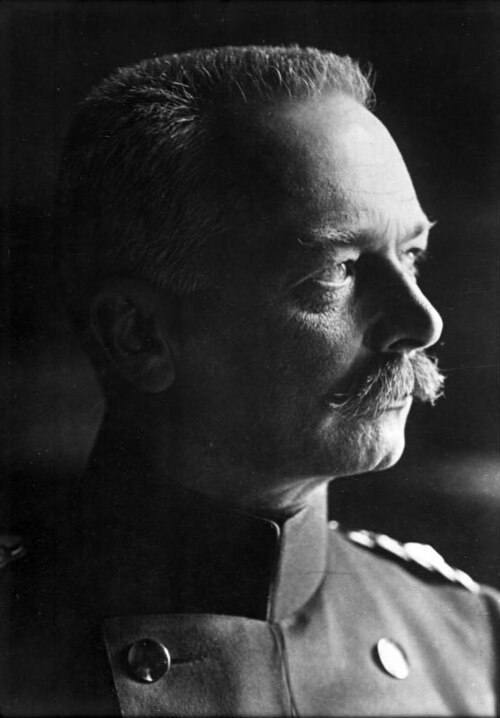

General; Prussian War Minister and Chief of the General Staff, 1914-1916 · Germany
On the regime page: German Empire under Wilhelm II
5 quotes, oldest first. Filter with other speakers.
“If we succeeded in opening the eyes of her people to the fact that in a military sense they have nothing more to hope for, that breaking-point would be reached and England's best sword knocked out of her hand.”
English: Anonymous English translation, Hutchinson (London, 1919). Original-language text not found.
Passage from the memorandum on the conduct of the war in 1916 that Falkenhayn says he submitted to the Emperor at Christmas 1915, as printed in his memoirs.
Erich von Falkenhayn, General Headquarters 1914-1916 and its Critical Decisions (London: Hutchinson, 1919), p. 217 (the memorandum he says he sent to the Emperor at Christmas 1915, reproduced in the chapter 'The Position at the End of 1915') Source
Historians dispute whether the memoir text reflects the memorandum as written in December 1915 (see Holger Afflerbach, Falkenhayn: Politisches Denken und Handeln im Kaiserreich, 1994; Robert T. Foley, German Strategy and the Path to Verdun, 2005); the original document was not checked here. The text is as printed in the memoir.
Content note: Attrition strategy aimed at heavy enemy casualties. The words are shown as they were said or written. Why
“Within our reach behind the French sector of the Western front there are objectives for the retention of which the French General Staff would be compelled to throw in every man they have. If they do so the forces of France will bleed to death — as there can be no question of a voluntary withdrawal — whether we reach our goal or not”
English: Anonymous English translation, Hutchinson (London, 1919). Original-language text not found.
Passage from the memorandum on the conduct of the war in 1916 that Falkenhayn says he submitted to the Emperor at Christmas 1915, as printed in his memoirs.
Erich von Falkenhayn, General Headquarters 1914-1916 and its Critical Decisions (London: Hutchinson, 1919), p. 217 (the memorandum he says he sent to the Emperor at Christmas 1915, reproduced in the chapter 'The Position at the End of 1915') Source
Historians dispute whether the memoir text reflects the memorandum as written in December 1915 (see Holger Afflerbach, Falkenhayn: Politisches Denken und Handeln im Kaiserreich, 1994; Robert T. Foley, German Strategy and the Path to Verdun, 2005); the original document was not checked here. The text is as printed in the memoir. The scan prints a bracket before 'Within' (a large printed brace); the closing bracket after 'not' is omitted.
“It is all the more necessary that we should ruthlessly employ every weapon that is suitable for striking at England on her own ground. Such weapons are the submarine war and the conclusion of a political and economic union between Germany and not her allies only, but all States which are not yet entirely under England's spell. This review is not concerned with the formation of such a union. The solution of that problem is the exclusive sphere of the political leaders.”
English: Anonymous English translation, Hutchinson (London, 1919). Original-language text not found.
Passage from the memorandum on the conduct of the war in 1916 that Falkenhayn says he submitted to the Emperor at Christmas 1915, as printed in his memoirs.
Erich von Falkenhayn, General Headquarters 1914-1916 and its Critical Decisions (London: Hutchinson, 1919), p. 214 (the memorandum he says he sent to the Emperor at Christmas 1915, reproduced in the chapter 'The Position at the End of 1915') Source
Historians dispute whether the memoir text reflects the memorandum as written in December 1915 (see Holger Afflerbach, Falkenhayn: Politisches Denken und Handeln im Kaiserreich, 1994; Robert T. Foley, German Strategy and the Path to Verdun, 2005); the original document was not checked here. The text is as printed in the memoir.
“Further, people were still convinced at the time that the Government of the United States seriously intended to remain neutral, and it was also credited with the strength of carrying out its intentions, all the more so as it was not expected that this Government, too, which could not be a stranger to the real whys and wherefores of the war, would fall a victim to the hypnotic power of the lying propaganda of the Entente. The opening of the submarine campaign in the form mentioned above was accordingly decided upon.”
English: Anonymous English translation, Hutchinson (London, 1919). Original-language text not found.
Memoir account of the reasoning behind the February 1915 German declaration of a war zone around Britain and the expected American reaction.
Erich von Falkenhayn, General Headquarters 1914-1916 and its Critical Decisions (London: Hutchinson, 1919), p. 72 (on the opening of the submarine campaign, February 1915) Source
“We could still anticipate that such a resumption, even if it took another form, would have attained its purpose of bleeding France white.”
English: Anonymous English translation, Hutchinson (London, 1919). Original-language text not found.
Memoir assessment of the Verdun offensive after its restriction in July 1916.
Erich von Falkenhayn, General Headquarters 1914-1916 and its Critical Decisions (London: Hutchinson, 1919), p. 286 (on the Verdun operations, summer 1916) Source