Erich Ludendorff
Illustration, not an archive object
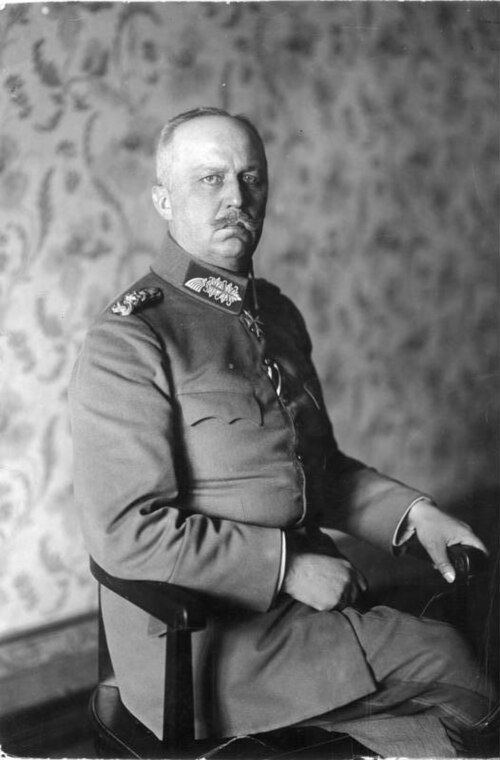

General; First Quartermaster General and co-head of the Supreme Army Command, 1916-1918 · Germany
On the regime page: German Empire under Wilhelm II
8 quotes, oldest first. Filter with other speakers.
“The war has demonstrated the exceptional power of photography and film as a means of educating and influencing. Unfortunately, our enemies have thoroughly exploited their lead in this area, causing us severe damage. In the further course of the war film will retain its momentous significance as a political and military means of influence.”
Original (German)
Der Krieg hat die überragende Macht des Bildes und Films als Aufklärungs- und Beeinflussungsmittel gezeigt. Leider haben unsere Feinde den Vorsprung, den sie auf diesem Gebiet hatten, so gründlich ausgenutzt, daß schwerer Schaden für uns entstanden ist. Auch für die fernere Kriegsdauer wird der Film seine gewaltige Bedeutung als politisches und militärisches Beeinflussungsmittel nicht verlieren.
English: English translation as published on filmportal.de (translator not named)
Opening paragraph of the letter that proposed consolidating the German film industry under state influence and led to the founding of Ufa in December 1917. The letter is usually described as drafted with the Military Office of the Foreign Ministry under Hans von Haeften.
Letter from the Chief of the General Staff of the Field Army (signed pp. Ludendorff) to the Royal War Ministry, Berlin, 4 July 1917, M.J. Nr. 20851 P., opening paragraph Source
Content note: Plan to conceal state ownership. The words are shown as they were said or written. Why
“However, it must not become known that the state is the purchaser. The entire financial transaction must be carried out by way of an expert, influential, experienced, reliable private entity (banking house), above all one that is absolutely loyal to the government. In no way should the negotiators be aware who the representative’s actual client is.”
Original (German)
Bekannt werden darf aber nicht, daß der Staat der Käufer ist. Die gesamte finanzielle Transaktion muß durch eine fachkundige, einflußreiche, erfahrene, zuverlässige und vor allen Dingen der Regierung unbedingt ergebene private Hand (Bankhaus) erfolgen. Die Unterhändler dürfen in keiner Form wissen, wer der wirkliche Auftraggeber des Beauftragten ist.
English: English translation as published on filmportal.de (translator not named)
Passage of the film-industry letter on how shares in German and Danish film companies would be bought without the state appearing as the buyer.
Letter from the Chief of the General Staff of the Field Army (signed pp. Ludendorff) to the Royal War Ministry, Berlin, 4 July 1917, M.J. Nr. 20851 P., section 2 ("What expenditure is required?") Source
“In accordance with the proposal submitted to me by Lieut.-Colonel Nicolai, General Headquarters arranged for patriotic instruction in the Field Army. But this was only a poor substitute for the work of enlightening public opinion at home, work which was done so consistently and effectively in the Entente countries.”
English: Anonymous English translation, Hutchinson (London, 1919). Original-language text not found.
Memoir account of the introduction of 'patriotic instruction' in the army in 1917 and the lack of a comparable civilian effort at home.
Erich Ludendorff, My War Memories, 1914-1918, vol. 2 (London: Hutchinson, 1919), p. 460 Source
“At home our attempt to improve the moral of the people by means of propaganda never got beyond the initial stages. After two years of pressure from me, the Chancellor had at last, in August, 1918, decided to create a Central Bureau for Press and propaganda purposes, both at home and abroad.”
English: Anonymous English translation, Hutchinson (London, 1919). Original-language text not found.
Memoir account of the August 1918 decision to create a central press and propaganda bureau, written after the war.
Erich Ludendorff, My War Memories, 1914-1918, vol. 2 (London: Hutchinson, 1919), p. 701 Source
Content note: Calls for hatred of the enemy. The words are shown as they were said or written. Why
“England's defiance of the laws of nations in employing the blockade against our very flesh and blood was not met by fiery protest ; the heart of the people was not filled with strong, manly hatred ; its holy ire was not directed against the inhuman enemy.”
English: Anonymous English translation, Hutchinson (London, 1919). Original-language text not found.
Memoir passage on the home front under the British blockade, arguing that the German government and public had not met it with sufficient anger.
Erich Ludendorff, My War Memories, 1914-1918, vol. 2 (London: Hutchinson, 1919), p. 453 Source
“The attempt on the part of our Foreign Office to establish military relations with Mexico strengthened public opinion against us in the United States. In spite of my warnings the Foreign Office had used an antiquated and easily decipherable secret code.”
English: Anonymous English translation, Hutchinson (London, 1919). Original-language text not found.
Memoir comment on the Foreign Office's January 1917 approach to Mexico and the cipher used for it, in the chapter covering America's entry into the war.
Erich Ludendorff, My War Memories, 1914-1918, vol. 2 (London: Hutchinson, 1919), p. 414 (on the Zimmermann telegram) Source
“August 8th was the black day of the German Army in the history of this war. This was the worst experience that I had to go through, except for the events that, from September 15th onwards, took place on the Bulgarian Front and sealed the fate of the Quadruple Alliance.”
English: Anonymous English translation, Hutchinson (London, 1919). Original-language text not found.
Memoir account of 8 August 1918, the first day of the Allied offensive at Amiens.
Erich Ludendorff, My War Memories, 1914-1918, vol. 2 (London: Hutchinson, 1919), p. 679 Source
“Duty compelled us at last to substitute action for idle time-wasting and empty words. The enemy had to be asked for peace and an armistice. The military position, which would all too probably get worse, demanded this.”
English: Anonymous English translation, Hutchinson (London, 1919). Original-language text not found.
Memoir account of the reasoning behind the Supreme Army Command's request at the end of September 1918 that the government seek an armistice.
Erich Ludendorff, My War Memories, 1914-1918, vol. 2 (London: Hutchinson, 1919), p. 719 (on the end of September 1918) Source