Andrew Bonar Law
Illustration, not an archive object
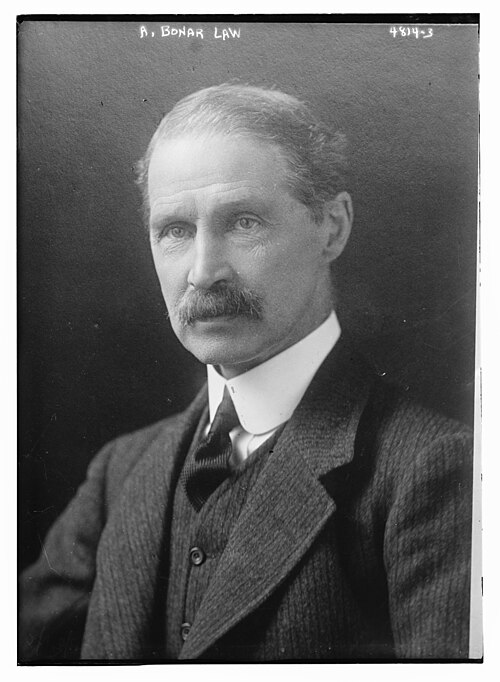

Leader of the Conservative and Unionist Party; Secretary of State for the Colonies from 1915 · United Kingdom
On the regime page: Asquith government
7 quotes, oldest first. Filter with other speakers.
“If the attempt be made under present conditions to force Home Rule on Ulster I can imagine no length of resistance to which Ulster will go in which I shall not be ready to support them.”
Bonar Law, then Leader of the Opposition, addressed a large Unionist rally in the grounds of Blenheim Palace against the Liberal Government's Home Rule Bill. The remark about Ulster was widely reported and debated at the time.
Andrew Bonar Law, speech at the Unionist demonstration at Blenheim Palace, 27 July 1912, as quoted in "Ulster Still Fighting Home Rule," The Literary Digest 45, no. 8 (24 August 1912), p. 291 Source
“The right hon. Gentleman has made a statement which, in view of the gravity of the situation as we all know, and as he best of all knows, seems to me one of the most amazing instances of paltering with the House of Commons and the country which we have ever had. The position is far more serious than the statement would lead us to suppose. A new danger has arisen, a danger which, I think, anyone might have foreseen, but which has apparently come upon the Government as a bolt from the blue, the danger, that is—and I shall show that I am not exaggerating—that our Army should be destroyed before our eyes.”
Bonar Law spoke after the Secretary of State for War's statement on the resignations of army officers at the Curragh camp, who had been told they might be ordered to act against Ulster resistance to Home Rule.
Andrew Bonar Law, Leader of the Opposition, speech on the motion for the adjournment (the Curragh incident), House of Commons, 23 March 1914, Hansard, HC Deb vol. 60, cols. 72-73 Source
“In these circumstances, in view of the facts which I have pointed out, in view of the fact that the First Lord has said that this was a treasonable conspiracy, and that the troops were only moved immediately after he had made that statement, in view of the belief which was held by the officer commanding the forces that they were at once to put down Ulster, I think it will be very difficult for the Prime Minister to convince the House—I accept his own good faith completely—his own good faith—I think it will be very difficult for the Prime Minister to convince the House or the country that, with or without his knowledge—in my belief without his knowledge—some of his colleagues, acting for the Government, did not make this movement of troops as part of a concerted plan either to provoke or to intimidate the people of Ulster.”
In the same speech Bonar Law gave his view of the Government's movement of troops towards Ulster in March 1914 and of what the Prime Minister's statement would have to answer.
Andrew Bonar Law, Leader of the Opposition, speech on the motion for the adjournment (the Curragh incident), House of Commons, 23 March 1914, Hansard, HC Deb vol. 60, col. 75 Source
“All I am trying to express is that where a power of that kind is given it grows. It is exercised by more and more people, and there is a danger that it may be used for purposes for which the Government would not willingly have it used.”
Bonar Law, Leader of the Opposition under the wartime party truce, spoke in the debate on a motion criticising the Press Bureau and its handling of war news.
Andrew Bonar Law, speech in the debate on the Press Bureau, House of Commons, 8 February 1915, Hansard, HC Deb vol. 69, col. 361 Source
“It used to be considered, I believe, that to force the Dardanelles was not a possible operation of war. Thanks largely to the fact that we have ships like the "Queen Elizabeth," with guns which cannot be approached, it is now a possible operation, and we hope and believe that it is going to be successful. If it be successful I cannot doubt that it is going to have a great effect on the ultimate issue of this War.”
Bonar Law, Leader of the Opposition, replied to the First Lord of the Admiralty while the Allied fleet was bombarding the Dardanelles forts. The naval attack failed later in March, and the Gallipoli land campaign followed.
Andrew Bonar Law, speech in the debate on the Navy Estimates, House of Commons, 1 March 1915, Hansard, HC Deb vol. 70, col. 604 Source
“I see no reason for a prosecution. The statements are simply not believed.”
Mr. Ginnell asked about allegations, made on oath by a committee of Ceylonese, that people were shot without trial under martial law during the disturbances in Ceylon in 1915, and why those making them had not been prosecuted.
Andrew Bonar Law, Secretary of State for the Colonies, reply to a question from Mr. Ginnell on Ceylon, House of Commons, 11 May 1916, Hansard, HC Deb vol. 82, col. 883 Source
“There is no foundation for the allegation that excesses were committed by the local forces in the suppression of disorder in Ceylon.”
The question asked whether any inquiry had been held into the conduct of civilian employees appointed as officers in control of troops and volunteers during ten weeks of martial law in Ceylon in 1915.
Andrew Bonar Law, Secretary of State for the Colonies, reply to a question from Mr. Ginnell on Ceylon, House of Commons, 11 May 1916, Hansard, HC Deb vol. 82, col. 884 Source