Gottlieb von Jagow
Illustration, not an archive object
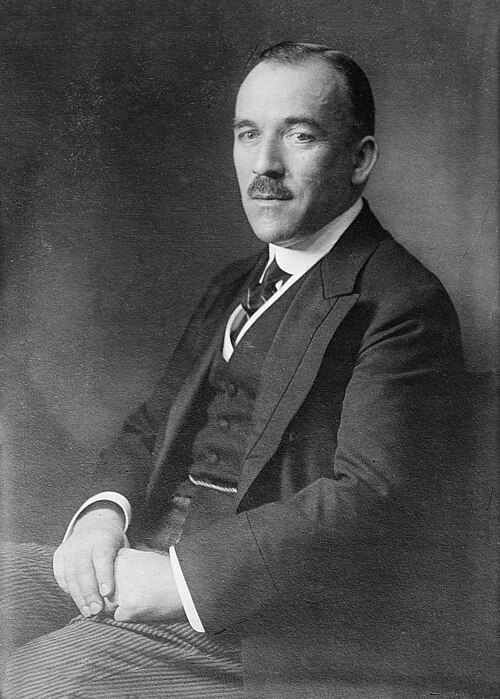

State Secretary for Foreign Affairs of the German Empire, 1913-1916 · Germany
On the regime page: German Empire under Wilhelm II
5 quotes, oldest first. Filter with other speakers.
“If we can not attain localization (of the conflict) and Russia attacks Austria, a casus foederis will then arise; we could not throw Austria over then. We stand in the midst of an isolation that can scarcely be called “proud.” I desire no preventive war, but if war should come, we cannot hide behind the fence.”
Original (German)
Läßt sich die Lokalisierung nicht erreichen und greift Rußland Österreich an, so tritt der casus foederis ein, so können wir Österreich nicht opfern. Wir ständen dann in einer nicht gerade proud zu nennenden Isolation. Ich will keinen Präventivkrieg, aber wenn der Kampf sich bietet, dürfen wir nicht kneifen.
English: Translated by the Carnegie Endowment for International Peace, Division of International Law (Oxford University Press, 1924)
Private letter to Prince Lichnowsky, the German Ambassador in London, written a few weeks after the Sarajevo assassination and before the Austro-Hungarian ultimatum to Serbia, replying to Lichnowsky's criticism of German support for Austria-Hungary.
Private letter from the Secretary of State for Foreign Affairs to the Ambassador in London, Berlin, 18 July 1914, Kautsky Documents No. 72 (German: Die deutschen Dokumente zum Kriegsausbruch 1914, vol. 1, No. 72), English p. 132 Source
“According to all competent observation, Russia will be prepared to fight in a few years. Then she will crush us by the number of her soldiers; then she will have built her Baltic Sea fleet and her strategic railroads. Our group, in the meantime, will have become weaker right along.”
Original (German)
In einigen Jahren wird Rußland nach aller kompetenten Annahme schlagfertig sein. Dann erdrückt es uns durch die Zahl seiner Soldaten, dann hat es seine Ostseeflotte und seine strategischen Bahnen gebaut. Unsere Gruppe wird inzwischen immer schwächer.
English: Translated by the Carnegie Endowment for International Peace, Division of International Law (Oxford University Press, 1924)
Private letter to Prince Lichnowsky, the German Ambassador in London, written a few weeks after the Sarajevo assassination and before the Austro-Hungarian ultimatum to Serbia, replying to Lichnowsky's criticism of German support for Austria-Hungary.
Private letter from the Secretary of State for Foreign Affairs to the Ambassador in London, Berlin, 18 July 1914, Kautsky Documents No. 72 (German: Die deutschen Dokumente zum Kriegsausbruch 1914, vol. 1, No. 72), English p. 132 Source
“The Imperial Government is in receipt of reliable information relating to the proposed advance of French armed forces along the Meuse, route Givet-Namur. They leave no doubt as to France’s intention to advance against Germany through Belgian territory. [...] It is for Germany a dictate of self-preservation that she anticipate the hostile attack.”
English: Translated by the Carnegie Endowment for International Peace, Division of International Law (Oxford University Press, 1924). Original-language text not found.
Text of the German demand to Belgium for passage of German troops, sent sealed on 29 July 1914 and presented to the Belgian government on 2 August 1914; German troops entered Belgium on 4 August 1914. The note states that Germany held reliable information of a planned French advance through Belgium.
Secretary of State for Foreign Affairs (v. Jagow) to the Minister at Brussels, Berlin, 29 July 1914, Kautsky Documents No. 376 (sealed instruction; to be opened on telegraphic order), in Outbreak of the World War: German Documents Collected by Karl Kautsky, ed. Max Montgelas and Walther Schucking (New York: Oxford University Press, 1924), p. 330 Source
“But despite all this, despite the fact that the aggressive tendency of the Russian policy was becoming constantly more evident, the idea of a preventive war was far removed from us. We did not decide to declare war on Russia until we had to face the Russian mobilization and to defend ourselves against a Russian invasion.”
English: Munroe Smith, in The Disclosures from Germany (New York: American Association for International Conciliation, 1918). Original-language text not found.
Published reply of the former Foreign Secretary to Prince Lichnowsky's memorandum on the origins of the war, which had circulated in Germany and abroad in 1918.
Gottlieb von Jagow, "Remarks on the article of Prince Lichnowsky 'My London Mission'," Norddeutsche Allgemeine Zeitung, 23 March 1918, in The Disclosures from Germany, trans. Munroe Smith (New York: American Association for International Conciliation, 1918), p. 139 Source
“It must either submit to the Russo-Serbian machinations, or command a quos ego, even at the risk of war. We could not leave our ally in the lurch.”
English: Munroe Smith, in The Disclosures from Germany (New York: American Association for International Conciliation, 1918). Original-language text not found.
The same published reply: Jagow's account of why Germany supported Austria-Hungary against Serbia in July 1914.
Gottlieb von Jagow, "Remarks on the article of Prince Lichnowsky 'My London Mission'," Norddeutsche Allgemeine Zeitung, 23 March 1918, in The Disclosures from Germany, trans. Munroe Smith (New York: American Association for International Conciliation, 1918), p. 139 Source