Max von Baden
Illustration, not an archive object
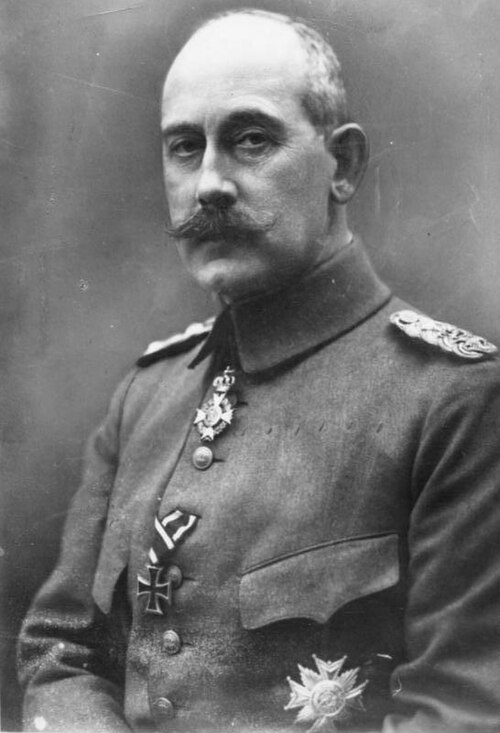

Prince; Imperial Chancellor of Germany, October-November 1918 · Germany
On the regime page: German Empire under Wilhelm II
5 quotes, oldest first. Filter with other speakers.
“The German Government requests the President of the United States of America to take steps for the restoration of peace, to notify all belligerents of this request, and to invite them to delegate plenipotentiaries for the purpose of taking up negotiations. The German Government accepts, as a basis for the peace negotiations, the program laid down by the President of the United States in his message to Congress of January 8, 1918, and in his subsequent pronouncements, particularly in his address of September 27, 1918. In order to avoid further bloodshed the German Government requests to bring about the immediate conclusion of a general armistice on land, on water, and in the air.”
English: English translation enclosed by the Swiss Legation, as printed in FRUS. Original-language text not found.
The first German request to the United States for an armistice, sent through the Swiss government after the Supreme Army Command asked the government at the end of September 1918 to seek one. Signed by the new Chancellor.
Note of the German Imperial Chancellor (Max, Prince of Baden) to President Wilson, dispatched 3-4 October 1918 and transmitted by the Swiss Chargé (Oederlin) on 6 October 1918, Papers Relating to the Foreign Relations of the United States, 1918, Supplement 1, The World War, vol. 1, p. 338 Source
“And here I do not advise the acceptance of the Social Democratic Ultimatum, but the upholding of the Monarchical principle by means of a solution still more democratic than that of the Ultimatum : His Majesty would at once declare his firm determination to abdicate as soon as the armistice negotiations have reached a point which permits of the issue of writs for the election of a Constituent National Assembly.”
English: W. M. Calder and C. W. H. Sutton (Constable, 1928). Original-language text not found.
Message the Chancellor says he telephoned to the Emperor's headquarters on 8 November 1918, the day after the Social Democratic ultimatum and during the revolution, proposing a conditional declaration of abdication.
The Memoirs of Prince Max of Baden, vol. 2, authorised translation by W. M. Calder and C. W. H. Sutton (London: Constable, 1928), p. 332 (message of 8 November 1918 as printed in the memoir) Source
“I was well aware that I was not formally entitled to make the publication without having the express consent of the Kaiser. But I considered it my duty to make known the Kaiser’s decision—now that, according to my information, it had been finally taken—while some good might still come of such publication.”
English: W. M. Calder and C. W. H. Sutton (Constable, 1928). Original-language text not found.
Memoir account of why he sent the announcement of the Emperor's abdication to the Wolff Telegraph Agency on 9 November 1918 without the Emperor's express consent, after failing to reach him by telephone at Spa.
The Memoirs of Prince Max of Baden, vol. 2, authorised translation by W. M. Calder and C. W. H. Sutton (London: Constable, 1928), p. 352 (memoir account of 9 November 1918) Source
“The Kaiser and King has resolved to renounce the throne. The Chancellor remains in office until the questions connected with the abdication of the Kaiser, the renunciation of the Crown Prince of the German Empire and of Prussia, and the setting-up of the Regency have been regulated. He intends to propose to the Regent the appointment of Herr Ebert to the Chancellorship and the bringing in of a Bill to enact that election writs be immediately issued for a German Constituent National Assembly. This would have to settle finally the future constitution of the German people, including any sections of it that might wish to be included within the Empire.”
English: W. M. Calder and C. W. H. Sutton (Constable, 1928). Original-language text not found.
Announcement the Chancellor issued around midday on 9 November 1918, as given in his memoirs. The memoir states he issued it on his own responsibility, without having the Emperor's express consent.
The Memoirs of Prince Max of Baden, vol. 2, authorised translation by W. M. Calder and C. W. H. Sutton (London: Constable, 1928), p. 353 (manifesto of 9 November 1918 as printed in the memoir) Source
“My speech would have aroused Germany to the startling consciousness that it had never considered what Wilson’s programme really meant.”
English: W. M. Calder and C. W. H. Sutton (Constable, 1928). Original-language text not found.
Memoir passage on the Reichstag speech of 5 October 1918: he says he gave up the speech he had intended after objections from his advisers, and that he regrets the decision.
The Memoirs of Prince Max of Baden, vol. 2, authorised translation by W. M. Calder and C. W. H. Sutton (London: Constable, 1928), p. 41 Source