Paul von Hindenburg
Illustration, not an archive object
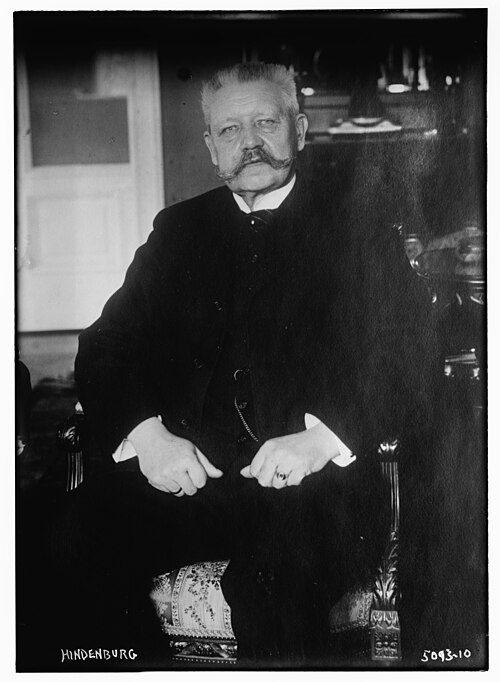

Field Marshal; Chief of the General Staff and head of the Supreme Army Command, 1916-1919; later Reich President · Germany
On the regime page: German Empire under Wilhelm II
6 quotes, oldest first. Filter with other speakers.
“But then, with renewed strength, we will press forward with God for the Emperor, the King, and the Fatherland until the last Russian has left our dear, sorely tried home province and we have carried our victorious flags into enemy territory. Long live His Majesty the Emperor and King, hurrah!”
English: English translation by German History in Documents and Images (GHDI). Original-language text not found.
Order of thanks to the 8th Army the day after the battle of Tannenberg, printed in German newspapers at the time. The recording used by the source was made in 1917 for the Prussian State Library.
Paul von Hindenburg, "Aus dem Dankerlass an die Truppen der 8. Armee nach der Schlacht von Tannenberg", 31 August 1914 (recorded by Wilhelm Doegen, 17 October 1917; Stiftung Deutsches Rundfunkarchiv), GHDI document ghdi:audio-5142 Source
“Since weapons and hunger could not break Germany's will to win, the enemy resorted to treachery. It sought to sow discord and divide the people from their emperor.”
English: English translation by German History in Documents and Images (GHDI). Original-language text not found.
Short recorded address on the war situation made for the sound archive of the Prussian State Library, three months after the Reichstag peace resolution of July 1917. It states the official account that Germany was fighting a defensive war.
Paul von Hindenburg, "Ansprache zur Lage Deutschlands im vierten Kriegsjahr", recorded 17 October 1917 at Bad Kreuznach (Stiftung Deutsches Rundfunkarchiv), GHDI document ghdi:audio-5144 Source
“An English general said with justice: “The German army was stabbed in the back.” No guilt applies to the good core of the army. Its achievements are just as admirable as those of the officer corps. Where the guilt lies has clearly been demonstrated. If it needed more proof, then it would be found in the quoted statement of the English general and in the boundless astonishment of our enemies at their victory.”
Original (German)
Ein englischer General sagte mit Recht: „Die deutsche Armee ist von hinten erdolcht worden.“ Den guten Kern des Heeres trifft keine Schuld. Seine Leistung ist ebenso bewunderungswürdig wie die des Offizierkorps. Wo die Schuld liegt, ist klar erwiesen. Bedurfte es noch eines Beweises, so liegt er in dem angeführten Ausspruche des englischen Generals und in dem maßlosen Erstaunen unserer Feinde über ihren Sieg.
English: GHDI translation, as printed in Anton Kaes, Martin Jay and Edward Dimendberg, eds., The Weimar Republic Sourcebook (University of California Press, 1994), pp. 15-16
Closing passage of a written declaration Hindenburg read before the committee investigating the causes of the war and the defeat, after the chairman had objected to part of his remarks. The GHDI introduction states it was drafted with Karl Helfferich and Erich Ludendorff. Hindenburg does not name the 'English general' in the passage.
Testimony of Field Marshal von Hindenburg, 18 November 1919, Stenographischer Bericht über die öffentlichen Verhandlungen des 15. Untersuchungsausschusses der verfassungsgebenden Nationalversammlung, vol. 2 (Berlin, 1920), pp. 700-701 Source
“A commander who cannot or will not dare to stake his last resources for the sake of victory is committing a crime towards his own people. If his blow fails, he is certain to have the curses and scorn of the weaklings and cowards upon his head !”
English: F. A. Holt (Cassell, 1920). Original-language text not found.
Written after the war, in the passage defending the January 1917 decision for unrestricted submarine warfare, which the Emperor took against the advice of the Imperial Chancellor. Hindenburg answers the charge that it was a last desperate throw.
Paul von Hindenburg, Out of My Life, trans. F. A. Holt (London: Cassell, 1920), p. 256 (on the decision of 9 January 1917 to begin unrestricted U-boat warfare) Source
“It was a dreadful disappointment for the army in the West ; worse, perhaps, for the public at home ; and worst — as we had good reason to fear — for our Allies. Loud rejoicings among our enemies ! Could more suitable material for propaganda be imagined ? The 246 Out of My Life brilliant, if somewhat belated, visible result of the bloody battle, the collapse of German resistance, the impetuous unceasing pursuit, the paroxysms about our methods of .warfare ! We could hear all the stops being drawn out beforehand. What a hail of propagandist literature would now descend on and behind our lines !”
English: F. A. Holt (Cassell, 1920). Original-language text not found.
Memoir account of the German withdrawal to the Arras-St Quentin-Soissons line in March 1917 and the expected Allied propaganda about it.
Paul von Hindenburg, Out of My Life, trans. F. A. Holt (London: Cassell, 1920), pp. 245-246 (on the withdrawal to the Siegfried Line, March 1917) Source
“Like Siegfried, stricken down by the treacherous spear of savage Hagan, our weary front collapsed. It was in vain that it had tried to drink in new vitality from that fountain in our homeland which had run dry. It was now our task to save what was left of our army for the subsequent reconstruction of our Fatherland.”
English: F. A. Holt (Cassell, 1920). Original-language text not found.
Memoir account of the end of the war on the Western Front in November 1918, written in 1920 after his November 1919 committee testimony. The spelling 'Hagan' is the translation's.
Paul von Hindenburg, Out of My Life, trans. F. A. Holt (London: Cassell, 1920), p. 440 (chapter "My Farewell", on the collapse of autumn 1918) Source
Often attributed, not verified
These words circulate under Paul von Hindenburg’s name but could not be traced to a source. They are listed so readers can check them, not as Paul von Hindenburg’s words.
“That Bohemian corporal”
No primary text (letter, minutes, diary) containing the words was found in the sources read for this file. Accounts differ on the exact wording and on who heard it.