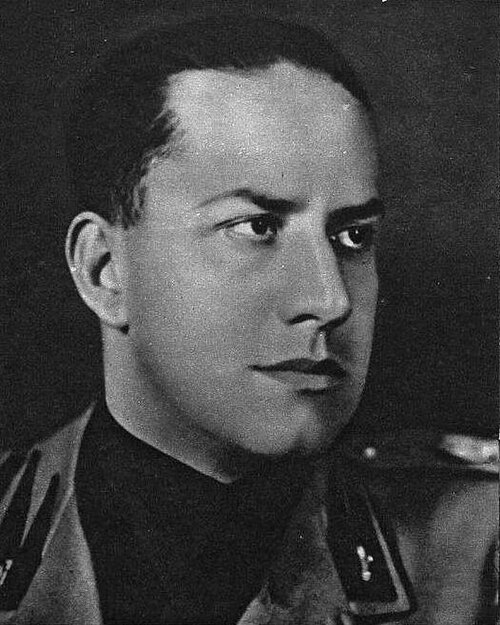
Galeazzo Ciano
Illustration, not an archive object
.jpg)
Italian Minister of Foreign Affairs (1936 to 1943) · Italy
On the regime page: Fascist Italy under Mussolini
6 quotes, oldest first. Filter with other speakers.
Content note: Order to kill prisoners. The words are shown as they were said or written. Why
“Many Italians also were taken prisoner: anarchist and communist. I informed the Duce about it, and he ordered that they all be shot, adding, “Dead men tell no tales.””
Original (Italian)
Anche molti italiani sono stati presi: anarchici e comunisti. Lo dico al Duce che mi ordina di farli fucilare tutti, ed aggiunge: “I morti non raccontano la storia”.
English: Hugh Gibson (ed.), The Ciano Diaries 1939-1943 (Doubleday, 1946; Simon Publications reprint, 2001) (English text as printed in this edition)
Ciano records General Gambara's report on the Spanish Civil War, in which Italian forces were fighting for Franco, and reports Mussolini's order about Italian anarchist and communist volunteers captured on the Republican side.
Galeazzo Ciano, diary entry of 22 February 1939, in Hugh Gibson (ed.), The Ciano Diaries 1939-1943 (Doubleday, 1946; Simon Publications reprint, 2001); Italian original: Galeazzo Ciano, Diario 1937-1943 (Italian text; Rizzoli edition text as reproduced in the 2020 FS digital reprint) Source
“I return to Rome completely disgusted with the Germans, with their leader, with their way of doing things. They have betrayed us and lied to us. Now they are dragging us into an adventure which we have not wanted and which might compromise the regime and the country as a whole.”
Original (Italian)
Torno a Roma disgustato della Germania, dei suoi Capi, del loro modo di agire. Ci hanno ingannato e mentito. È oggi stanno per tirarci in un'avventura che non abbiamo voluta e che può compromettere il Regime e il Paese.
English: Hugh Gibson (ed.), The Ciano Diaries 1939-1943 (Doubleday, 1946; Simon Publications reprint, 2001) (English text as printed in this edition)
Ciano had met Ribbentrop at Fuschl and Hitler at the Berghof on 11 to 13 August 1939, where he was told that Germany had decided on war with Poland. He wrote this on his return, after reporting to Mussolini at the Palazzo Venezia.
Galeazzo Ciano, diary entry of 13 August 1939, in Hugh Gibson (ed.), The Ciano Diaries 1939-1943 (Doubleday, 1946; Simon Publications reprint, 2001); Italian original: Galeazzo Ciano, Diario 1937-1943 (Italian text; Rizzoli edition text as reproduced in the 2020 FS digital reprint) Source
“Mussolini speaks from the balcony of the Palazzo Venezia. The news of the war does not surprise anyone and does not arouse very much enthusiasm. I am sad, very sad. The adventure begins. May God help Italy!”
Original (Italian)
Mussolini parla dal Balcone di Palazzo Venezia. La notizia della guerra non sorprende nessuno e non desta eccessivi entusiasmi. lo sono triste: molto triste. L'avventura comincia. Che Dio assista l'Italia.
English: Hugh Gibson (ed.), The Ciano Diaries 1939-1943 (Doubleday, 1946; Simon Publications reprint, 2001) (English text as printed in this edition)
Ciano, Foreign Minister, had that afternoon handed the declarations of war on Britain and France to their ambassadors. He wrote this after Mussolini's speech announcing the declaration from the balcony of the Palazzo Venezia.
Galeazzo Ciano, diary entry of 10 June 1940, in Hugh Gibson (ed.), The Ciano Diaries 1939-1943 (Doubleday, 1946; Simon Publications reprint, 2001); Italian original: Galeazzo Ciano, Diario 1937-1943 (Italian text; Rizzoli edition text as reproduced in the 2020 FS digital reprint) Source
Content note: Order to shoot hostages (Mussolini, quoted by Ciano). The words are shown as they were said or written. Why
““I, too, will adopt the method of hostages,” he said. “I have given orders that for every one of our men who is wounded, two of theirs must be shot, and for every one of our dead, twenty of theirs.” But he knows that he won’t do it.”
Original (Italian)
“Comincio anch'io col sistema degli ostaggi” dice. “Ho dato ordine che per ogni nostro ferito ne vengano fucilati due, e venti per ogni nostro morto.” Ma non lo farà.
English: Hugh Gibson (ed.), The Ciano Diaries 1939-1943 (Doubleday, 1946; Simon Publications reprint, 2001) (English text as printed in this edition)
Ciano reports Mussolini's anger at attacks on Italian soldiers by Croats at Spalato (Split) in Italian-occupied Dalmatia. The speaker is Mussolini; the closing sentence is Ciano's own comment.
Galeazzo Ciano, diary entry of 11 November 1941, in Hugh Gibson (ed.), The Ciano Diaries 1939-1943 (Doubleday, 1946; Simon Publications reprint, 2001); Italian original: Galeazzo Ciano, Diario 1937-1943 (Italian text; Rizzoli edition text as reproduced in the 2020 FS digital reprint) Source
Content note: Call to exterminate a population (Vidussoni, quoted by Ciano); period racial term in the editor's gloss. The words are shown as they were said or written. Why
“Vidussoni comes to see me. After having spoken about a few casual things, he makes some political allusions and announces savage plans against the Slovenes. He wants to kill them all. I take the liberty of observing that there are a million of them. “That does not matter,” he answers firmly; “we must imitate the Ascari [Negro soldiers from Italian colonies] and exterminate them!””
Original (Italian)
Viene a vedermi Vidussoni. Dopo aver parlato di piccole questioni contingenti, fa alcuni cenni politici e dichiara truci propositi contro gli sloveni. Li vuole ammazzare tutti. Mi permetto osservare che sono un milione. Non importa — risponde deciso — bisogna fare come gli ascari e sterminarli tutti.
English: Hugh Gibson (ed.), The Ciano Diaries 1939-1943 (Doubleday, 1946; Simon Publications reprint, 2001) (English text as printed in this edition)
Ciano records a visit from Aldo Vidussoni, then secretary of the National Fascist Party, concerning policy towards the Slovenes in Italian-annexed territory. The speaker quoted is Vidussoni; the bracketed gloss is the edition's.
Galeazzo Ciano, diary entry of 5 January 1942, in Hugh Gibson (ed.), The Ciano Diaries 1939-1943 (Doubleday, 1946; Simon Publications reprint, 2001); Italian original: Galeazzo Ciano, Diario 1937-1943 (Italian text; Rizzoli edition text as reproduced in the 2020 FS digital reprint) Source
“As always, victory finds a hundred fathers, but defeat is an orphan.”
Original (Italian)
Come sempre, la vittoria trova cento padri, e nessuno vuole riconoscere l'insuccesso.
English: Hugh Gibson (ed.), The Ciano Diaries 1939-1943 (Doubleday, 1946; Simon Publications reprint, 2001) (English text as printed in this edition)
Ciano notes Mussolini's anger at Rommel and the quarrelling over responsibility in Libya, after the failure of the Axis offensive at Alam Halfa.
Galeazzo Ciano, diary entry of 9 September 1942, in Hugh Gibson (ed.), The Ciano Diaries 1939-1943 (Doubleday, 1946; Simon Publications reprint, 2001); Italian original: Galeazzo Ciano, Diario 1937-1943 (Italian text; Rizzoli edition text as reproduced in the 2020 FS digital reprint) Source