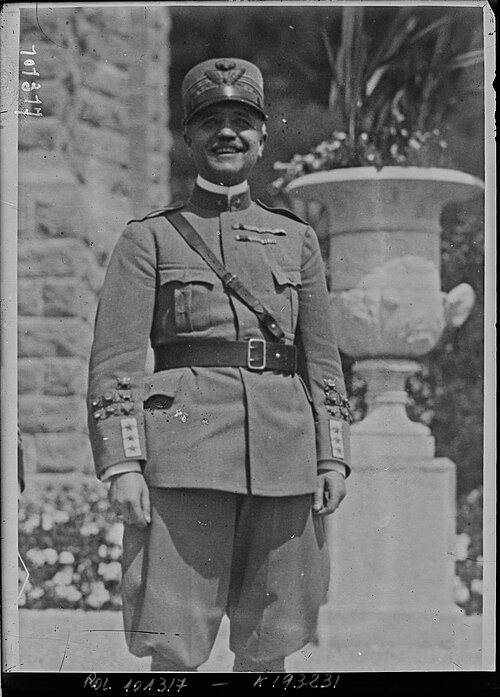
Pietro Badoglio
Illustration, not an archive object
_-_btv1b53147592n.jpg)
Marshal of Italy; Chief of the General Staff (1925 to 1940); Head of Government (1943 to 1944) · Italy
On the regime page: Fascist Italy under Mussolini
3 quotes, oldest first. Filter with other speakers.
“Your Excellency, you know perfectly well that we are absolutely unprepared—you have received complete reports every week. We have about twenty divisions with 70 per cent. of the necessary equipment and training; and about another twenty divisions with 50 per cent. We have no tanks. The Air Force, as you know from General Pricolo’s reports, is grounded. This is to say nothing of stores—we have not even sufficient shirts for the army. In such a state of affairs how is it possible to declare war? Our colonies lack everything. Our merchant shipping is on the high seas.”
English: Muriel Currey, in Pietro Badoglio, Italy in the Second World War: Memories and Documents (Oxford University Press, London, 1948). Original-language text not found.
Badoglio, Chief of the General Staff, recounts a meeting with Mussolini at which Mussolini said he intended to declare war on Britain and France after 5 June 1940. The words are Badoglio's own reply as he reported it in his 1946 memoir (Italian original: L'Italia nella seconda guerra mondiale, Mondadori, 1946).
Pietro Badoglio, Italy in the Second World War: Memories and Documents, trans. Muriel Currey (OUP, 1948), ch. 2, "Mussolini decides on Intervention", pp. 14-15 (Badoglio's account of his reply to Mussolini on 28 May 1940) Source
““There is no doubt that Jacomoni and Visconti Prasca have a large share of the responsibility in the Albanian affair, but the real blame must be sought elsewhere. It lies entirely in the Duce’s command. This is a command that he, the Duce, cannot hold. Let him leave everything to us, and when things go wrong let him punish those responsible.””
Original (Italian)
“Non c'è dubbio che Jacomoni e Visconti Prasca hanno delle grosse responsabilità nell'affare albanese. Ma la colpa maggiore bisogna cercarla altrove, ed è tutta nel comando del Duce. È un comando ch'egli non può esercitare. Lasci fare a noi, e quando le cose non vanno, colpisca i responsabili”.
English: Hugh Gibson (ed.), The Ciano Diaries 1939-1943 (Doubleday, 1946; Simon Publications reprint, 2001) (English text as printed in this edition)
After the Italian setbacks in Greece and Albania, Alessandro Pavolini, Minister of Popular Culture, told Ciano what Badoglio had said to him about responsibility for the campaign. Pavolini passed it to Mussolini, who called Badoglio an "enemy of the regime" and a "traitor".
Galeazzo Ciano, diary entry of 22 November 1940, recording the words of Pietro Badoglio (as reported to Ciano by Alessandro Pavolini), in Hugh Gibson (ed.), The Ciano Diaries 1939-1943 (Doubleday, 1946; Simon Publications reprint, 2001); Italian original: Galeazzo Ciano, Diario 1937-1943 (Italian text; 2020 FS digital reprint) Source
Content note: Statement on antisemitic legislation. The words are shown as they were said or written. Why
“The second measure related to the Jews. It was not possible at that moment to abrogate publicly all the racial laws without coming into violent conflict with the Germans, or, to be more accurate, with Hitler. He had not only inspired this legislation, he had actually forced it on Mussolini, who only a few months earlier had declared in the Senate that there was no Jewish problem in Italy. I sent for representative Jews and told them that, though it was not possible at the moment to revoke the laws, they would not be carried out.”
English: Muriel Currey, in Pietro Badoglio, Italy in the Second World War: Memories and Documents (Oxford University Press, London, 1948). Original-language text not found.
Badoglio, Head of Government after Mussolini's dismissal on 25 July 1943, describes in his memoir how his government handled the 1938 racial laws in the weeks before the armistice of 8 September 1943.
Pietro Badoglio, Italy in the Second World War: Memories and Documents, trans. Muriel Currey (OUP, 1948), ch. 7, pp. 62-63 (Badoglio's account of his government's measures after 25 July 1943) Source