
Herbert Hoover
Illustration, not an archive object
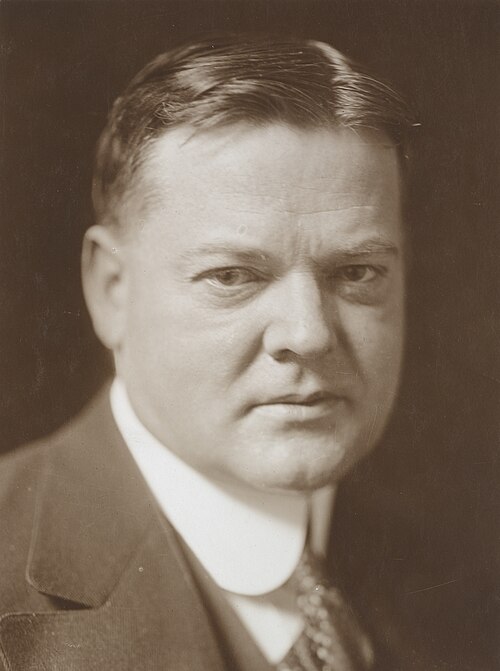

U.S. Food Administrator (1917-1919); later Secretary of Commerce and 31st President of the United States · United States
On the regime page: Wilson administration
4 quotes, oldest first. Filter with other speakers.
“This necessity was so great that our Allied colleagues considered it our duty to impose a compulsory ration upon the American population. My colleagues and myself, however, believed that the spirit of self-sacrifice of the American people could be relied upon for so great a service as to accomplish the necessary results upon a voluntary basis.”
Hoover wrote the Preface in 1920 as a summary of the Food Administration's work, after the agency was demobilised, because no formal report was prepared. The passage explains why the Food Administration asked households to cut consumption voluntarily instead of rationing them.
Herbert Hoover, Preface to a Report of the United States Food Administration (introduction dated 27 March 1920; April 1920), p. 12 Source
“The plan of organization adopted was to assemble, as far as possible, the voluntary service of individuals in administrative work and the voluntary co-operation of the householders, farmers and the food trades. The results amply demonstrated the high sense of service in our people, as it proved that measures of legal force were needed for an infinitesimal per cent.”
Hoover wrote the Preface in 1920 as a summary of the Food Administration's work, after the agency was demobilised, because no formal report was prepared. He describes the agency set up by executive order on 10 August 1917.
Herbert Hoover, Preface to a Report of the United States Food Administration (introduction dated 27 March 1920; April 1920), p. 8 Source
“A large amount of propaganda was initiated to secure the substitution in consumption of littoral for deep sea fishes.”
Hoover wrote the Preface in 1920 as a summary of the Food Administration's work, after the agency was demobilised, because no formal report was prepared. The sentence is from his account of measures to protect supplies of fats and meats needed for export to the Allies. He uses the word propaganda for the Food Administration's own conservation publicity.
Herbert Hoover, Preface to a Report of the United States Food Administration (introduction dated 27 March 1920; April 1920), p. 12 Source
“It was imperative that no charge of inhumanity should be laid at our door by continuing this starvation after the surrender. Furthermore, the only hope of saving Europe from anarchy lay in prompt measures on a large scale.”
Hoover wrote the Preface in 1920 as a summary of the Food Administration's work, after the agency was demobilised, because no formal report was prepared. The passage explains why the Food Administration continued to organise food supplies for Central Europe, including the former enemy states, after the armistice of November 1918.
Herbert Hoover, Preface to a Report of the United States Food Administration (introduction dated 27 March 1920; April 1920), p. 39 Source