Wilhelm Keitel
Illustration, not an archive object
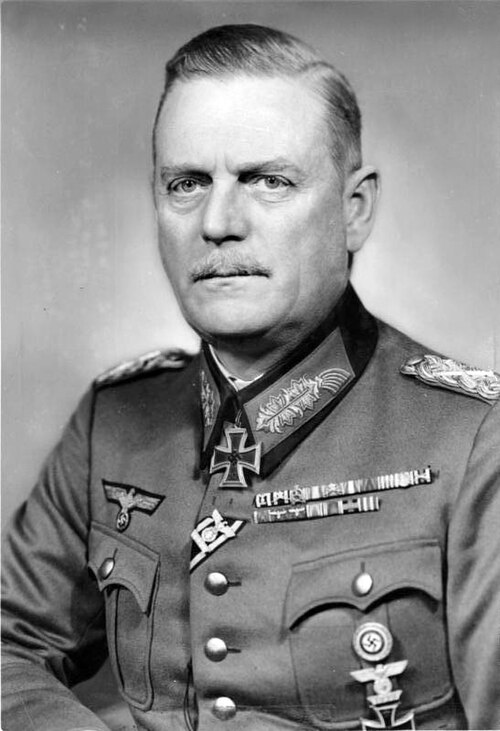

Chief of the OKW · Germany
On the regime page: Nazi Germany
8 quotes, oldest first. Filter with other speakers.
Content note: Order for ruthless action against civilians and guerrillas in the invasion of the USSR. The words are shown as they were said or written. Why
“This is possible only if the troops take ruthless action themselves against any threat from the enemy population. For these reasons I herewith issue the following order effective for the area "Barbarossa" (area of operations, army rear area, and area of political administration) : I. Treatment of offenses committed by enemy civilians : 1. Until further notice the military courts and the courts martial will not be competent for crimes committed by enemy civilians. 2. Guerillas should be disposed of ruthlessly by the military, whether they are fighting or in flight. 3. Likewise all other attacks by enemy civilians on the Armed Forces, its members and employees, are to be suppressed at once by the military, using the most extreme methods, until the assailants are destroyed.”
English: Office of United States Chief of Counsel, translation of Nuremberg document C-50. Original-language text not found.
Order issued about six weeks before the invasion of the Soviet Union, removing offences by enemy civilians from the jurisdiction of military courts and instructing troops how to deal with resistance. Hitler is the issuing authority; the OKW chief signed and distributed it.
Order concerning the exercise of martial jurisdiction in the area "Barbarossa", issued by Hitler on 13 May 1941 and circulated "By order" by the Chief of the OKW over Keitel's signature, document C-50, in Office of United States Chief of Counsel for Prosecution of Axis Criminality, Nazi Conspiracy and Aggression, vol. 6 (Washington: US Government Printing Office, 1946), p. 872 Source
Content note: Order to execute 50 to 100 Communists for each German soldier killed. The words are shown as they were said or written. Why
“In this connection it should be remembered that a human life in unsettled countries frequently counts for nothing and a deterrent effect can be attained only by unusual severity. The death penalty for 50-100 Communists should generally be regarded in these cases as suitable atonement for one German soldier's life. The way in which sentence is carried out should still further increase the deterrent effect. The reverse course of action, that of imposing relatively lenient penalties, and of being content, for purposes of deterrence, with the threat of more severe measures, does not accord with these principles and should therefore not be followed.”
English: Office of United States Chief of Counsel, translation of Nuremberg document C-148. Original-language text not found.
Secret order to military commanders in the occupied areas, issued after the start of the war against the Soviet Union, on how to respond to resistance. It states that the Fuehrer had ordered action with "the most drastic means".
Order "Communist Insurrection in occupied territories", Chief of the Supreme Command of the Armed Forces (signed Keitel), 16 September 1941, document C-148, in Office of United States Chief of Counsel for Prosecution of Axis Criminality, Nazi Conspiracy and Aggression, vol. 6 (Washington: US Government Printing Office, 1946), pp. 960-962 (quoted passage on p. 961) Source
Content note: Order to make civilians disappear in order to intimidate populations. The words are shown as they were said or written. Why
“It is the carefully considered will of the Fuehrer that now measures should be conceived in order to counteract attacks against the German State or the occupying power in the occupied territories. The Fuehrer is of the following opinion. If these offences are punished with imprisonment, even with hard labor for life, this will be looked upon as a sign of weakness. Efficient and enduring intimidation can only be achieved either by capital punishment or by measures by which the relatives of the criminal and the population do not know the fate of the criminal. This aim is achieved when the criminal is transferred to Germany.”
English: Office of United States Chief of Counsel, translation of Nuremberg document L-90. Original-language text not found.
Covering letter to the Night and Fog directives, under which civilians suspected of offences against the occupation in the western occupied territories were to be taken to Germany without any information given on their fate.
Communication of the Chief of the Supreme Command of the Armed Forces (signed Keitel), 12 December 1941, covering the directives of 7 December 1941 ("Night and Fog" decree), document L-90, in Office of United States Chief of Counsel for Prosecution of Axis Criminality, Nazi Conspiracy and Aggression, vol. 7 (Washington: US Government Printing Office, 1946), p. 872 Source
Content note: Defends measures against civilians but not killing of women and children. The words are shown as they were said or written. Why
“I considered these measures to be right and as such I admit them; but not measures to kill. That was a crime.”
English: Official IMT simultaneous translation. Original-language text not found.
Cross-examination by Soviet prosecutor Rudenko about the passage of an order authorising the use of any means "even against women and children". Rudenko asked whether Keitel regarded such measures as just.
Cross-examination of Keitel by General Rudenko, in Trial of the Major War Criminals before the International Military Tribunal (Nuremberg: IMT, 1947), vol. 10, p. 620 (session of 6 April 1946) Source
“I personally had different views on the hostage system, but I signed it, because I had been ordered to do so.”
English: Official IMT simultaneous translation. Original-language text not found.
Cross-examination by Sir David Maxwell-Fyfe on an OKW order under which hostages were to be shot after attacks on German forces. Keitel was asked whether he approved of it.
Cross-examination of Keitel by Sir David Maxwell-Fyfe, in Trial of the Major War Criminals before the International Military Tribunal (Nuremberg: IMT, 1947), vol. 10, p. 645 (session of 6 April 1946) Source
“In the course of the Trial my defense counsel submitted two fundamental questions to me, the first one already some months ago. It was: "In case of a victory, would you have refused to participate in any part of the success?" I answered: "No, I should certainly have been proud of it." The second question was: "How would you act if you were in the same position again?" My answer: "Then I would rather choose death than to let myself be drawn into the net of such pernicious methods."”
English: Official IMT simultaneous translation. Original-language text not found.
From Keitel's final statement to the Tribunal, quoting two questions his counsel had put to him during the trial and his answers.
Final statement of the defendant Keitel, in Trial of the Major War Criminals before the International Military Tribunal (Nuremberg: IMT, 1947), vol. 22, p. 376 (session of 31 August 1946) Source
“It is tragic to have to realize that the best I had to give as a soldier, obedience and loyalty, was exploited for purposes which could not be recognized at the time, and that I did not see that there is a limit set even for a soldier's performance of his duty. That is my fate.”
English: Official IMT simultaneous translation. Original-language text not found.
Closing passage of Keitel's final statement to the Tribunal before judgment.
Final statement of the defendant Keitel, in Trial of the Major War Criminals before the International Military Tribunal (Nuremberg: IMT, 1947), vol. 22, p. 377 (session of 31 August 1946) Source
“I call on God Almighty to have mercy on the German people. More than 2 million German soldiers went to their death for the fatherland before me. I follow now my sons - all for Germany.”
English: As rendered in the International News Service dispatch of Kingsbury Smith. Original-language text not found.
Keitel's last words on the scaffold, as reported by the sole US press witness to the executions. He was executed immediately after Ribbentrop.
Kingsbury Smith, "The Execution of Nazi War Criminals", International News Service dispatch from Nuremberg Gaol, 16 October 1946 Source