Adolf Hitler
Illustration, not an archive object
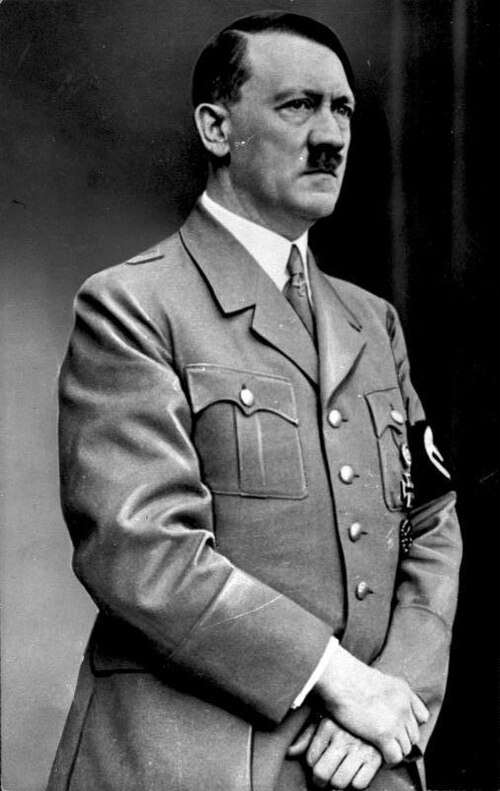

Reich Chancellor; from 1934 Führer and Reich Chancellor · Germany
On the regime page: Nazi Germany
26 quotes, oldest first. Filter with other speakers.
Content note: Antisemitic rhetoric; invokes Christian scripture against Jews. The words are shown as they were said or written. Why
“I would like here to appeal to a greater than I, Count Lerchenfeld. He said in the last session of the Landtag that his feeling ‘as a man and a Christian’ prevented him from being an Anti-Semite. I say: my feeling as a Christian points me to my Lord and Saviour as a fighter. It points me to the man who once in loneliness, surrounded only by a few followers, recognized these Jews for what they were and summoned men to the fight against them and who, God’s truth! was greatest not as sufferer but as fighter. In boundless love as a Christian and as a man I read through the passage which tells us how the Lord at last rose in His might and seized the scourge to drive out of the Temple the brood of vipers and of adders. How terrific was His fight for the world against the Jewish poison to-day, after two thousand years, with deepest emotion I recognize more profoundly than ever before in the fact that it was for this that He had to shed His blood upon the Cross. As a Christian I have no duty to allow myself to be cheated, but I have the duty to be a fighter for truth and justice. And as a man I have the duty to see to it that human society does not suffer the same catastrophic collapse as did the civilization of the ancient world some two thousand years ago—a civilization which was driven to its ruin through this same Jewish people.”
English: Norman H. Baynes (ed.), The Speeches of Adolf Hitler (OUP for the RIIA, 1942). Original-language text not found.
Early speech to a Munich audience, answering a Bavarian politician who had said his feelings as a Christian kept him from antisemitism. Hitler was then a regional party speaker; the National Socialist German Workers' Party had been founded two years earlier.
Speech of 12 April 1922, in Norman H. Baynes (ed.), The Speeches of Adolf Hitler, April 1922 to August 1939, vol. 1 (Oxford University Press for the Royal Institute of International Affairs, 1942), pp. 19-20 Source
Content note: Attributes the big-lie technique to Jews and Marxists. The words are shown as they were said or written. Why
“All this was inspired by the principle - which is quite true in itself - that in the big lie there is always a certain force of credibility; because the broad masses of a nation are always more easily corrupted in the deeper strata of their emotional nature than consciously or voluntarily; and thus in the primitive simplicity of their minds they more readily fall victims to the big lie than the small lie, since they themselves often tell small lies in little matters but would be ashamed to resort to large-scale falsehoods.”
Original (German)
Man ging dabei von dem sehr richtigen Grundsatze aus, daß in der Größe der Lüge immer ein gewisser Faktor des Geglaubtwerdens liegt, daß die breite Masse eines Volkes im tiefsten Grunde ihres Herzens leichter verdorben als bewußt und absichtlich schlecht sein wird, mithin bei der primitiven Einfalt ihres Gemütes einer großen Lüge leichter zum Opfer fällt als einer kleinen, da sie selber ja wohl manchmal im kleinen lügt, jedoch vor zu großen Lügen sich doch zu sehr schämen würde.
English: James Murphy (Hurst and Blackett, 1939)
Passage in the chapter on the causes of Germany's 1918 defeat, where Hitler describes what he says Jewish and Marxist writers did in blaming General Ludendorff. It is the origin of the phrase 'big lie' (große Lüge) in the German text.
Adolf Hitler, Mein Kampf, vol. 1, ch. 10 (Eher Verlag, Munich, 1925); English in Adolf Hitler, Mein Kampf, trans. James Murphy (Hurst and Blackett, London, 1939), p. 185; German in the Eher one-volume edition, 851st-855th printing (1943), pp. 252-253 Source
“The receptive powers of the masses are very restricted, and their understanding is feeble. On the other hand, they quickly forget. Such being the case, all effective propaganda must be confined to a few bare essentials and those must be expressed as far as possible in stereotyped formulas. These slogans should be persistently repeated until the very last individual has come to grasp the idea that has been put forward. If this principle be forgotten and if an attempt be made to be abstract and general, the propaganda will turn out ineffective; for the public will not be able to digest or retain what is offered to them in this way.”
Original (German)
Die Aufnahmefähigkeit der großen Masse ist nur sehr beschränkt, das Verständnis klein, dafür jedoch die Vergeßlichkeit groß. Aus diesen Tatsachen heraus hat sich jede wirkungsvolle Propaganda auf nur sehr wenige Punkte zu beschränken und diese schlagwortartig so lange zu verwerten, bis auch bestimmt der Letzte unter einem solchen Worte das Gewollte sich vorzustellen vermag.
English: James Murphy (Hurst and Blackett, 1939)
Passage in the chapter on the propaganda of the First World War, where Hitler sets out the rules he says effective propaganda must follow. Written in 1924-25 and published in the first volume of Mein Kampf in July 1925.
Adolf Hitler, Mein Kampf, vol. 1, ch. 6 'War Propaganda' (Kriegspropaganda) (Eher Verlag, Munich, 1925); English in Adolf Hitler, Mein Kampf, trans. James Murphy (Hurst and Blackett, London, 1939), p. 148 (page number as printed in the Internet Archive scan); German in the Eher one-volume edition, 855th printing (1943) Source
“The Press is the chief means employed in the process of political ‘enlightenment’. It represents a kind of school for adults. This educational activity, however, is not in the hands of the State but in the clutches of powers which are partly of a very inferior character.”
Original (German)
Sie besorgt in erster Linie diese „Aufklärungsarbeit“ und stellt damit eine Art von Schule für die Erwachsenen dar. Nur liegt dieser Unterricht nicht in der Hand des Staates, sondern in den Klauen von zum Teil höchst minderwertigen Kräften.
English: James Murphy (Hurst and Blackett, 1939)
Passage in Hitler's account of his years in Vienna, on the role of the newspaper press in forming public opinion. The paragraph goes on to describe what he saw of how the press shaped opinion in a few days.
Adolf Hitler, Mein Kampf, vol. 1, ch. 3 (Vienna years: political reflections) (Eher Verlag, Munich, 1925); English in Adolf Hitler, Mein Kampf, trans. James Murphy (Hurst and Blackett, London, 1939); German in the Eher one-volume edition, 855th printing (1943) Source
Content note: Says poison gas should have been used on Jews; genocidal rhetoric. The words are shown as they were said or written. Why
“At the beginning of the War, or even during the War, if twelve or fifteen thousand of these Jews who were corrupting the nation had been forced to submit to poison-gas, just as hundreds of thousands of our best German workers from every social stratum and from every trade and calling had to face it in the field, then the millions of sacrifices made at the front would not have been in vain. On the contrary: If twelve thousand of these malefactors had been eliminated in proper time probably the lives of a million decent men, who would be of value to Germany in the future, might have been saved.”
Original (German)
Hätte man zu Kriegsbeginn und während des Krieges einmal zwölf- oder fünfzehntausend dieser hebräischen Volksverderber so unter Giftgas gehalten, wie Hunderttausende unserer allerbesten deutschen Arbeiter aus allen Schichten und Berufen es im Felde erdulden mußten, dann wäre das Millionenopfer der Front nicht vergeblich gewesen. Im Gegenteil: Zwölftausend Schurken zur rechten Zeit beseitigt, hätten vielleicht einer Million ordentlicher, für die Zukunft wertvoller Deutschen das Leben gerettet.
English: James Murphy (Hurst and Blackett, 1939)
Passage in the second volume, in the chapter on the right of self-defence, about the First World War and the Marxist movement.
Adolf Hitler, Mein Kampf, vol. 2, ch. 15 'Das Notwehrrecht' (Eher Verlag, Munich, 1926); English in Adolf Hitler, Mein Kampf, trans. James Murphy (Hurst and Blackett, London, 1939), vol. 2 ch. XV, p. 518 Source
“Therefore we National Socialists have purposely drawn a line through the line of conduct followed by pre-War Germany in foreign policy. We put an end to the perpetual Germanic march towards the South and West of Europe and turn our eyes towards the lands of the East. We finally put a stop to the colonial and trade policy of pre-War times and pass over to the territorial policy of the future. But when we speak of new territory in Europe to-day we must principally think of Russia and the border States subject to her.”
Original (German)
Damit ziehen wir Nationalsozialisten bewußt einen Strich unter die außenpolitische Richtung unserer Vorkriegszeit. Wir setzen dort an, wo man vor sechs Jahrhunderten endete. Wir stoppen den ewigen Germanenzug nach dem Süden und Westen Europas und weisen den Blick nach dem Land im Osten. Wir schließen endlich ab die Kolonial- und Handelspolitik der Vorkriegszeit und gehen über zur Bodenpolitik der Zukunft. Wenn wir aber heute in Europa von neuem Grund und Boden reden, können wir in erster Linie nur an Rußland und die ihm untertanen Randstaaten denken.
English: James Murphy (Hurst and Blackett, 1939)
Passage setting out the foreign-policy aim of acquiring territory in Eastern Europe, in the chapter on Germany's policy towards Russia. Hitler returns to the argument in later speeches and in the 1937 conference of 5 November (see that entry).
Adolf Hitler, Mein Kampf, vol. 2, ch. 14 'Ostorientierung oder Ostpolitik' (Eher Verlag, Munich, 1926); English in Adolf Hitler, Mein Kampf, trans. James Murphy (Hurst and Blackett, London, 1939), vol. 2 ch. XIV, p. 500 Source
Content note: Threat of retribution against political opponents. The words are shown as they were said or written. Why
“I can assure you that when the National Socialist Movement is victorious in its fight then there will come a National Socialist Court of Justice and November 1918 will then find its retribution and heads will roll.”
English: Norman H. Baynes (ed.), The Speeches of Adolf Hitler (OUP for the RIIA, 1942). Original-language text not found.
Hitler was called as a witness in the trial of three Reichswehr officers charged with Nazi activity, a fortnight after his party won 107 Reichstag seats. Baynes notes that the phrase is often quoted as 'heads will roll on the sand' and that the Frankfurter Zeitung report does not include those last words.
Evidence given at the Leipzig trial of Reichswehr officers, 25 September 1930, as reported in Frankfurter Zeitung, 26 September 1930, in Norman H. Baynes (ed.), The Speeches of Adolf Hitler, April 1922 to August 1939, vol. 1 (Oxford University Press for the Royal Institute of International Affairs, 1942), p. 191 Source
“Similarly, the Reich Government, which regards Christianity as the unshakable foundation of the ethics and morality of the Volk, places great value on friendly relations with the Vatican and attempts to develop them.”
English: Mary Fran Gilbert, in Max Domarus, Hitler: Speeches and Proclamations (Bolchazy-Carducci). Original-language text not found.
Delivered to the Reichstag meeting in the Kroll Opera House two days after the Day of Potsdam, before the vote on the Enabling Act. This section of the speech addresses the churches and foreign relations.
Speech to the Reichstag introducing the Enabling Act, 23 March 1933, in Max Domarus, Hitler: Speeches and Proclamations 1932-1945, vol. 1 (Bolchazy-Carducci, 1990), p. 283
“Finding a reasonable and lasting solution to the problems existing today lies in the interests of all. No new European war would be capable of bringing about anything better in place of the unsatisfactory conditions of the present.”
English: Mary Fran Gilbert, in Max Domarus, Hitler: Speeches and Proclamations (Bolchazy-Carducci). Original-language text not found.
Reply to President Roosevelt's message of 16 May 1933 to heads of state on disarmament, delivered to the Reichstag and broadcast. It came during the Geneva disarmament conference, four months after Hitler became Chancellor.
Reichstag speech of 17 May 1933 (the 'peace speech'), in Max Domarus, Hitler: Speeches and Proclamations 1932-1945, vol. 1 (Bolchazy-Carducci, 1990), p. 327
Content note: Justifies extrajudicial killings. The words are shown as they were said or written. Why
“Although only a few days before I had been prepared to exercise clemency, at this hour there was no place for any such consideration. Mutinies are suppressed in accordance with laws of iron which are eternally the same. If anyone reproaches me and asks why I did not resort to the regular courts of justice for conviction of the offenders, then all that I can say to him is this: in this hour I was responsible for the fate of the German people, and thereby I became the supreme Justiciar of the German people!”
English: Norman H. Baynes (ed.), The Speeches of Adolf Hitler (OUP for the RIIA, 1942). Original-language text not found.
Hitler's public account to the Reichstag of the killings of 30 June to 2 July 1934, in which SA leaders and other people were shot without trial. The German is 'oberster Gerichtsherr', as Baynes notes.
Speech to the Reichstag, 13 July 1934, in Norman H. Baynes (ed.), The Speeches of Adolf Hitler, April 1922 to August 1939, vol. 1 (Oxford University Press for the Royal Institute of International Affairs, 1942), p. 321 Source
“This Reich stands, and it is building itself up for the future upon its youth. And this new Reich will give its youth to no one, but will itself take youth and give to youth its own education and its own upbringing.”
English: Norman H. Baynes (ed.), The Speeches of Adolf Hitler (OUP for the RIIA, 1942). Original-language text not found.
May Day address to young people in Berlin. Baynes cites a press report of 3 May 1937 and notes that the claim raised difficulties for the Catholic Church.
Speech to German youth, Berlin, 1 May 1937, in Norman H. Baynes (ed.), The Speeches of Adolf Hitler, April 1922 to August 1939, vol. 1 (Oxford University Press for the Royal Institute of International Affairs, 1942), p. 549 Source
“The aim of German policy was to make secure and to preserve the racial community [Volksmasse] and to enlarge it. It was therefore a question of space.”
English: Documents on German Foreign Policy 1918-1945, Series D, vol. 1 (US Government Printing Office, 1949). Original-language text not found.
Hitler addressed the War Minister, the army, navy and air force commanders and the Foreign Minister in a closed meeting, and asked that his statements be treated as his 'last will and testament'. The minutes were written five days later by Colonel Hossbach from memory and notes.
Minutes of the conference in the Reich Chancellery of 5 November 1937 (the Hossbach Memorandum, dated 10 November 1937), in Documents on German Foreign Policy 1918-1945, Series D, vol. 1: From Neurath to Ribbentrop (US Government Printing Office, 1949) Source
“Germany's problem could only be solved by means of force and this was never without attendant risk.”
English: Documents on German Foreign Policy 1918-1945, Series D, vol. 1 (US Government Printing Office, 1949). Original-language text not found.
Said in the same closed meeting, after Hitler had described the need for living space. He went on to set out three possible cases for action against Austria and Czechoslovakia.
Minutes of the conference in the Reich Chancellery of 5 November 1937 (the Hossbach Memorandum, dated 10 November 1937), in Documents on German Foreign Policy 1918-1945, Series D, vol. 1: From Neurath to Ribbentrop (US Government Printing Office, 1949) Source
“And now before us stands the last problem that must be solved and will be solved. It is the last territorial claim which I have to make in Europe, but it is the claim from which I will not recede and which, God willing, I will make good.”
English: Norman H. Baynes (ed.), The Speeches of Adolf Hitler (OUP for the RIIA, 1942). Original-language text not found.
Delivered during the Sudeten crisis, days before the Munich Agreement of 29-30 September 1938 ceded the Sudetenland to Germany. German troops entered Prague on 15 March 1939 and Bohemia and Moravia became a Protectorate.
Speech in the Sportpalast, Berlin, 26 September 1938, in Norman H. Baynes (ed.), The Speeches of Adolf Hitler, April 1922 to August 1939, vol. 2 (Oxford University Press for the Royal Institute of International Affairs, 1942), p. 1517 Source
Content note: Antisemitic threat of annihilation. The words are shown as they were said or written. Why
“To-day I will once more be a prophet: If the international Jewish financiers in and outside Europe should succeed in plunging the nations once more into a world war, then the result will not be the bolshevization of the earth, and thus the victory of Jewry, but the annihilation of the Jewish race in Europe!”
Original (German)
Ich will heute wieder ein Prophet sein: Wenn es dem internationalen Finanzjudentum in- und außerhalb Europas gelingen sollte, die Völker noch einmal in einen Weltkrieg zu stürzen, dann würde das Ergebnis nicht die Bolschewisierung der Erde und damit der Sieg des Judentums sein, sondern die Vernichtung der jüdischen Rasse in Europa.
English: Norman H. Baynes (ed.), The Speeches of Adolf Hitler (OUP for the RIIA, 1942)
Delivered on the sixth anniversary of Hitler becoming Chancellor, in a long speech mostly about foreign and economic policy. The sentences that follow in the speech link 'annihilation' to the effect of German and Italian propaganda; Hitler cited the passage again in speeches in 1941, 1942 and 1943.
Reichstag speech, Berlin, 30 January 1939 (authorized English translation), in Norman H. Baynes (ed.), The Speeches of Adolf Hitler, April 1922 to August 1939, vol. 1 (Oxford University Press for the Royal Institute of International Affairs, 1942), pp. 740-741; German as printed on holocaust-chronologie.de from the Reichstag text Source
“I shall give a propagandists cause for starting the war — never mind whether it be plausible or not. The victor shall not be asked, later on, whether we told the truth or not. In starting and making a war, not the Right is what matters but Victory.”
English: Office of United States Chief of Counsel, translation of Nuremberg document 1014-PS. Original-language text not found.
Hitler addressed the Wehrmacht commanders-in-chief and army group and army commanders at the Obersalzberg on 22 August 1939, nine days before the invasion of Poland. The text is a participant's record, offered at Nuremberg with two others from the same day.
'Second speech by the Fuehrer on 22 Aug 1939', document 1014-PS, in Office of United States Chief of Counsel for Prosecution of Axis Criminality, Nazi Conspiracy and Aggression (US Government Printing Office, 1946), vol. 3, p. 665
Content note: Order to kill civilians; reference to the Armenian genocide. The words are shown as they were said or written. Why
“Our strength is in our quickness and our brutality. Ghengis Khan had millions of women and children killed by his own will and with a gay heart. History sees only in him a great state builder. What weak Western European civilization thinks about me does not matter. I have given the order and will have every one shot, who utters even one word of criticism that the aim of the war is not to attain certain lines, but consists in the physical destruction of the opponent. Thus for the time being I have sent to the East only my "Death's Head Units" with the order to kill without pity or mercy all men, women, and children of Polish race or language. Only in such a way will we win the vital space that we need. Who still talks nowadays of the extermination of the Armenians ?”
English: Office of United States Chief of Counsel, translation of document L-3. Original-language text not found.
Version of Hitler's address of 22 August 1939 to military commanders, passed by a source to the American journalist Louis Lochner and put before the Nuremberg tribunal as L-3. The tribunal did not admit it into evidence.
'Contents of Hitler's talk to the Supreme Commander and Commanding Generals, Obersalzberg, 22-8-39', document L-3 (Louis Lochner's version), in Office of United States Chief of Counsel for Prosecution of Axis Criminality, Nazi Conspiracy and Aggression (US Government Printing Office, 1946), vol. 7, pp. 752-754
Disputed. The Nuremberg tribunal admitted 798-PS and 1014-PS but not L-3. Neither 798-PS nor 1014-PS contains an Armenians sentence; 1014-PS has 'Destruction of Poland in the foreground. The aim is elimination of living forces' and 'Have no pity. Brutal attitude.' Historians differ on how far the L-3 wording reproduces what was said. The spelling 'Ghengis' and the space before the question mark are as printed.
“This night for the first time Polish regular soldiers fired on our territory. Since 5.45 A.M. we have been returning the fire, and from now on bombs will be met by bombs.”
Original (German)
Polen hat heute nacht zum erstenmal auf unserem eigenen Territorium auch mit bereits regulären Soldaten geschossen. Seit 5.45 Uhr wird jetzt zurückgeschossen! Und von jetzt ab wird Bombe mit Bombe vergolten!
English: English translation as published by the Avalon Project, Yale Law School (translator not named on the page)
Delivered to the Reichstag on the morning German forces invaded Poland. The 'Polish attacks' on German territory that the speech cites were staged by the SS, as documented at Nuremberg and in later research.
Address to the Reichstag, 1 September 1939, Avalon Project text; German from the DNB text in Max Domarus, Hitler: Reden und Proklamationen, vol. 3, as reproduced at emersonkent.com Source
Content note: Authorises the killing of disabled and sick people. The words are shown as they were said or written. Why
“Reichsleiter Bouhler and Dr. Brandt, M.D. are charged with the responsibility of enlarging the authority of certain physicians to be designated by name in such a manner that persons who, according to human judgment, are incurable can, upon a most careful diagnosis of their condition of sickness, be accorded a mercy death.”
English: Office of United States Chief of Counsel, translation of Nuremberg document 630-PS. Original-language text not found.
Short authorisation signed by Hitler and addressed to the head of his Chancellery (Philipp Bouhler) and his physician (Karl Brandt). It was the written basis for the 'Aktion T4' programme, under which about 70,000 psychiatric patients and disabled people were killed in 1940-41.
Letter on Hitler's private letterhead dated 1 September 1939 (signed in October 1939 and dated back to the first day of the war), document 630-PS, in Office of United States Chief of Counsel for Prosecution of Axis Criminality, Nazi Conspiracy and Aggression (US Government Printing Office, 1946), vol. 3, p. 451
Content note: War of annihilation against the Soviet Union and Communists. The words are shown as they were said or written. Why
“Struggle of two ideologies. Scathing condemnation of Bolshevism: equals social criminality; Communism immense danger to the future. We must distance ourselves from the idea of soldierly good fellowship. A communist is not a comrade, neither before nor afterwards. It is a matter of a struggle of annihilation. If we do not see it this way, then we will still defeat the enemy, but the Communist enemy will confront us again in thirty years. We are not waging war in order to preserve the enemy.”
English: Mary Fran Gilbert, in Max Domarus, Hitler: Speeches and Proclamations (Bolchazy-Carducci). Original-language text not found.
Hitler spoke for about two and a half hours to senior officers about the planned invasion of the Soviet Union, which began on 22 June 1941. The words survive in the notes of the Chief of the Army General Staff, General Halder.
Hitler's address to generals and commanders, 30 March 1941, as noted in Franz Halder's diary entry of that day, quoted in Max Domarus, Hitler: Speeches and Proclamations 1932-1945, vol. 4 (Bolchazy-Carducci, 2004), p. 2393
Content note: Antisemitic characterisation of the enemy. The words are shown as they were said or written. Why
“Therefore, the hour has now come in which it has become necessary to oppose this conspiracy of the Jewish-Anglo-Saxon warmongers and likewise the Jewish ruling powers in the Bolshevik control station at Moscow.”
English: Mary Fran Gilbert, in Max Domarus, Hitler: Speeches and Proclamations (Bolchazy-Carducci). Original-language text not found.
Public proclamation issued on the day German forces invaded the Soviet Union, setting out Hitler's reasons for ending the German-Soviet pact of 1939.
Proclamation to the German People, 22 June 1941, in Max Domarus, Hitler: Speeches and Proclamations 1932-1945, vol. 4 (Bolchazy-Carducci, 2004), p. 2451
Content note: Public statement announcing the annihilation of the Jews. The words are shown as they were said or written. Why
“We are fully aware that this war can end either in the extermination of the Aryan people or in the disappearance of Jewry from Europe. I said as much before the German Reichstag on September 1, 1939. I wish to avoid making hasty prophesies, but this war will not end as the Jews imagine, namely, in the extermination of the European-Aryan people; instead, the result of this war will be the annihilation of Jewry. For the first time, the old, truly Jewish rule of “an eye for an eye, a tooth for a tooth,” will obtain.”
English: Mary Fran Gilbert, in Max Domarus, Hitler: Speeches and Proclamations (Bolchazy-Carducci). Original-language text not found.
Delivered ten days after the Wannsee Conference and seven weeks after the German declaration of war on the United States, at a time when mass killings of Jews were under way in occupied Soviet territory and at Chelmno.
Speech in the Sportpalast on the ninth anniversary of the seizure of power, 30 January 1942, in Max Domarus, Hitler: Speeches and Proclamations 1932-1945, vol. 4 (Bolchazy-Carducci, 2004), p. 2574
Content note: Public statement threatening and predicting the destruction of Jews. The words are shown as they were said or written. Why
“At the Reichstag session of September 1, 1939, I said two things: First, since this war was forced on us, neither the power of arms nor time will defeat us. Second, should Jewry instigate an international world war in order to exterminate the Aryan people of Europe, then not the Aryan people will be exterminated, but the Jews.” The wire-pullers of this insane man in the White House have managed to pull one nation after another into this war. Correspondingly, however, a wave of anti-Semitism swept over one nation after another. And it will continue to do so, taking hold of one state after another. Every state that enters this war will one day emerge from it as an anti-Semitic state. The Jews once laughed about my prophecies in Germany. I do not know whether they are still laughing today or whether they no longer feel like laughing. Today, too, I can assure you of one thing: they will soon not feel like laughing anymore anywhere. My prophecies will prove correct here, too.”
English: Mary Fran Gilbert, in Max Domarus, Hitler: Speeches and Proclamations (Bolchazy-Carducci). Original-language text not found.
Public speech opening the Winter Relief campaign, delivered during the German offensive towards Stalingrad and the Caucasus, while deportations of Jews to extermination camps were under way. Hitler here refers back to his earlier public statements about Jews.
Speech in the Sportpalast opening the Winter Relief Campaign, 30 September 1942, in Max Domarus, Hitler: Speeches and Proclamations 1932-1945, vol. 4 (Bolchazy-Carducci, 2004), pp. 2678-2680
Content note: Order to kill captured soldiers. The words are shown as they were said or written. Why
“From now on all enemies on so-called Commando missions in Europe or Africa challenged by German troops, even if they are to all appearances soldiers in uniform or demolition troops, whether armed or unarmed, in battle or in flight, are to be slaughtered to the last man.”
English: Office of United States Chief of Counsel, translation of Nuremberg document 498-PS. Original-language text not found.
Secret order issued after Allied raiding parties operated in occupied Europe, distributed in twelve copies to the armed forces. It directed that captured commandos be killed rather than treated as prisoners of war.
Fuehrer order no. 003830/42 g.Kdos. OKW/WFSt of 18 October 1942 (the Commando Order), document 498-PS, in Office of United States Chief of Counsel for Prosecution of Axis Criminality, Nazi Conspiracy and Aggression (US Government Printing Office, 1946), vol. 3, p. 416
Content note: Antisemitic blame for the war. The words are shown as they were said or written. Why
“It is untrue that I or anyone else in Germany wanted the war in 1939. It was desired and instigated exclusively by those international statesmen who were either of Jewish descent or worked for Jewish interests.”
Original (German)
Es ist unwahr, dass ich oder irgendjemand anderer in Deutschland den Krieg im Jahre 1939 gewollt haben. Er wurde gewollt und angestiftet ausschliesslich von jenen internationalen Staatsmännern, die entweder jüdischer Herkunft waren oder für jüdische Interessen arbeiteten.
English: Office of United States Chief of Counsel, translation of Nuremberg document 3569-PS
Dictated hours before Hitler's marriage to Eva Braun and the day before he and she died by suicide, as Soviet forces fought in Berlin. It is the first part of two documents (a personal will and a political testament).
'My political Testament', 29 April 1945 4:00 a.m., document 3569-PS, in Office of United States Chief of Counsel for Prosecution of Axis Criminality, Nazi Conspiracy and Aggression (US Government Printing Office, 1946), vol. 6, p. 260; German as printed in Werner Maser, Hitlers Briefe und Notizen (Düsseldorf, 1973), via ns-archiv.de Source
Content note: Final antisemitic charge to successors. The words are shown as they were said or written. Why
“Above all I charge the leaders of the nation and those under them to scrupulous observance of the laws of race and to merciless opposition to the universal poisoner of all peoples, international Jewry.”
Original (German)
Vor allem verpflichte ich die Führung der Nation und die Gefolgschaft zur peinlichen Einhaltung der Rassegesetze und zum unbarmherzigen Widerstand gegen den Weltvergifter aller Völker, das internationale Judentum.
English: Office of United States Chief of Counsel, translation of Nuremberg document 3569-PS
Final sentence of the political testament, addressed to the successor government named in the second part of the document (Dönitz as President, Goebbels as Chancellor).
'My political Testament', 29 April 1945, document 3569-PS, in Office of United States Chief of Counsel for Prosecution of Axis Criminality, Nazi Conspiracy and Aggression (US Government Printing Office, 1946), vol. 6, p. 263; German as printed in Werner Maser, Hitlers Briefe und Notizen (Düsseldorf, 1973), via ns-archiv.de Source
Often attributed, not verified
These words circulate under Adolf Hitler’s name but could not be traced to a source. They are listed so readers can check them, not as Adolf Hitler’s words.
“Make the lie big, make it simple, keep saying it, and eventually they will believe it.”
Not found in Murphy's 1939 translation of Mein Kampf, Baynes's Speeches of Adolf Hitler (vols 1-2) or Domarus. The nearest real text is the 'big lie' passage in Mein Kampf vol. 1 ch. 10 (included in this file), which is a different wording and describes what Hitler says his opponents did.
“What luck for rulers that men do not think.”
Not found in Murphy's Mein Kampf (1939), Baynes vols 1-2 or Domarus's Speeches and Proclamations. No primary text located; often listed without citation.
“I want to raise a generation of young people devoid of a conscience, imperious, relentless and cruel.”
Not found in Baynes, Domarus or Mein Kampf. It comes from Rauschning's reconstructed conversations with Hitler, which most historians regard as unreliable or partly invented, so it is not treated as a verified quotation.
“Who, after all, speaks today of the annihilation of the Armenians?”
This is the wording most often quoted. It does not appear in Nuremberg documents 798-PS or 1014-PS. The English in document L-3 (Nazi Conspiracy and Aggression vol. 7, p. 753) reads 'Who still talks nowadays of the extermination of the Armenians ?' and is included above as disputed. The Tribunal did not admit L-3.