Wilhelm II
Illustration, not an archive object
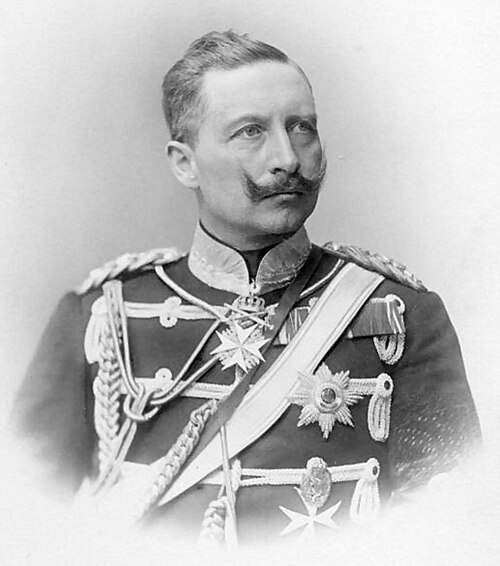

German Emperor and King of Prussia · Germany
On the regime page: German Empire under Wilhelm II
19 quotes, oldest first. Filter with other speakers.
Content note: Order to shoot own relatives, including parents. The words are shown as they were said or written. Why
“Recruits! You have now sworn loyalty to me before this consecrated servant of God and in front of this altar. You are still too young to understand the true meaning of what has just been spoken, but for now strive to always follow the rules and teachings you have been given. You have sworn loyalty to me, which – children of my Guards – means you are now my soldiers, you have committed yourselves to me body and soul; there is for you only one enemy, and that is my enemy. Given the current subversive activities of the socialists, it could happen that I order you to shoot down your own kin, brothers, indeed, parents – God forbid it should come to pass – but even then you must follow my orders without grumbling.”
Original (German)
Rekruten! Ihr habt jetzt vor dem geweihten Diener Gottes und angesichts dieses Altars Mir Treue geschworen. Ihr seid noch zu jung, um die wahre Bedeutung des eben Gesprochenen zu verstehen; aber befleißigt euch zunächst, daß ihr die gegebenen Vorschriften und Lehren immer befolgt. Ihr habt Mir Treue geschworen, das – Kinder Meiner Garde – heißt, ihr seid jetzt Meine Soldaten, ihr habt euch Mir mit Leib und Seele ergeben; es giebt für euch nur einen Feind, und der ist Mein Feind. Bei den jetzigen socialistischen Umtrieben kann es vorkommen, daß Ich euch befehle, eure eignen Verwandten, Brüder, ja Eltern niederzuschießen – was ja Gott verhüten möge –, aber auch dann müßt ihr Meine Befehle ohne Murren befolgen.
English: Thomas Dunlap, in German History in Documents and Images (GHDI)
Wilhelm addressed recruits of the Guards regiments at their swearing-in at Potsdam. Two newspaper versions of the speech survive (the Breslauer Lokalanzeiger of 8 December 1891 and the Neisser Zeitung); this is the Neisser Zeitung wording.
Wilhelm II, address to recruits of the Guards, Potsdam, 1891 (Neisser Zeitung version), in Ernst Johann, Reden des Kaisers. Ansprachen, Predigten und Trinksprüche Wilhelms II (Munich, 1966), pp. 55-56 Source
“I express my sincere congratulations that you and your people, without appealing to friendly powers for help, by dint of your own vigor, have been able to restore the peace against the armed hordes that invaded your country as disturbers of the peace, and to preserve the independence of the country against outside attacks.”
Original (German)
Ich spreche Ihnen Meinen aufrichtigen Glückwunsch aus, daß es Ihnen, ohne an die Hülfe befreundeter Mächte zu appellieren, mit Ihrem Volke gelungen ist, in eigener Tatkraft gegenüber den bewaffneten Scharen, welche als Friedensstörer in Ihr Land eingebrochen sind, den Frieden wieder herzustellen und die Unabhängigkeit des Landes gegen Angriffe von außen zu wahren.
English: Thomas Dunlap, in German History in Documents and Images (GHDI)
Sent after the failure of the Jameson Raid into the Transvaal. The telegram was published in the British press and caused a strong reaction in Britain.
Telegram from Wilhelm II to President Paul Kruger of the South African Republic, 3 January 1896, in Johannes Lepsius et al., eds., Die Große Politik der europäischen Kabinette 1871-1914, vol. 11 (Berlin, 1922-27), pp. 31-32 Source
Content note: Order to give no quarter and take no prisoners; ethnic contempt. The words are shown as they were said or written. Why
“When you encounter him, know this: no quarter will be given. Prisoners will not be taken. Exercise your arms such that for a thousand years no Chinese will dare to look cross-eyed at a German.”
Original (German)
Kommt ihr an ihn, so wißt: Pardon wird nicht gegeben. Gefangene werden nicht gemacht. Führt eure Waffen so, daß auf tausend Jahre hinaus kein Chinese mehr es wagt, einen Deutschen scheel anzusehen.
English: Thomas Dunlap, in German History in Documents and Images (GHDI)
Wilhelm spoke without a manuscript to troops departing to suppress the Boxer uprising in China, after the killing of the German envoy Clemens von Ketteler. The Foreign Office issued an edited version that omitted the passage quoted in the next entry.
Wilhelm II, address to troops of the East Asian Expeditionary Corps, Bremerhaven, 27 July 1900 (version issued by the Foreign Office), in Johannes Penzler, ed., Die Reden Kaiser Wilhelms II, vol. 2 (Leipzig, n.d.), pp. 209-12 Source
Content note: Order to give no quarter and take no prisoners; ethnic contempt. The words are shown as they were said or written. Why
“Should you encounter the enemy, he will be defeated! No quarter will be given! Prisoners will not be taken! Whoever falls into your hands is forfeited. Just as a thousand years ago the Huns under their King Attila made a name for themselves, one that even today makes them seem mighty in history and legend, may the name German be affirmed by you in such a way in China that no Chinese will ever again dare to look cross-eyed at a German.”
Original (German)
Kommt Ihr vor den Feind, so wird derselbe geschlagen! Pardon wird nicht gegeben! Gefangene werden nicht gemacht! Wer euch in die Hände fällt, sei euch verfallen! Wie vor tausend Jahren die Hunnen unter ihrem König Etzel sich einen Namen gemacht, der sie noch jetzt in Überlieferung und Märchen gewaltig erscheinen läßt, so möge der Name Deutscher in China auf 1000 Jahre durch euch in einer Weise bestätigt werden, daß es niemals wieder ein Chinese wagt, einen Deutschen scheel anzusehen!
English: Thomas Dunlap, in German History in Documents and Images (GHDI)
The unofficial wording, from press reports of 29 July 1900, is the one that gave the speech its name. It was not in the Foreign Office text. Wilhelm spoke without notes and the wording varies between reports.
Wilhelm II, address at Bremerhaven, 27 July 1900 (unofficial but, per GHDI, correct wording of the key passage), reprinted in Manfred Görtemaker, Deutschland im 19. Jahrhundert (Opladen, 1996; Schriftenreihe der Bundeszentrale für politische Bildung, vol. 274), p. 357 Source
Content note: Refers to a colonial war later classed as genocide. The words are shown as they were said or written. Why
“Their great sacrifices have not been made in vain. The latest dispatches reporting the defeat of the Witboi give us reason to hope that peace and order will be quickly restored in the sorely tried protectorates. Now our goal must be to make the re-conquered land profitable again.”
Original (German)
Die großen Opfer sind nicht umsonst gemacht worden. Die letzten Meldungen über die Unterwerfung der Witboi berechtigen uns zu der Hoffnung auf die baldige Wiederherstellung von Friede und Ordnung in dem schwer geprüften Schutzgebiete. Es gilt nun, den aufs neue erkämpften Boden fruchtbringend zu bereiten,
English: Adam Blauhut, in German History in Documents and Images (GHDI)
The speech opened the Reichstag session during the Herero and Nama war in German South West Africa and unrest in German East Africa. In it Wilhelm thanked the colonial troops.
Speech from the throne opening the Reichstag, Berlin, 28 November 1905, in Johannes Penzler, ed., Die Reden Kaiser Wilhelms II, vol. 3: 1901-Ende 1905 (Leipzig, n.d.), p. 289 Source
““You English,” he said, “are mad, mad, mad as March hares. What has come over you that you are so completely given over to suspicions quite unworthy of a great nation? What more can I do than I have done? I declared with all the emphasis at my command, in my speech at Guildhall, that my heart is set upon peace, and that it is one of my dearest wishes to live on the best of terms with England. Have I ever been false to my word? Falsehood and prevarication are alien to my nature. My actions ought to speak for themselves, but you listen not to them but to those who misinterpret and distort them. That is a personal insult which I feel and resent. To be forever misjudged, to have my repeated offers of friendship weighed and scrutinized with jealous, mistrustful eyes, taxes my patience severely. I have said time after time that I am a friend of England, and your press – or, at least, a considerable section of it – bids the people of England refuse my proffered hand and insinuates that the other holds a dagger. How can I convince a nation against its will?””
The Daily Telegraph printed the text as a communication from a source of "unimpeachable authority", reporting a long conversation with the Emperor. His remarks on British policy angered the British public and discredited him with many Germans.
Interview with Wilhelm II, The Daily Telegraph (London), 28 October 1908, reprinted in Louis L. Snyder, ed., Documents of German History (New Brunswick: Rutgers University Press, 1958), pp. 296-300 Source
““But, you will say, what of the German navy? Surely, that is a menace to England ! Against whom but England are my squadrons being prepared? If England is not in the minds of those Germans who are bent on creating a powerful fleet, why is Germany asked to consent to such new and heavy burdens of taxation? My answer is clear. Germany is a young and growing empire. She has a worldwide commerce which is rapidly expanding, and to which the legitimate ambition of patriotic Germans refuses to assign any bounds. Germany must have a powerful fleet to protect that commerce and her manifold interests in even the most distant seas. She expects those interests to go on growing, and she must be able to champion them manfully in any quarter of the globe. Her horizons stretch far away. She must be prepared for any eventualities in the Far East. Who can foresee what may take place in the Pacific in the days to come, days not so distant as some believe, but days, at any rate, for which all European Powers with Far Eastern interests ought steadily to prepare? Look at the accomplished rise of Japan; think of the possible national awakening of China; and then judge of the vast problems of the Pacific. Only those Powers which have great navies will be listened to with respect, when the future of the Pacific comes to be solved; and, if for that reason only, Germany must have a powerful fleet. It may even be that England herself will be glad that Germany has a fleet when they speak together on the same side in the great debates of the future.””
In the same interview the Emperor addressed British concern over the German battle fleet and linked its size to German trade and to the Pacific.
Interview with Wilhelm II, The Daily Telegraph (London), 28 October 1908, reprinted in Louis L. Snyder, ed., Documents of German History (New Brunswick: Rutgers University Press, 1958), pp. 296-300 Source
Content note: Call for military action against Serbia. The words are shown as they were said or written. Why
“The Serbs must be disposed of, and that right soon!”
Original (German)
Mit den Serben muß aufgeräumt werden, und zwar bald.
English: English edition of the Kautsky documents: Outbreak of the World War (Oxford University Press, New York, 1924)
Written in the margin of the diplomatic report about talks with Austro-Hungarian officials after the Sarajevo assassination. In the same report the ambassador said he had advised against hasty steps against Serbia.
Marginal note by Wilhelm II on Ambassador Tschirschky's report from Vienna of 30 June 1914, in Outbreak of the World War: German Documents Collected by Karl Kautsky, ed. Max Montgelas and Walther Schücking (New York: Oxford University Press, 1924), no. 7; German text in Die deutschen Dokumente zum Kriegsausbruch 1914, ed. Max Montgelas and Walter Schücking (Berlin: Deutsche Verlagsgesellschaft für Politik und Geschichte, 1919/1927), no. 7 Source
Content note: Contempt for the British. The words are shown as they were said or written. Why
“England reveals herself in her true colors at a moment when she thinks that we are caught in the toils and, so to speak, disposed of! That common crew of shopkeepers has tried to trick us with dinners and speeches.”
Original (German)
England dekouvriert sich im Moment wo es der Ansicht ist, daß wir im Lappjagen eingestellt sind und so zu sagen erledigt! Das gemeine Krämergesindel hat uns mit Diners und Reden zu täuschen versucht.
English: English edition of the Kautsky documents: Outbreak of the World War (Oxford University Press, New York, 1924)
Lichnowsky reported a warning from the British Foreign Secretary, Sir Edward Grey, that Britain might intervene if France were drawn into a war. Wilhelm's comment was written on the telegram in the following days; the edition prints it as an annotation.
Marginal note by Wilhelm II on Ambassador Lichnowsky's telegram no. 178 from London of 29 July 1914, in Outbreak of the World War: German Documents Collected by Karl Kautsky, ed. Max Montgelas and Walther Schücking (New York: Oxford University Press, 1924), no. 368; German text in Die deutschen Dokumente zum Kriegsausbruch 1914, ed. Max Montgelas and Walter Schücking (Berlin: Deutsche Verlagsgesellschaft für Politik und Geschichte, 1919/1927), no. 368 Source
“This is more than one could have expected! A great moral victory for Vienna; but with it every reason for war drops away”
Original (German)
Das ist mehr als man erwarten konnte! Ein großer moralischer Erfolg für Wien; aber damit fällt jeder Kriegsgrund fort
English: English edition of the Kautsky documents: Outbreak of the World War (Oxford University Press, New York, 1924)
Wilhelm read the Serbian reply to the Austro-Hungarian ultimatum on 28 July 1914. His note was added to the document; the edition refers to a letter from the Emperor of 28 July, 10 a.m. (no. 293).
Marginal note by Wilhelm II on the Serbian reply to the Austro-Hungarian ultimatum, 28 July 1914, in Outbreak of the World War: German Documents Collected by Karl Kautsky, ed. Max Montgelas and Walther Schücking (New York: Oxford University Press, 1924), no. 271; German text in Die deutschen Dokumente zum Kriegsausbruch 1914, ed. Max Montgelas and Walter Schücking (Berlin: Deutsche Verlagsgesellschaft für Politik und Geschichte, 1919/1927), no. 271 Source
“Edward VII is stronger after his death than am I who am still alive!”
Original (German)
Edward VII. ist nach seinem Tode noch stärker als ich, der ich lebe!
English: English edition of the Kautsky documents: Outbreak of the World War (Oxford University Press, New York, 1924)
Wilhelm wrote a long marginal comment on a diplomatic report on the evening of 30 July 1914, blaming Britain, Russia and France for the crisis. The comment was read by the Chancellor, the Foreign Secretary and Zimmermann on 1 August.
Marginal note by Wilhelm II on Ambassador Pourtalès's telegram from St Petersburg, evening of 30 July 1914, in Outbreak of the World War: German Documents Collected by Karl Kautsky, ed. Max Montgelas and Walther Schücking (New York: Oxford University Press, 1924), no. 401; German text in Die deutschen Dokumente zum Kriegsausbruch 1914, ed. Max Montgelas and Walter Schücking (Berlin: Deutsche Verlagsgesellschaft für Politik und Geschichte, 1919/1927), no. 401 Source
“England, Russia and France have agreed among themselves—after laying the foundation of the casus foederis for us through Austria— to take the Austro-Serbian conflict for an excuse for waging a war of extermination against us.”
Original (German)
England, Rußland u. Frankreich haben sich verabredet — unter zu Grunde Legung des casus foederis für uns Österreich gegenüber — den Österreichisch-Serb. Konflikt zum Vorwand nehmend gegen uns den Vernichtungskrieg zu führen.
English: English edition of the Kautsky documents: Outbreak of the World War (Oxford University Press, New York, 1924)
Part of the same marginal comment as the Edward VII entry. The Emperor set out his view that the Triple Entente had planned war against Germany.
Marginal note by Wilhelm II on Ambassador Pourtalès's telegram from St Petersburg, evening of 30 July 1914, in Outbreak of the World War: German Documents Collected by Karl Kautsky, ed. Max Montgelas and Walther Schücking (New York: Oxford University Press, 1924), no. 401; German text in Die deutschen Dokumente zum Kriegsausbruch 1914, ed. Max Montgelas and Walter Schücking (Berlin: Deutsche Verlagsgesellschaft für Politik und Geschichte, 1919/1927), no. 401 Source
“I thank all of you for the love and loyalty that you have shown me these past days. These were serious days like none before them. Should there be battle, all political parties will cease to exist! I, too, have been attacked by one party or another. That was in times of peace. It is now forgiven with all my heart. I no longer think in terms of parties or confessions; today we are all German brothers and only German brothers. If our neighbors want it no other way, if our neighbors do not grant us peace, then I hope to God that our good German sword will emerge victorious from this hard battle.”
Original (German)
Ich danke euch für alle Liebe und Treue, die ihr Mir in diesen Tagen erwiesen habt. Sie waren ernst, wie keine vorher! Kommt es zum Kampf, so hören alle Parteien auf! Auch Mich hat die eine oder die andere Partei wohl angegriffen. Das war in Friedenszeiten. Ich verzeihe es heute von ganzem Herzen! Ich kenne keine Parteien und auch keine Konfessionen mehr; wir sind heute alle deutsche Brüder und nur noch deutsche Brüder. Will unser Nachbar es nicht anders, gönnt er uns den Frieden nicht, so hoffe Ich zu Gott, daß unser gutes deutsches Schwert siegreich aus diesem schweren Kampfe hervorgeht.
English: Jeffrey Verhey, in German History in Documents and Images (GHDI)
Wilhelm spoke to a crowd outside the palace on the day Germany ordered mobilization and declared war on Russia. The speech is the origin of the phrase about no longer recognising parties.
Address from the balcony of the Royal Palace, Berlin, 1 August 1914, in Kriegs-Rundschau I, p. 43, reprinted in Wolfdieter Bihl, ed., Deutsche Quellen zur Geschichte des Ersten Weltkrieges (Darmstadt, 1991), p. 49 Source
“No lust of conquest drives us on; we are inspired by the unalterable will to protect the place in which God has set us for ourselves and all coming generations.”
English: English text from the Frankfurter Zeitung as printed in Christian Gauss, ed., The German Emperor as Shown in His Public Utterances (Charles Scribner's Sons, New York, 1915). Original-language text not found.
The Kaiser opened the special wartime session of the Reichstag after Germany had declared war on Russia and France. The speech presented the war as defensive and was followed the same day by the war credits vote.
Address opening the Reichstag, Berlin, 4 August 1914, in Christian Gauss, ed., The German Emperor as Shown in His Public Utterances (New York: Charles Scribner's Sons, 1915), p. 326 (English text taken from the Frankfurter Zeitung; the volume notes there was no official edition) Source
“But now they want to humiliate us. They demand that we stand by with folded arms and watch our enemies prepare for a treacherous attack. They will not tolerate our standing in resolute loyalty to our ally, who is fighting for its status as a great power and whose humiliation would also mean the loss of our own authority and honor. The sword must now decide. In the midst of peace, the enemy attacks us. Therefore, to arms! Any wavering, any hesitation would be treason against the fatherland. The very existence of our empire, which our fathers re-established, is at stake. The very existence of German power and the German spirit is at stake. We will defend ourselves to the last breath of man and horse. And we will prevail in this struggle, even against a world of enemies.”
Original (German)
Nun aber will man uns demütigen. Man verlangt, daß wir mit verschränkten Armen zusehen, wie unsere Feinde sich zu tückischem Überfall rüsten. Man will nicht dulden, daß wir in entschlossener Treue zu unserem Bundesgenossen stehen, der um sein Ansehen als Großmacht kämpft und mit dessen Erniedrigung auch unsere Macht und Ehre verloren ist. Es muß denn das Schwert nun entscheiden. Mitten im Frieden überfällt uns der Feind. Darum auf zu den Waffen! Jedes Schwanken, jedes Zögern wäre Verrat am Vaterlande. Um Sein oder Nichtsein unseres Reiches handelt es sich, das unsere Väter sich neu gründeten. Um Sein oder Nichtsein deutscher Macht und deutschen Wesens. Wir werden uns wehren bis zum letzten Hauch von Mann und Roß. Und wir werden diesen Kampf bestehen, auch gegen eine Welt von Feinden.
English: English text on German History in Documents and Images (GHDI); translator not named on the page
The proclamation was issued after the German declarations of war on Russia and France and the British entry into the war. GHDI reproduces the text from a recording that Wilhelm made on 10 January 1918.
Wilhelm II, Aufruf des Kaisers an das deutsche Volk (proclamation "To the German people"), 6 August 1914; recording made 10 January 1918, Stiftung Deutsches Rundfunkarchiv (DRA) Source
“Given the colossal achievements of the whole people in this terrible war, I am convinced that there is no room any longer for the three-class franchise system in Prussia. Furthermore, the proposed bill is to provide for the direct and secret election of deputies.”
Original (German)
Nach den gewaltigen Leistungen des ganzen Volkes in diesem furchtbaren Kriege ist nach meiner Überzeugung für das Klassenwahlrecht in Preußen kein Raum mehr. Der Gesetzentwurf wird ferner die unmittelbare und geheime Wahl der Abgeordneten vorzusehen haben.
English: Jeffrey Verhey and Roger Chickering, in German History in Documents and Images (GHDI)
Issued after the February Revolution in Russia and during growing pressure in Germany for constitutional change. It promised reform of the Prussian three-class franchise after the war.
Erlass of Wilhelm II to Chancellor Bethmann Hollweg, 7 April 1917 ("Easter Message"), in F. Purlitz, ed., Der europäische Krieg in aktenmäßiger Darstellung: Deutscher Geschichtskalender, vol. 6 (Leipzig, 1919), pp. 768ff, reprinted in Ernst Rudolf Huber, Dokumente zur deutschen Verfassungsgeschichte, vol. 2 (Stuttgart, 1961), pp. 467-68 Source
“I cannot bring myself to dismiss this propaganda by branding it with catchwords such as "a piece of rascality," etc., since it constitutes an achievement which, in spite of its repugnant nature, cannot be ignored; it did us more harm than the arms in the hands of our opponents.”
English: Thomas R. Ybarra (Harper & Brothers, New York, 1922). Original-language text not found.
Wilhelm's own account of Allied wartime propaganda, written in exile.
The Kaiser's Memoirs, 1888-1918, English translation by Thomas R. Ybarra (New York: Harper & Brothers, 1922), chapter 14, "The Question of Guilt", p. 332 (on British wartime propaganda) Source
“I went, or — to put it much more correctly — I was overthrown by my own Government, and — Herr Solf remained.”
English: Thomas R. Ybarra (Harper & Brothers, New York, 1922). Original-language text not found.
Wilhelm's own account of the events of October and November 1918 and his departure from Germany, written in exile.
The Kaiser's Memoirs, 1888-1918, English translation by Thomas R. Ybarra (New York: Harper & Brothers, 1922), p. 277 (on November 1918) Source
Often attributed, not verified
These words circulate under Wilhelm II’s name but could not be traced to a source. They are listed so readers can check them, not as Wilhelm II’s words.
“Press, Jews & Mosquitoes ... are a nuisance that humanity must get rid of in some way or another. I believe the best would be gas!”
The letter, its date and its gist are confirmed by Röhl himself in the Frankfurter Allgemeine Zeitung of 1 October 2019 (German rendering: Juden und Mücken müssten vernichtet werden, "Ich glaube das Beste wäre Gas!") and by Karina Urbach, "Useful idiots: the Hohenzollerns and Hitler", Historical Research 93 (2020), who cites Röhl, Die Zeit, 25 November 1994. The sources I could open give three different wordings, and I did not see the English text of the letter itself (Poultney Bigelow papers, New York Public Library), so no exact wording is published here.
“Ich kenne keine Parteien mehr, ich kenne nur noch Deutsche.”
The recorded wording found in GHDI (Kriegs-Rundschau I, p. 43) is the 1 August 1914 balcony speech: "Ich kenne keine Parteien und auch keine Konfessionen mehr; wir sind heute alle deutsche Brüder und nur noch deutsche Brüder." The Frankfurter Zeitung wording in Gauss (1915), p. 324, differs again. The 4 August Reichstag speech text in Gauss (1915), pp. 325-327, does not contain the phrase. The compressed form was not seen in a primary text.
“exterminate first the treacherous English and walk over General French's contemptible little Army”
The wording is known from a British printing issued with Routine Orders of 24 September 1914 (Imperial War Museum, item 1502015887). No German-language original of such an order has been located, and the sources I searched give none.