- Techniques
- Fear appealCard stacking
In one line: in the Second World War the US government told Americans that a hidden enemy was listening; since 2010 it has asked them to watch for and report "suspicious activity". Both keep a hidden threat in view without saying how common it is.
The shared technique: Fear appeal, with Card stacking. The archive's definition of a fear appeal: "Imminent harm is staged so the audience accepts the offered protection without comparing base rates or alternatives." Card-stacking applies because both campaigns show the threat but leave out the numbers a reader would need to judge it.
How strong is this match? This is the mildest pair on these pages. The wartime posters show a menacing enemy; the modern campaign mostly shows icons and a neutral list. It is included because the two share a structure (a hidden threat, every citizen responsible, no base rate), and it is stated here so the reader can judge the match.
| Then | Now | |
|---|---|---|
| The item | Posters such as He's Watching You | If You See Something, Say Something signs, videos and infographics |
| When | 1942 | Created for New York's MTA in 2002; national DHS campaign from 2010; this infographic about 2018 |
| Who | U.S. government home-front campaigns | U.S. Department of Homeland Security, licensing the MTA's slogan |
| Government at the time | Franklin D. Roosevelt (Democratic) | Launched nationally under Barack Obama (Democratic); continued under later administrations of both parties |
| What it asks | Stay silent: don't talk about your work | Speak up: report suspicious activity to police |
| What was going on | A declared world war with real enemy espionage cases | The long campaign against terrorism after 11 September 2001 |
Then: He's Watching You (U.S., 1942)
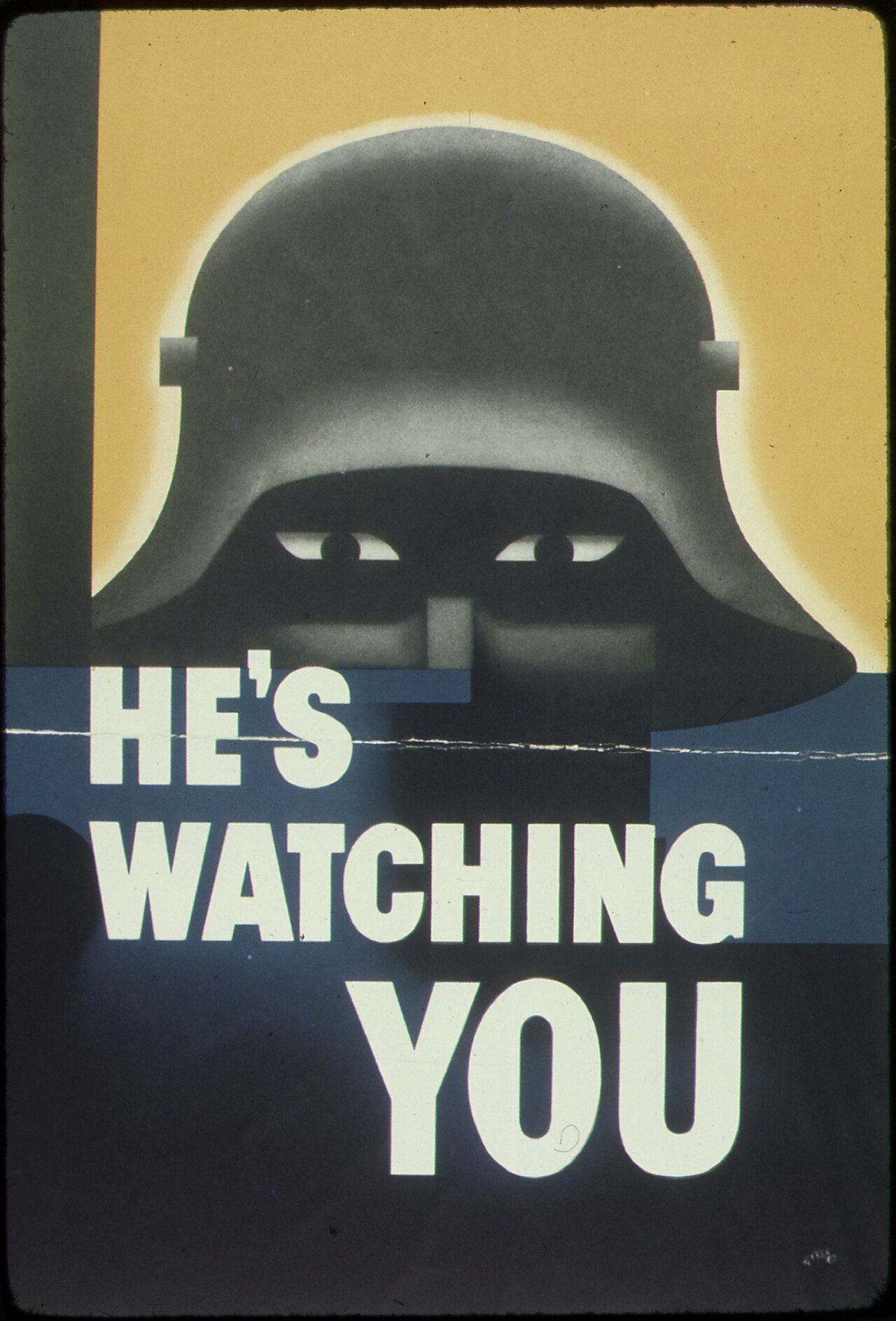
He's Watching You. U.S. government, 1942. Public domain.
A German helmet with glaring eyes looms over the words "He's watching you." No unit, place or evidence is given; the enemy is simply everywhere.
What was going on. The United States had entered the war in December 1941. The FBI had broken up a German spy network, the Duquesne ring, in 1941, and German saboteurs landed on the East Coast in June 1942. Posters urged workers and families not to discuss ship movements or war production.
How the technique shows. The threat is real in general but shown as constant and personal, with no sense of scale, so any conversation feels dangerous.
Now: If You See Something, Say Something (U.S., 2010s)
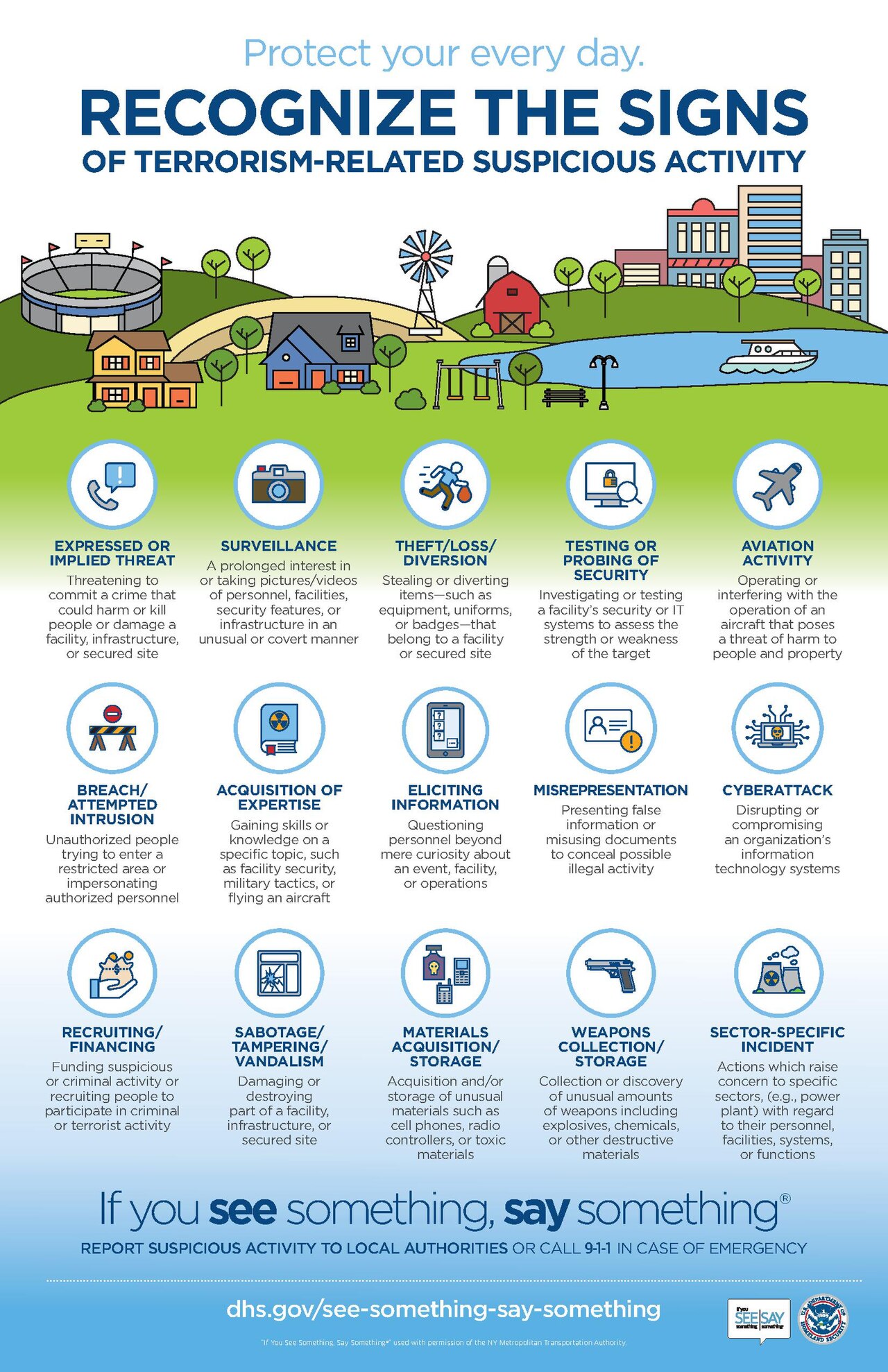
Recognize the Signs of Terrorism-Related Suspicious Activity ("If You See Something, Say Something"). U.S. Department of Homeland Security infographic. Public domain. The slogan is a registered trademark of New York's Metropolitan Transportation Authority, used by DHS with permission.
The infographic, headed "Protect your every day", lists fifteen "signs of terrorism-related suspicious activity", from "expressed or implied threat" to "eliciting information", and asks people to report them to local authorities. In 2010 DHS spread the campaign to transit systems, sports venues, hotels, malls and hundreds of Walmart stores, together with the Justice Department's Nationwide Suspicious Activity Reporting Initiative.
What was going on. After the 11 September attacks, US security policy leaned heavily on public vigilance. The campaign's partners ranged from Amtrak and the Mall of America to professional sports leagues.
How the technique shows. The campaign makes a rare threat feel present in ordinary places ("your every day") and offers one action, reporting, without saying how often reports lead to anything. A 2008 New York Times review, reported by Gothamist, found that of the 1,944 calls to New York police the previous year, 18 led to arrests and none of those were for terrorism.
Where they are alike
- A government keeps a hidden threat visible in daily life.
- Every citizen is made responsible for security.
- Neither gives the reader a sense of how likely the threat is.
Where they differ
- Silence or speech. The wartime posters asked people to say less. The modern campaign asks them to report more, into police databases, which raises different civil-liberties questions.
- The enemy. The 1942 poster shows a German soldier. The modern campaign names no group and shows no enemy face.
- Context. 1942 was a declared war with documented enemy spies on US soil. The modern campaign runs during an open-ended counter-terrorism effort against rare but real attacks.
- Tone. The wartime poster is menacing. The modern infographic is calm and informational, which is why this is the weakest match on these pages.
Positions on the record
- DHS describes the campaign as raising public awareness of the indicators of terrorism and terrorism-related crime, and says reports have helped investigations.
- Critics across the spectrum, including the libertarian magazine Reason and the American Civil Liberties Union, have argued that such campaigns generate large numbers of low-value reports and can encourage profiling.
Same-method test
Any government's vigilance campaign that keeps a threat in view without giving its scale, whether against spies, terrorists or criminals, would be scored the same way here. A campaign that says how common the threat is and what reports have led to would not.
How to spot it
- Ask how often the threat actually occurs, and whether the message says.
- Ask what happens to reports, and how many led to anything.
- Notice whether "suspicious" is defined by behaviour or left to the viewer's assumptions.
Sources
- National Archives, Powers of Persuasion: He's Watching You.
- FBI, Duquesne Spy Ring.
- U.S. Department of Homeland Security, If You See Something, Say Something: About the campaign.
- CNN, Homeland Security teams up with Walmart for safety, December 2010.
- Gothamist, 'See Something, Say Something': A Post-9/11 Experiment in Citizen Policing Endures (summarising the 2008 New York Times findings).
- Reason, Ten Years of 'If You See Something, Say Something', March 2012.
- Wikimedia Commons, DHS seesomethingsaysomething indicatorinfographic.pdf.
Images
| Image | Source | Licence |
|---|---|---|
| He's Watching You (1942) | FRAME gallery | Public domain (U.S. government work) |
| DHS "Recognize the signs" infographic | FRAME gallery, from Wikimedia Commons | Public domain (U.S. government work); slogan trademarked by the MTA |
Image gaps
- MTA subway posters from 2002 onward. Some are on Wikimedia Commons under CC BY 2.0 and could be added to the gallery later.