- Techniques
- Card stackingGlittering generalities
In one line: on Monday 23 June 1941, a US territorial daily led with an Associated Press account of the declaration of war and a second banner about Japan, while a Soviet provincial daily printed Molotov's radio address across its upper half. Both are shown as printed; the conditions under which they were produced differed, as set out below.
The facts. German forces attacked the Soviet Union on 22 June 1941 (Operation Barbarossa). Molotov, then Deputy Chairman of the Council of People's Commissars and People's Commissar for Foreign Affairs, broadcast the Soviet government's announcement at about midday Moscow time. Italy declared war on the USSR the same day, and on 22–23 June Finland was claiming neutrality, as the American page reports.
The shared definitions. Both pages are tagged against the archive's definitions, quoted here from the archive's technique list, and the same definition is applied to each:
- Card stacking: "Select, omit, or order facts so the remaining pile can only be read one way."
- Glittering generalities: "Virtue words (freedom, security, the people, science) used as substitutes for a testable claim."
| United States | Soviet Union | |
|---|---|---|
| The paper | The Daily Alaska Empire, Juneau, Alaska Territory; a member of the Associated Press | Сталинское знамя (Stalin's Banner), Ryazan; organ of the oblast and city committees of the Party and of the Soviets |
| Who issued it | A privately owned daily, wire-fed | A Party-and-Soviet organ, the paper of the local authorities |
| Date | Monday 23 June 1941 (No. 8758) | Monday 23 June 1941 (No. 146) |
| Government at the time | Roosevelt administration; the US was not at war | Stalin government (Stalin was Chairman of the Council of People's Commissars from May 1941); the USSR was at war from 22 June |
| Source of the news | Associated Press, with datelines from London, Shanghai, Tokyo, Vichy and Washington | The government's own statement (Molotov's address, with decrees of the Presidium of the Supreme Soviet) |
The United States: The Daily Alaska Empire, 23 June 1941
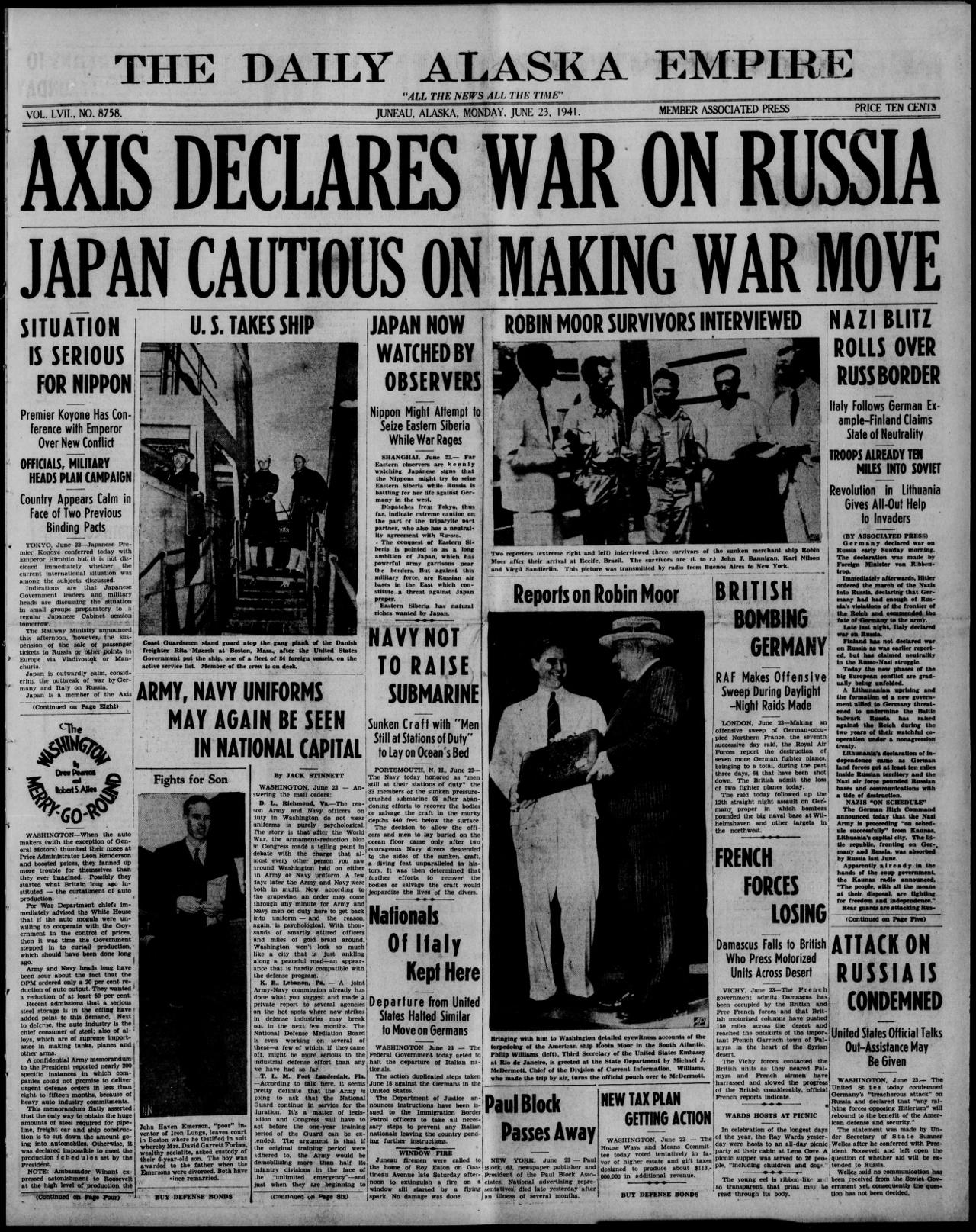
The Daily Alaska Empire, 'AXIS DECLARES WAR ON RUSSIA' front page, 23 June 1941. Front page, Library of Congress, Chronicling America (Alaska State Library Historical Collections). No known restrictions.
Headlines as printed. "AXIS DECLARES WAR ON RUSSIA" over "JAPAN CAUTIOUS ON MAKING WAR MOVE". Beneath them: "NAZI BLITZ ROLLS OVER RUSS BORDER", "TROOPS ALREADY TEN MILES INTO SOVIET" and "ATTACK ON RUSSIA IS CONDEMNED".
What the page does. The Associated Press lead attributes the declaration of war to the German Foreign Minister and reports Hitler's order to march, in Hitler's stated terms ("violations of the frontier of the Reich"). The page carries two further stories about Japan, one of them in the second-largest type on the page, a US Government statement condemning the attack, and, in the lower left, a photograph and report about the seizure of a Danish freighter in Boston.
How the definitions apply. Under the card-stacking definition, the ordering matters: the second banner and the left-hand column are about whether Japan would also move, which is the question that bore most directly on an Alaska readership (that is an inference from placement and story count; the page does not state its reasons). The Soviet-side account of events is not on the page, because the page has no Soviet-sourced text. The page's statements of fact are attributed to the Associated Press and to named officials.
The Soviet Union: Сталинское знамя, 23 June 1941
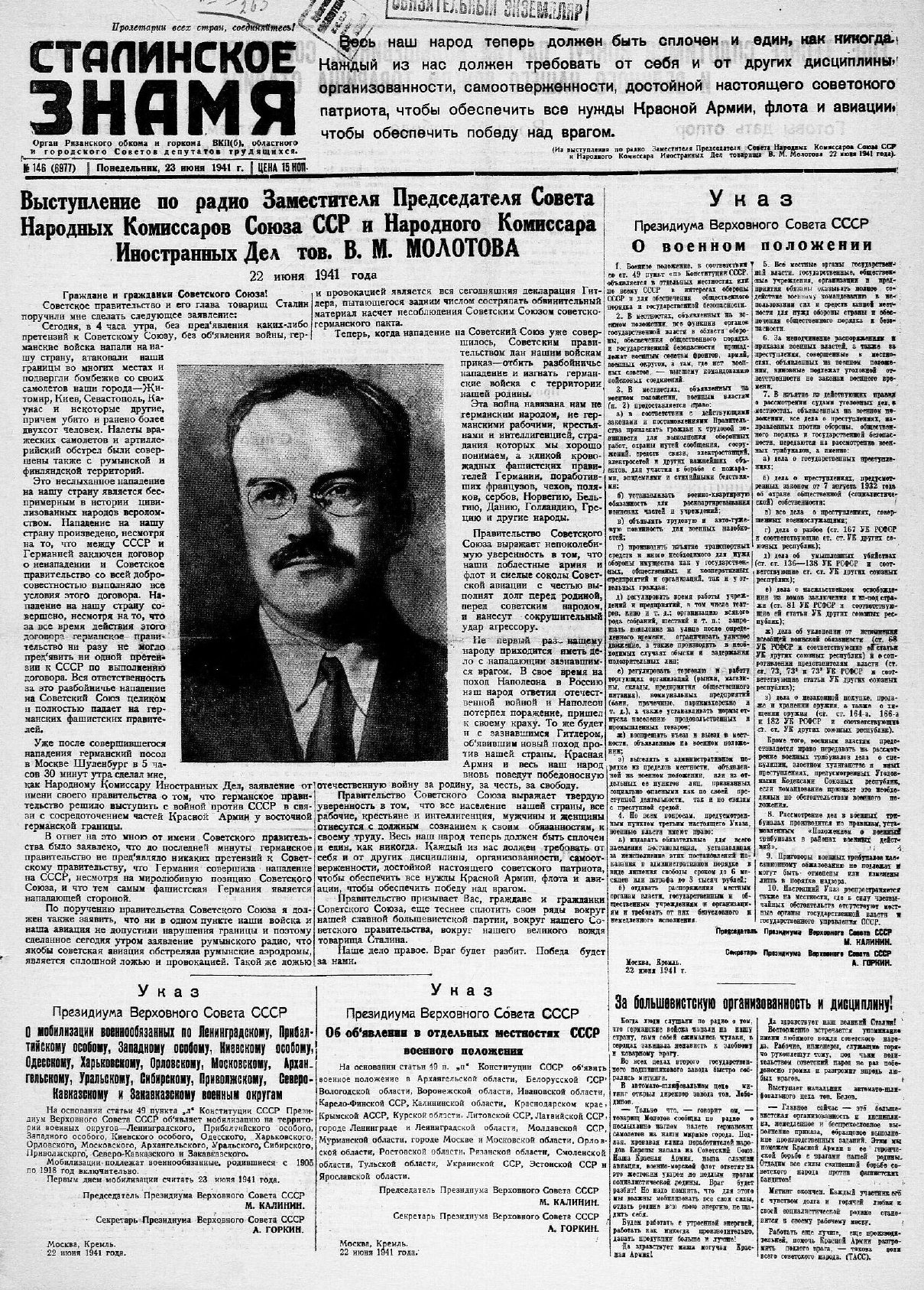
Сталинское знамя (Stalin's Banner), Ryazan, front page with Molotov's radio address, 23 June 1941. Front page, Ryazan Regional Universal Scientific Library (digitised volume), via Wikimedia Commons. Public domain (basis cited on the Commons file page).
Headlines as printed. "Выступление по радио Заместителя Председателя Совета Народных Комиссаров Союза ССР и Народного Комиссара Иностранных Дел тов. В. М. Молотова, 22 июня 1941 года" ("Radio address of the Deputy Chairman of the Council of People's Commissars of the USSR and People's Commissar for Foreign Affairs, Comrade V. M. Molotov, 22 June 1941"). The strapline over the masthead reads "Весь наш народ теперь должен быть сплочен и един, как никогда" ("Our whole people must now be united and as one as never before"). The address closes: "Наше дело правое. Враг будет разбит. Победа будет за нами." ("Our cause is just. The enemy will be defeated. Victory will be ours.") Two decrees of the Presidium, on martial law and on mobilisation, share the page.
What the page does. It presents the government's account in the government's words: the attack came "без предъявления каких-либо претензий... без объявления войны" ("without any claims presented... without a declaration of war"), and the troops had been ordered "отбить разбойничье нападение" ("to repel the bandit attack"). It then turns to what each reader is to do: be united, disciplined and self-sacrificing, "worthy of a true Soviet patriot".
How the definitions apply. Under the glittering-generalities definition, the strapline and the closing sentences use virtue words ("united", "discipline", "self-sacrifice", "just") as the request itself; none is a testable claim. Under the card-stacking definition, the page contains only the official statement and the decrees, with no other account, and it says nothing about the 1939 Soviet-German pact beyond Molotov's statement that the Soviet Union had fulfilled it "with complete good faith"; the secret protocols to that pact were not published by the Soviet government until 1989.
Where they differ
- Source and control. The Alaska paper compiled wire reports from several countries and, in the US in June 1941, was not under wartime censorship. The Ryazan paper was an organ of the ruling Party's local committee and carried the official text, in a one-party state where the press was under Party control and the page printed the official text.
- Position in the war. The Alaska page is written by a neutral country's press, with the US still outside the war; the Ryazan page is written by a state that was under attack and mobilising.
- What is asked of the reader. The Alaska page asks nothing; it informs. The Ryazan page asks for unity and sacrifice, and prints decrees that took effect at once.
Where they are alike
- Each page leads with the invasion and the official responses to it, and each selects and orders what it prints.
Sources
- Library of Congress, Chronicling America: The Daily Alaska Empire, 23 June 1941
- Ryazan Regional Universal Scientific Library: Сталинское знамя, June 1941 (PDF)
- Wikimedia Commons file page for the Ryazan front page
_s01.jpg)
Image gaps: no German, Italian, Finnish or Japanese front page of 22–23 June 1941 could be cleared for hosting.