In one line: Hitler's chapters on propaganda in Mein Kampf and the ministry Joseph Goebbels ran from March 1933 turned a stated theory of mass persuasion into a single state authority over press, radio, film and the arts, and supplied the best-known modern case of accusing an enemy of the "big lie".
Content note. This page quotes and describes antisemitic texts and propaganda as they were written and used. They are shown as historical evidence.
The source
Full text in this archive: Mein Kampf (German, 1943 printing of the 1925/26 text), with a content note and the edition caveat on its page.
- Adolf Hitler, Mein Kampf, vol. 1 (Munich: Franz Eher, 1925): chapter 6, "Kriegspropaganda" (War Propaganda), and chapter 10, "Ursachen des Zusammenbruchs" (Causes of the Collapse). English translations by James Murphy (London: Hurst and Blackett, 1939) and Ralph Manheim (Boston: Houghton Mifflin, 1943).
- Decree establishing the Reich Ministry for Public Enlightenment and Propaganda, 13 March 1933, signed by Reich President Paul von Hindenburg and Reich Chancellor Adolf Hitler.
- Leonard W. Doob, "Goebbels' Principles of Propaganda", Public Opinion Quarterly 14, no. 3 (Fall 1950): 419-442, a set of nineteen principles Doob derived from the Goebbels diaries.
- Joseph Goebbels, "Aus Churchills Lügenfabrik" (From Churchill's Lie Factory), dated 12 January 1941, reprinted in Die Zeit ohne Beispiel (Munich: Zentralverlag der NSDAP, 1941), 364-369; English translation by Randall Bytwerk in the German Propaganda Archive.
- Language: German originals; English translations as listed.
- Rights on this archive: the 1925 German text of Mein Kampf is in the US public domain, but the English translations quoted and the post-1930 works (Goebbels 1941, Doob 1950, Bytwerk) are in copyright or of uncertain status. All are summarised with short quotations.
Context
Hitler wrote volume 1 of Mein Kampf after the failed Munich putsch of November 1923, drawing lessons from the German defeat of 1918. Like many German nationalists, he held that Allied propaganda had helped break German morale while German official propaganda had failed. Joseph Goebbels, NSDAP Gauleiter of Berlin from 1926 and head of party propaganda from 1930, ran the party's election campaigns before 1933.
Hitler became chancellor on 30 January 1933. After the Reichstag election of 5 March, the cabinet created a new ministry on 13 March with Goebbels as minister. The decree gave it responsibility for "enlightening and propagandizing" the population about the government's policy of national reconstruction. The party used the word "propaganda" openly and without negative sense in the ministry's own name.
Content note: Studio portrait of Joseph Goebbels in uniform with a swastika armband. This object is shown as it was published. Why 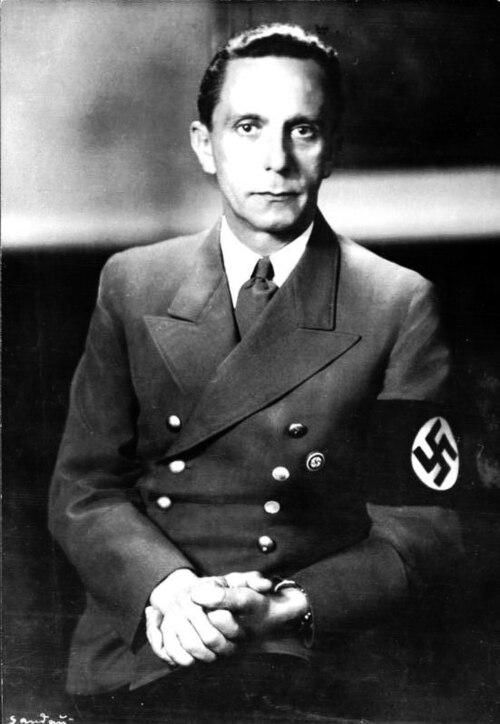
Joseph Goebbels, Reich Minister for Public Enlightenment and Propaganda, studio portrait dated 1942 in the Bundesarchiv catalogue. Photo by Sandau, ADN-ZB archive. Bundesarchiv, Bild 183-1989-0821-502, CC BY-SA 3.0 DE.
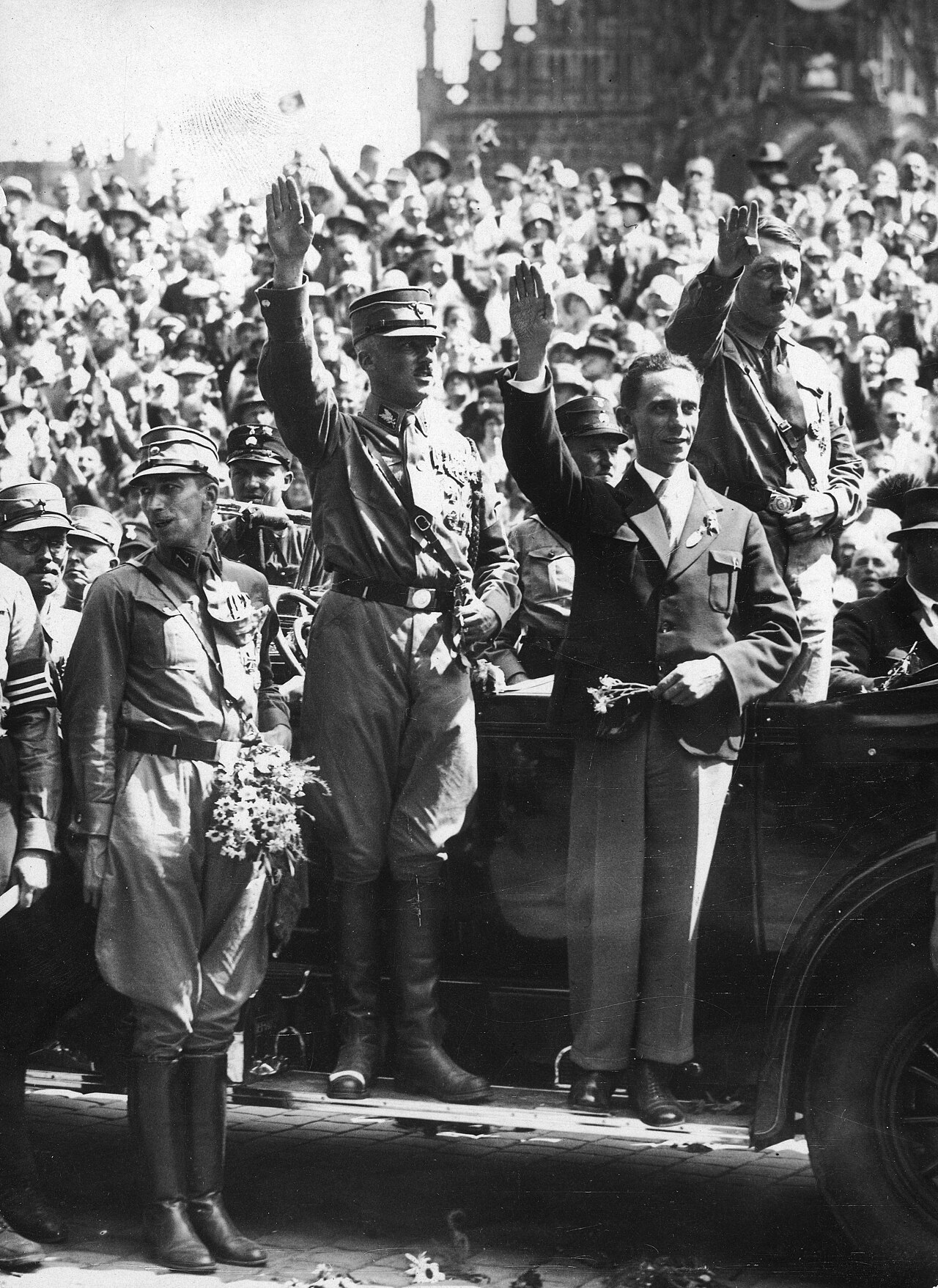
Adolf Hitler, Joseph Goebbels and SA commander Franz Pfeffer von Salomon salute a crowd from an open car at the Nuremberg rally, 1-4 August 1929. Photo by Robert Sennecke, published by Internationaler Illustrations-Verlag, October 1929; held by the Narodowe Archiwum Cyfrowe (Polish National Digital Archive), marked with a Public Domain Mark. First published in 1929, the photograph entered the U.S. public domain on 1 January 2025 under the 95-years-from-publication rule.
What it says
Propaganda is for the mass, and must be simple and repeated. In the War Propaganda chapter Hitler writes: "The receptivity of the great masses is very limited, their intelligence is small, but their power of forgetting is enormous." He concludes that effective propaganda keeps to a few points repeated as slogans.
Propaganda is one-sided by design. The same chapter argues that propaganda should not weigh the opponent's case or admit part of the blame, and credits British and US wartime propaganda with presenting the enemy as wholly guilty. He faults German wartime propaganda for doing the opposite.
The "big lie" is attributed to Jews. In chapter 10 Hitler describes the big lie as a method of his enemies, writing that "in the big lie there is always a certain force of credibility", because the masses more readily fall for a large lie than a small one. He assigns this method to Jews and to Marxists, whom he blames for Germany's defeat and for the charge that Germany caused the war.
One authority for all communication. The 1933 decree and the laws that followed placed press, radio, film, theatre, music, literature and fine arts under the ministry. Doob's second principle states this as Goebbels's view: propaganda must be planned and directed by one authority that issues all directives and oversees other agencies whose actions have propaganda effects.
Truth is decided by credibility. Doob's seventh principle reads: "Credibility alone must determine whether propaganda output should be true or false." Bytwerk notes that in public Goebbels always maintained that propaganda had to be truthful; the principle as Doob states it treats truth as a question of what would be believed.
Hatred is given a target. Doob's eighteenth principle reads: "Propaganda must facilitate the displacement of aggression by specifying the targets for hatred."
Doob's nineteen principles, in summary. In this archive's paraphrase, Doob's list covers the following. Goebbels relied on current intelligence about events and public opinion; wanted one authority to plan all propaganda and to weigh the propaganda effect of every policy; and shaped, withheld or released material to influence enemy decisions. He judged whether to answer enemy propaganda, whether to censor, and whether to reuse enemy material case by case, and he used black (unattributed or falsely attributed) output where white output would be less credible. He used prestigious leaders as speakers, attended closely to timing and to repetition short of fatigue, and labelled people and events with easily learned slogans that drew on feelings the audience already had and could not easily be turned back on their user. For the home front he avoided raising hopes that events might dash, aimed to keep fear of the consequences of defeat high while reducing other anxieties, prepared the public for expected setbacks, and offered action or distraction where attitudes were too strong to change directly.
How it worked in practice
- The ministry (from 13 March 1933). Goebbels took office the next day. He set out the ministry's tasks in speeches of 15 and 25 March 1933 (translated in German History in Documents and Images).
- Reich Press Conference (from 1 July 1933). Selected press representatives received daily instructions at the ministry on what to report and how. The prewar directives are published in NS-Presseanweisungen der Vorkriegszeit, ed. Hans Bohrmann and Gabriele Toepser-Ziegert (7 vols, 1984-2001).
- Reich Chamber of Culture Law (22 September 1933). It created chambers for literature, theatre, music, film, radio, fine arts and the press. Membership was required to work in these fields, and proof of "Aryan" descent and political reliability was required for membership, which excluded Jews and political opponents.
- Editors Law (4 October 1933). Editors had to be registered; the registers excluded Jews and people married to Jews.
- The Volksempfänger. The VE 301 "people's receiver", designed by Otto Griessing at Goebbels's request, was presented at the Berlin radio exhibition on 18 August 1933 at a subsidised 76 Reichsmarks, about half the price of the cheapest sets then on sale.
- Film and the pogrom of November 1938. The ministry supervised the feature film Jud Süß (1940) and the pseudo-documentary Der ewige Jude (1940), both antisemitic. On the evening of 9 November 1938 Goebbels's speech to party leaders in Munich preceded the nationwide pogrom against Jews.
- Accusing the British of the big lie (1941). In "Aus Churchills Lügenfabrik" Goebbels writes: "The English follow the principle that when one lies, one should lie big, and stick to it."
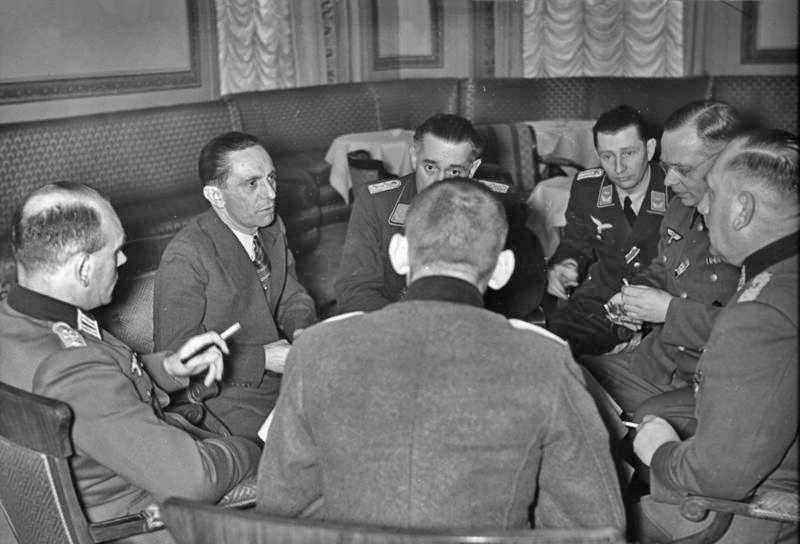
Goebbels receives the chiefs of the propaganda companies of the three Wehrmacht branches, Berlin, 28 January 1941. Photographer not recorded. Bundesarchiv, Bild 183-B00548, CC BY-SA 3.0 DE.
Content note: Photograph of a Nazi rally in the Berlin Sportpalast with swastika banners and a 'total war' slogan. This object is shown as it was published. Why 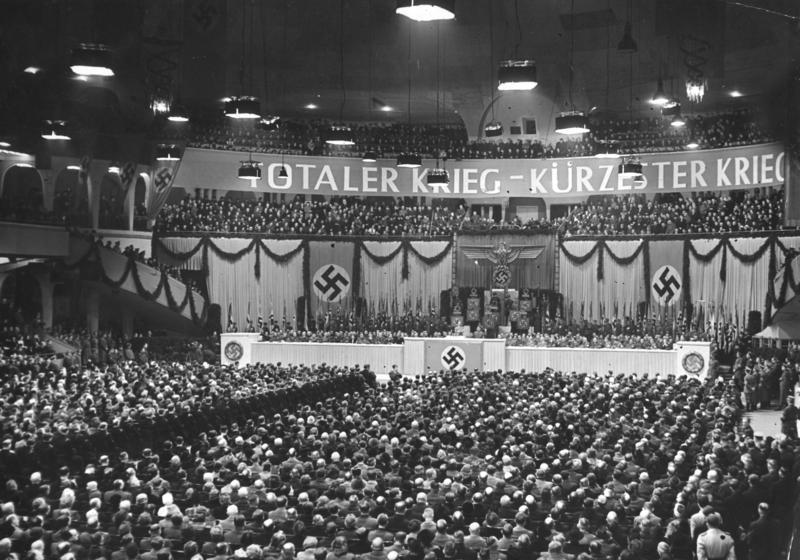
Mass rally in the Berlin Sportpalast, 18 February 1943, where Goebbels gave his "total war" speech. The banner reads "Totaler Krieg – Kürzester Krieg" (Total war, shortest war). Photo by Schwahn. Bundesarchiv, Bild 183-J05235, CC BY-SA 3.0 DE.
Techniques in this archive's taxonomy
- Accusation in a mirror: Hitler attributes the big lie to Jews in the same book that calls for one-sided, repeated propaganda; Goebbels in 1941 charges the British with lying big while directing an apparatus built on the directives above.
- Scapegoating: Doob's eighteenth principle names the method, and the ministry's film and press output assigned blame for Germany's defeat and crises to Jews.
- Fear appeal: Doob's sixteenth principle describes keeping fear of the consequences of defeat high on the home front.
- Name-calling: Doob's fourteenth principle describes labelling people and events with slogans chosen to trigger existing responses.
- Card stacking: the daily press directives set which items appeared, which were withheld and how they were framed.
Reception and criticism
- Nazi self-description. The ministry's name joined "enlightenment" and "propaganda"; officials presented both as legitimate state tasks.
- Leonard Doob, a Yale psychologist who had worked in US wartime propaganda, presents the principles as a reconstruction from the diaries, not a document Goebbels wrote.
- On the "big lie" quotation. Randall Bytwerk, in "False Nazi Quotations" and "Goebbels Didn't Say It", reports that the popular line "If you tell a lie big enough and keep repeating it, people will eventually come to believe it" has no located source in Goebbels's writings or speeches. He points to Hitler's chapter 10 and to the 1941 article, in both of which the big lie is charged to opponents.
- Ian Kershaw (The "Hitler Myth", 1987) traces how the image of Hitler as leader was built and received. David Welch (The Third Reich: Politics and Propaganda, 1993) supports Kershaw's thesis and argues that propaganda worked best where it reinforced existing values, since it had to preach to the partially converted.
Same-standard note
Hitler's own model was Allied propaganda of 1914-1918 (see Arthur Ponsonby, Falsehood in War-Time (1928) and Harold D. Lasswell, Propaganda Technique in the World War (1927)), and the same technique ids apply to it. Britain's Ministry of Information (1939) and the US Office of War Information (1942) also centralised wartime messaging, but they worked alongside elected legislatures and a press that stayed privately owned, and did not bar Jews from professions; the German ministry was created in peacetime and worked together with legal exclusion and state violence against Jews. The mirror accusation recurs elsewhere, for example in Rwanda in 1994, the setting of the studies from which this archive's taxonomy takes the term. For the contemporaneous Soviet apparatus, see Lenin and the Communist Party of the Soviet Union, the agitprop model (1902-1991).
Sources
- Adolf Hitler, Mein Kampf, vol. 1 (Munich: Franz Eher, 1925), chs. 6 and 10; trans. James Murphy (London: Hurst and Blackett, 1939). Wikisource, ch. 10)
- Decree Establishing the Reich Ministry for Public Enlightenment and Propaganda, 13 March 1933, German History Intersections (German Historical Institute). germanhistory-intersections.org
- Leonard W. Doob, "Goebbels' Principles of Propaganda", Public Opinion Quarterly 14, no. 3 (1950): 419-442. academic.oup.com
- Joseph Goebbels, "Aus Churchills Lügenfabrik", 12 January 1941, in Die Zeit ohne Beispiel (Munich: Zentralverlag der NSDAP, 1941), 364-369; trans. Randall Bytwerk, German Propaganda Archive. research.calvin.edu
- Randall Bytwerk, "False Nazi Quotations", German Propaganda Archive. bytwerk.com; and "Goebbels Didn't Say It". bytwerk.wordpress.com
- Hans Bohrmann and Gabriele Toepser-Ziegert, eds., NS-Presseanweisungen der Vorkriegszeit, 7 vols (Munich: Saur, 1984-2001).
- United States Holocaust Memorial Museum, "Ministry of Propaganda and Public Enlightenment", Holocaust Encyclopedia. encyclopedia.ushmm.org
- Ian Kershaw, The "Hitler Myth": Image and Reality in the Third Reich (Oxford: Oxford University Press, 1987).
- David Welch, The Third Reich: Politics and Propaganda (London: Routledge, 1993; 2nd ed. 2002).