How this guide was made. Every statement below about another institution comes from that institution's own web page, read on 3 October 2026, and is quoted or closely paraphrased. This guide is a pointer, not a ranking: it makes no comparison between institutions and no claim about completeness. Pages that could not be read on that date are listed only by name and link.
Short answer
Propaganda is held in national libraries and archives, war museums, university libraries and a small number of specialist sites, usually organised by country, war or medium. This guide lists several of them with a plain description taken from each one's own page, says where the items in this archive come from, and gives five questions for judging any collection before you cite it.
Where to find propaganda archives and collections
National libraries, archives and museums
- U.S. National Archives, "Powers of Persuasion". The National Archives describes its online exhibit as one that "explores the strategies of persuasion as evidenced in the form and content of World War II posters", and says it "features 11 posters, 2 audio files and a video from a more extensive exhibition" held at the National Archives Building in Washington, DC, from May 1994 to February 1995. archives.gov/exhibits/powers-of-persuasion
- The National Archives (UK), Second World War posters. A teaching resource that, in its own words, "includes various Ministry of Information posters produced by the government during the Second World War", with questions "to help students learn how to interrogate them". It is written for Key Stage 4 (ages 14 to 16) and Key Stage 5 (ages 16 to 18). nationalarchives.gov.uk
- Library of Congress, Prints and Photographs Division, and Imperial War Museums. Both are credited as holding institutions on items in this archive. Their sites could not be read for this guide on the date above, so no description of their holdings is given here. loc.gov and iwm.org.uk
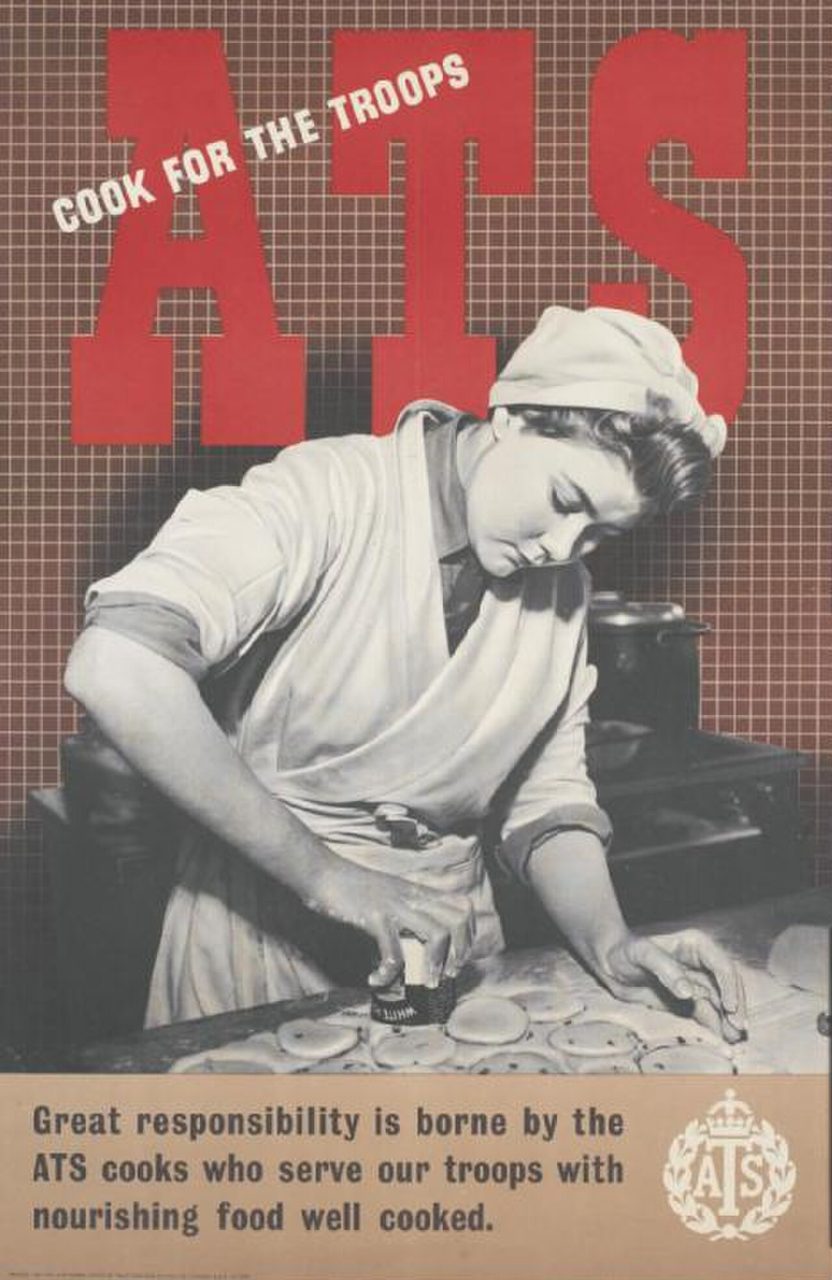
A British poster of 1939 held by the Imperial War Museums (reference Art.IWM PST 14532), shown here from a scan on Wikimedia Commons. Its line "Great responsibility is borne by the ATS cooks" attaches a large virtue word to kitchen work: glittering generalities. Its object page gives the source and rights.
Specialist sites, by country
- German Propaganda Archive. "Propaganda was central to Nazi Germany and the German Democratic Republic," its home page says, and the archive "includes both propaganda itself and material produced for the guidance of propagandists." It is "maintained by Randall Bytwerk, Professor Emeritus, Calvin University". research.calvin.edu/german-propaganda-archive
- Chinese Posters. Its home page says the site "shows over 5,750 Chinese propaganda posters". The page does not name who runs the site. chineseposters.net
- North Korean posters, Leiden University Libraries. "This digital database consists of scans of over 1,000 printed North Korean posters from the private collection of Willem van der Bijl", covering "the time of the Korean War (1950-53) right through to the 2010s", as a service provided by Leiden University Libraries. digitalcollections.universiteitleiden.nl/NKPosters
- Duke University Libraries, Russian Posters. Duke University Libraries are credited as the holder of several Russian posters in this archive. The collection's own page could not be read for this guide, so no description of it is given. repository.duke.edu/dc/russianposters
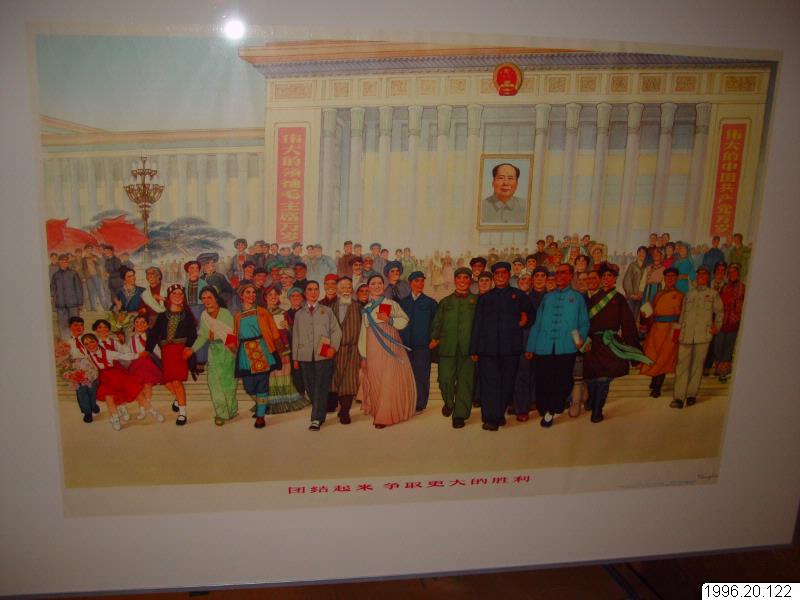
A Shanghai poster of 1974 held by the Museum of Ethnography in Stockholm (Världskulturmuseerna, inventory 1996.20.0122) and photographed in a display case, so there is glare at upper left. It is shown here through Europeana; its object page records the holding institution, the rights basis and a verbatim transcription.
Encyclopedias and reference
- United States Holocaust Memorial Museum, Holocaust Encyclopedia. Its article on Nazi propaganda opens: "The Nazis effectively used propaganda to win the support of millions of Germans in a democracy and, later in a dictatorship, to facilitate persecution, war, and ultimately genocide." encyclopedia.ushmm.org
- Wikimedia Commons. "A media file repository making available public domain and freely licensed educational media content", where "the license conditions of each individual media file can be found on their description page." Many items in this archive were hosted from Commons scans of institutional holdings. commons.wikimedia.org
Where the items in this archive come from
This archive does not hold originals. Each object page links to the holding institution's own record, and the institutions credited most often across the collection include Wikimedia Commons (as a host for scans of institutional holdings), the Library of Congress, the U.S. National Archives, the Internet Archive, the Australian War Memorial, the Bundesarchiv, the Imperial War Museums, the Rijksmuseum, Europeana contributors and a number of national libraries. Items come from public-domain holdings or from material the holder has released under an open licence, and the rights basis is stated per item. Where rights are limited or uncertain, the object page says so.
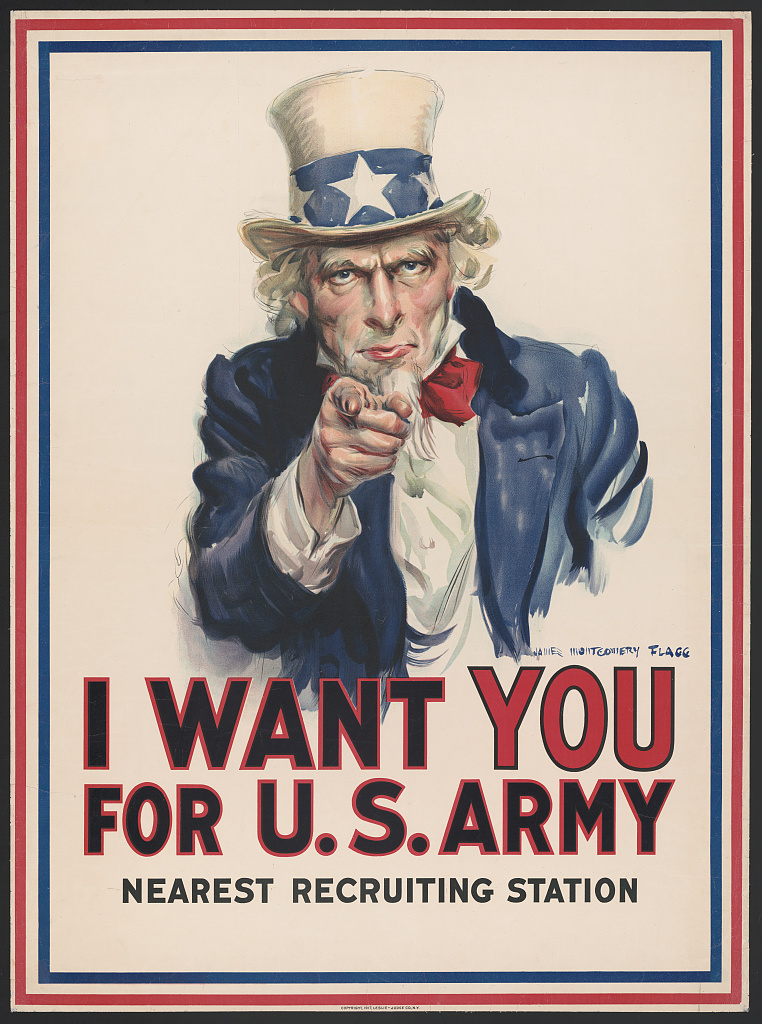
James Montgomery Flagg's 1917 recruiting poster, from the Library of Congress. Its object page records the Library's catalogue information and the public-domain basis for hosting it.
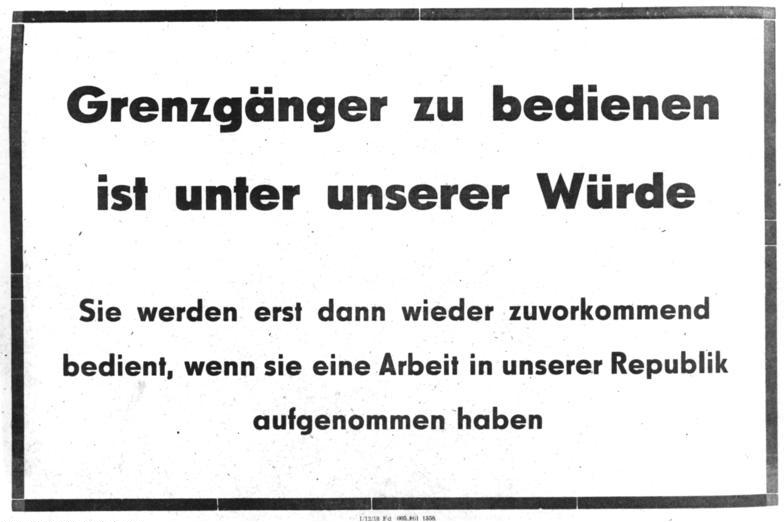
A typeset shop-window notice photographed in August 1961 by the East German state news agency ADN-Zentralbild, held by the Bundesarchiv (Bild 183-65208-0001) and released on Wikimedia Commons under a Creative Commons licence. Its object page states the licence and the credit line.
Five questions to ask of any propaganda collection
- Who holds the original, and who made the scan? A catalogue record from the holding institution is stronger evidence than a re-upload.
- What are the rights? A statement from the holder, a licence tag, or "rights not evaluated" are three different things, and a reuse decision depends on which one you have.
- Is the date given by the sheet or by the cataloguer? Posters are often undated, and a bracketed date is an estimate.
- Are transcriptions and translations separated from commentary? A reader should be able to see what the sheet says before reading what anyone says about it.
- What is the scope? Every collection covers some countries, wars and media and not others, and none covers everything.
What FRAME adds, and what it does not
This archive tags each item by the persuasion technique it uses, with one set of definitions applied to every side, country and era (how FRAME defines propaganda), and shows the source and the rights of each item. It makes no claim to cover every issuer or to replace the specialist and national collections above, and it recommends them for depth on a single country, war or medium. To use the archive, start with propaganda posters, propaganda leaflets or propaganda examples, or browse the full collection by technique, era, country and medium.