Content note: this page shows a 1642 English print of Protestant settlers being drowned and shot at Portadown, and quotes sectarian and partisan insults of the period.
In one line: when the Crown's press controls collapsed in 1641, royalists, parliamentarians, Irish insurgents and radicals all went to print, and within eight years they had used atrocity reports, weekly newsbooks, a witch-dog, a martyr-king and a forged royal commission to win readers.
Content note: Sectarian atrocity print: men, women and children driven off a bridge and shot. This object is shown as it was published. Why 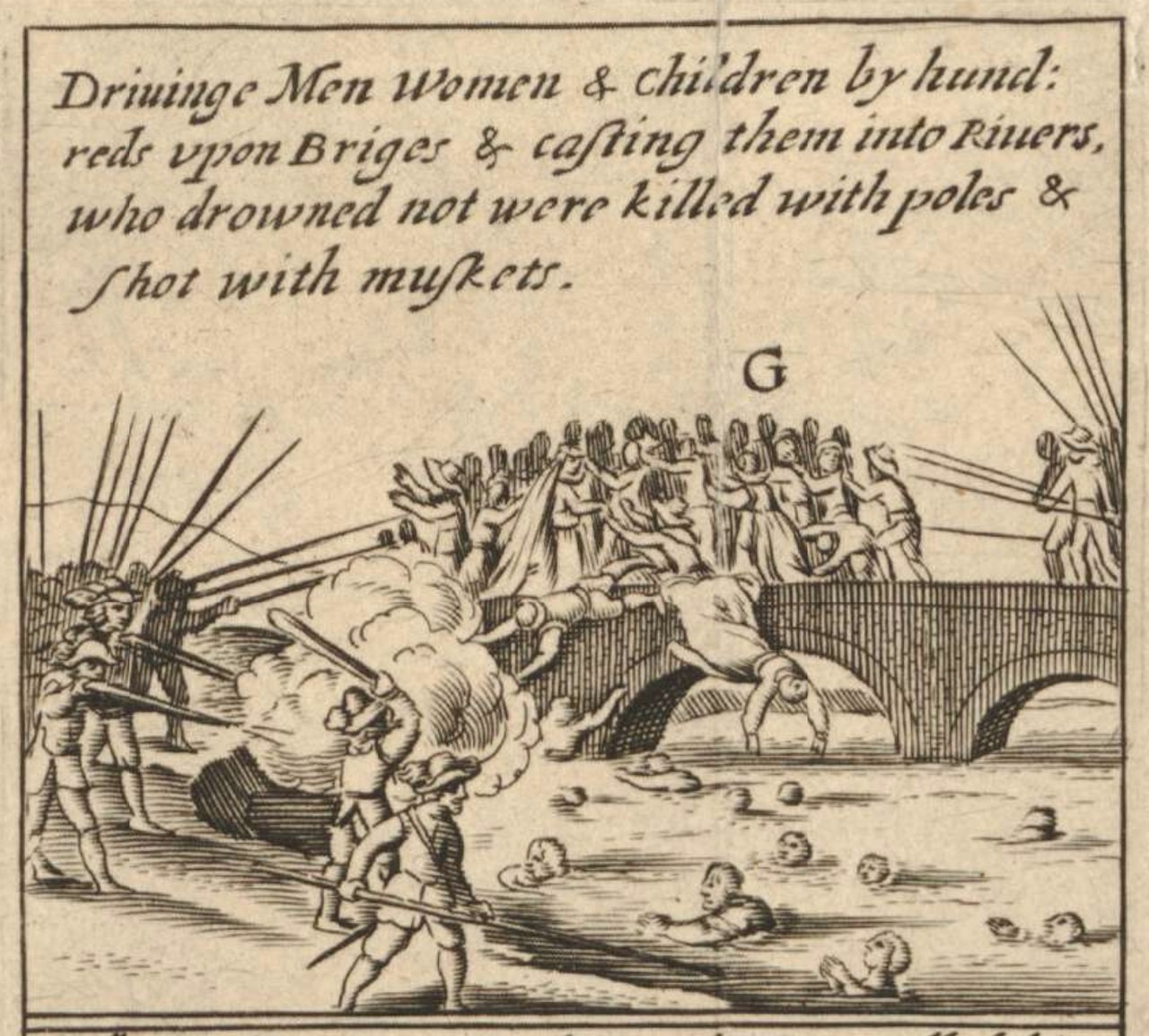
Plate "G" on the drownings at Portadown bridge, November 1641, first published in James Cranford's The Teares of Ireland (London, 1642); engraving attributed to Wenceslaus Hollar (British Museum). Public domain.
What happened
- 1637 to July 1641. Under Charles I, printing is licensed under a Star Chamber decree of 1637. In 1638 Star Chamber has the young John Lilburne whipped and pilloried for circulating unlicensed books. The Long Parliament abolishes Star Chamber and the High Commission in July 1641, and licensing stops working in practice.
- 1641-1642. Output surges. English Short Title Catalogue counts cited by historians of the period (for example David Cressy) run from roughly 850 titles in 1640 to more than 4,000 in 1642. The first weekly domestic newsbook, The Heads of Severall Proceedings in this Present Parliament, appears in late November 1641.
- From 1640. The London bookseller George Thomason, at the Rose and Crown in St Paul's Churchyard, starts buying one copy of nearly everything printed, and often writes the date of acquisition on it. By 1661 he holds some 22,000 items, royalist and parliamentarian alike. George III buys the collection in 1762 and gives it to the British Museum; it is now in the British Library as the Thomason Tracts. Much of the pamphlet record survives because of him.
- 23 October 1641. Catholic insurgents rise in Ulster. Protestant settlers are killed, stripped and driven from their homes; at Portadown in November about a hundred are drowned in the River Bann. Sir Phelim O'Neill displays a commission, sealed and dated at Edinburgh, 1 October 1641, that claims the king's authority for the rising. At his trial in 1653 he said he had fixed on it a seal taken from another document.
- 1641-1642. London printers issue dozens of "bloody news from Ireland" pamphlets. Henry Jones, dean of Kilmore, presents a Remonstrance of extracts from settlers' sworn statements to the Commons in March 1642 and it is printed. Cranford's The Teares of Ireland (1642) adds numbered pictures of burnings, drownings and killings of children. In January 1642, soldiers from the Carrickfergus garrison kill Catholic inhabitants of Islandmagee, County Antrim; Catholic writers later cite it as the counter-atrocity, some with much larger numbers.
- 1643. Mercurius Aulicus, "Communicating the Intelligence and affaires of the Court, to the rest of the Kingdome", starts at royalist Oxford in January, first under Peter Heylyn and soon mainly written by John Berkenhead. Mercurius Britanicus begins in London that August to answer it, first under Thomas Audley and then Marchamont Nedham. On 14 June, Parliament passes an order reinstating licensing before printing and giving the Stationers' Company powers of search.
- 1642-1644. Prince Rupert's white poodle, Boy, becomes a pamphlet subject (below) until he is killed at Marston Moor, 2 July 1644.
- 24 October 1644. Parliament orders that no quarter be given to Irishmen taken in arms in England or at sea.
- November 1644. Milton's Areopagitica is printed without licence, registration or printer's name.
- July 1645. After Naseby, Parliament prints the king's captured letters, with its own commentary, as The King's Cabinet Opened.
- 1646. Sir John Temple's The Irish Rebellion puts the Protestant dead at about 300,000. Aulicus has stopped in September 1645; Britanicus ends in May 1646 after Nedham prints a mock "hue and cry" after the king and is briefly imprisoned.
- 1646-1649. The Levellers publish A Remonstrance of Many Thousand Citizens (1646), An Arrow Against All Tyrants (1646), An Agreement of the People (1647) and England's New Chains Discovered (1649). Their leaders are arrested in March 1649.
- 30 January 1649. Charles I is executed. Within days Richard Royston is selling Eikon Basilike, presented as the king's own meditations. Francis Madan's bibliography counts some three dozen English editions in 1649. In October, the Council of State's answer, Milton's Eikonoklastes, is "Published by Authority".
How it works
- Fear appeal: the Irish atrocity pamphlets told English readers that the same "popish" violence could cross the Irish Sea. Keith Lindley and Ethan Shagan document panics in English towns in 1641-42 over rumoured Irish landings, and Parliament's use of the Irish danger in its case for controlling the militia. The royalist and Presbyterian press offered a mirror fear: sects and "levelling" would dissolve property, family and church. Thomas Edwards's Gangraena (1646), a Presbyterian catalogue of sectarian "errors", is the fullest example.
- Scapegoating: a rising with many causes (land confiscation, plantation, religion, the collapse of royal authority) was laid on Irish Catholics as a people. The October 1644 no-quarter ordinance shows the label applied to prisoners by nationality. The royalist side's version laid the war on a small faction of sectaries and schismatics in Parliament and London, leaving the king's own policies out of the account.
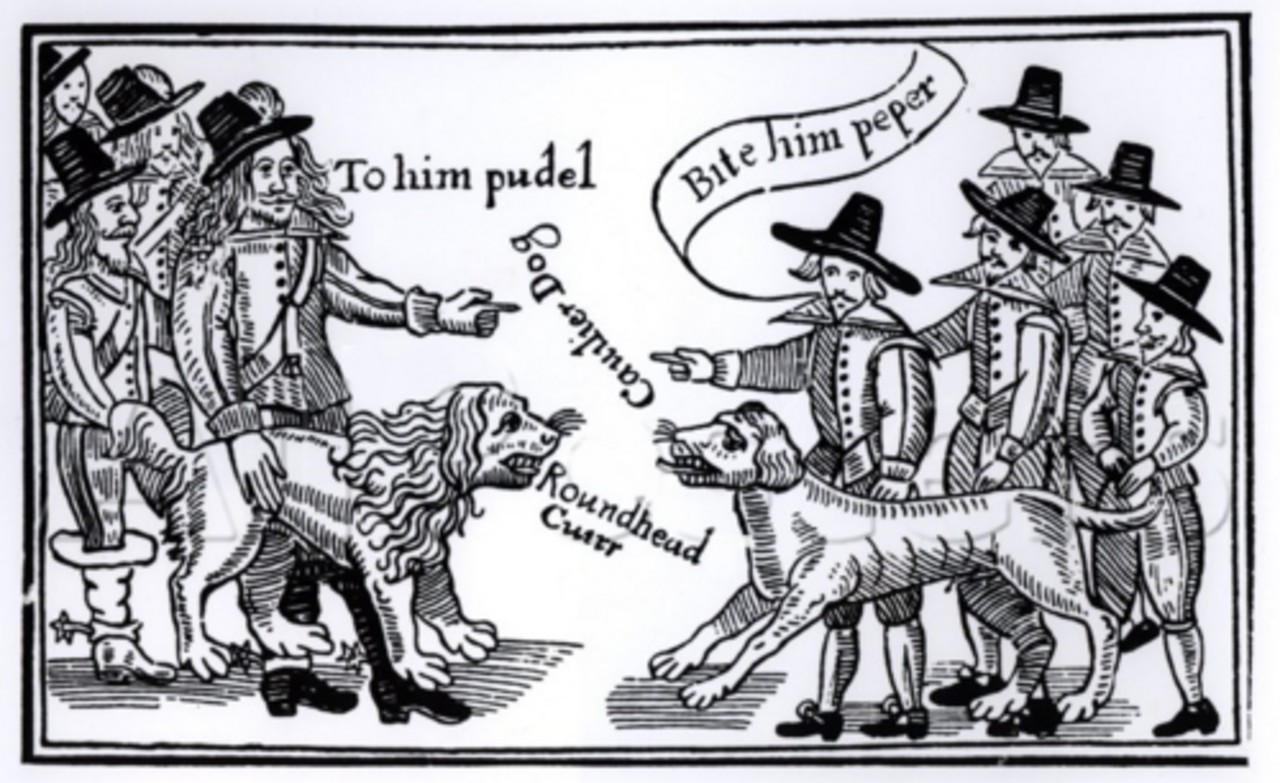
Woodcut from A Dialogue, or rather a Parley, betweene Prince Ruperts Dogge whose name is Puddle, and Tobies Dog whose name is Pepper (London, 1643). Anonymous. Public domain.
- Name-calling: "Roundhead" and "Cavalier" both began as insults in the street fights of winter 1641-42, and the 1643 woodcut above uses both at once. Mercurius Aulicus called one parliamentarian retreat "one of the Noblest pieces of cowardice that ever attended a bad cause and conscience" (week ending 16 December 1643). Parliamentarian tracts called Rupert "Prince Robber" after the burning of Birmingham in April 1643. "Leveller" was a name given by opponents in 1647 to suggest the movement would level estates; its leaders rejected it in print, for example in A Manifestation (April 1649).
- Transfer: William Marshall's Eikon Basilike frontispiece gives Charles the crown of thorns, lettered "Gratia", while his earthly crown lies on the floor marked "Vanitas". The attached verse reads: "With joie I take this Crown of thorn, / Though sharp, yet easie to be born." The prestige of Christ's passion is moved onto the king. The parliamentarian dog pamphlets moved the stigma of witchcraft onto Rupert and, through him, onto the royalist cavalry. Eikonoklastes puts Proverbs 28:15, "so is a wicked Ruler over the poor people", on its title page.
- Card stacking: Jones's Remonstrance and The Teares of Ireland print the worst sworn statements, including hearsay, and none of the insurgents' grievances or the Islandmagee killings. Temple's 300,000 is larger than modern estimates of the whole Protestant settler population of Ireland at the time. Modern estimates, drawing on the 1641 Depositions, put settlers killed outright at about 4,000, with perhaps several thousand more dying of exposure and hunger after being driven out; totals up to about 12,000 are commonly given. The King's Cabinet Opened printed a selection of Charles's letters with parliamentary annotations steering the reading.
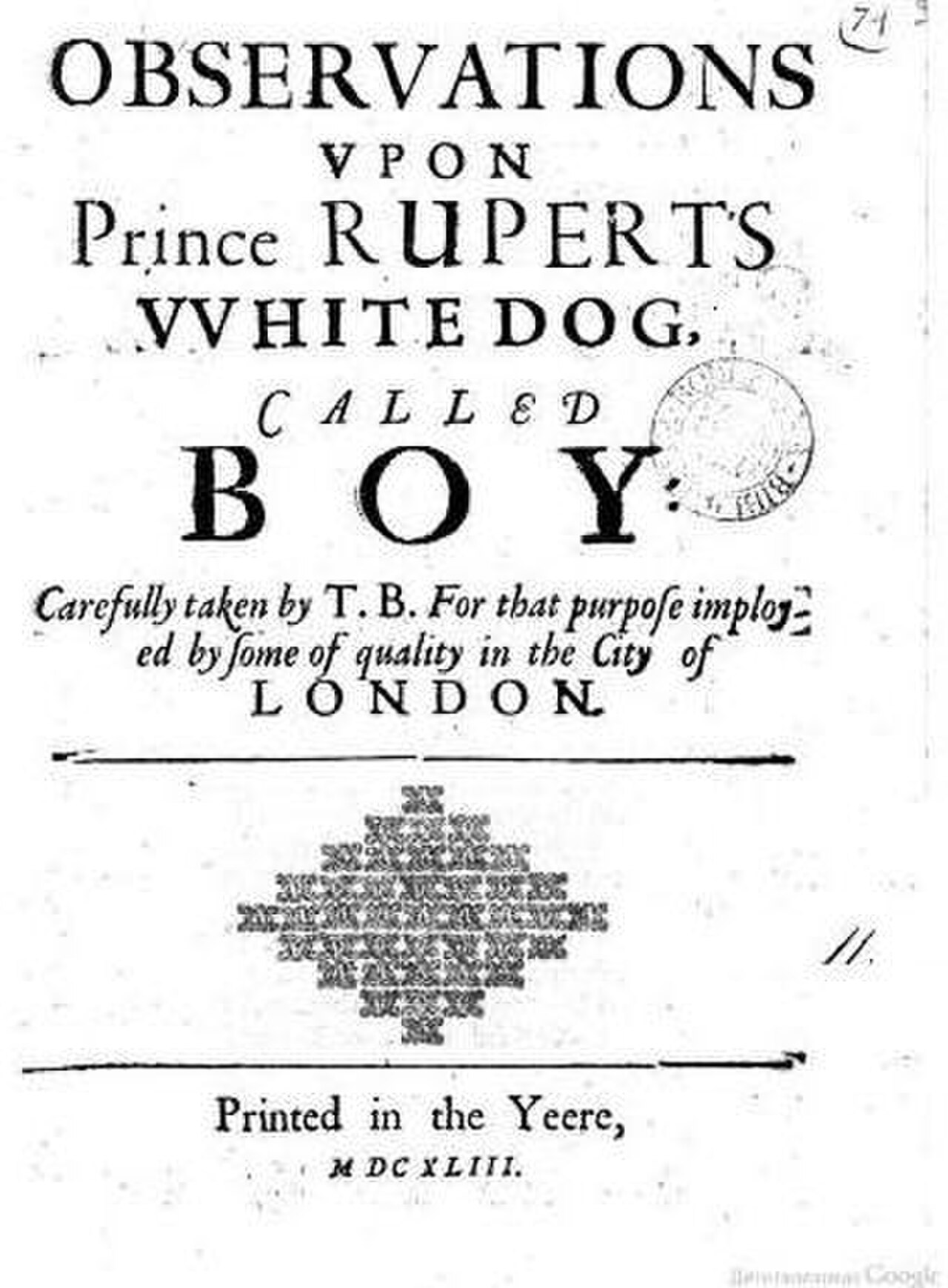
Title page, Observations upon Prince Ruperts White Dog, called Boy (1643), by "T. B.". Public domain.
The dog, and a black pamphlet
In late 1642 parliamentarian writers began to describe Boy as a witch's familiar that protected the prince. Observations upon Prince Ruperts White Dog (1643) claims to be the report of an agent "imployed by some of quality in the City of London". It gives the dog absurd powers, including that he is shot-proof and a transformed Lapland lady. The historian Mark Stoyle argues that this tract and several like it were royalist spoofs written in the voice of a credulous Roundhead to make the other side look foolish, and that the parliamentarian press then took up the imagery again after Boy's death in A Dogs Elegy, or Ruperts Tears (1644). If Stoyle is right, the Observations is black propaganda: it falsifies its own origin. Which tracts were sincere and which were satire is often unclear.
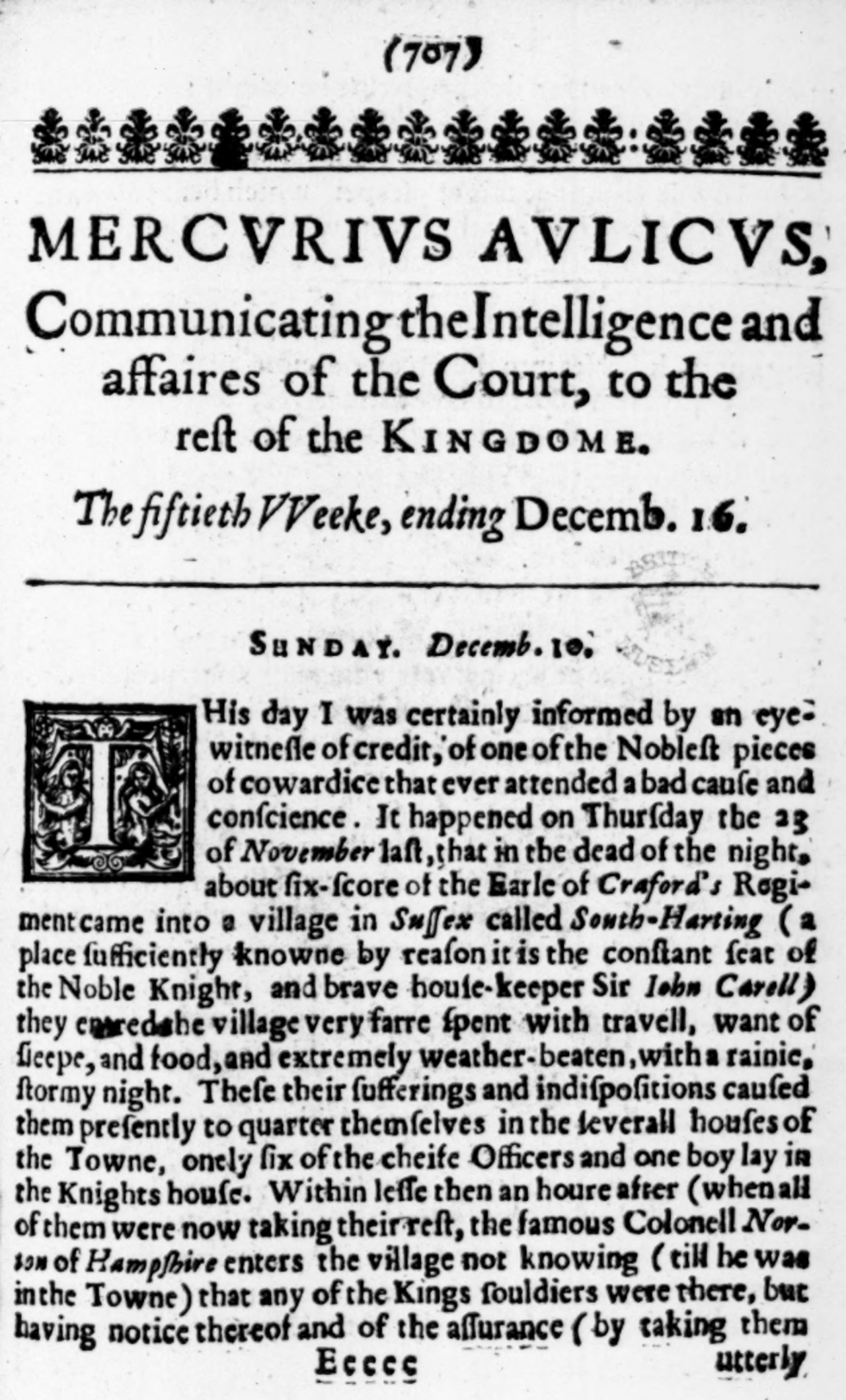
First page of Mercurius Aulicus, week ending 16 December 1643 (Oxford), by John Berkenhead and Peter Heylyn. Public domain.
The newsbook duel
Aulicus was white propaganda: the court's paper, under the court's name, with dated day-by-day entries and a tone of amused certainty. It was reprinted and smuggled into London. Britanicus took its name and its format from Aulicus in order to contradict it issue by issue. Neither title has the stronger claim to accuracy in the record. P. W. Thomas (on Berkenhead) and Joad Raymond (on the newsbooks) find selective reporting in both. Nedham went on to write the royalist Mercurius Pragmaticus from 1647 and the Commonwealth's Mercurius Politicus from 1650: the same writer served each side in turn.
The martyr book and its answer
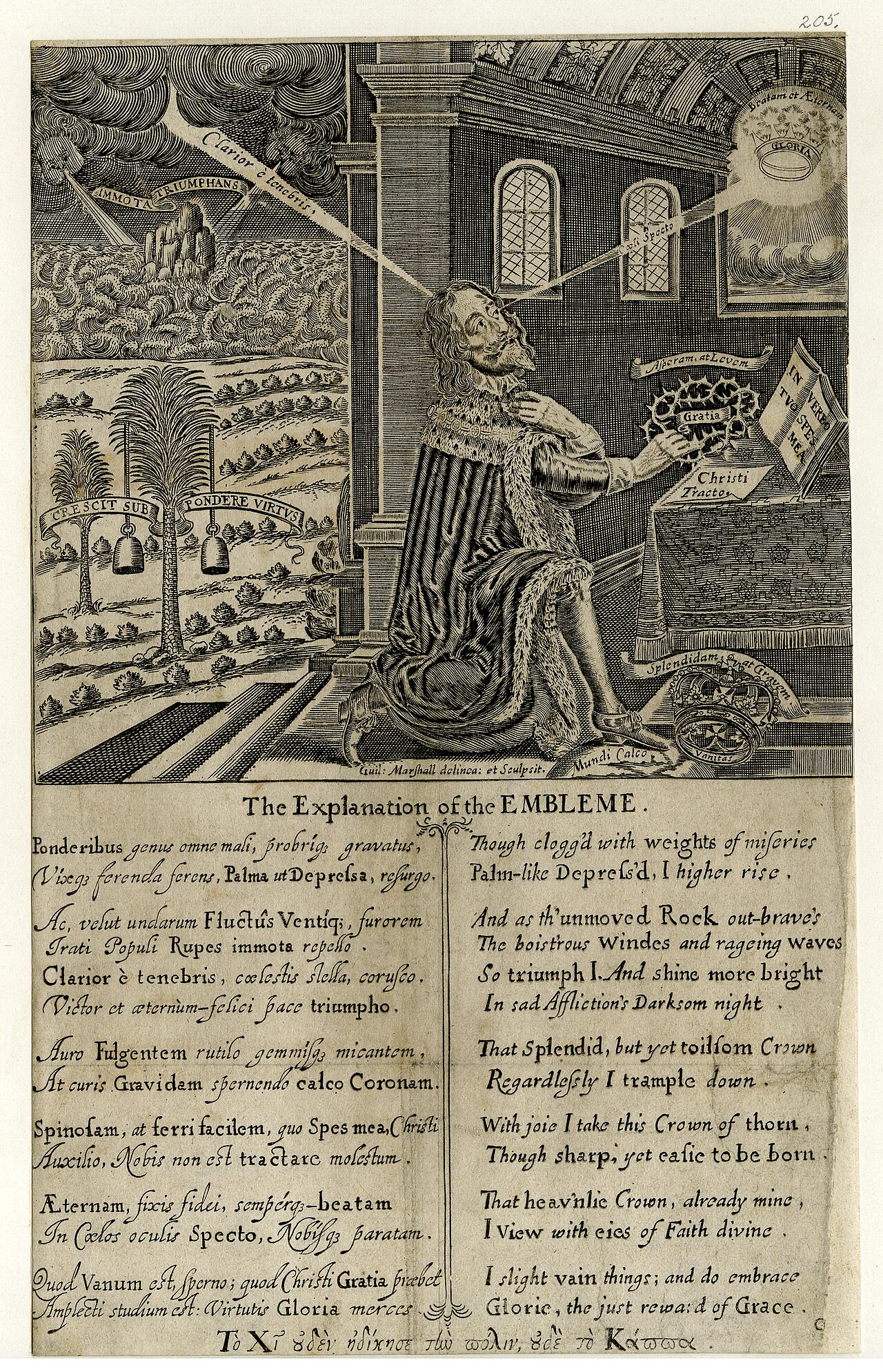
William Marshall, frontispiece to Eikon Basilike (1649), etching and engraving, British Museum 1868,0808.13507. Public domain.
Eikon Basilike was issued as the king's own prayers and reflections. In 1661 John Gauden, by then bishop of Exeter, wrote privately to Clarendon and others that he had composed it. His claim became public in the 1690s through Anthony Walker's A True Account of the Author of a Book entituled Eikon Basilike (1692). Royalist writers defended the king's authorship. Many modern scholars accept Gauden as the main author, perhaps working from papers of the king's, but the question is still argued. If Gauden wrote it, the book is gray propaganda: its real author is concealed behind a royal voice.
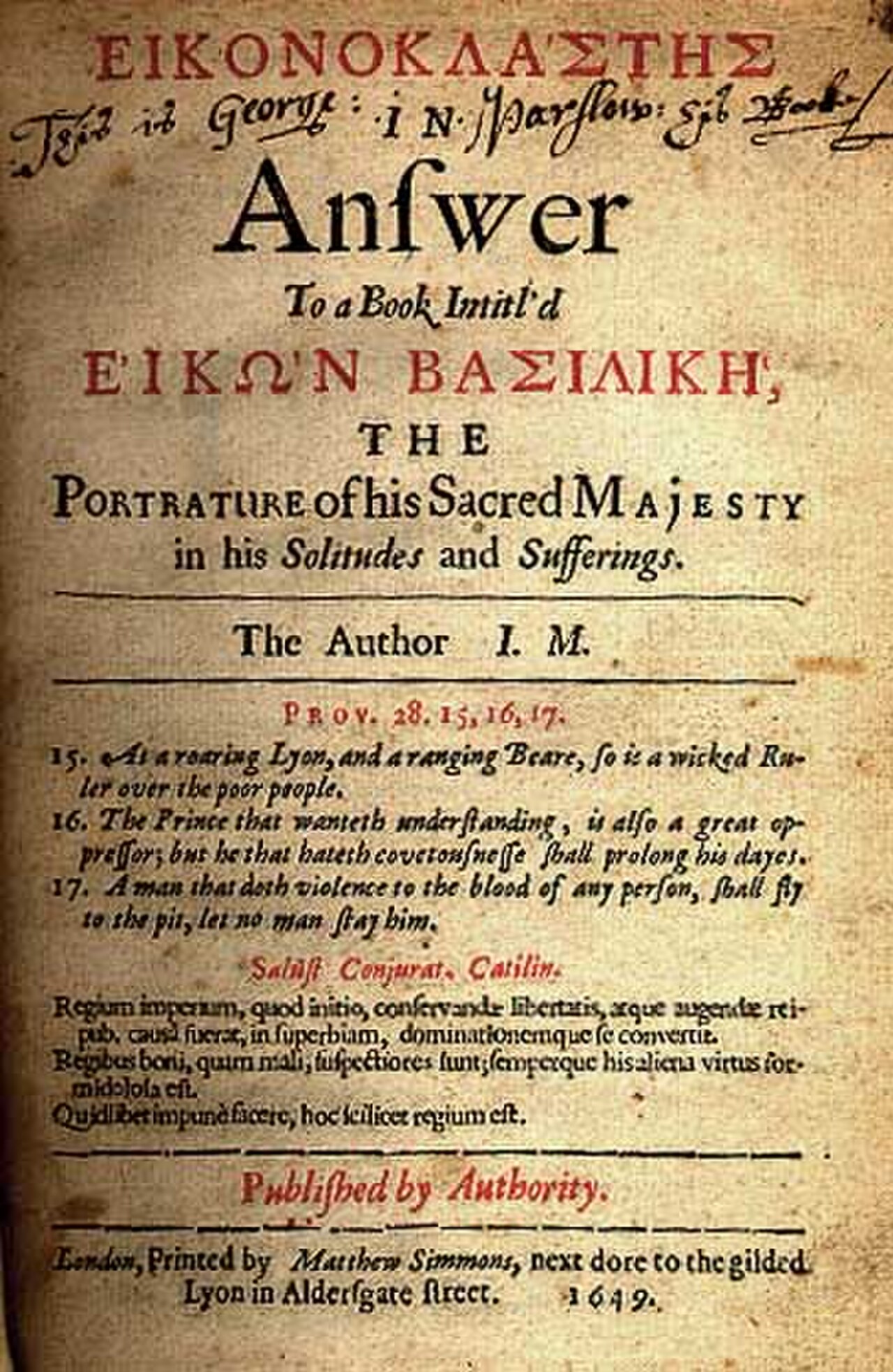
Title page, John Milton, Eikonoklastes (London: Matthew Simmons, 1649). Public domain.
Milton's reply went through the book chapter by chapter. It pointed out that a prayer printed with some editions was adapted from Pamela's prayer in Sidney's Arcadia, and it dismissed the book's readers as an "Image-doting rabble". A later royalist story, based on hearsay, that Milton's side had the prayer planted is unproven. Eikonoklastes had two English editions (1649 and 1650), against the dozens of the king's book.
The licensing fight and the Levellers
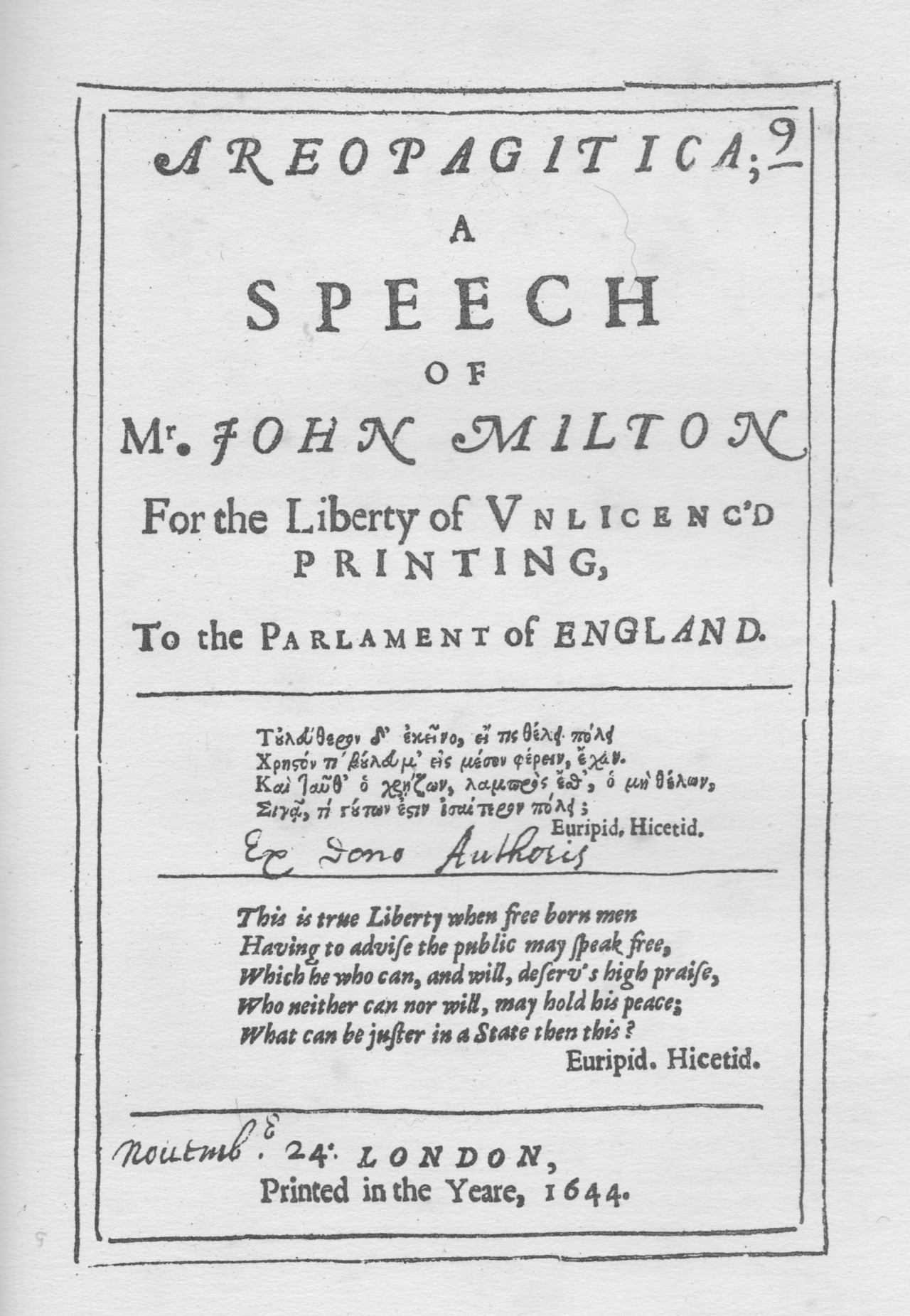
Title page, John Milton, Areopagitica (London, 1644). The handwritten date and "Ex dono Authoris" ("gift of the author") match the notes George Thomason wrote on his copies. Public domain.
Areopagitica attacked Parliament's June 1643 order, not royal censorship: "Give me the liberty to know, to utter, and to argue freely according to conscience, above all liberties." It also excluded "Popery, and open superstition" from the toleration it asked for. Both sides controlled print where they could. The king's government had done it through Star Chamber, the royalists at Oxford ran a court press, and Parliament restored licensing in London.
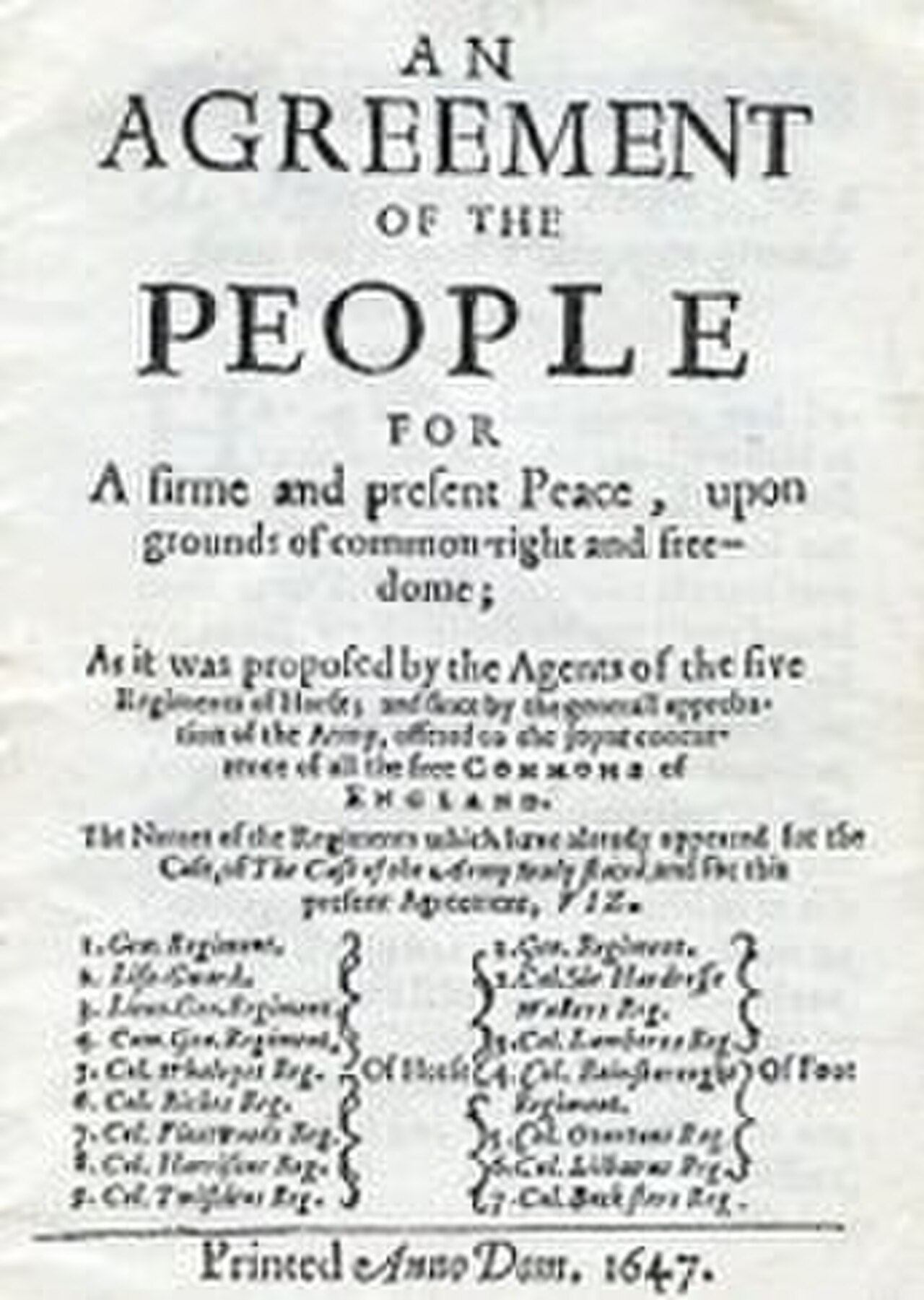
Title page, An Agreement of the People (1647). Public domain.
The Levellers printed largely without licence; Overton ran a secret press. The Agreement lists concrete proposals (biennial parliaments, redistributed seats, reserved rights), an argued programme rather than virtue words, so it is not tagged for glittering generalities. Lilburne's appeals to Magna Carta and the "freeborn" Englishman are made as legal arguments with cited authorities and are not tagged as Transfer either. Their opponents used the label "Leveller" and the fear of "levelling" estates against them.
Then and now
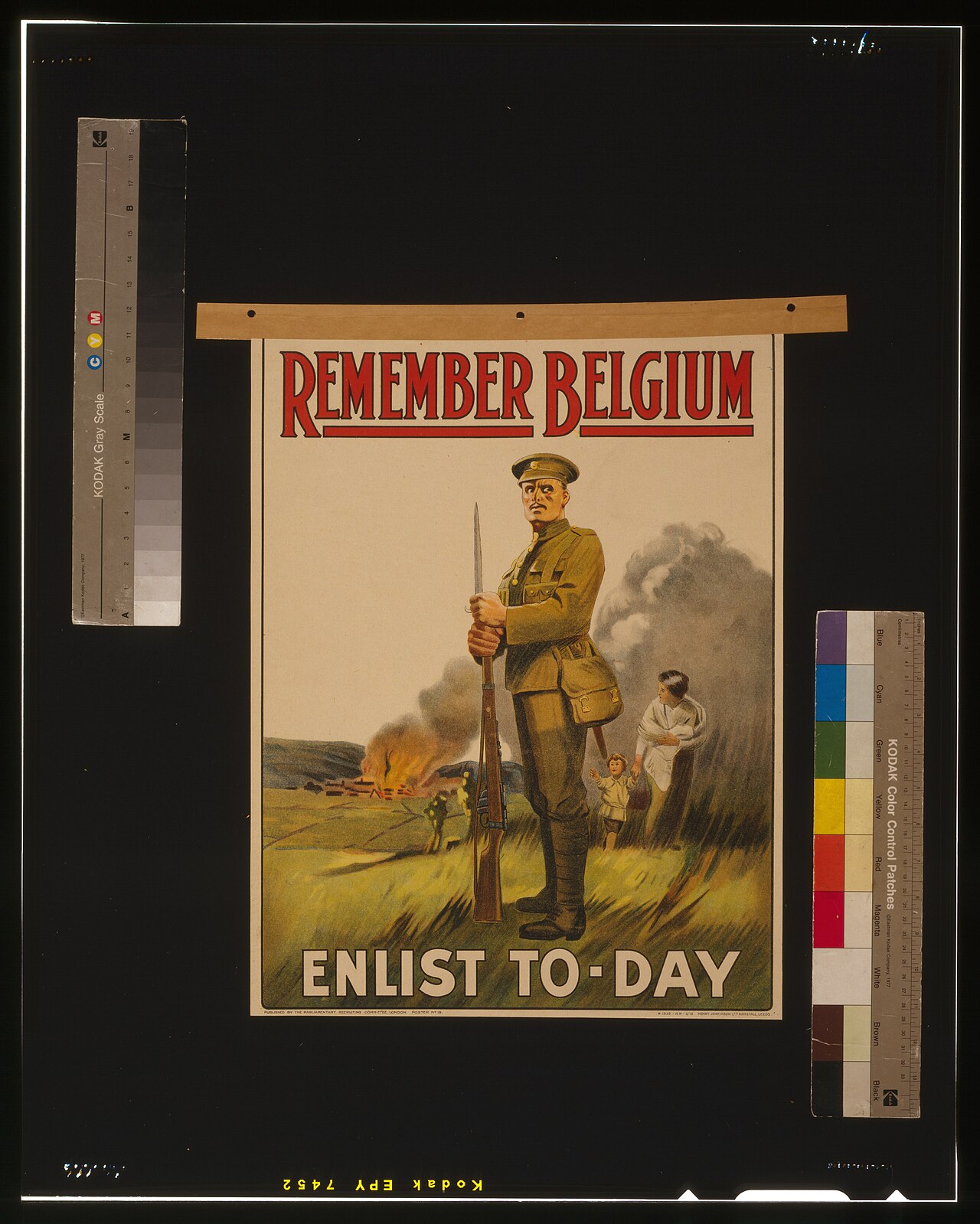
Remember Belgium — Enlist To-Day, Parliamentary Recruiting Committee, 1915. Public domain.
In 1641-42 and again in 1914-15, real killings of civilians were turned into printed pictures and witness-statement reports for a home audience, and inflated numbers circulated beside true ones. The 1915 Bryce Committee report, like Jones's Remonstrance, printed witness statements without cross-examination. The differences matter. The 1641 killings were a sectarian rising inside the king's own dominions, not an invading army. The 1640s material was sold by competing private printers and rival authorities, not issued by one national recruiting committee. And the English readers of 1642 were being asked to fear their Catholic neighbours as well as a distant enemy. The Catholic Church's own organised effort of the same decades, from the other side of the confessional divide these pamphlets exploited, is covered in Propaganda Fide, 1622: where the word comes from.
Positions on the record
- Parliament's stated position: it was defending the Protestant religion, the law and Parliament against evil counsellors and a papist conspiracy, of which it took the Irish rising as proof. It restored licensing against what it called scandalous and seditious papers.
- The king's stated position: a faction of sectaries in Parliament and London had seized the militia and raised rebellion against lawful authority. Eikon Basilike presents the king as a Christian ruler who forgave his enemies.
- The Levellers' stated position: sovereignty lay with the people, and Parliament and army grandees had betrayed the war's purpose. They rejected the name "Leveller".
- The Irish insurgents' stated position: at the start, they said they acted to defend the king and their religion, which is the claim O'Neill's forged commission was made to support.
- What historians say: the atrocities of 1641 were real and are recorded in the Depositions. The printed numbers were inflated many times over, and English fear of the rising shaped the path to war (Lindley, Shagan, Canny). On Eikon Basilike, most accept Gauden's hand to some degree. On Boy, Stoyle's royalist-spoof reading is the main scholarly account.
- This archive's reading: documented: the pamphlets, their dates and printers, the O'Neill commission and his 1653 statement, the June 1643 order, and the gap between contemporary and modern death tolls. Not shown: that any single pamphlet changed a specific decision, or how widely readers believed the witch-dog stories. The surviving record leans toward London and Parliament, because London printed more and Thomason collected there; royalist and Irish Catholic output is thinner in the collections, not necessarily milder.
Same-method test
Had a Catholic press in 1641 printed numbered engravings of settlers' killings of Catholic families, with a death toll larger than the Catholic population, it would get the same fear-appeal, scapegoating and card-stacking tags. Had Parliament published a martyr-book of a dead general under a false author, it would be gray here, like Eikon Basilike. Had a parliamentarian written a spoof in a Cavalier's voice, it would be black, like the Observations.
How to spot it
- Check the number against the population. A death toll larger than the community it describes is card-stacking, whoever prints it.
- Ask who is speaking. A title page claiming to be written "for" or "by" the other side, or a book in a dead king's voice, is a question about origin before it is a question about content.
- Read the rivals together. Aulicus and Britanicus side by side show what each left out.
- Keep the atrocity separate from the argument drawn from it. The Portadown drownings happened; that every Catholic neighbour was a danger does not follow.
Images
| Image | Source | Licence |
|---|---|---|
| Portadown plate from The Teares of Ireland (1642), attributed to Wenceslaus Hollar | Wikimedia Commons, from British Museum P_1854-1113-100 | Public domain (PD-old-70) |
| A Dialogue... betweene Prince Ruperts Dogge... and Tobies Dog woodcut (1643) | Wikimedia Commons | Public domain (PD-old-70) |
| Observations upon Prince Ruperts White Dog title page (1643) | Wikimedia Commons | Public domain (PD-old-70) |
| Mercurius Aulicus, week ending 16 December 1643 | Wikimedia Commons | Public domain (PD-old-70; PD-US-expired) |
| William Marshall, Eikon Basilike frontispiece (1649) | Wikimedia Commons, British Museum 1868,0808.13507 | Public domain (PD-old-100) |
| Eikonoklastes title page (1649) | Wikimedia Commons | Public domain (PD-old-100) |
| Areopagitica title page (1644) | Wikimedia Commons | Public domain (PD-old-70) |
| An Agreement of the People title page (1647) | Wikimedia Commons | Public domain (PD-old) |
| Remember Belgium (1915) | FRAME gallery | Public domain (published before 1923) |


.jpg)


.jpg)
Image gaps
- A Mercurius Britanicus title page. Scans of 1640s London newsbooks exist in early-English-books PDFs on Commons, but no single-page image was found for this build. This gap can be filled by extracting a page from a public-domain scan.
- The other Teares of Ireland plates and the full broadsheet. Only the Portadown plate was taken. Other public-domain plates can be added.
- The O'Neill commission, The King's Cabinet Opened and A Dogs Elegy (1644). No openly licensed single images were found. All are public domain as texts; fillable from scans.
- An Irish Catholic or Confederate printed piece. Far less survives in accessible collections, and none was found on Commons for this build. That gap is part of the record's London tilt described above.
- The 1641 Depositions manuscripts (Trinity College Dublin). Digitised images are online, but their licence was not checked for this build.
Sources
- James Cranford, The Teares of Ireland (London: A.N. for John Rothwell, 1642).
- Henry Jones, A Remonstrance of Divers Remarkable Passages concerning the Church and Kingdome of Ireland (London, 1642).
- Sir John Temple, The Irish Rebellion (London, 1646).
- Mercurius Aulicus (Oxford, 1643-1645); Mercurius Britanicus (London, 1643-1646).
- Eikon Basilike: The Pourtraicture of His Sacred Majestie in his Solitudes and Sufferings (London: Richard Royston, 1649).
- John Milton, Areopagitica (London, 1644); Eikonoklastes (London: Matthew Simmons, 1649).
- Order of the Lords and Commons for the regulating of printing, 14 June 1643, in C. H. Firth and R. S. Rait (eds), Acts and Ordinances of the Interregnum, 1642-1660 (London: HMSO, 1911).
- G. K. Fortescue, Catalogue of the Pamphlets, Books, Newspapers, and Manuscripts relating to the Civil War, the Commonwealth, and Restoration, collected by George Thomason, 1640-1661, 2 vols (London: British Museum, 1908).
- 1641 Depositions, Trinity College Dublin, MSS 809-841 (digitised by the 1641 Depositions Project).
- Joad Raymond, The Invention of the Newspaper: English Newsbooks 1641-1649 (Oxford: Clarendon Press, 1996).
- Joad Raymond, Pamphlets and Pamphleteering in Early Modern Britain (Cambridge: Cambridge University Press, 2003).
- Jason Peacey, Politicians and Pamphleteers: Propaganda during the English Civil Wars and Interregnum (Aldershot: Ashgate, 2004).
- David Cressy, England on Edge: Crisis and Revolution 1640-1642 (Oxford: Oxford University Press, 2006).
- Mark Stoyle, The Black Legend of Prince Rupert's Dog: Witchcraft and Propaganda during the English Civil War (Exeter: University of Exeter Press, 2011).
- P. W. Thomas, Sir John Berkenhead 1617-1679: A Royalist Career in Politics and Polemics (Oxford: Clarendon Press, 1969).
- Joseph Frank, Cromwell's Press Agent: A Critical Biography of Marchamont Nedham, 1620-1678 (Lanham: University Press of America, 1980).
- Keith Lindley, "The Impact of the 1641 Rebellion upon England and Wales, 1641-5", Irish Historical Studies 18 (1972).
- Ethan Shagan, "Constructing Discord: Ideology, Propaganda, and English Responses to the Irish Rebellion of 1641", Journal of British Studies 36 (1997).
- Nicholas Canny, Making Ireland British, 1580-1650 (Oxford: Oxford University Press, 2001).
- Francis F. Madan, A New Bibliography of the Eikon Basilike of King Charles the First (Oxford Bibliographical Society, 1950).
- Andrew Sharp (ed.), The English Levellers (Cambridge: Cambridge University Press, 1998).