In one line: Finland has written media literacy into national policy (2013, 2019), the school curriculum (2016) and civil-service training (from about 2016), and it has topped the Media Literacy Index in every edition since 2017; no study has measured how much of that ranking the programmes themselves caused, because the index scores background conditions such as education, press freedom and trust that were high before the programmes began.

Helsinki and Turku, the two places tied to the programmes and studies on this page. Map drawn by FRAME from Natural Earth (public domain).
What happened
- 2013. The Ministry of Education and Culture publishes Good Media Literacy: National Policy Guidelines 2013–2016.
- 2014. Faktabaari, a non-partisan fact-checking service founded by Mikko Salo, starts checking claims in national and European Parliament election debates. It is run by the non-profit Avoin Yhteiskunta ry and later joins the International Fact-Checking Network.
- 2014 to 2018. The journalist Jessikka Aro of the public broadcaster Yle investigates pro-Kremlin troll accounts and becomes the target of a long harassment campaign. In October 2018 the Helsinki District Court convicts Ilja Janitskin, founder of the MV-lehti site, and the activist Johan Bäckman: Janitskin receives 22 months in prison and Bäckman a 12-month suspended sentence, and the court describes the offences as "an exceptionally aggravated set of crimes". An appeals court later reduces one of the sentences.
- 2015 to 2016. As online trolling increases, President Sauli Niinistö calls on every Finn to take responsibility for countering false information. From 2016 the government trains civil servants to recognise information influence, bringing in American experts to advise officials, according to CNN's 2019 report.
- 2016. A renewed national core curriculum for basic education takes effect. It adds seven "transversal competences" taught across all subjects, including "multiliteracy": the ability to read and judge texts in the broad sense (news, statistics, images, video, podcasts).
- 2017. Faktabaari launches Faktabaari EDU, taking fact-checking methods into schools.
- 2017 onwards. Open Society Institute Sofia publishes its first Media Literacy Index. Finland ranks first; in 2023 it is first for the sixth consecutive edition, with 74 points out of 100 across 41 countries.
- 2019. KAVI and the ministry publish Media Literacy in Finland: National Media Education Policy, updating the 2013 guidelines. Its three stated goals are media education that is comprehensive, high-quality and systematic.
- 2025. The government adopts an updated Security Strategy for Society, the framework for Finland's "comprehensive security" model. It says Russia's war against Ukraine and its influence efforts mean all branches of government must prepare for hostile, state-sponsored attempts at influence.
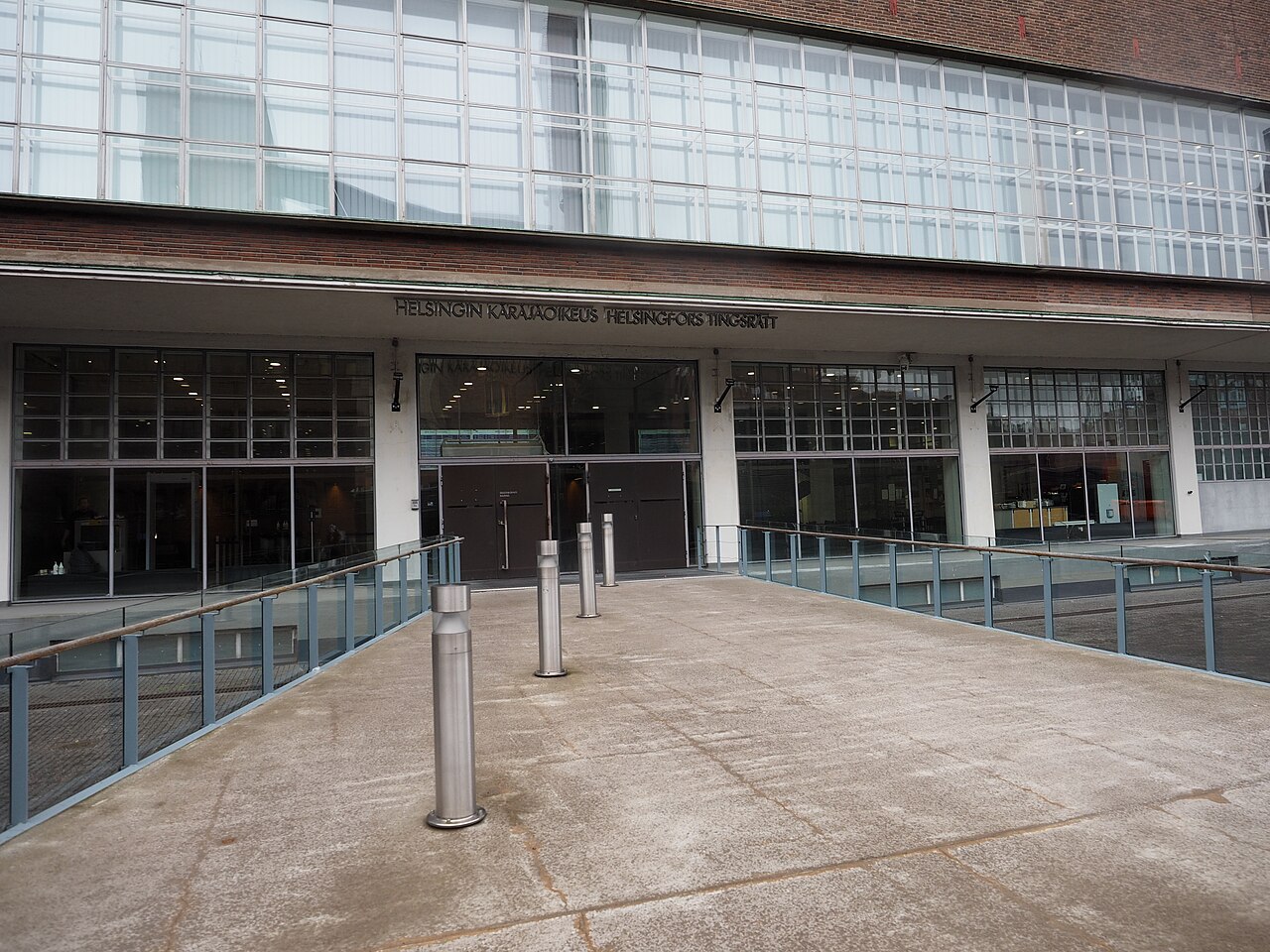
Main entrance of the District Court of Helsinki, Salmisaari, the court that in October 2018 convicted Ilja Janitskin and Johan Bäckman in the harassment case described above. Photographed 16 September 2022 by JIP, Wikimedia Commons, CC BY-SA 4.0.
How it worked
- Schools, not a single course. Media literacy sits inside multiliteracy and digital competence, which every subject is expected to develop, rather than in a standalone class. The Finnish National Agency for Education describes the goal as reading, producing and evaluating texts in all forms.
- Coordination. KAVI, a state agency, coordinates media education nationally with libraries, NGOs, broadcasters and universities.
- Civil service and elections. The Prime Minister's Office coordinates the government's work on disinformation. Its chief communications specialist, Jussi Toivanen, says more than 10,000 civil servants, citizens and journalists have been trained to understand information influencing. The government has also offered training to political parties and candidates.
- Comprehensive security. Under this model, authorities, businesses, organisations and citizens share responsibility for keeping society's vital functions running in a crisis. Resistance to information influence is treated as one part of that.
- Civil society. Faktabaari fact-checks election debates and produces teaching material, including exercises in which students examine YouTube claims, compare clickbait headlines and write fake stories themselves to see how they work.
No FRAME technique is tagged on this page. The programmes teach recognition of manipulation in general; the page documents no specific piece of propaganda.
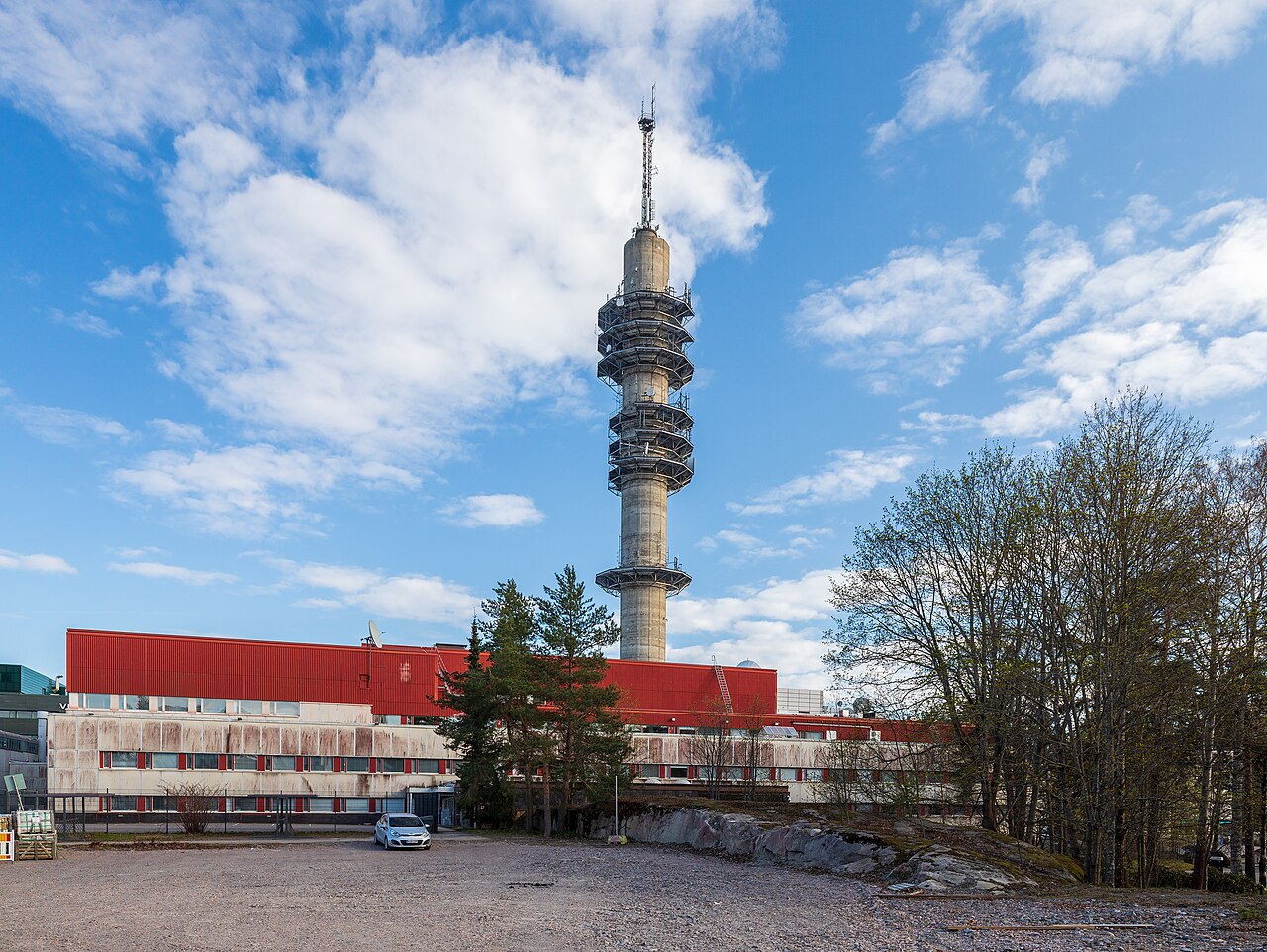
Yle Studios (Studiotalo) and the Yle transmission tower in Länsi-Pasila, Helsinki, of the Finnish public broadcaster Yle. Photographed 6 May 2022 by Simo Räsänen, Wikimedia Commons, CC BY-SA 4.0.
Measured effect
- The index is not an effect measure. The Media Literacy Index combines existing indicators: quality of education (including PISA scores), media freedom (from Freedom House and Reporters Without Borders), trust in society, and use of new forms of participation. Finland scores highly on all of them. None of them measures whether a given programme changed anyone's ability to spot false information.
- Trust came first, or at least alongside. Finns report some of the highest trust in news in the world: 69 percent in the Reuters Institute's 2022 to 2024 surveys and 67 percent in 2025. The public broadcaster Yle reaches most of the population each week. Commentators on the Finnish case point to these conditions, to Finland's small and relatively cohesive population, and to the Finnish language itself as barriers to foreign influence that no curriculum created.
- One comparison study. Shane Horn and Koen Veermans (University of Turku, 2019) gave Stanford's digital-literacy tasks to students at an international school in Finland preparing for the International Baccalaureate. Both cohorts outperformed Stanford's U.S. samples to a statistically significant degree. The authors caution that the school is not typical of Finland and that their results should not be generalised to national school systems.
- Gaps inside Finland. A Finnish research project, CRITICAL, is reported to have found that about 40 percent of 12-year-olds could not clearly distinguish commercial from factual information, that most young people could not read misleading graphs, and that almost a third of upper-secondary students had difficulty judging the reliability of texts.
- Not measured. No randomised or quasi-experimental evaluation of the 2016 curriculum, the civil-service training or Faktabaari's school work against a comparison group was found for this page.
Positions on the record
- The Finnish government: media literacy is a civic skill and part of national resilience. Official outlets such as thisisFINLAND present the model as a reason Finland is resistant to disinformation, and the Security Strategy for Society treats information influence as a security matter.
- Faktabaari: it describes itself as non-partisan, bound by the Finnish journalists' ethical code, and since 2024 backed by an independent support foundation to protect its independence.
- Researchers and critical commentators: the index ranking reflects education, press freedom and trust more than programmes, and parts of the model (a small population, a hard-to-learn language, high trust) cannot be exported. Horn and Veermans warn against reading their school study as a national result.
- The Russian government: Foreign Ministry spokeswoman Maria Zakharova, as reported by the Russian state agency TASS, said "myths" about a Russian threat circulating in Finland harmed relations and described an "aggressive media campaign" against Russia with "thousands of articles containing fake news, myths and disinformation". Finnish pro-Russian outlets such as Naapuriseura accuse the Finnish government and media of "Russophobia".
Same-method test
A national programme in any country that wrote "critical reading" into its curriculum, trained civil servants to spot foreign influence and then cited an index ranking as proof of success would be recorded the same way: the policy documents, the training numbers the government itself reports, and the absence of a causal evaluation. The page would say the same about a programme in a country the reader distrusts. What distinguishes Finland's record is not evidence of effect but the breadth of the effort and the conditions it sits on.
What the record shows and doesn't
- Documented: the 2013 guidelines, the 2016 curriculum's multiliteracy competence, the 2019 policy, Faktabaari's founding and work, the Aro convictions, the training figures the government reports, the index rankings and the trust figures.
- Not shown: that the programmes caused Finland's index rank or its resistance to disinformation. The ranking and the programmes are both real; the link between them is assumed in most coverage rather than measured.
- "Finland is winning the war on fake news" (CNN's 2019 headline) and "Finland's success is just high trust" are both frames. The record supports high resilience indicators and a broad programme, and leaves the share due to each open.
See also
- Media literacy: what the wider research says about media-literacy teaching, including null and backfire results.
- Baltic counter-disinformation: Estonia, Latvia and Lithuania: Finland's neighbours, who relied more on broadcast bans and volunteer groups.
- EUvsDisinfo and the EEAS East StratCom Task Force: the EU's counter-disinformation service.
- Fact-checking and corrections: fact-checking of the kind Faktabaari does.
- Countering propaganda: the index of this section.
See also in Learn
Images
| Image | Source | Licence |
|---|---|---|
| Where the Finnish media literacy measures on this page are based | FRAME drawing (case-studies/make_baltic_map.py); basemap Natural Earth |
CC BY 4.0 (FRAME drawing); Natural Earth basemap is public domain |
| Main entrance of the District Court of Helsinki, Salmisaari | Wikimedia Commons, JIP | CC BY-SA 4.0 (also GFDL 1.2+) |
| Yle Studios (Studiotalo) and transmission tower, Länsi-Pasila, Helsinki | Wikimedia Commons, Simo Räsänen (Ximonic) | CC BY-SA 4.0 |


Image gaps
- Classroom material from Faktabaari EDU or KAVI. Copyrighted by their publishers; not included.
- Photos of Finnish classrooms or of KAVI. Searched on Wikimedia Commons; only historical classroom photos and school facades were found, none tied to the programmes. This gap can be filled.
- A photo of Jessikka Aro. A CC BY 4.0 image exists on Commons but is a candid crop of an audience, so it is not used.
Sources
- Ministry of Education and Culture and KAVI: Media Literacy in Finland, National Media Education Policy (2019, PDF)
- Medialukutaito Suomessa: guidelines
- Nordicom: Finland's national policy for media education updated
- Finnish National Agency for Education: Multiliteracy and media literacy
- Seminar.net: Behind the concepts of multiliteracies and media literacy in the renewed Finnish core curriculum
- KAVI: Finnish Media Education (PDF)
- EDMO: Mapping the media literacy sector, Finland
- Faktabaari: FactBar in English and the Digital Information Literacy Guide
- Issues in Science and Technology: In Finland, we make each schoolchild a scientist (Kivinen, 2023)
- CNN: Finland is winning the war on fake news (May 2019)
- CDA Institute: Jussi Toivanen on Finland's society-wide approach
- Finnish Government: New Security Strategy for Society (2025)
- Security Committee: Comprehensive security
- Open Society Institute Sofia: Finland tops the Media Literacy Index 2023
- Reuters Institute: Digital News Report 2023, Finland and Tampere University: Finland's 2025 country report
- Horn and Veermans 2019, Critical thinking efficacy and transfer skills defend against "fake news" at an international school in Finland and University of Turku press release
- Monocle: What other countries can learn from Finland's media literacy
- thisisFINLAND: Educated decisions, Finnish media literacy deters disinformation
- RSF: Pro-Kremlin activists on trial in Finland for harassing reporter and Journalistiliitto: MV trial
- News Now Finland: Appeals court cuts sentence for pro-Kremlin activist
- TASS: Myths about Russian threat harm Russian-Finnish ties, Russian Foreign Ministry
- UNITED24 Media: Russian propaganda in Finland