In one line: experiments in several countries find that a fact-check usually moves beliefs toward accuracy, rarely backfires, often fades, and did not change feelings toward the politician corrected in the one US test.
Evidence: moderate. The core finding (corrections improve accuracy on average) is replicated by independent teams, a meta-analysis and a four-country study, but effects are modest, shrink with prior beliefs and time, and were measured almost entirely in survey experiments, not real feeds.
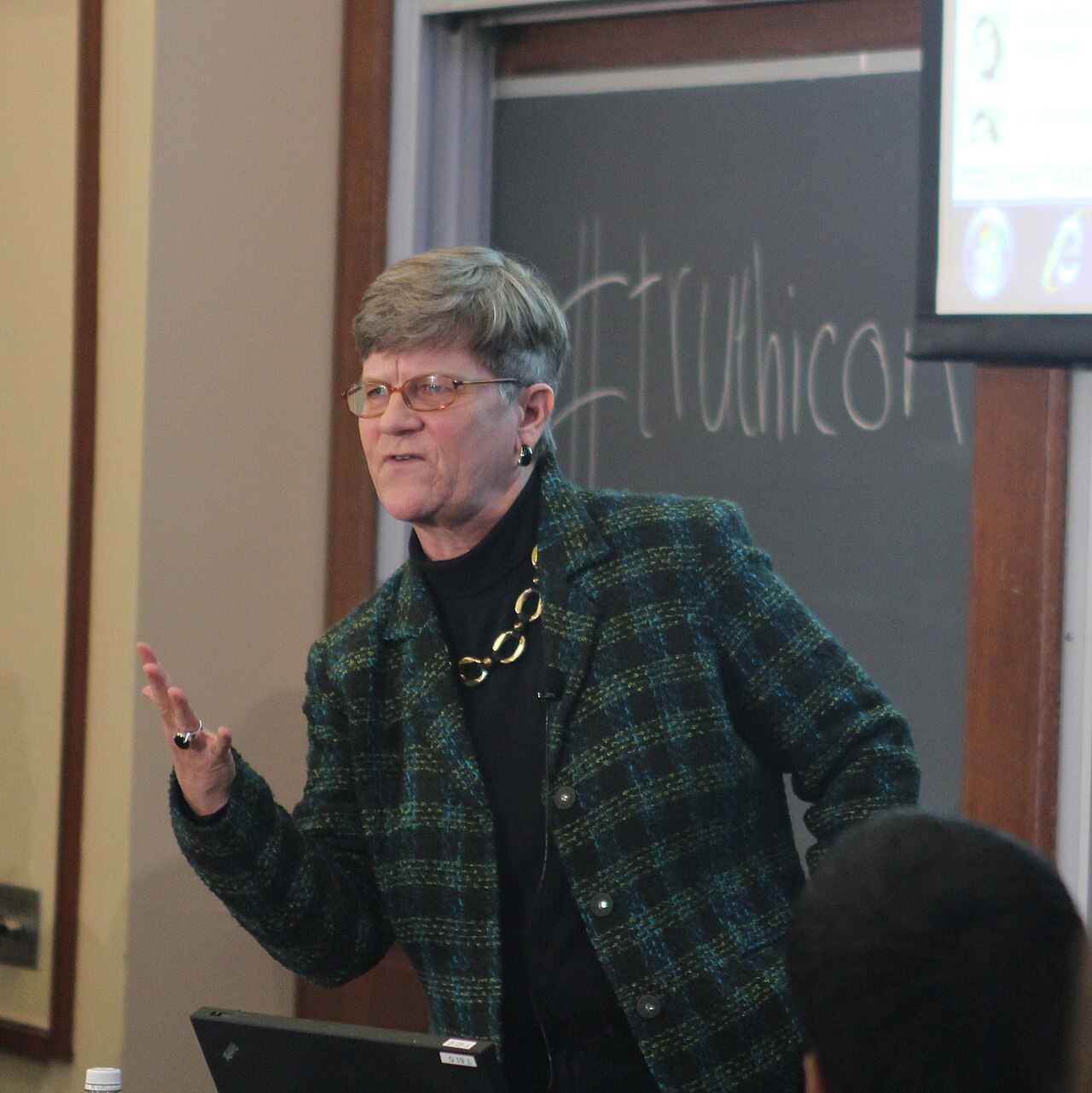
Kathleen Hall Jamieson, co-founder of FactCheck.org with Brooks Jackson, at the Berkman Center for Internet & Society, 7 March 2012. Photo: Berkman Center for Internet & Society, CC BY 2.0.
Background
- 1920s: checking before print. Time began employing checkers ("researchers") in 1923. The New Yorker started rigorous checking in 1927 after a largely invented profile of Edna St. Vincent Millay drew a legal threat from her mother (Time; Press Herald).
- 1988 to 1992: checking campaign ads on air. In the United States, Brooks Jackson traces political ad-checking to journalists' frustration with the 1988 campaign, including the "Willie Horton" ad. At CNN in 1992 he ran "Ad Police" reports on candidates' advertising (CNN; Ballotpedia).
- December 2003: FactCheck.org. Jackson and Kathleen Hall Jamieson launched FactCheck.org at the University of Pennsylvania's Annenberg Public Policy Center. Meant as a temporary 2004 project, it became permanent after the election (Penn Today).
- 2007: PolitiFact and the Fact Checker. Bill Adair and Matthew Waite launched PolitiFact at the St. Petersburg Times on 22 August 2007. It won the 2009 Pulitzer Prize for National Reporting for checking more than 750 claims in the 2008 campaign; Poynter acquired it in 2018. Michael Dobbs launched the Washington Post Fact Checker, with its "Pinocchio" scale, on 19 September 2007; Glenn Kessler revived it in 2011.
- 2010 onwards: outside the United States. Chequeado, founded in Buenos Aires in October 2010, was the first fact-checking organisation in Latin America; Africa Check became the continent's first independent fact-checker. In Brazil, Aos Fatos and Lupa check politicians' claims; Aos Fatos's director Tai Nalon faced a criminal complaint from Jornal da Cidade Online, a site Aos Fatos had investigated, which a Brazilian court declined to dismiss.
- 2016: an international code. On 15 September 2016, 35 organizations from 27 countries signed the International Fact-Checking Network (IFCN) Code of Principles, committing to nonpartisanship, transparency of sources, funding and methods, and open corrections. It now lists more than 170 verified signatories in over 80 countries.
- 2025 to 2026: contraction. The Duke Reporters' Lab counted 443 active projects in 116 countries in its 2025 census, close to 450 for several years. In 2025 about three closed for every one that opened, leaving 437 by June 2026; US projects fell from 65 to 61. Kessler took a Post buyout in July 2025, and the paper then dropped the Fact Checker column.
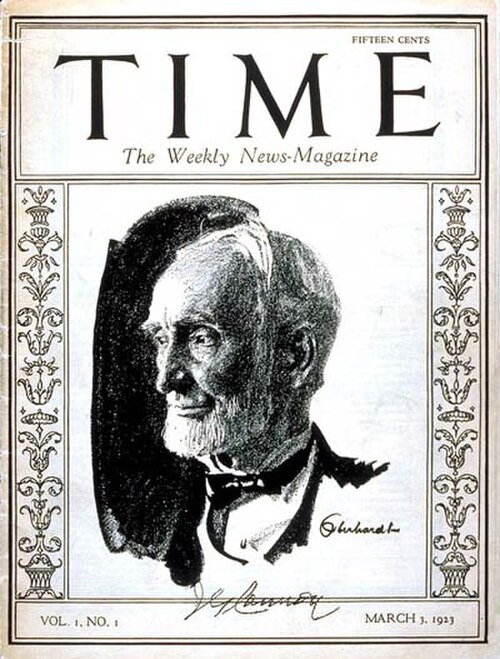
Cover of the first issue of Time, 3 March 1923 (portrait of Joseph G. Cannon by William Oberhardt). Time began employing checkers, which it called researchers, in 1923. Public domain (published in the United States before 1931), via Wikimedia Commons.
What was tried
Stand-alone sites rate claims on scales (Truth-O-Meter, Pinocchios) or in prose (FactCheck.org). PolitiFact's principles (February 2011) say it picks verifiable, significant statements likely to be repeated, that a typical person would hear and "wonder: Is that true?"
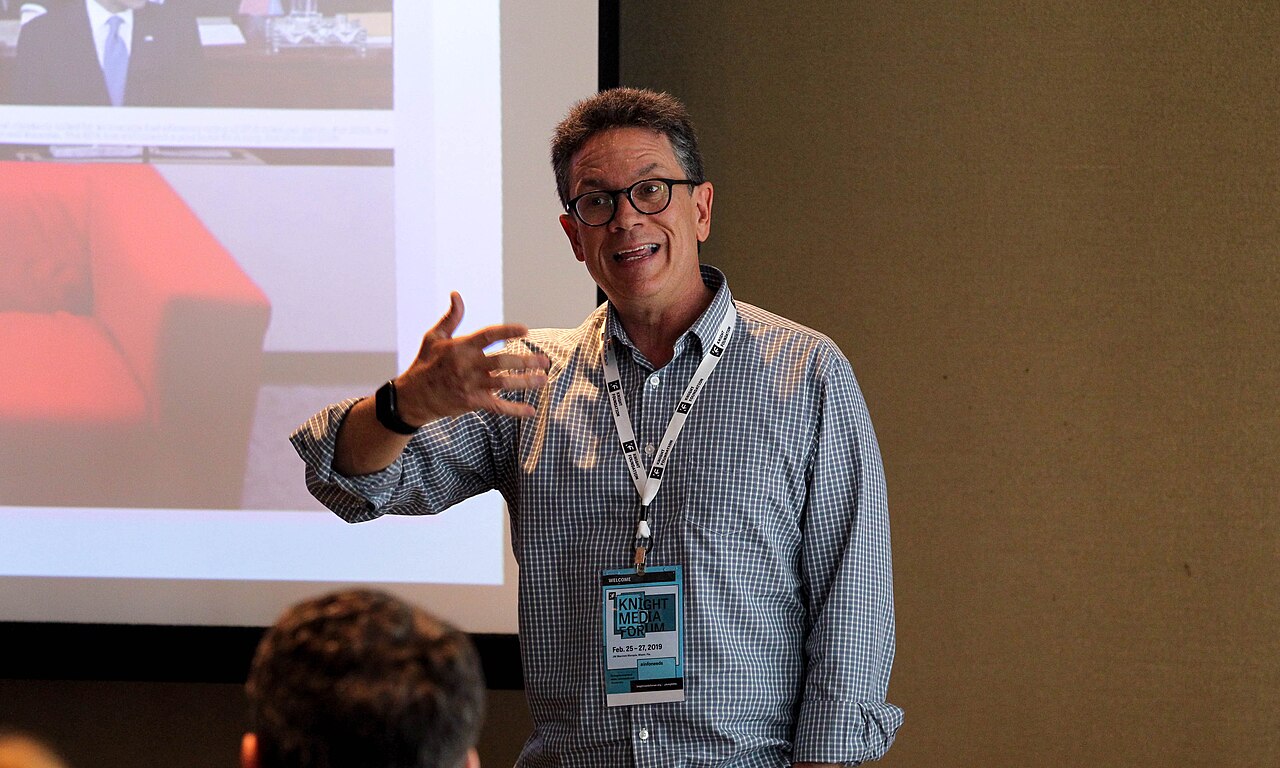
Bill Adair of Duke University, who launched PolitiFact with Matthew Waite in 2007, at the Knight Foundation Media Forum, Miami, 26 February 2019. Photo: Patrick Farrell, CC BY-SA 2.0, via Wikimedia Commons.
Platform partnerships. In December 2016 Facebook announced a third-party fact-checking program with five US partners: ABC News, the Associated Press, FactCheck.org, PolitiFact and Snopes, all IFCN signatories. Posts rated false were labeled and demoted in the News Feed; Facebook has said this cut future views "by over 80% on average." In April 2019 it added Check Your Fact, owned by the Daily Caller. IFCN surveys put Meta's program at about 45 percent of fact-checkers' income in the early 2020s.
The US exit. On 7 January 2025 Mark Zuckerberg announced that Meta would replace US fact-checkers with Community Notes, saying the fact-checkers had been "too politically biased" and had "destroyed more trust than they've created, especially in the U.S." US fact-checking ended on 7 April 2025; the change applied to the US only. See Platform interventions: labels, nudges, notes, friction and takedowns.
Measured effects
| Study | Design | N | Finding | Caveats |
|---|---|---|---|---|
| Johnson and Seifert (1994) | Lab; fictional warehouse-fire report, then a retraction | See paper | People kept using a retracted cause even when they remembered the retraction; an alternative cause reduced this on some measures | Fictional, non-political story |
| Nyhan and Reifler (2010), Political Behavior | Four experiments with mock news articles, with and without a correction | See paper | Corrections often failed to reduce misperceptions in the ideological group targeted; several cases of "backfire" (belief rose) | Backfire hard to reproduce later |
| Wood and Porter (2019), Political Behavior | Experiments on 52 polarized issues | More than 10,100 | No correction triggered backfire; people mostly accepted factual information even when it cut against their ideology | Survey experiments |
| Nyhan, Porter, Reifler and Wood (2020), Political Behavior | Fact-checks of Donald Trump's 2016 convention speech and a general-election debate | See paper | Accuracy improved, including among Trump supporters; no measurable change in attitudes toward Trump | Beliefs moved, votes and feelings did not |
| Walter, Cohen, Holbert and Morag (2020), Political Communication | Meta-analysis of 30 studies | 20,963 | Average effect on beliefs d = 0.29; weaker with truth scales, partial refutations, campaign statements, and when prior beliefs or ideology favored the claim | Lab and survey studies |
| Porter and Wood (2021), PNAS | Simultaneous experiments, 22 fact-checks, in Argentina, Nigeria, South Africa and the UK | Four national samples | False beliefs fell in every country, with little variation; most effects detectable after two weeks | Forced exposure |
| Carnahan and Bergan (2022), Political Communication | Two-wave experiment on immigration claims | See paper | Corrective effects detectable up to four weeks; repeated exposure helped | Durability vanished under a stricter definition of "misinformed" |
| Prike, Blackley, Swire-Thompson and Ecker (2023), Cognitive Research | Three experiments with stand-alone corrections of novel claims | 1,156 | No backfire immediately or after one week | Single-item measures can yield spurious backfire |
Null results, decay and critiques
- Backfire is rare. Brendan Nyhan, co-author of the 2010 study, argued in PNAS (2021) that later coverage exaggerated how general the finding was: corrections usually work somewhat, but the gains decay and can be overwhelmed by cues from political elites and media. Ecker, Lewandowsky and colleagues (Nature Reviews Psychology, 2022) also call backfire rare, possible mainly when a correction attacks a worldview.
- Continued influence. Lewandowsky, Ecker and co-authors (2012) reviewed the continued influence effect, in which retracted information keeps shaping reasoning, and set out interventions.
- Decay. A Nature Human Behaviour study of COVID-19 fact-checks in the US, Britain and Canada is titled "The ephemeral effects of fact-checks." Porter and Wood found longer-lasting effects; results vary by topic and measure.
- What was not measured. Almost all effect sizes come from experiments where participants are made to read a fact-check. Real-world reach, and effects on elections or politicians' behavior, are largely unmeasured. Facebook's 80 percent figure is the company's own.
- Which claims get checked. Lucas Graves's Deciding What's True (2016) studies from the inside how PolitiFact, FactCheck.org and the Post choose and rate claims. Chloe Lim (2018) found that only about one statement in ten was checked by both PolitiFact and the Post, and that agreement was high for clear falsehoods but much lower in the "Half True" or "Mostly False" range. Michelle Amazeen (2015, 2016) found high agreement among fact-checkers on 2008 and 2012 campaign ads. Joseph Uscinski and Ryden Butler (2013) argue that rating compound statements and predictions as single facts is unsound; Uscinski later answered Amazeen that agreement could reflect shared bias.
Who uses it and who criticises it
- Fact-checkers' position. IFCN director Angie Drobnic Holan responded to Meta in January 2025 that "fact-checking journalism has never censored or removed posts; it's added information and context to controversial claims."
- Selection-bias critics (US conservatives). Eric Ostermeier (University of Minnesota, Smart Politics, February 2011) counted more than 500 PolitiFact stories from 2010: 39 percent of Republican statements were rated "False" or "Pants on Fire" against 12 percent of Democratic ones. He asked whether this reflected selection, citing Adair's 2009 remark that "we choose to check things we are curious about." A 2013 Center for Media and Public Affairs count found a similar ratio (32 percent against 11 percent). FCC commissioner Brendan Carr wrote in November 2024 that "fact checking" groups, NewsGuard and platforms had formed a "censorship cartel."
- Selection-bias tests. K. T. Greene, J. N. Shapiro and colleagues (PNAS Nexus, 2025) found that for members of Congress in 2018 to 2021, prominence predicted being fact-checked and party did not. This tests selection, not ratings.
- Critics from the US left. Fairness & Accuracy in Reporting (FAIR) argues that fact-checkers sometimes reach for Democratic examples to appear balanced, producing what it calls nitpicking and false equivalence (see Bothsidesism). Facebook's 2019 addition of the Daily Caller's Check Your Fact drew objections; the newsletter Popular Information, for example, published a piece headlined "The Daily Caller uses status as Facebook fact-checker to boost Trump."
- Trust gap. In a Pew Research Center survey in the United States (February to March 2019), 70 percent of Republicans said fact-checkers tend to favor one side, against 29 percent of Democrats. Across the 48 markets in the Reuters Institute's 2025 Digital News Report, 25 percent of respondents said they would turn to fact-checkers to check information they thought might be wrong, behind trusted news outlets (38 percent) and official sources (35 percent).
- Critics outside the United States. In Brazil, Jair Bolsonaro and his supporters have accused fact-checkers of close ties to large newspapers and of left-leaning staff. In the Philippines, the IFCN described the Philippine government's 2022 decision to shut down Rappler, a fact-checking partner that had opposed President Duterte, as part of "draconian attacks on the press". When Brazil's federal government under President Lula launched its own "Brasil contra Fake" site in March 2023, independent checkers objected; Lupa's chief executive Natália Leal called it "discourse appropriation" of the fact-checking format. Poynter reported in 2024 on concern among fact-checkers over a global rise in government-led fact-checking initiatives (see Government fact-check units: Russia, China, India and Ukraine).
- Platform money. Snopes left Facebook's program in February 2019, calling it labor intensive; Facebook had paid it up to $100,000 in 2017. Meta's share of fact-checkers' income fell to 34.3 percent in the IFCN's report on 2025, with grants (46.2 percent) now the largest source. About three-quarters of more than 100 fact-checkers surveyed by the IFCN said they were financially vulnerable or in crisis.
- Oversight Board. In a March 2026 advisory opinion, Meta's Oversight Board said Community Notes alone were not adequate against harmful misinformation. It set about 900 visible US notes in six months against roughly 35 million EU posts labeled with fact-checkers' help over a similar period.
What the evidence supports and doesn't
- Supported: a fact-check read by a person usually shifts that person's factual belief toward accuracy, across parties and in at least five countries tested. Large backfire effects are rare.
- Supported: effects are smaller when the claim fits the reader's politics, and they fade; repetition helps.
- Not shown: that correcting a politician's claims lowers support for that politician (Nyhan et al. 2020 found no attitude change).
- Unresolved: whether ratings in the ambiguous middle are consistent across organizations, and whether the uneven rates of "False" ratings by party reflect speakers' behavior or checkers' choices.
- Unmeasured: real-world reach and effect of fact-checks at population scale.
See also
- Countering propaganda
- Inoculation and prebunking: warning before exposure rather than correcting after.
- Platform interventions: labels, nudges, notes, friction and takedowns: labels, Community Notes and the platform side of fact-checking.
- Media literacy: teaching audiences to evaluate sources.
- The debate over counter-disinformation: the wider argument over counter-disinformation work.
- Government fact-check units: Russia, China, India and Ukraine: when a state rather than a newsroom does the checking.
- World War II rumor clinics and rumor control (1940 to 1947): an earlier newspaper effort to correct rumors in print.
- Sleeper effect: why a discounted claim can outlive its correction.
See also in Learn
Images
| Image | Source | Licence |
|---|---|---|
| Kathleen Hall Jamieson, 2012 | Wikimedia Commons, Berkman Center for Internet & Society | CC BY 2.0 |
| Time, first issue cover, 3 March 1923 | Wikimedia Commons, artwork by William Oberhardt | Public domain (published in the US before 1931) |
| Bill Adair, 26 February 2019 | Wikimedia Commons, Patrick Farrell | CC BY-SA 2.0 |
.jpg)

.jpg)
Image gaps
- Rating graphics (Truth-O-Meter, Pinocchios) and Facebook's warning label: copyrighted designs, not on Commons under a free licence.
- Glenn Kessler. The only Commons photograph found is a screenshot upload (CC BY-SA 4.0, 2025) of unclear origin; not hosted.
- Brooks Jackson and CNN's 1992 "Ad Police" segments: no openly licensed image found; CNN footage is copyrighted.
Sources
- LatAm Journalism Review: How Argentine innovators created Chequeado
- Reuters Institute: The fight for facts in the Global South (Africa Check and others)
- Rappler: Brazil court denies Aos Fatos plea to dismiss criminal complaint
- Reuters Institute: Brazil's election and fact-checkers (2022)
- Poynter: IFCN statement on the Philippine decision to shut down Rappler (2022)
- LatAm Journalism Review: Brazilian government launches official fact-checking website (6 April 2023)
- Poynter: A global rise in government-led fact-checking initiatives (2024)
- Reuters Institute: How the public checks information it thinks might be wrong (Digital News Report 2025)
- Time: The history of fact-checking jobs in news journalism
- Press Herald: The New Yorker's fact-checking started with a letter from a Maine poet's mother (2025)
- CNN AllPolitics: Brooks Jackson biography
- Ballotpedia: Brooks Jackson and FactCheck.org
- Penn Today: FactCheck.org at 20
- PolitiFact: PolitiFact wins Pulitzer (2009)
- Poynter: Poynter acquires PolitiFact (2018)
- Washington Post: Happy 10th birthday, Fact Checker (2017)
- NPR: Glenn Kessler reflects on 14 years as the Post's Fact Checker (2025)
- Poynter: Fact-checkers agree on shared code of principles (2016) and IFCN Code of Principles
- Duke Reporters' Lab: 2025 census and 2026 census
- PolitiFact: Principles of PolitiFact and the Truth-O-Meter (2011)
- TechCrunch: Facebook now flags and down-ranks fake news (15 December 2016)
- Nieman Lab: Facebook partners with sites like Snopes (December 2016)
- Facebook: Hard Questions: How is Facebook's fact-checking program working? (2018)
- Media Bias/Fact Check: Check Your Fact added as Facebook fact checker (2019)
- Popular Information: The Daily Caller uses status as Facebook fact-checker to boost Trump
- Meta: More speech and fewer mistakes (7 January 2025)
- NPR: Meta says it will end fact-checking (7 January 2025)
- Fox 4: Meta to stop fact-checking in the US on April 7
- Angie Drobnic Holan statement on X (January 2025)
- The Quint: IFCN open letter to Meta
- Oversight Board: Assessing Meta's plans to expand Community Notes (2026) and Nieman Lab coverage
- IFCN: State of the Fact-Checkers report on 2025; State of the Fact-Checkers 2022
- Poynter: Snopes pulls out of its partnership with Facebook (2019); CNBC
- Johnson and Seifert (1994) replication, Acta Psychologica
- Nyhan and Reifler (2010), When Corrections Fail
- Wood and Porter (2019), The Elusive Backfire Effect
- Nyhan, Porter, Reifler and Wood (2020), Taking Fact-Checks Literally But Not Seriously?
- Walter, Cohen, Holbert and Morag (2020), Fact-Checking: A Meta-Analysis
- Porter and Wood (2021), The global effectiveness of fact-checking, PNAS
- Carnahan and Bergan (2022), Correcting the Misinformed
- Prike et al. (2023), Examining the replicability of backfire effects after standalone corrections
- Nyhan (2021), Why the backfire effect does not explain the durability of political misperceptions, PNAS
- Lewandowsky et al. (2012), Misinformation and Its Correction
- Ecker et al. (2022), The psychological drivers of misinformation belief and its resistance to correction
- Nature Human Behaviour: The ephemeral effects of fact-checks on COVID-19 misperceptions
- Lucas Graves, Deciding What's True (Columbia University Press, 2016)
- Lim (2018), Checking how fact-checkers check
- Ballotpedia: Academic studies of political fact-checking (Amazeen)
- Uscinski and Butler (2013), The Epistemology of Fact Checking and rejoinder to Amazeen (2015)
- Ostermeier (2011), Selection Bias? PolitiFact Rates Republican Statements as False at 3 Times the Rate of Democrats
- Center for Media and Public Affairs: Media fact-checker says Republicans lie more (2013)
- Brendan Carr on X (November 2024)
- Greene, Pisharody, Carroll and Shapiro (2025), Fact-checks focus on famous politicians, not partisans, PNAS Nexus
- FAIR: 'Opinions Differ' Should Be the Start of PolitiFact's Job and FAIR fact-checking archive
- Pew Research Center: Republicans far more likely to say fact-checkers favor one side (2019)