In one line: in 2015 EU leaders asked the EU's diplomatic service to "challenge Russia's ongoing disinformation campaigns"; the small team it set up built EUvsDisinfo, a public database of pro-Kremlin claims that grew past 18,000 entries, was sued by three Dutch outlets it had wrongly listed, was questioned by the EU's own auditors on its independence, and fed into the later "FIMI" threat reports.
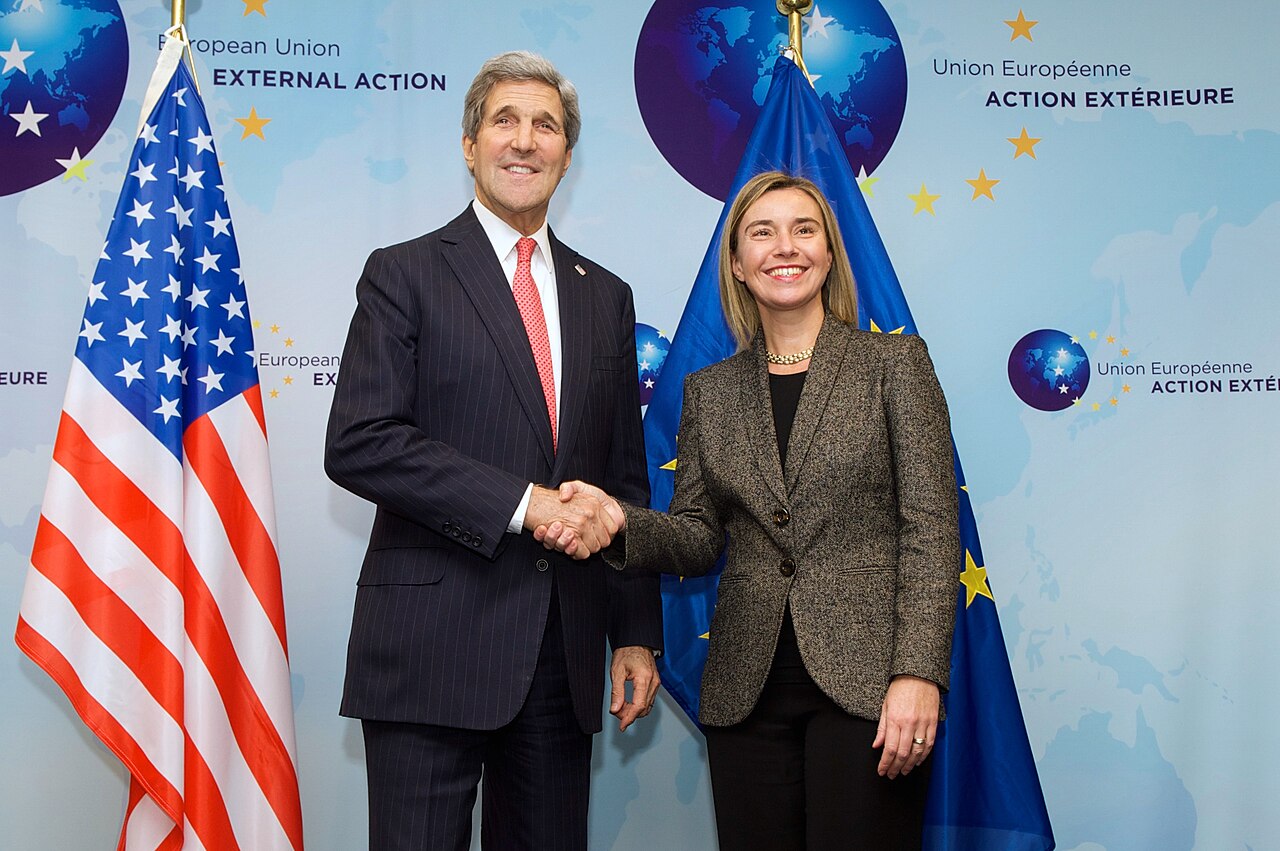
EU High Representative Federica Mogherini (right) with US Secretary of State John Kerry at EEAS headquarters, Brussels, 3 December 2014. Mogherini was the official the European Council asked in March 2015 to prepare the strategic communication action plan. Photo: U.S. Department of State, public domain.
What happened
- 19 to 20 March 2015. The European Council stresses "the need to challenge Russia's ongoing disinformation campaigns" and invites the High Representative, with member states and EU institutions, to prepare an action plan on strategic communication by June. It calls the setting up of a communication team a first step.
- June 2015. The EEAS presents the Action Plan on Strategic Communication. It has three aims: communicate EU policies in the Eastern neighbourhood, strengthen the wider media environment there, and improve the EU's capacity to forecast and respond to disinformation.
- November 2015. The team launches the weekly Disinformation Review in English and Russian, its main awareness product.
- 2015 to 2017. Jakub Kalenský, an early member, has said that for roughly the first year he was the only team member working solely on disinformation. In March 2017 more than 120 people from government, media, security and civil society sign an open letter calling the EU "irresponsibly weak" on disinformation.
- 2018. A European Parliament briefing describes a 14-strong team with no budget of its own, drawing on seconded national staff. The Parliament then funds it directly (see budget below).
- February to March 2018. Three Dutch publishers, GeenStijl, The Post Online (TPO) and the publisher of the regional daily De Gelderlander, sue the EU in Amsterdam over their inclusion in the database. On 6 March 2018 the Dutch lower house passes a motion asking the government to press for EUvsDisinfo to be shut down. EUvsDisinfo removes the three cases and changes its wording. The court hearing set for 14 March does not go ahead.
- 2021. The European Court of Auditors publishes Special Report 09/2021, Disinformation affecting the EU: tackled but not tamed, which reviews the task forces and the database.
- 27 February to 2 March 2022. After Russia's full-scale invasion of Ukraine, Commission President Ursula von der Leyen announces that the EU will "ban in the EU the Kremlin's media machine". The Council suspends the broadcasting of RT and Sputnik (Regulation (EU) 2022/350). This sanctions measure is separate from the Task Force.
- February 2023 onward. The EEAS publishes annual reports on "Foreign Information Manipulation and Interference" (FIMI) threats, which widen the scope from Russia to China and other actors.

The Tweede Kamer (Dutch House of Representatives) building at Lange Poten, The Hague, 1 December 2019. On 6 March 2018 the House passed a motion asking the government to press for EUvsDisinfo to be shut down. Photo: Steven Lek (Tukka), CC BY-SA 4.0, via Wikimedia Commons.
How it worked
Staff and money. The team began on seconded staff and existing communication budgets. The EEAS states that it received €1.1 million in 2018 from a European Parliament preparatory action, €3 million in 2019 and €4 million in 2020. The Court of Auditors found that for 2021 the EEAS Strategic Communications division had €11.1 million for work on disinformation and strategic communication, and that funding for the StratCom task forces had risen nearly fourfold since the 2018 EU action plan. The auditors also found that staffing still depended heavily on national secondments and that recruitment targets had not been met.
The database. EUvsDisinfo collects individual media items, articles, broadcasts and posts, that it judges to give "a partial, distorted, or false depiction of reality" and to spread key pro-Kremlin messages. Each entry summarises the item and gives a "disproof". The project says it excludes clearly labelled satire but includes claims made on talk shows even when they are presented as opinion. Reported sizes over time:
| Date | Reported size | Source |
|---|---|---|
| December 2019 | more than 7,000 cases, about 40% targeting Ukraine | Euromaidan Press, reporting EUvsDisinfo |
| 13 September 2022 | 14,382 records (Jan 2015 to Sep 2022) | Kaggle dataset scraped from the database (third-party count) |
| Undated EU data portal entry | more than 13,000 cases, more than 5,500 about Ukraine | data.europa.eu |
| As read in September 2026 | "over 18,000" samples | EUvsDisinfo About page |
The counts measure how many items the team logged, not how much disinformation circulated.
What it was countering. The mandate named Russia's disinformation campaigns, and the database logs pro-Kremlin messages in EU languages and in Russian. From 2023 the FIMI reports describe the target as behaviour (coordinated, deceptive activity by foreign actors) rather than only false content, and add China.
FIMI reports. The 1st EEAS FIMI report (February 2023) applied a new analytic framework to a sample of 100 incidents from October to December 2022. It reported Chinese state media amplifying selected pro-Kremlin narratives, such as claims of US military "biolabs" in Ukraine. The 2nd report (January 2024) covered 750 incidents from 1 December 2022 to 30 November 2023, named Ukraine as the main target and counted 149 targeted organisations. The 3rd report (March 2025) covered 505 incidents from 4 November 2023 to 4 November 2024, involving about 38,000 channels on 25 platforms, and reported that Russian actors targeted the 2024 European elections.
Measured effect
- No causal evaluation of EUvsDisinfo's effect on audiences was found. No published study measures whether readers of the Disinformation Review or the database became less likely to believe the claims it listed.
- The Court of Auditors' view. The auditors judged that the database "has helped raise awareness" of Russian disinformation. That is an assessment by auditors, not a measured change in belief.
- Use as data. Researchers have built on the database, for example a 2024 multilingual detection dataset (ACM CIKM). This shows reuse, not effect, and inherits any labelling errors.
- The RT and Sputnik suspension. In November 2022 the German fact-checking outlet Correctiv documented how RT DE continued to reach German audiences through simple workarounds. The Institute for Strategic Dialogue also examined what the ban meant for platform regulation. No study found here measures how far the ban reduced exposure overall.
Positions on the record
- The EEAS and the Task Force. The EEAS describes EUvsDisinfo as its flagship project to forecast, address and respond to Russian disinformation. After the Dutch complaints it said the three articles had been "wrongly included". It replaced the label "disinforming outlet" with "outlet where the disinformation appeared" and pointed to its disclaimer that listing an item does not mean the outlet is linked to the Kremlin, is pro-Kremlin, or meant to disinform.
- Supporters. The March 2017 open letter argued the EU was doing too little. RFE/RL reported the European Parliament pressing for more money to fight Russian disinformation. An EUobserver opinion piece in 2018 argued the site "must be strengthened, not abolished".
- Dutch critics (2018). The three publishers argued they had been wrongly labelled. Lawyers for De Gelderlander said the complaint that it had reported a press conference "uncritically" showed "the EU wants to control information". NL Times reported that VVD member Dilan Yeşilgöz and SP member Peter Kwint said EUvsDisinfo "misses its target" and "meddles with the free press in the Netherlands". The PVV, GroenLinks and SGP also backed scrapping it. Journalist and democracy campaigner Arjen Nijeboer wrote in EUobserver (28 March 2018) that a listing amounts to an official EU label of disinformation and that the state should not interfere with free media.
- EU auditors. The Court of Auditors wrote that the database's placement inside the EEAS "raises some questions about its independence and ultimate purpose, as it could be perceived as representing the EU's official position". It asked whether such a tool should be run by a public authority or by civil society.
- Russian government and state media. RT France called the 2022 suspension "censorship". Sputnik said the Commission should "ban the internet altogether". After the EU General Court upheld the ban, Al Jazeera reported that Kremlin spokesman Dmitry Peskov said Russia would take similar measures against Western media. This page did not find a verified Russian Foreign Ministry statement aimed specifically at the Task Force. The database itself logs a pro-Kremlin claim that the Task Force was created because Russian media were gaining credibility in the West.
- Press-freedom critics of the 2022 ban. The European Federation of Journalists said that "combating disinformation with censorship is a mistake". Columbia University's Global Freedom of Expression project called the ban "a step in the wrong direction", and a Media@LSE blog post called it "understandable, but still wrong". On the other side, a Verfassungsblog analysis argued it was a lawful measure against propaganda for war. On 27 July 2022 the General Court (Grand Chamber) dismissed RT France's challenge (case T-125/22). It held that the Council had power to adopt the measure and, given the war, did not have to hear RT France first.
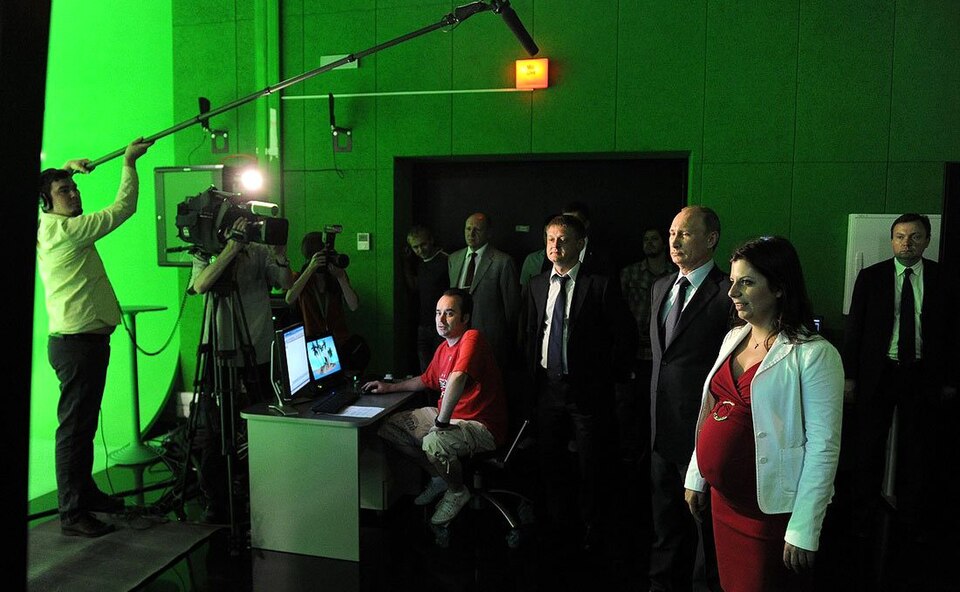
Russian President Vladimir Putin and RT editor-in-chief Margarita Simonyan (right) in a studio at the channel's new broadcasting centre, Moscow, 11 June 2013. RT and Sputnik are the outlets the EU suspended in 2022 (Regulation 2022/350). Photo: kremlin.ru, CC BY 4.0 (dual-licensed CC BY 3.0/4.0 on Commons).

Towers of the Court of Justice of the European Union, Kirchberg, Luxembourg, 28 April 2022. On 27 July 2022 the General Court, part of this institution, dismissed RT France's challenge to the broadcast suspension (case T-125/22). Photo: Alf van Beem, CC0, via Wikimedia Commons.
Same-method test
A foreign ministry that kept a public list of named Western outlets' articles marked as false, run by a team inside the ministry, would be scored here the same way: a state body labelling media output, with the independence question the EU auditors raised. The differences in this case are documented, not assumed. EUvsDisinfo labels carried no legal penalty, and the listed Dutch outlets could and did go to a domestic court. A national parliament voted against the project, and the entries were removed. The RT and Sputnik suspension did carry legal force, and it was reviewed and upheld by an EU court. Comparable bodies elsewhere are set side by side in Government fact-check units: Russia, China, India and Ukraine.
What the record shows and doesn't
- Documented: the 2015 mandate; the team's small start; the budget rise from €1.1 million (2018) to €11.1 million for the division (2021); the database's growth past 18,000 entries; the three wrongly included Dutch articles, the lawsuit, the Dutch parliament's motion and the change of wording; the auditors' independence concern; the FIMI report counts; the 2022 ban and the court ruling upholding it.
- Not shown: that the database or the Disinformation Review changed what audiences believe; how many other entries are wrong (the Dutch cases were caught because the outlets complained); how far the 2022 ban reduced exposure to RT and Sputnik.
- Frames, not findings: "an EU censorship office" and "Europe's only defence against Kremlin lies" are both arguments laid over this record.
See also
- Government fact-check units: Russia, China, India and Ukraine, Baltic counter-disinformation: Estonia, Latvia and Lithuania, Laws against "fake news": Germany, France and Malaysia under one standard
- The State Department's Global Engagement Center (2016 to 2025), The UK's Counter Disinformation Unit and its sister units (2019 to 2024)
- Fact-checking and corrections, The debate over counter-disinformation
- Countering propaganda
See also in Learn
Images
| Image | Source | Licence |
|---|---|---|
| Mogherini and Kerry at EEAS headquarters, 3 December 2014 | Wikimedia Commons, U.S. Department of State | Public domain (US government work) |
| Tweede Kamer building, The Hague, 2019 | Wikimedia Commons, Steven Lek (Tukka) | CC BY-SA 4.0 |
| Putin and Simonyan at the RT broadcasting centre, 2013 | Wikimedia Commons, kremlin.ru | CC BY 4.0 (kremlin.ru) |
| CJEU towers, Luxembourg, 2022 | Wikimedia Commons, Alf van Beem | CC0 |
.jpg)


Image gaps
- Screenshots of EUvsDisinfo, the Disinformation Review or a database entry. EEAS web content is not clearly under an open licence that covers a screenshot, and the site could not be reached from the environment used to build this page. Not included.
- Photos of the Task Force team. No openly licensed photo was found. The Dutch House of Representatives building (where the March 2018 motion passed) and the EU court complex are hosted above; no photo of the debate itself was cleared.
- RT and Sputnik branding. Non-free logos; not included.
Sources
- EEAS, Questions and Answers about the East StratCom Task Force
- EUvsDisinfo, "To challenge Russia's ongoing disinformation campaigns": the story of EUvsDisinfo
- European Parliament briefing, Online disinformation and the EU's response (2018)
- European Court of Auditors, Special Report 09/2021: Disinformation affecting the EU: tackled but not tamed
- RFE/RL, European Parliament presses for more money to fight Russian disinformation
- Radio Prague International, interview with Jakub Kalenský
- EUvsDisinfo, About and Database
- Euromaidan Press, EU vs Disinfo registered 7,000 pro-Kremlin disinformation cases (10 December 2019)
- Kaggle, EUvsDisinfo Disinformation Database
- data.europa.eu, EUvsDisinfo: Disinformation Cases about Ukraine
- EUvsDisinfo, Removal of three cases further to complaints by Dutch media
- EUvsDisinfo, Change of terminology in the EUvsDisinfo database
- Poynter, Three publications are suing the EU over fake news allegations (2018)
- DutchNews.nl, Dutch media outlets take EU to court over disinformation claims (February 2018)
- Lead Stories, EUvsDisinfo publicly retracts disinformation labels (March 2018)
- NL Times, Dutch politicians want EU anti-fake news watchdog scrapped (6 March 2018)
- Arjen Nijeboer, Why the EU must close EUvsDisinfo, EUobserver (28 March 2018)
- EUobserver, EUvsDisinfo site must be strengthened, not abolished
- EUvsDisinfo database entry: "The East StratCom Task Force was established because of the increasing credibility of the Russian media in the West"
- EEAS, 1st Report on FIMI Threats (February 2023)
- EEAS, 2nd Report on FIMI Threats (January 2024)
- EEAS, 3rd Report on FIMI Threats (March 2025)
- EUvsDisinfo: a Dataset for Multilingual Detection of Pro-Kremlin Disinformation in News Articles (CIKM 2024)
- Council of the EU press release, 2 March 2022: sanctions on RT/Russia Today and Sputnik's broadcasting
- Council Regulation (EU) 2022/350
- Euronews, EU officials defend move to ban RT and Sputnik amid censorship claims (8 March 2022)
- Global Freedom of Expression (Columbia), EU silences Russian state media: a step in the wrong direction
- Media@LSE, Understandable, but still wrong (10 June 2022)
- Verfassungsblog, The EU's "ban" of RT and Sputnik: a lawful measure against propaganda for war
- General Court, Case T-125/22 RT France v Council (27 July 2022) and IRIS Merlin summary
- Al Jazeera, European court upholds broadcasting ban on Russia's RT (27 July 2022)
- Correctiv, How RT DE circumvents the EU sanctions (17 November 2022)
- ISD, Banning RT and Sputnik across Europe