Content note. This case quotes the labels the martial-law authorities used for the people of Gwangju ("rioters", "impure elements", "sleeper spies") and the later label "Gwangsu" for people in 1980 photographs. It describes soldiers killing civilians and gives death tolls. The labels are quoted as evidence of the method. They are not this archive's description of anyone.
In one line: as troops put down the Gwangju uprising, censors let the national press print the Martial Law Command's account, which called protesters rioters and impure elements and blamed outside agitators and spies; local journalists resigned, a citizens' bulletin carried another account, and the spy claim, revived decades later, led to a defamation conviction and was found groundless.
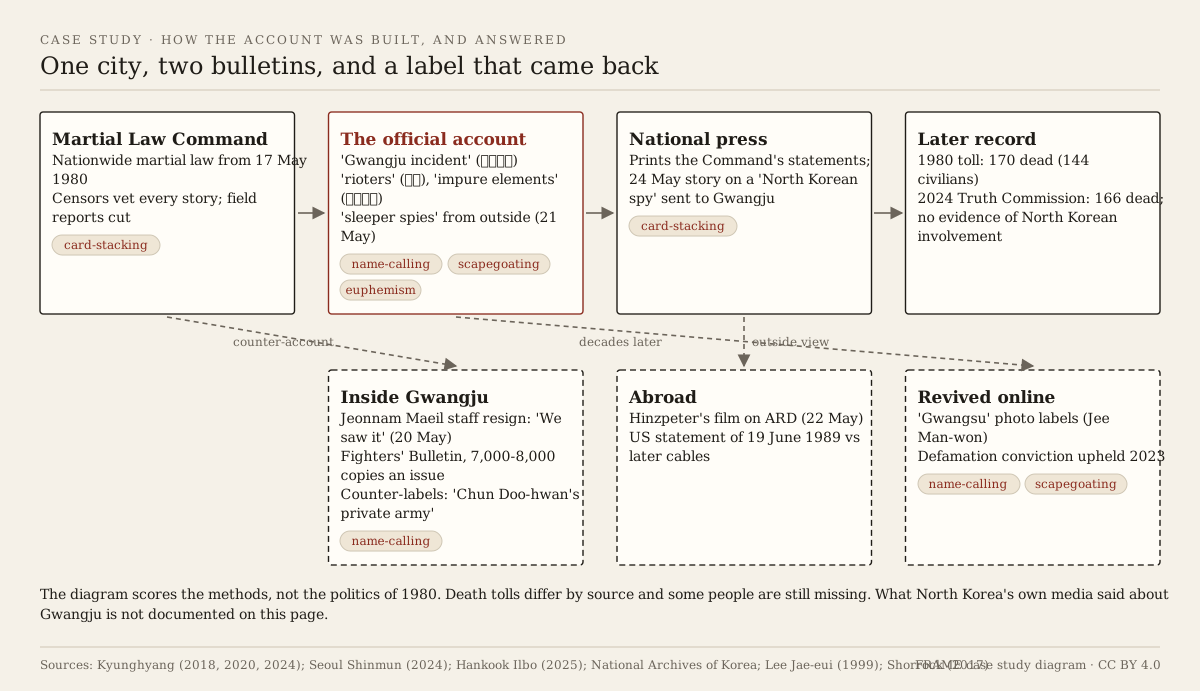
What happened
- 17-18 May 1980. Martial law, in force since 27 October 1979 (Hankook Ilbo, 2025), is extended nationwide. In Gwangju, protests against the military leadership around Chun Doo-hwan meet airborne troops (Library of Congress; OhmyNews, 2021). The city is cut off and placed under curfew (English Wikipedia, "Jürgen Hinzpeter").
- Censorship. The Martial Law Command's press-censorship team vets every story. In Gwangju a censors' office inside the South Jeolla provincial hall bars all reporting on the events (OhmyNews, 2021). Between October 1979 and January 1981 the censors deleted 352 Hankook Ilbo manuscripts, including field reports from Gwangju (Hankook Ilbo, 2025).
- 20 May: "We saw it." Journalists at the Jeonnam Maeil Shinmun resign together. Their statement, written by reporter Park Hwa-gang, begins "우리는 보았다" ("We saw it"). It says they saw people dragged off and killed, could not print a line of it, and ends: "이에 우리는 부끄러워 붓을 놓는다" ("So, ashamed, we put down our pens") (Kukmin Ilbo; Newsis, 2014).
- 21 May: the official account. Martial Law Commander Lee Hee-sung issues a statement, printed in the national papers on 22 May, that the unrest was driven by "타지역 불순인물 및 고정간첩" ("impure persons from other regions and sleeper spies") who, it says, had infiltrated to spread malicious rumours, destroy public facilities and set fires as planned incitement. The Command's statements call the protesters "폭도" (rioters) and "불순분자" (impure elements), and name the events the "광주사태" ("Gwangju incident"). The same day troops open fire in the city (Noh, 2015). That evening Lee reads a second statement warning that troops will invoke their "자위권" ("right of self-defence") (National Archives of Korea; Korean Wikipedia). At the 1996 trial prosecutors said Chun's Defense Security Command had drafted it, and Lee said he could not rule that out (Hankook Ilbo, 1996).
- The press. Newspapers stay silent at first, then print the Command's statements (Kyunghyang, 2018; CCDM, 2025). On 24 May Kyunghyang Shinmun reports the arrest in Seoul of an alleged North Korean spy, Lee Chang-yong, said to have been sent to Gwangju to incite an armed revolt. In 2007 a Defense Ministry truth commission found no evidence that he took part in the events or tried to enter Gwangju. On 27 May the paper reports that troops had worked for a peaceful resolution; a 2018 Defense Ministry inquiry found that commanders had drawn up several plans for retaking the city (Kyunghyang, 2020).
- Inside the city. From 21 May, activists at the Deulbul night school print the Tusa Hoebo (투사회보, "Fighters' Bulletin"). Yun Sang-won and Jeon Yong-ho wrote the text and Park Yong-jun copied it out by hand for the mimeograph. Each issue ran to 7,000-8,000 copies; the eighth came out on 25 May. Lee Jae-eui describes it as carrying news the official media did not. Both men were killed on 27 May, when troops retook the city (Digital Gwangju Culture Encyclopedia; Lee, 1999). The citizens' leadership described the military leadership as "유신잔당" ("Yushin remnants") and the paratroopers as "전두환의 사병" ("Chun Doo-hwan's private army") (Korean Wikipedia).
- Abroad. ARD's Tokyo-based cameraman Jürgen Hinzpeter enters Gwangju on 20 May. His film is flown out and airs on the Tagesschau in West Germany on 22 May (English Wikipedia, "Jürgen Hinzpeter"; Korea.net). Foreign reporting carries the story abroad; domestic papers do not (Library of Congress).
- 31 May. The Martial Law Command gives 170 dead: 144 civilians, 22 soldiers and 4 police (English Wikipedia, citing the Command's figures).
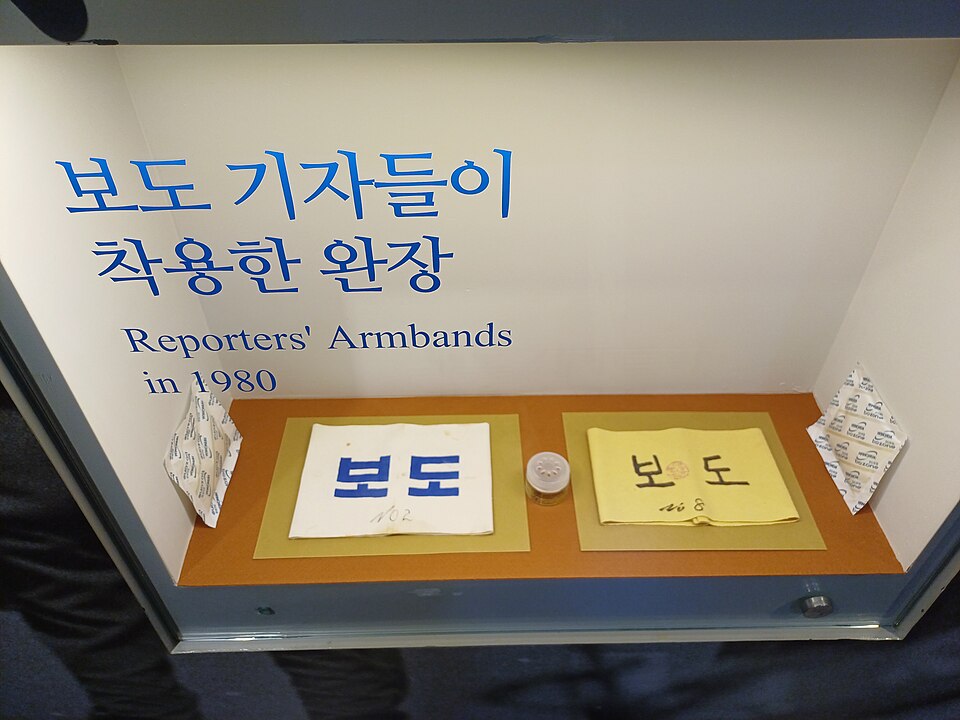
Two armbands reading 보도 ("press") worn by reporters in May 1980, in a museum display. Photo by Wikimedia user Kimge2020, 2025, CC BY-SA 4.0. Shown because reporters in Gwangju could gather news but not publish it.
Later record
- 1989. After National Assembly hearings on Gwangju that began in 1988 (Library of Congress), the U.S. government submits written answers instead of testifying, and on 19 June 1989 states the United States "had neither authority over nor prior knowledge of the movement of the Special Warfare Command units to Kwangju" (Shorrock, 38 North). Cables later obtained by journalist Tim Shorrock appeared to contradict parts of it, and the State Department acknowledged an "apparent discrepancy" while defending the statement's conclusions (Shorrock Files).
- 1996-97. Chun Doo-hwan and his successor Roh Tae-woo are tried and convicted over the 1979 coup and May 1980. Both are pardoned in December 1997 (Korea Democracy Foundation archive).
- 2016-2023. Commentator Jee Man-won says North Korean special forces directed the uprising. He labels people in 1980 photographs "광수" ("Gwangsu", plus a number) and says they are North Korean officers. Indicted in 2016 for defamation, including of the Justice and Peace Committee of the Roman Catholic Archdiocese of Gwangju, he is sentenced to two years in February 2020; the Supreme Court upholds the sentence on 12 January 2023. The court said his conduct aimed not at establishing historical truth but at belittling the movement (English Wikipedia; Seoul Shinmun, 2023).
- January 2021. An amendment to the May 18 special act comes into force, making spreading false facts about the movement a crime punishable by prison (Special Act on the May 18 Democratization Movement, Article 8).
- 3 April 2024. The May 18 Democratization Movement Truth Commission, set up under a 2018 special act, concludes that the North Korean infiltration claims are groundless. Claims that people in 1980 photographs were North Korean soldiers were found false, as was a claimed North Korean attack on the Gwangju prison with 475 dead. A defector who said he had infiltrated Gwangju told the commission he had made it up. National Intelligence Service files, declassified U.S. documents and Unification Ministry holdings gave no support to the claim (Kyunghyang, 2024; Edaily).
- 24 June 2024. The commission's final report counts 166 dead during the uprising, including 71 civilians killed as troops sealed off the city's outskirts. It establishes the cause and place of death for 104 people whose deaths the 1995 prosecution inquiry had not properly examined, and it reconfirms helicopter fire on civilians (Seoul Shinmun, 2024).
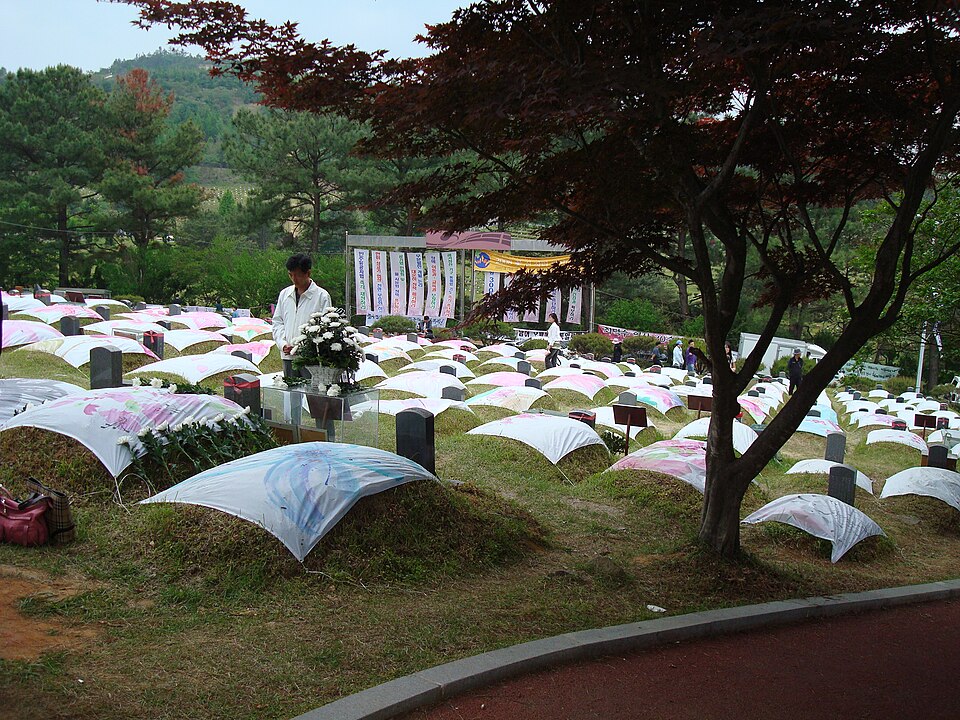
The Mangwol-dong cemetery in Gwangju, where victims of May 1980 were buried, on the anniversary in 2008. Photo by Wikimedia user Rhythm, CC BY-SA 3.0.
How it works
- Name-calling: "폭도" (rioters) and "불순분자" (impure elements) reached readers without the field reports on what troops had done, which the censors cut. The label stood in for the evidence. The revival works the same way: "Gwangsu" plus a number turns a photographed resident into a North Korean officer before any identification. The citizens' side also used labels, "Yushin remnants" and "Chun Doo-hwan's private army". The scale differed: one set ran through every national newspaper under censorship, the other through a mimeographed bulletin in one city.
- Scapegoating: the 21 May statement put the cause of the unrest on "impure persons from other regions and sleeper spies", a bounded outside group, rather than on the residents and the troops. The 24 May spy story gave the claim a name and a face. A 2007 Defense Ministry commission found no link between that man and Gwangju. The 2024 Truth Commission found no evidence of North Korean involvement.
- Card stacking: censors removed field reports and newspapers printed the Command's statements. Readers outside Gwangju got the Command's selection of facts and little else. The 27 May story about a peaceful resolution left out the retaking plans documented in 2018. The Jeonnam Maeil journalists wrote that they had seen the killings and could not print a line.
- Euphemism / doublespeak: the "Gwangju incident" (광주사태) named a military operation that killed civilians. A warning that troops would invoke their "right of self-defence" was issued on the evening of the day troops had opened fire in the city.
Then and now
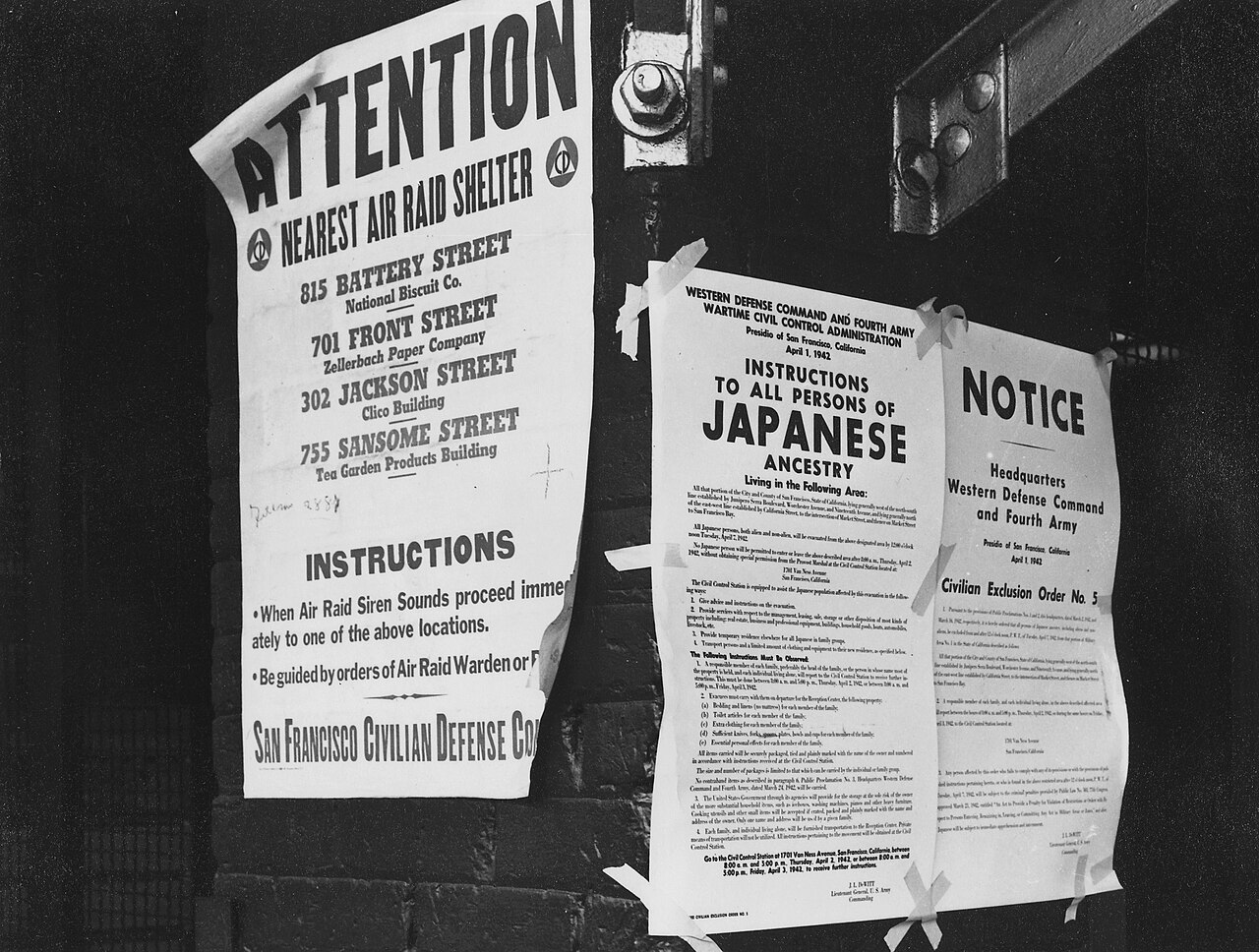
'Instructions to All Persons of Japanese Ancestry' (exclusion order posted in San Francisco), U.S. Army Western Defense Command, 1942. Photo by Dorothea Lange for the War Relocation Authority. Public domain.
A different country, era and outcome, with one shared feature: a government used force against its own residents in the name of security, and a later government commission rejected its stated reasons. The U.S. commission of 1983 found the removal driven by "race prejudice, war hysteria and a failure of political leadership". Korea's 2024 commission found the North Korean spy claim groundless. The differences are large. The 1942 orders removed about 120,000 people to camps; in Gwangju troops killed civilians during ten days of fighting and blockade. The U.S. orders were a published policy; the Gwangju framing ran under press censorship.
In May 2026, a fake newspaper page styled as a 1980 Gwangju Ilbo, a paper that did not exist in 1980, spread online with the North Korean spy claim. It was reported as AI-made, and police opened an investigation (Nate News, 2026).
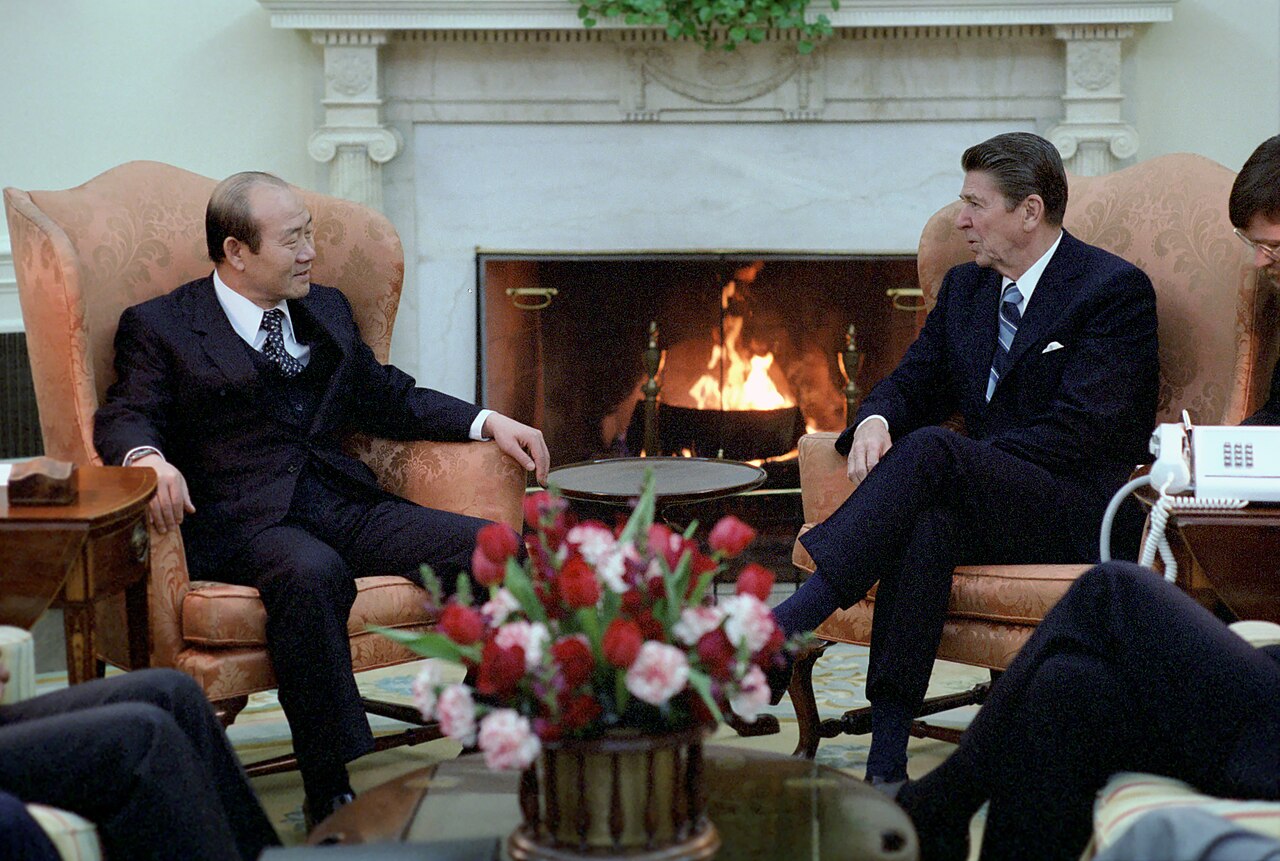
Chun Doo-hwan, by then president, meets Ronald Reagan in the Oval Office, 2 February 1981. White House photograph, Ronald Reagan Presidential Library. Public domain (U.S. government work). Shown because the U.S. government's own account of its role in 1980, published in 1989, is part of the record on this page. Reagan took office in January 1981, after the events.
Positions on the record
- The Martial Law Command (1980): impure elements and spies from outside stirred the unrest; troops would invoke their right of self-defence.
- The Jeonnam Maeil journalists and the citizens' bulletin (1980): troops were killing people and the press could not report it.
- U.S. government (1989): it had neither authority over nor prior knowledge of the special-forces deployment. Critics cite later cables that appear to contradict parts of this.
- Proponents of the North Korean infiltration claim: Jee Man-won and others say North Korean forces directed the uprising and that the official history is wrong. The East Asia Research Center reported a January 2023 ruling as a court imprisoning a retired army colonel and Vietnam War veteran "for saying North Korea was involved" (EARC, 2023).
- What is documented: nationwide martial law and censorship; the 21 May statements and labels; the 24 May spy story and the 2007 finding against it; the journalists' resignation; the Tusa Hoebo; the 1980 official toll; the 1996-97 convictions; Jee's defamation conviction; the 2024 commission findings.
- What is not shown / disputed: the full toll. The 1980 figure was 170 dead including soldiers and police; the commission counts 166 dead during the uprising; the government-recognised toll cited by VOA is 165, while residents believe more than 300 died and dozens are still missing (VOA); critics citing foreign press reports have given 1,000-2,000 (English Wikipedia). None of these is settled here. Also not documented on this page: what North Korea's own state media said about Gwangju in 1980 and after, and the exact wording of each Tusa Hoebo issue.
Same-method test
The finding does not depend on the flag. The U.S. Army Western Defense Command's 1942 exclusion orders, whose security rationale a 1983 U.S. commission rejected, are scored with the same definitions here. Any government, Western or not, that labelled protesting citizens rioters and foreign agents, censored field reports and called a lethal operation an "incident" would be tagged the same way. So would any campaign, of any political side, that relabels people in news photographs as enemy soldiers.
How to spot it
- When officials blame unrest on "outside" agitators or spies, ask for names, charges and evidence, and check whether any later court or commission confirmed them.
- When only one side's statements appear in print, look for what censors removed: resignation letters, deleted manuscripts, foreign footage, local bulletins.
- Treat a photo labelled "enemy soldier" as a claim about identity. Ask who identified the person, how, and whether the person or their family has been found.
Images
| Image | Source | Licence |
|---|---|---|
| Mechanism diagram (above) | Drawn for FRAME from the sources below (make_diagrams.py) |
CC BY 4.0, FRAME |
| Reporters' armbands, 1980 (museum display) | Wikimedia Commons, Kimge2020 | CC BY-SA 4.0 |
| Mangwol-dong cemetery, 2008 | Wikimedia Commons, Rhythm | CC BY-SA 3.0 |
| Chun Doo-hwan and Ronald Reagan, 2 February 1981 | Wikimedia Commons, Ronald Reagan Presidential Library | Public domain (U.S. government work) |
| Instructions to All Persons of Japanese Ancestry (1942) | FRAME gallery | Public domain (U.S. government work) |


.jpg)
Image gaps
- The Martial Law Command's statements and the censored front pages of May 1980. Not included: no openly licensed scans were found. The statements are held by the National Archives of Korea; Korean government works under KOGL Type 1 could fill this gap if a scan is released under it. Possibly fillable.
- The Tusa Hoebo leaflets and the Jeonnam Maeil resignation statement. Not included: their authors' works are still in copyright and no open licence was found. Not fillable without a licence from the rights holders.
- Photographs and film from May 1980, including Hinzpeter's footage and Na Gyeong-taek's Jeonnam Maeil negatives. Not included: copyrighted. A Commons photo of Na's negatives in a museum case exists, but the negatives are themselves copyrighted photographs, so it was left out.
- The 1989 U.S. government statement and the declassified cables. U.S. government works and public domain, but no scan could be reached from the environment used to build this page. Fillable.
- North Korean state media on Gwangju. Not included: not sourced here, and DPRK works are not safely public domain in the U.S.
Sources
- Library of Congress, "Kwangju Uprising (1980)", South Korean Democratization Movement research guide
- Kyunghyang Shinmun, 18 May 2020: correcting its own May 1980 Gwangju stories after 40 years
- Kyunghyang Shinmun, 17 May 2018: how newspapers distorted "May in Gwangju" in 1980
- Kyunghyang Shinmun, 3 April 2024: Truth Commission finds no evidence for the North Korean infiltration claim
- Seoul Shinmun, 24 June 2024: the commission's final report
- Edaily: defector admits his claim to have been a North Korean soldier in Gwangju was false
- Hankook Ilbo, 2 December 2025: 352 articles deleted by martial-law censors
- Kukmin Ilbo, undated: "Ashamed, we put down our pens", a newspaper's resignation letter
- Newsis, 31 August 2014: "We saw it", dismissed journalists' testimony
- OhmyNews, 25 November 2021: the journalists of May 1980 and the censors' office
- Citizens' Coalition for Democratic Media (CCDM), newsletter, Summer 2025: the press in 1980 and the journalists who resisted.
- Hankook Ilbo, 7 May 1996: Lee Hee-sung at the 5·18 trial on the Defense Security Command's role in the self-defence statement
- National Archives of Korea, 5·18 exhibition: Martial Law Commander Lee Hee-sung's statement
- Noh Young-ki (노영기), "1980년 5월 21일 계엄군의 발포와 희생" (The martial-law troops' firing and the victims of 21 May 1980), 민주주의와 인권 (Democracy and Human Rights), 2015 (KCI)
- Korean Wikipedia, "5·18 광주 민주화 운동"
- Digital Gwangju Culture Encyclopedia, 『투사회보』
- Lee Jae-eui, Kwangju Diary: Beyond Death, Beyond the Darkness of the Age, trans. Kap Su Seol and Nick Mamatas (Los Angeles: UCLA Asian Pacific Monograph Series, 1999).
- English Wikipedia, "Jürgen Hinzpeter"
- Korea.net: In memoriam, Hinzpeter's Gwangju exhibit
- English Wikipedia, "Gwangju Uprising"
- VOA: As South Koreans reexamine a 1980 massacre, some ask US to do the same
- Tim Shorrock, "The Gwangju Uprising and North Korea: What We Can Learn From Declassified Documents", 38 North, October 2017
- The Shorrock Files: "5.18: Turning Point in the Cold War in Asia" (the Cherokee files and the State Department's response)
- The Shorrock Files: Gwangju 5.18 documents
- U.S. Department of State, "United States Government Statement on the Events in Kwangju, Republic of Korea, in May 1980", 19 June 1989.
- Korea Democracy Foundation open archive: prosecution of those responsible for 12.12 and 5.18
- English Wikipedia, "Jee Man-won"
- Seoul Shinmun, 12 January 2023: Supreme Court confirms Jee Man-won's two-year sentence
- Seoul Shinmun, 13 February 2020: Jee Man-won sentenced to two years at first instance
- East Asia Research Center, 17 January 2023: court imprisons retired colonel over North Korea claim
- Nate News, 21 May 2026: AI-made fake 1980 "Gwangju Ilbo" spreads the North Korean spy claim
- Nate News, 22 May 2026: police open an investigation into the AI-made fake Gwangju Ilbo
- Special Act on the May 18 Democratization Movement (5·18민주화운동 등에 관한 특별법), Article 8, as amended in force from January 2021.