In one line: from August 2017 to the end of 2018 a think-tank dashboard charted what a private list of about 600 Twitter accounts was sharing; press coverage often turned its charts into "Russian bots" stories, and Twitter staff privately concluded that most accounts on the list were ordinary users, a finding that became public only in January 2023.
What happened
- July 2017. The Alliance for Securing Democracy (ASD) launches at the German Marshall Fund of the United States (GMF). It is directed by Laura Rosenberger, a former foreign policy adviser to Hillary Clinton's 2016 campaign, and Jamie Fly, a former adviser to Senator Marco Rubio. Its advisory council includes Bill Kristol, Michael Morell and Michael McFaul (GMF launch notice; Hewlett Foundation Q&A; Wikipedia).
- 2 August 2017. ASD publishes Hamilton 68: A New Tool to Track Russian Disinformation on Twitter. GMF says the name refers to Federalist No. 68, in which Alexander Hamilton wrote of protecting the electoral process from foreign meddling (ASD; GMF). The Foreign Policy Research Institute (FPRI) announces that its fellow Clint Watts, a former FBI special agent, and colleagues have launched it (FPRI).
- October 2017. According to the Twitter Files, Yoel Roth, later Twitter's head of trust and safety, reverse-engineers the monitored list from the dashboard's requests to Twitter's API and finds 644 accounts. He writes internally: "I think we need to just call this out on the bullshit it is" (Tablet; The Federalist).
- 19 January 2018. Axios reports, citing Hamilton 68, that the monitored network's use of #ReleaseTheMemo rose 233,000 percent in 48 hours (Axios).
- January 2018. Senator Dianne Feinstein and Representative Adam Schiff ask Twitter and Facebook for a forensic examination of the hashtag: "If these reports are accurate, we are witnessing an ongoing attack by the Russian government through Kremlin-linked social media actors directly acting to intervene and influence our democratic process" (Feinstein press release; House Intelligence Committee Democrats). The Daily Beast reports a source saying Twitter's internal analysis found the hashtag "organically American" (Daily Beast).
- 28 February 2018. BuzzFeed News publishes Stop Blaming Russian Bots For Everything by Miriam Elder and Charlie Warzel. It traces most "Russian bot" stories to Hamilton 68 and quotes Watts: "I'm not convinced on this bot thing." He calls the narrative "overdone" (BuzzFeed News).
- April 2018. FAIR (5 April) reports that outlets kept citing the dashboard weeks after its own team had in effect told reporters to stop writing such stories. ASD's communications director Bret Schafer tells the Daily Caller (9 April) that headlines like "Russian bots are pushing X" are "inherently inaccurate" because "bots are only a small portion of the network that we monitor" (FAIR; Daily Caller).
- End of 2018. ASD retires Hamilton 68. From 2019 its Hamilton 2.0 dashboard tracks messaging from Chinese, Iranian and Russian state media and government officials (GMF; ASD).
- 27 January 2023. Matt Taibbi publishes the Hamilton 68 material as the fifteenth "Twitter Files" thread, Move Over, Jayson Blair: Twitter Files Expose Next Great Media Fraud (Twitter Files; Scheerpost reprint). ASD answers with a fact sheet (ASD).
- 18 May 2023. The Washington Post says a review found "some imprecision" in how seven of its articles and a Post newsletter described Hamilton 68, and corrects them (Washington Post).
- 4 December 2025. ASD and ISD-US announce a merger under the ISD-US name, effective 1 January 2026 (ISD).
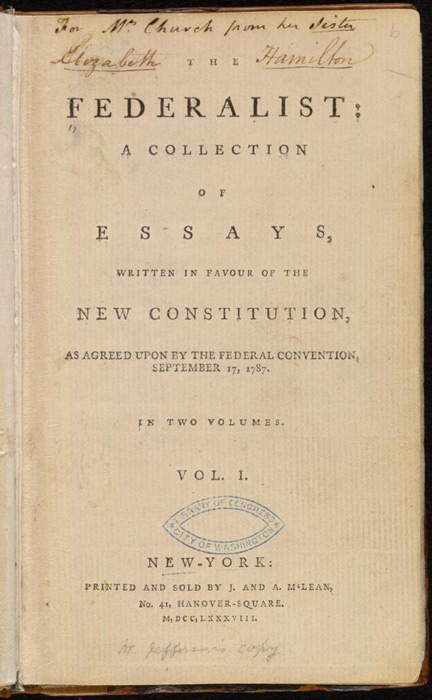 Title page of the first edition of The Federalist, volume I (New York: J. and A. M'Lean, 1788), the collection that includes No. 68, after which the dashboard was named. Public domain, via Wikimedia Commons.
How it worked
- What was on screen. A public web page charting the hashtags, topics and links that a monitored network of about 600 accounts was sharing, in near real time. The list itself was kept confidential.
- Who built it. FPRI credits Watts and colleagues; BuzzFeed names Watts and J.M. Berger among the founders. ASD's methodology paper sets out Berger's approach (ASD methodology). Taibbi writes that the dashboard was designed by Jonathon Morgan of the company New Knowledge (Racket).
- How accounts were chosen. The methodology describes three groups: overtly pro-Russian and Russian government-affiliated accounts such as RT and Sputnik; bots and human accounts run by troll operations; and people around the world "who amplify pro-Russian themes either knowingly or unknowingly." Suspected automated accounts were found with an "Influence-Outlier" metric Berger had developed, which flags accounts disproportionately engaged with the network relative to their follower counts (ASD methodology).
- What it did not do. ASD says: "The Hamilton 68 team did not individually review or verify all accounts because the focus of the dashboard was to analyze behavior in aggregate networks, not specific accounts." Berger said the team deliberately made no characterisation of individual users and kept the list private so others would not either (ASD fact sheet).
- How it was used. Outlets including the Washington Post and Axios quoted dashboard trends as evidence of Russian activity on U.S. topics, and Taibbi reports that the New York Times used it as the sole source for a story on Parkland shooting hashtags (Racket). The dashboard's name, its "Russian influence" framing and its hidden list made the charts easy to report as "Russian bots" and hard for anyone outside to check.
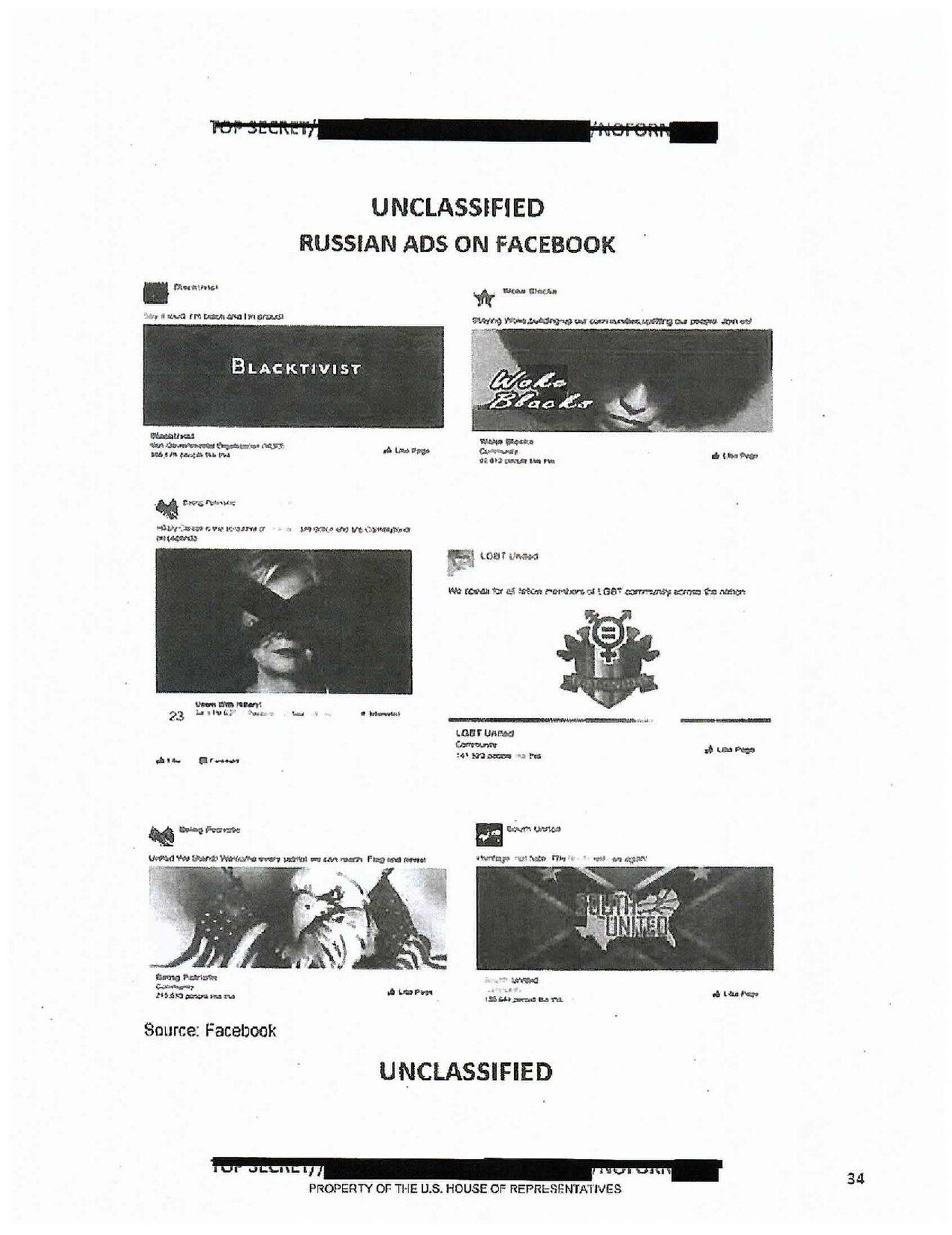
'Russian Ads on Facebook' (House Intelligence Committee exhibit), House Intelligence Committee report, 2018. Facebook pages the Internet Research Agency ran while posing as American communities, aimed at both left and right identities. This is a different operation on a different platform from Hamilton 68's Twitter list; it illustrates the "troll operation" category in the dashboard's method, not the dashboard's own list, which was never published.
Measured effect
- On its stated aim. This page found no independent audit of the dashboard's accuracy published while it ran. The only account-level review on the record is Twitter's internal one, released in 2023: of 644 accounts, 36 were registered in Russia, 86 percent were English-language, and most were "legitimate people" in the United States, Canada and Britain. The internal report says the accounts "are neither strongly Russian nor strongly bots" and that there was "no evidence to support the statement that the dashboard is a finger on the pulse of Russian information ops" (Reason; Fox News). ASD says this does not test its tool, since it never said the accounts were bots or Russian.
- On #ReleaseTheMemo. ASD's fact sheet says Kremlin-oriented accounts were heavily engaged but "likely represented a very, very small percentage of the overall engagement with the hashtag" (ASD fact sheet).
- On public understanding. No study measured whether the dashboard improved or distorted readers' understanding. The documented outcome is in the press record: one major paper corrected seven articles and a newsletter, and the dashboard's own staff said much coverage mischaracterised it. ASD itself says its data was often "misunderstood or misrepresented" (Insider via Yahoo).
Positions on the record
- ASD. The dashboard was "an analysis of networks that (1) reliably amplified Russian propaganda and disinformation, either wittingly or unwittingly." "Some accounts we track are automated bots, some are trolls, and some are real users. Some are in Russia, but many are not." Americans were included "not because they were labelled by analysts as being a bot or even Russian," but because the analysis placed them in a network that promoted or engaged with Russian propaganda aimed at Americans (ASD fact sheet). ASD also published How to Interpret the Hamilton 68 Dashboard: Key Points and Clarifications (ASD).
- Twitter staff (internal, 2017 to 2018). Roth wrote that the dashboard "falsely accuses a bunch of legitimate right-leaning accounts of being Russian bots" and, in January 2018, that it "promotes polarization and distrust through its shoddy methodology" and that "Real people need to know they've been unilaterally labeled Russian stooges without evidence or recourse." He proposed an ultimatum: "you release the list or we do" (Insider via Yahoo; Sinclair/KATV; The Federalist). Tablet notes that neither Roth nor anyone else at Twitter said this publicly at the time (Tablet).
- Critics on the left. James Carden wrote in The Nation (7 August 2017) that the project "seeks to police and narrow the scope of acceptable political discourse" (The Nation). AlterNet's Grayzone Project criticised Berger and Morgan in McCarthyism Inc (November 2017) (The Grayzone). FAIR criticised outlets for citing the dashboard after its own team's caution. Glenn Greenwald also criticised the project (Wikipedia). The Real News Network ran Hamilton 68: How former intelligence officials and Democratic operatives conspired to manufacture "Russiagate" (Real News). Joe Lauria, editor of Consortium News, was on the list and said such organisations "are in business to enforce an official narrative" (Consortium News).
- Critics on the right and libertarian side. Taibbi called the dashboard "digital McCarthyism." Reason's headline said Twitter employees "knew the media's favorite Russian bots list was fake" (Reason). The conservative commentator Dennis Michael Lynch and the writer David Horowitz were among the accounts Taibbi named (Consortium News).
- Defence of the dashboard in the press. Sinclair's national desk ran Twitter Files 15 furthers the misunderstanding of Hamilton 68, arguing that ASD had flagged the nuance all along (Sinclair/KATV).
- The Russian side. Sputnik criticised the dashboard in August 2017, as FPRI itself reported (FPRI). RT treated the 2018 BuzzFeed piece as vindication in The Great Russian Bot Panic (RT).
Twitter's headquarters at Market Square, 1355 Market Street, San Francisco, 28 August 2016. The internal Twitter review of the monitored list was released in 2023 (see "Measured effect"). Photo: Tobias Kleinlercher, CC BY-SA 3.0, via Wikimedia Commons.
Same-method test
Suppose a state-linked institute in Moscow or Beijing ran a live dashboard of what "accounts linked to U.S. influence activities" were posting, kept the list secret, included local users who shared U.S. outlets' content, and let its media cite the charts as "American bots". This archive would score it the same way: the aggregate method can be defended as network research, but a hidden list under a nation-linked label leaves the people on it no way to contest it and the public no way to check the label. The differences should be stated plainly: ASD was a non-governmental think tank, it published its methodology, and its own staff (Watts, Schafer) warned in public against the "bot" reading.
What the record shows and doesn't
- Documented. The dashboard's launch, stated aim and retirement. Its three-group method and ASD's statement that accounts were not individually verified. The hidden list. Twitter's internal counts (644, 36, 86 percent) and Roth's emails. The Feinstein-Schiff letter. The Washington Post's corrections. The move to Hamilton 2.0, which tracks named state-media and government accounts.
- Argued, not settled. Whether Hamilton 68 was "fraud" (Taibbi) or honest network research that journalists misreported (ASD, Sinclair). Whether Twitter's internal review tested ASD's actual claim (a network amplifying Russian themes) or a stronger claim ASD says it never made (that the accounts were Russian or bots). How much of the result lies with the tool's design and name, and how much with the reporting.
- Not shown. Any measurement of how the dashboard affected public belief, or of harm to named account holders beyond their own statements.
See also
- The debate over counter-disinformation
- Platform interventions: labels, nudges, notes, friction and takedowns
- The State Department's Global Engagement Center (2016 to 2025)
- The DHS Disinformation Governance Board (2022)
- The Active Measures Working Group (1981 to 1992)
- Countering propaganda
See also in Learn
Images
| Image | Source | Licence |
|---|---|---|
| Title page of The Federalist, vol. I, 1788 | Wikimedia Commons | Public domain (published 1788) |
| Twitter headquarters, San Francisco, 2016 | Wikimedia Commons, Tobias Kleinlercher | CC BY-SA 3.0 |
_-_02.jpg)
.JPG)
Image gaps
- The dashboard itself (2017 to 2018). Screenshots are copyrighted to ASD/GMF and no openly licensed capture was found on Wikimedia Commons.
- Roth's internal emails. Published as screenshots in Taibbi's threads; copyright status unclear, not hosted.
- Photos of the dashboard team or Twitter staff. No openly licensed photo was found; the Twitter headquarters photo above shows only the building.
- Portraits of the people involved. Not attempted: the Commons API was rate-limiting requests, and a portrait adds little to a page about a method.
Sources
- ASD, Fact sheet: Hamilton 68 Dashboard (2017-2018)
- ASD, The Methodology of the Hamilton 68 Dashboard
- ASD, How to Interpret the Hamilton 68 Dashboard: Key Points and Clarifications
- ASD, Hamilton 68: A New Tool to Track Russian Disinformation on Twitter (2 August 2017)
- GMF, "Alliance for Securing Democracy" Launches at GMF
- GMF, The Alliance for Securing Democracy Launches Hamilton 2.0 Dashboard
- ASD, Hamilton 2.0 Methodology & FAQs
- ISD, ISD-US and the Alliance for Securing Democracy announce merger (4 December 2025)
- Hewlett Foundation, Q&A with Laura Rosenberger and Jamie Fly
- FPRI, Fox Fellow Clint Watts and Colleagues Launch Hamilton 68 (August 2017)
- FPRI, Fox Fellow Clint Watts's Bot-Tracking Website Criticized by Russian-Controlled Sputnik News (August 2017)
- Axios, Russian Twitter bots jump on #ReleaseTheMemo (19 January 2018)
- Senator Dianne Feinstein, Feinstein, Schiff Request Twitter and Facebook Conduct Investigation of Russian Bot Activity in #ReleaseTheMemo Campaign
- House Intelligence Committee Democrats, the same letter
- Daily Beast, Source: Twitter Pins #ReleaseTheMemo on Republicans, Not Russia
- BuzzFeed News, Stop Blaming Russian Bots For Everything (28 February 2018)
- FAIR, Media Warn of "Russian Bots", Despite Primary Source's Disavowal (5 April 2018)
- Daily Caller, "We Don't Track Bots": What The Media's Russian Bot Coverage Is Getting All Wrong (9 April 2018)
- The Nation, James Carden, Our Russia Fixation Is Devolving Into an Assault on Political Discourse (7 August 2017)
- The Grayzone, McCarthyism Inc (10 November 2017)
- Matt Taibbi, Move Over, Jayson Blair: Twitter Files Expose Next Great Media Fraud (27 January 2023); Scheerpost reprint (28 January 2023)
- Matt Taibbi, CTI Files #4: The Hamilton 68 Connection (Racket)
- Reason, Twitter Files: Employees knew the media's favorite Russian bots list was fake (27 January 2023)
- Consortium News, CN Editor Named on Secret "Disinfo" List (27 January 2023)
- Fox News, Latest Twitter Files show media, Dems relied on single source alleging "Russian bot" activity
- The Federalist, The Astounding Saga Of Hamilton 68 (31 January 2023); Twitter, Media, And Dems Are All Guilty (1 February 2023)
- Tablet, A Guide to Understanding the Hoax of the Century
- Insider via Yahoo News, Here's what we know about Hamilton 68
- Sinclair/KATV, Twitter Files 15 furthers the misunderstanding of Hamilton 68
- The Real News Network, Hamilton 68: How former intelligence officials and Democratic operatives conspired to manufacture "Russiagate"
- Washington Post, The Post issues minor corrections in coverage of Hamilton 68 (18 May 2023)
- RT, The Great Russian Bot Panic (March 2018)
- Wikipedia, Alliance for Securing Democracy