In one line: a State Department office set up to counter terrorist, then Russian and Chinese, propaganda abroad; it published reports and funded outside groups, drew a lawsuit and congressional investigations over its grants (one $100,000 sub-grant reached the Global Disinformation Index, a group that also rated U.S. media), lost its legal authority in December 2024, and its successor office was closed in April 2025.
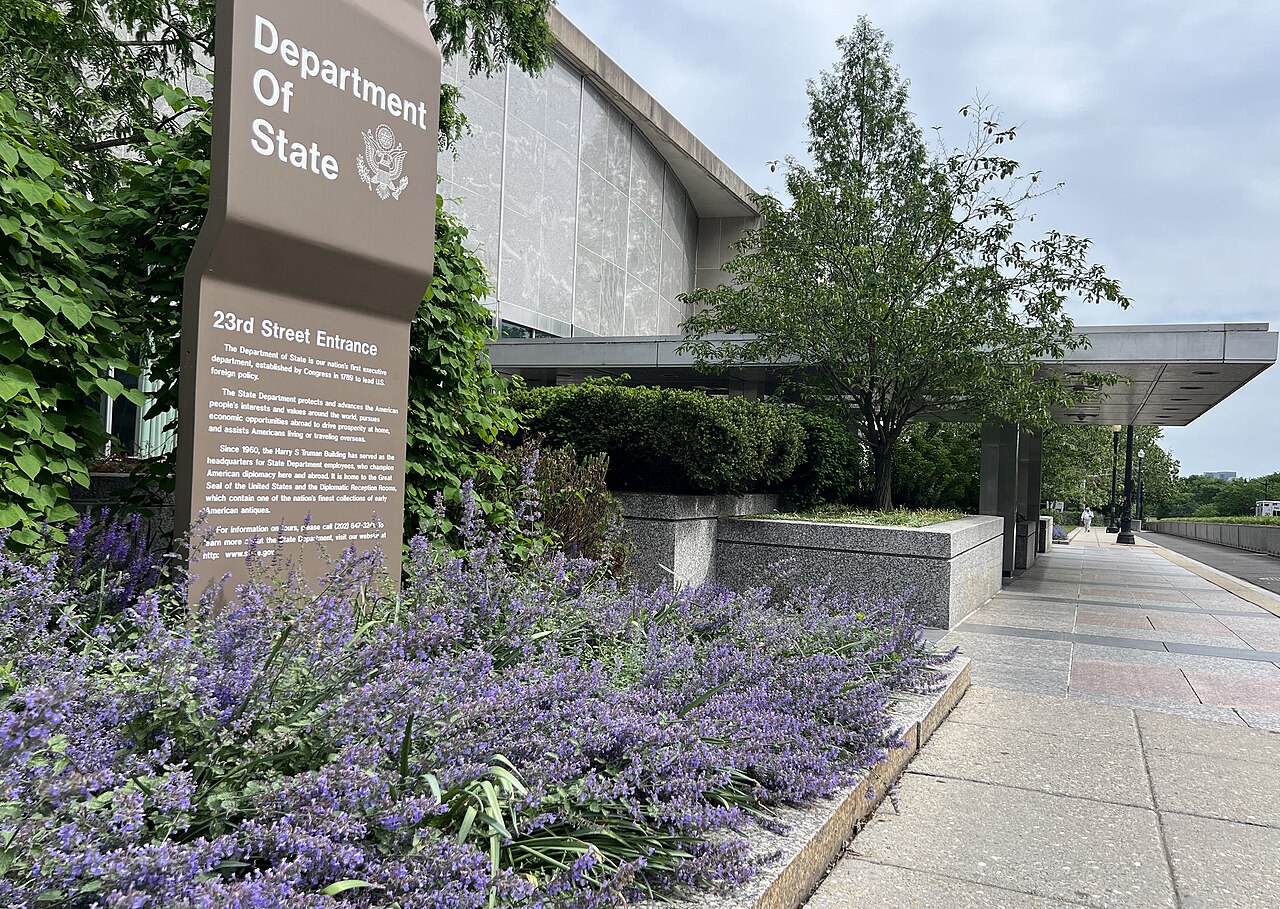
The Harry S. Truman Building, State Department headquarters, where the GEC was housed. Official State Department photo by Linda D. Epstein, May 2024. Public domain (U.S. government work).
What happened
- 2011. Executive Order 13584 creates the Center for Strategic Counterterrorism Communications (CSCC) inside the State Department.
- 14 March 2016. President Obama signs Executive Order 13721, "Developing an Integrated Global Engagement Center to Support Government-wide Counterterrorism Communications Activities Directed Abroad." It revokes EO 13584 and turns the CSCC into the GEC. The Congressional Research Service (CRS) says the counterterrorism mission stayed largely unchanged. A 2016 State Department fact sheet describes the new approach as "partner-driven messaging and data analytics."
- FY2017 NDAA. The Countering Foreign Propaganda and Disinformation Act, from Senators Rob Portman (R-OH) and Chris Murphy (D-CT), passes as part of the FY2017 National Defense Authorization Act. It gives the GEC a statutory mission to "recognize, understand, expose, and counter foreign state and non-state propaganda and disinformation efforts" aimed at the United States, its allies and partners, and creates a grant program for NGOs, think tanks, civil society and outside experts.
- 2017. Politico, CNN and Newsweek report that Secretary of State Rex Tillerson has not unlocked nearly $80 million meant for the center: $60 million parked at the Pentagon and $19.8 million at State. A Politico source said adviser R.C. Hammond argued that spending it would needle Russia; Hammond denied saying this to CNN. State officials said the delay was part of a broader policy review.
- 26 February 2018. State signs a memorandum of agreement with the Pentagon to transfer $40 million to the GEC, partly for grants to civil society groups, media, academic institutions and companies.
- 5 August 2020. The GEC publishes Pillars of Russia's Disinformation and Propaganda Ecosystem (77 pages).
- 2021. The Global Disinformation Index (GDI), a London-based group, receives a $100,000 sub-grant from a GEC implementing partner, according to the State Department. The Washington Examiner reports that the money came through Disinfo Cloud, a GEC platform run by Park Advisors.
- 28 September 2023. The GEC publishes How the People's Republic of China Seeks to Reshape the Global Information Environment.
- 6 December 2023. The Daily Wire, The Federalist and the State of Texas, represented by the New Civil Liberties Alliance (NCLA), sue the State Department in the Eastern District of Texas.
- 7 May 2024. Judge Jeremy D. Kernodle rules that the plaintiffs "have satisfied their burden to demonstrate standing at this stage." He dismisses one of five counts (the Administrative Procedure Act claim) and denies the rest of the motion to dismiss and the motion to transfer.
- 21 to 23 December 2024. A provision extending the GEC's authority to 2031 is dropped from the final defense bill. The continuing appropriations act passed on 21 December contains no reauthorization. CRS reports the GEC's statutory authority terminated on 23 December 2024. State reorganizes the work into an office called Counter Foreign Information Manipulation and Interference (R/FIMI).
- 16 April 2025. Secretary of State Marco Rubio closes R/FIMI.
- September 2025. State announces it is ceasing what it calls "censorship frameworks," including a framework the GEC first launched against foreign information manipulation. The Hill reports this as State halting "all frameworks" to counter foreign misinformation.
- April 2026. A federal judge enters a consent decree settling the Daily Wire suit. The plaintiffs act as compliance monitors until 2036.
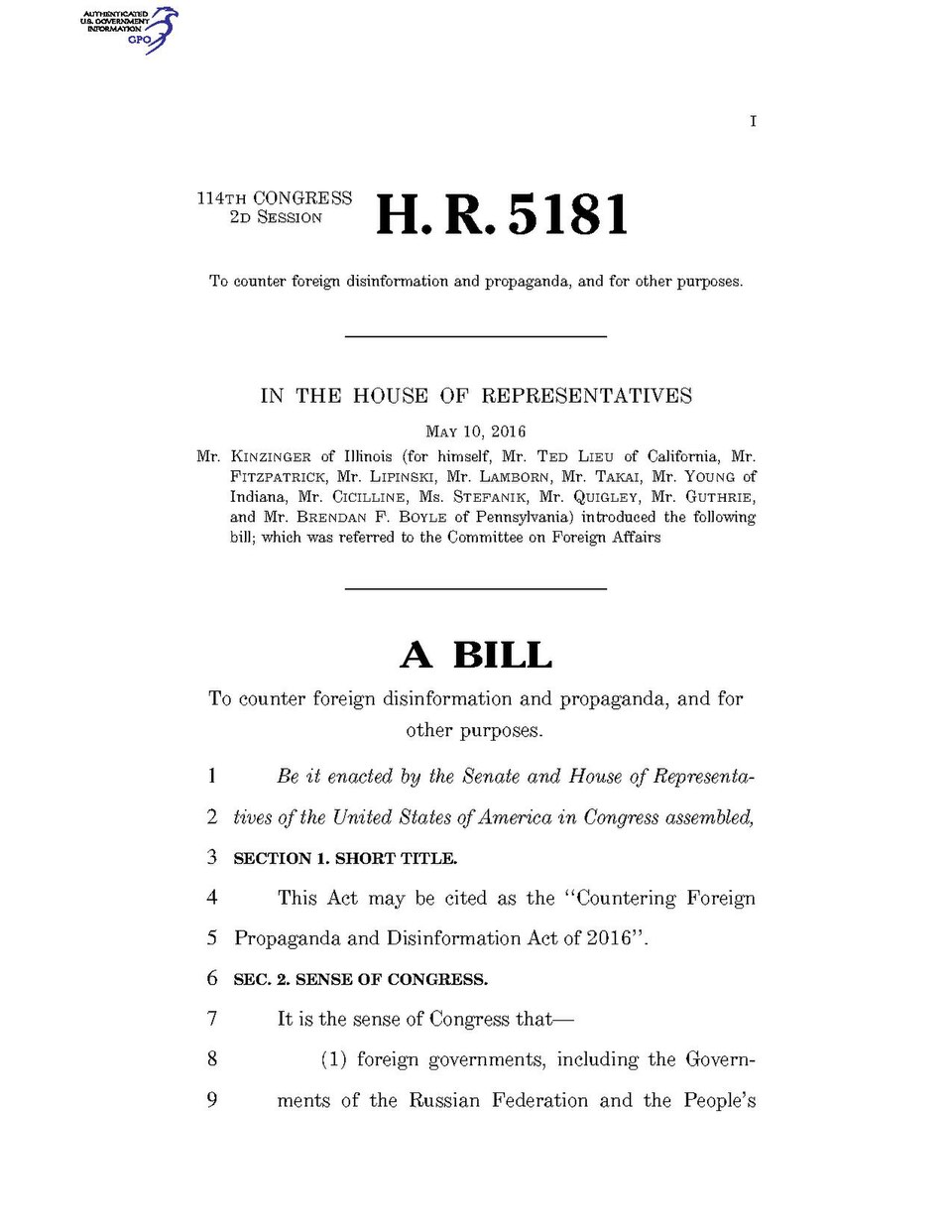
First page of H.R. 5181, the House bill titled "Countering Foreign Propaganda and Disinformation Act of 2016", introduced by Rep. Adam Kinzinger on 10 May 2016. The Senate bill of the same name was by Sens. Portman and Murphy; the provision creating the GEC's statutory mission became law in the FY2017 NDAA. U.S. Government Publishing Office, public domain (U.S. government work), via Wikimedia Commons.
How it worked
- Staff and money. CRS gives FY2016 funding of about $16 million, rising to an estimated $32 million by the end of FY2017. The State Inspector General says the GEC received about $98.7 million in FY2018 and issued 39 grants and cooperative agreements worth $58.6 million that year. The GEC managed $57 million in diplomatic engagement resources in FY2023. In late 2024, State gave CRS figures of about 120 staff and an annual budget of $61 million. Announcing the closure in 2025, State said the office cost "more than $50 million per year."
- Public reports. The 2020 Russia report sets out five "pillars": official government communications, state-funded global messaging, cultivation of proxy sources, weaponized social media and cyber-enabled disinformation. Its main focus is proxy websites that appear independent while spreading or amplifying Kremlin narratives, with the Strategic Culture Foundation as a leading example. The GEC here describes Narrative laundering: a state message passed through outlets whose state origin is hidden. The 2023 China report says Beijing spends billions of dollars a year on foreign information manipulation, and groups its methods into five "elements," including exercising control over Chinese-language media and pairing cooptation with pressure. It also ran a "Faces of Kremlin Propaganda" series, including a profile that calls Foreign Ministry spokeswoman Maria Zakharova "among the most high-profile purveyors of Russia's disinformation."
- Grants and technology. Under the 2016 law the GEC funded outside groups and technology. Disinfo Cloud, run by Park Advisors, tested and promoted counter-disinformation tools. The Washington Examiner reports that GDI and two other groups shared a $250,000 award in a U.S.-Paris Tech Challenge in September 2021.
- Interagency role. The GAO's September 2024 report says, citing State officials, that the GEC helped federal agencies, foreign partners and U.S. embassies build analytic skills, policy responses and technical capacity against foreign disinformation overseas.
Measured effect
No public causal study measured whether GEC messaging or grants changed what foreign audiences believed. The published audits are about process, not outcomes:
- State OIG audit AUD-MERO-20-26 (April 2020). 9 of 10 monitoring and evaluation plans lacked required elements. Officials did not review recipients' performance reports and financial information as required. 4 of 10 performance reports only described past activity and did not link it to performance indicators. The OIG put this partly down to too few experienced staff when the FY2018 awards went out.
- State OIG inspection ISP-I-22-15 (September 2022). 18 recommendations and $745,000 in "funds for better use." These included closing out overdue awards and appointing "an evaluation coordinator with decision-making authority."
- GAO-24-107600 (September 2024) describes how agencies detect foreign disinformation. It does not measure the GEC's effect.
- A July 2025 State report to Congress assessed the GEC's core functions under the FY2024 appropriations act. Its conclusions could not be checked for this page.
Positions on the record
- The GEC and its founders. Portman and Murphy presented the 2016 law as a way to help allies counter propaganda from Russia, China and others.
- State on the GDI grant. State said reports that its money funded GDI's work in the United States were "inaccurate." It said the 2021 sub-grant paid GDI to apply its tools in East Asia and Europe, and that "no domestic-focused activities were included." The National Endowment for Democracy, a separate GDI funder, said it never funded GDI's U.S. work.
- The government in court. Its motion to dismiss said the GEC had "never funded, promoted, nor encouraged the use of technologies targeting either the Media Plaintiffs or other Americans." NewsGuard said in a declaration that none of its State Department money funded its ratings of domestic publications.
- Plaintiffs and conservative critics. The Daily Wire, The Federalist, Texas Attorney General Ken Paxton and NCLA said the GEC financed "censorship technology" and argued Disinfo Cloud acted as an "alter ego" of the government. The House Small Business Committee subpoenaed GEC award records since 2018, naming GDI, NewsGuard and Park Advisors among about two dozen groups. Senator Chuck Grassley wrote to State about GDI funding. A House hearing in the 118th Congress was titled "The Global Engagement Center: Helping or Hurting U.S. Foreign Policy." In April 2025 the House Foreign Affairs Committee put out a release titled "Chairman Mast Applauds Ending Biden-Era Censorship Program."
- Libertarian critics. Reason reported in February 2023 that GDI's risk index warned advertisers away from Reason itself. A Cato Institute blog post described the lawsuit's allegations as "government censorship by proxy."
- The Rubio decision. Rubio said the office "spent millions of dollars to actively silence and censor the voices of Americans they were supposed to be serving," calling this "antithetical to the very principles we should be upholding."
- Defenders of the office. Other State Department officials, as reported in April 2025, called the censorship accusations "fictitious" and said the closure was politically motivated. The group Issue One criticized the elimination. A TechPolicy.Press essay described the closure as part of "disappearing guardrails against disinformation."
- On the 2017 delay. A Brookings FixGov post in October 2017 was titled "Secretary Tillerson is doing the right thing, so why is Congress bashing him?"
- After the settlement. Acting Attorney General Todd Blanche said: "The weaponization of the Biden Administration against the American people who they disfavored is over." A Lawfare analysis notes that the decree states it "shall not be construed as evidence or as an admission" of the plaintiffs' allegations, and that it contains no judicial finding or admission that a Biden-era "censorship regime" existed.
- China. China's Foreign Ministry said the 2023 report was itself disinformation. It called the GEC "a source of disinformation and the command center of 'perception warfare'" and called the United States an "empire of lies," citing Iraq, Syria and U.S. reports on Xinjiang.
- Russia. No official Russian government response to the 2020 Pillars report was found in the sources checked for this page.
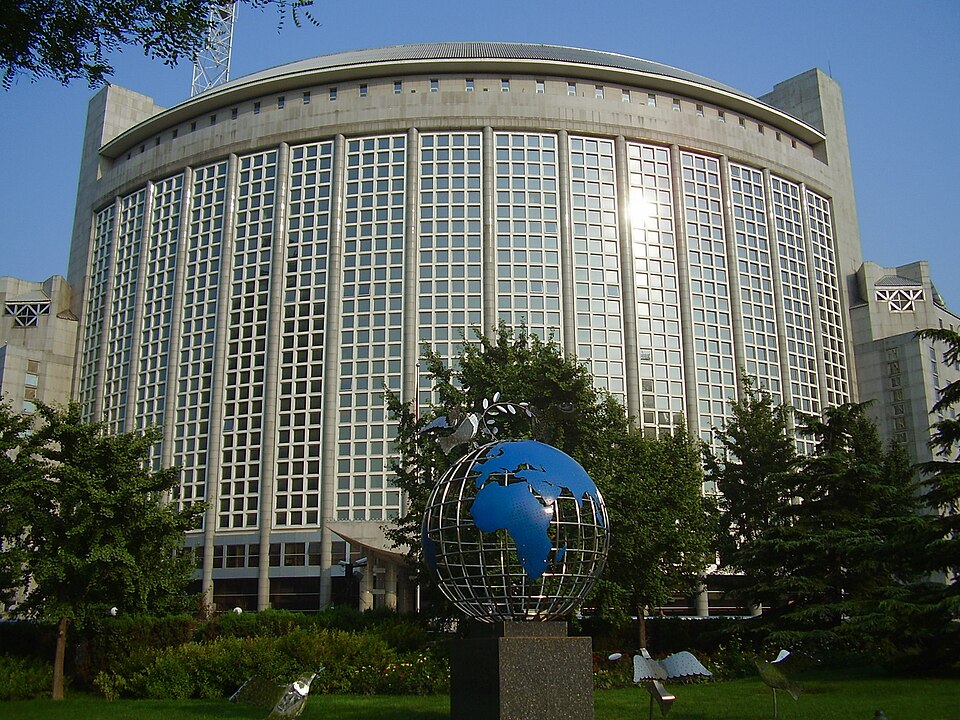
Headquarters of the Ministry of Foreign Affairs of the People's Republic of China, Chaoyangmen Nandajie, Beijing. In 2023 the ministry called the GEC's China report itself disinformation (see "Positions on the record"). Photo: WhisperToMe, CC0, via Wikimedia Commons.
Same-method test
A Chinese or Russian foreign-ministry office that named U.S.-funded outlets as proxies, funded foreign NGOs to rate media, and whose grant money reached a group that also rated outlets at home would be scored the same way: by what its reports documented, where its money went, and what audits and courts found, not by how its government described its motives. The documented context of this case: the GEC's budget was tens of millions of dollars a year. Its work was audited in public, challenged in open court, and ended by its own government's political process.
What the record shows and doesn't
- Documented: the office's legal basis, budget figures, report titles and dates; the $100,000 sub-grant to GDI through a partner and State's statement of its foreign scope; the OIG findings on weak monitoring and evaluation; the court's standing ruling; the consent decree's terms; the lapse and the closure.
- Not documented: any public study showing the GEC changed foreign audiences' beliefs, or that it failed to. The court made no finding on the merits, and the decree states it is not an admission.
- Not found: a public record of whether content made by GEC-funded partners told its audiences that it was paid for by the U.S. government. The OIG's 2022 inspection is public; its classified annex is not.
- Frames: "censorship-industrial complex" and "an office that silenced Americans" (critics, the 2025 State Department) and "a guardrail against foreign disinformation" (defenders) are positions. The documents above do not settle either one. A "command center of perception warfare" (China's Foreign Ministry) is the targeted government's framing.
See also
- The Active Measures Working Group (1981 to 1992), the Cold War interagency body that exposed Soviet disinformation.
- The DHS Disinformation Governance Board (2022) and The UK's Counter Disinformation Unit and its sister units (2019 to 2024), comparable disputes over domestic reach.
- EUvsDisinfo and the EEAS East StratCom Task Force, the EU counterpart; Hamilton 68: the Russian-influence dashboard and its secret account list and RICU and the Integrity Initiative: UK government-funded messaging that did not show its source (the Integrity Initiative), other contested counter-disinformation projects.
- The debate over counter-disinformation and Countering propaganda.
See also in Learn
Images
| Image | Source | Licence |
|---|---|---|
| Harry S. Truman Building, May 2024 | Wikimedia Commons, official State Department photo by Linda D. Epstein | Public domain (U.S. government work) |
| First page of H.R. 5181 (2016) | Wikimedia Commons, U.S. Government Publishing Office via congress.gov | Public domain (U.S. government work) |
| PRC Ministry of Foreign Affairs, Beijing | Wikimedia Commons, WhisperToMe | CC0 |


Image gaps
- Covers of the 2020 Russia and 2023 China reports. Both are U.S. government works and so public domain, but neither is on Wikimedia Commons, and state.gov could not be reached from the environment used to build this page. The first page of the 2016 House bill is hosted above instead. The report covers can still be filled.
- GEC logo, staff photos, the Texas courthouse and Russian-side material. No public-domain copy was found on Commons. No official Russian government response to the 2020 report was found, so no Russian-side image is included; the PRC Ministry of Foreign Affairs building is hosted above because that ministry did respond.
Sources
- Executive Order 13721, Federal Register, 17 March 2016
- State Department fact sheet: The Global Engagement Center (U.S. Mission Geneva, July 2016)
- CRS Insight IN10744: Global Engagement Center, Background and Issues
- CRS Insight IN12475: Termination of the State Department's Global Engagement Center
- Sen. Portman: President Signs Portman-Murphy Counter-Propaganda Bill into Law
- Sen. Murphy: Murphy, Portman welcome State-DoD memorandum operationalizing GEC
- CNN, 2 August 2017: Funds to counter Russia, extremists gather dust at State Department
- Newsweek: Rex Tillerson rejects $80 million from Congress to fight Russian propaganda
- Brookings FixGov, 27 October 2017
- The Hill: State Dept. launches $40M offensive against foreign propaganda
- GEC Special Report: Pillars of Russia's Disinformation and Propaganda Ecosystem (August 2020, PDF)
- GEC Special Report: How the People's Republic of China Seeks to Reshape the Global Information Environment (September 2023)
- State Department: Faces of Kremlin Propaganda, Maria Zakharova
- PRC Foreign Ministry: Spokesperson's remarks on the US State Department's report targeting China (30 September 2023)
- Hong Kong Free Press: China rejects State Dep't report
- State OIG AUD-MERO-20-26: Audit of GEC Federal Assistance Award Management and Monitoring
- State OIG ISP-I-22-15: Inspection of the Global Engagement Center
- GAO-24-107600: Foreign Disinformation, Defining and Detecting Threats
- State Department report to Congress on an assessment of the GEC (July 2025, PDF)
- Washington Examiner: State Department bankrolls group secretly blacklisting conservative media
- Washington Examiner: State Department hit with subpoena over "censorship-by-proxy"
- Reason, 14 February 2023: U.S. State Department funds a disinformation index that warns advertisers to avoid Reason
- Cato at Liberty: Lawsuit alleges more government censorship by proxy
- National Endowment for Democracy statement on the Global Disinformation Index and U.S. media
- Sen. Grassley letter to State on GDI funding (PDF)
- NCLA case page: The Daily Wire, The Federalist, Texas v. State Department
- Texas Attorney General press release, December 2023
- Daily Wire v. State Department, E.D. Tex., order of 7 May 2024 (Justia, Doc. 53)
- House hearing: The Global Engagement Center, Helping or Hurting U.S. Foreign Policy (118th Congress)
- CyberScoop: State Department's disinformation office to close after funding nixed in NDAA
- Washington Post, 16 April 2025: Rubio shuts State Dept. foreign disinformation office, citing censorship
- Times of Israel: Rubio shutters office that tracks disinformation from Iran, Russia, China
- House Foreign Affairs Committee: Chairman Mast applauds ending Biden-era censorship program
- Issue One: criticism of the elimination of the State Department office
- TechPolicy.Press: The downfall of the Global Engagement Center
- State Department, September 2025: United States champions free expression, ceases censorship frameworks
- The Hill: State Department halts "all frameworks" to counter foreign misinformation
- DOJ: Justice Department settles lawsuit challenging Biden State Department's alleged social media censorship
- Lawfare: What the Murthy v. Missouri and Daily Wire consent decrees do, and don't, establish