Area: Group identity · Evidence: moderate (How we rate the evidence). A meta-analysis finds a small but reliable effect, but its size depends heavily on how it is measured, and it sometimes reverses.
In brief
People tend to see members of other groups as more alike than members of their own: "we" are a varied bunch of individuals, "they" are all the same. This makes it easier to generalize from one outsider's behavior to the whole group. Political messages that present an opposing party, nation or movement as a single uniform mass draw on this tendency, and research on American partisans shows how far the imagined out-group can drift from the real one.
What the research shows
In a classic study, George Quattrone and Edward Jones showed students at Princeton and Rutgers, two rival universities, a videotape of a student making a simple choice, such as whether to listen to rock or classical music during an experiment. Participants were told the student came from their own university or the rival one, then estimated what percentage of that university's students would make the same choice. They were more willing to generalize from a single person to the whole group when that person belonged to the other university [1]. The authors linked this to the "law of small numbers," the habit of drawing broad conclusions from very little evidence.
Patricia Linville, Gregory Fischer and Peter Salovey proposed that familiarity is a major cause. People know more members of their own group, and know them in more detail, so their mental picture of the in-group is more differentiated. In four experiments involving groups defined by age and nationality, greater familiarity went with seeing more variety within a group [2].
Social identity researchers found that the effect is not simply about knowledge. Bernd Simon and Rupert Brown showed that members of a minority group can see their own group as more homogeneous, especially on traits central to what makes the group distinct [3]. A group under pressure may emphasize its own unity, which suggests that perceived sameness also serves group goals.
The most politically relevant recent evidence concerns party stereotypes. Douglas Ahler and Gaurav Sood asked Americans to estimate the share of each party's supporters who belong to groups stereotypically linked to it. Respondents greatly overestimated these shares: on average they thought 32 percent of Democrats were LGBT (the real figure was about 6 percent) and that 38 percent of Republicans earned over $250,000 a year (about 2 percent did). Supporters of both parties held these misperceptions, and people with larger misperceptions about the opposing party felt more negatively toward it and saw it as more extreme [4].

Drawn by FRAME from Ahler and Sood (2018) [4], as summarized above. CC BY 4.0 (FRAME).
James Druckman and colleagues found a related effect in measures of partisan hostility. When asked about "the other party," people tend to picture its most politically engaged, ideological members. When told they are being asked about typical, less political supporters, their hostility falls considerably [5]. The out-party in people's heads is narrower and more extreme than the one in the electorate.
Has it held up?
The effect is real but smaller and more conditional than textbook summaries suggest. A 2007 meta-analysis by Jennifer Boldry, Lowell Gaertner and Jeff Quinn pooled 177 effect sizes from about 12,000 participants. It found a small but reliable tendency to see more variability in the in-group than the out-group, and the tendency was stronger for real groups than for groups created in the laboratory [6]. The eleven different measures researchers have used, however, did not agree with one another, and depending on the measure and on the groups' relative status, some produced out-group homogeneity while others produced in-group homogeneity [6].
In short, the "they're all alike" perception is a tendency, not a law. It is most likely in established, emotionally charged group divides, which is where political messaging operates. The party-composition findings [4], [5] are recent and come from American data, so how well they generalize to other countries is less established.
How it shows up in political messaging
- World War II America. The U.S. poster series behind This Is the Enemy reduced whole states and populations to a single symbolic figure under one label. Its companion piece He's Watching You did the same with a single faceless helmet.
- World War I, both directions. American posters such as Beat Back the Hun with Liberty Bonds and Destroy This Mad Brute — Enlist turned Germans into one type, "the Hun." The German reply Sind wir die Barbaren? (Are We the Barbarians?) ("Are we the barbarians?") shows the other side of the process: a targeted nation contesting the blanket label with statistics of its own.
- Insurgent declarations, 1998. The "World Islamic Front" statement signed by Osama bin Laden and others, published in the newspaper Al-Quds al-Arabi on 23 February 1998, declared that "to kill the Americans and their allies – civilians and military – is an individual duty for every Muslim" [7], [8]. It treated the population of a whole country and its allies, soldiers and civilians alike, as a single enemy.
- American partisanship, both sides. Democrats and Republicans alike overestimate how stereotypical the other party's supporters are [4], and messages that picture the other side through its most extreme members exploit the gap Druckman and colleagues measured [5].
- Recognizing the reverse move. Simon and Brown's work shows that groups under pressure sometimes present themselves as uniform [3], which is why activist and minority movements, as well as governments, may stress unbroken unity in their own messaging.
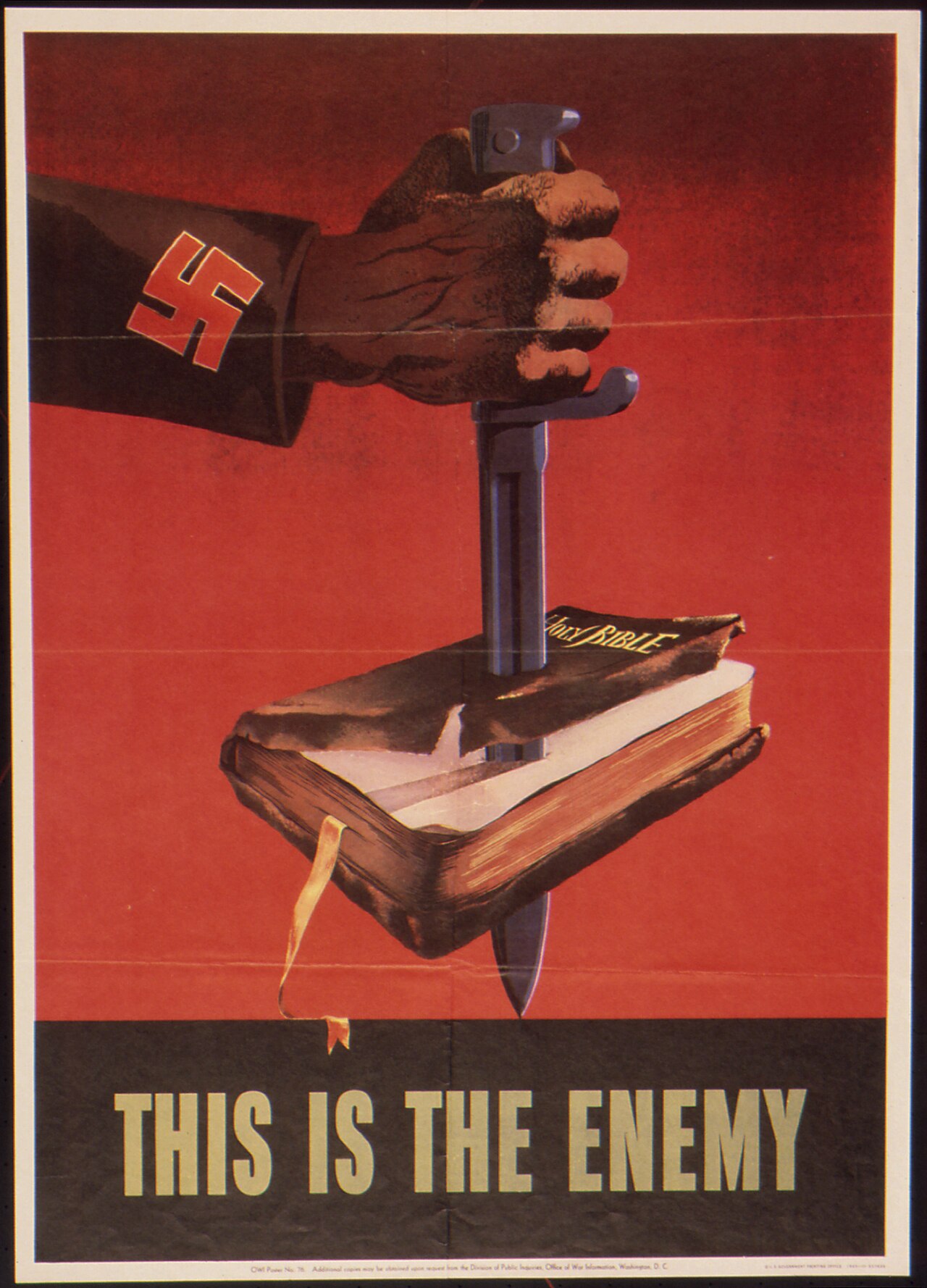
This Is the Enemy: "This Is the Enemy", U.S. Office of War Information poster no. 76, 1943. A nation reduced to one symbol. Public domain.
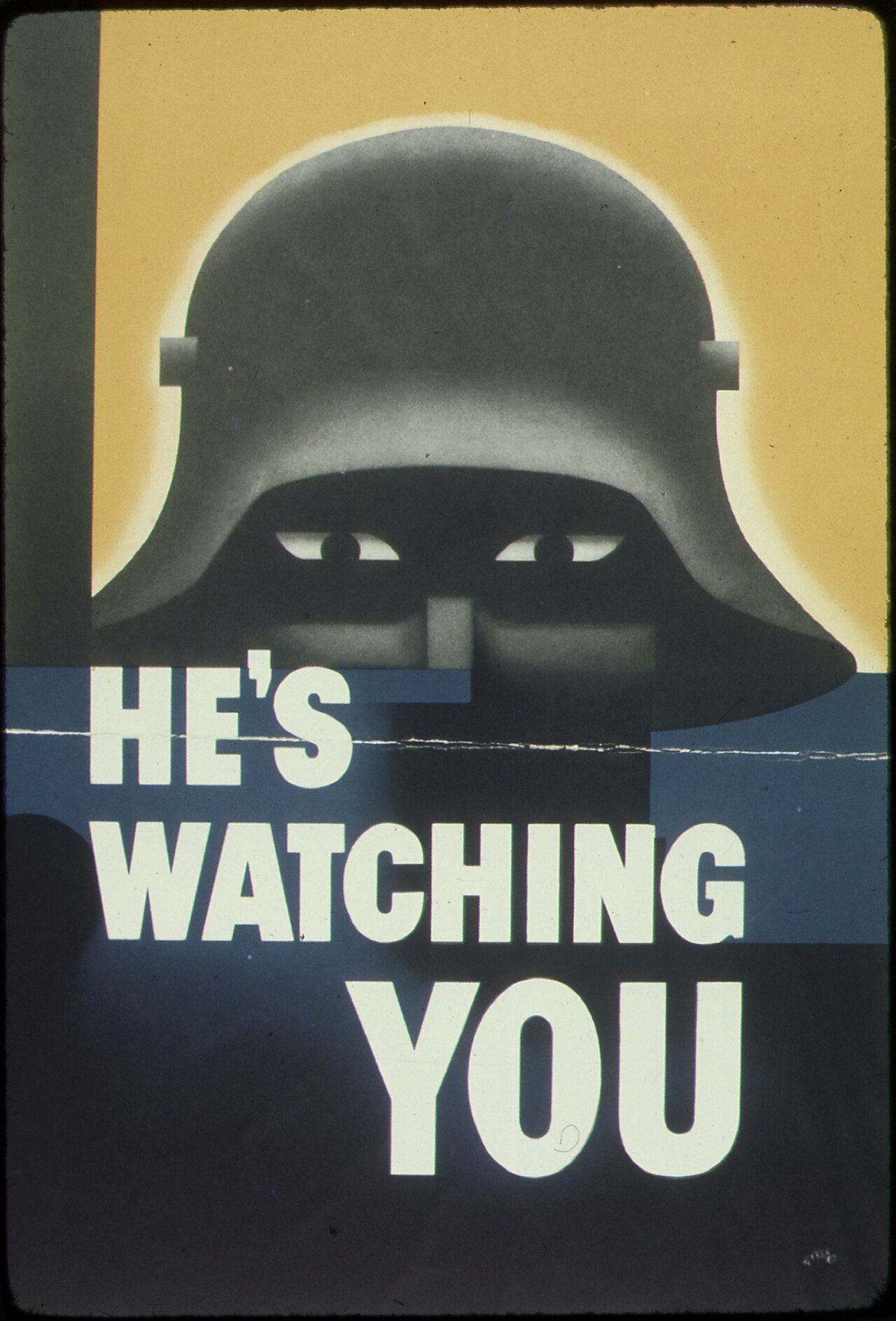
He's Watching You: "He's Watching You", U.S. government home-front security campaign, 1942, artist Glenn Grohe. Public domain.
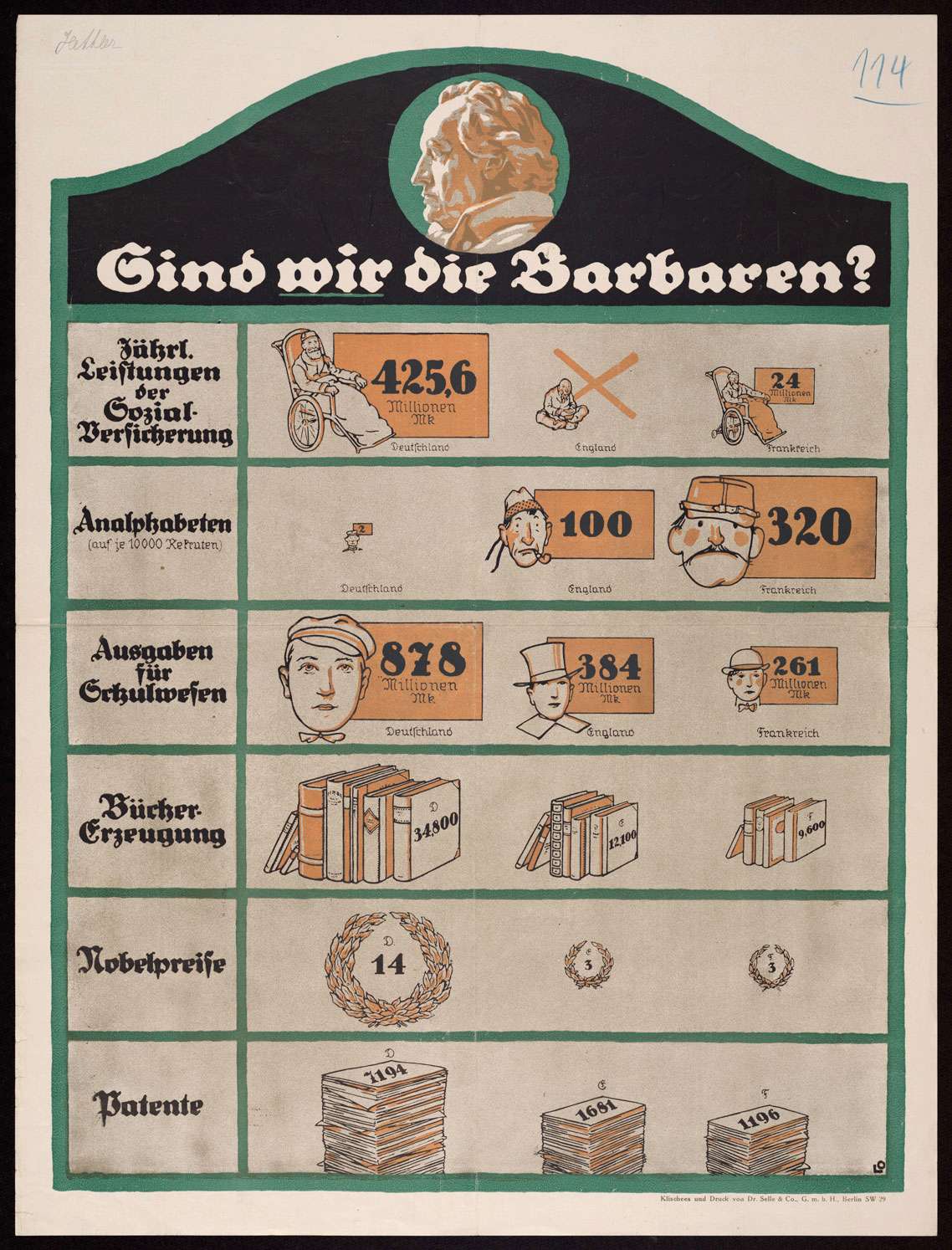
Sind wir die Barbaren? (Are We the Barbarians?): "Sind wir die Barbaren?" (Are we the barbarians?), Imperial German counter-propaganda, 1916, artist Louis Oppenheim. A targeted nation answering a blanket label. Public domain.
How to spot it
- A group of millions is described with a single noun and a single motive ("they want...").
- One member's statement or act is presented as representative of the whole group.
- The examples chosen are the group's most extreme or visible members.
- No internal disagreement within the out-group is acknowledged, while the in-group's diversity is taken for granted.
- Numbers about the group's makeup are absent, or would contradict the picture if supplied.
Persuasion or manipulation?
It is fair to criticize a party's platform, a government's policy or an organization's documented actions. Honest writing names who did what, specifies which part of a group holds a view, and gives an idea of scale ("a faction of," "most polled members"). It tips into manipulation when a writer presents the loudest members as typical, attributes one person's act to everyone who shares a label, or hides the variety of views inside the group being criticized. The simplest check is whether the claim would survive being stated with a number attached.
Archive techniques that lean on this
- Scapegoating — Scapegoating: needs the target to be seen as a single bounded class with one character, which out-group homogeneity supplies.
- Name-calling — Name-calling: a single label ("the Hun") applied to a whole population invites the audience to treat everyone under it as interchangeable.
Related topics
- Social identity — Social identity
- In-group favoritism — In-group favoritism
- Dehumanization — Dehumanization
- Base-rate neglect — Base-rate neglect
- Availability heuristic — Availability heuristic
- Transfer — Transfer
Sources
- Quattrone, G. A., & Jones, E. E. (1980). The perception of variability within in-groups and out-groups: Implications for the law of small numbers. Journal of Personality and Social Psychology, 38(1), 141–152. https://doi.org/10.1037/0022-3514.38.1.141
- Linville, P. W., Fischer, G. W., & Salovey, P. (1989). Perceived distributions of the characteristics of in-group and out-group members: Empirical evidence and a computer simulation. Journal of Personality and Social Psychology, 57(2), 165–188. https://doi.org/10.1037/0022-3514.57.2.165
- Simon, B., & Brown, R. (1987). Perceived intragroup homogeneity in minority-majority contexts. Journal of Personality and Social Psychology, 53(4), 703–711.
- Ahler, D. J., & Sood, G. (2018). The parties in our heads: Misperceptions about party composition and their consequences. The Journal of Politics, 80(3), 964–981. https://doi.org/10.1086/697253
- Druckman, J. N., Klar, S., Krupnikov, Y., Levendusky, M., & Ryan, J. B. (2022). (Mis)estimating affective polarization. The Journal of Politics, 84(2), 1106–1117. https://doi.org/10.1086/715603
- Boldry, J. G., Gaertner, L., & Quinn, J. (2007). Measuring the measures: A meta-analytic investigation of the measures of outgroup homogeneity. Group Processes & Intergroup Relations, 10(2), 157–178. https://doi.org/10.1177/1368430207075153
- World Islamic Front. (1998, February 23). Jihad against Jews and Crusaders [English translation of the statement published in Al-Quds al-Arabi]. Federation of American Scientists. https://irp.fas.org/world/para/docs/980223-fatwa.htm
- Lewis, B. (1998, November/December). License to kill: Usama bin Ladin's declaration of jihad. Foreign Affairs. https://www.foreignaffairs.com/articles/saudi-arabia/1998-11-01/license-kill-usama-bin-ladins-declaration-jihad
Images
| Image | Source | Licence |
|---|---|---|
| Bar chart: guessed and actual party composition (Ahler and Sood 2018) | Drawn by FRAME from the cited study (make_group_identity_charts.py) |
CC BY 4.0, FRAME |
| This Is the Enemy (1943) | FRAME gallery, This Is the Enemy | Public domain |
| He's Watching You (1942) | FRAME gallery, He's Watching You | Public domain (U.S. government work) |
| Sind wir die Barbaren? (1916) | FRAME gallery, Sind wir die Barbaren? (Are We the Barbarians?) | Public domain (author died 1936) |
Image gaps
The 1998 World Islamic Front statement is cited from its published text; no image of it was sought. No open image showing the reverse case (a group presenting itself as uniform) was found.