In one line: Israel's Ministry of Strategic Affairs paid Israeli media groups to run articles, supplements and conference panels for its campaign against the boycott (BDS) movement, labelled only as made "in cooperation with" the ministry. Years later, according to the New York Times, a different ministry paid a Tel Aviv firm to run fake American accounts aimed at U.S. lawmakers.
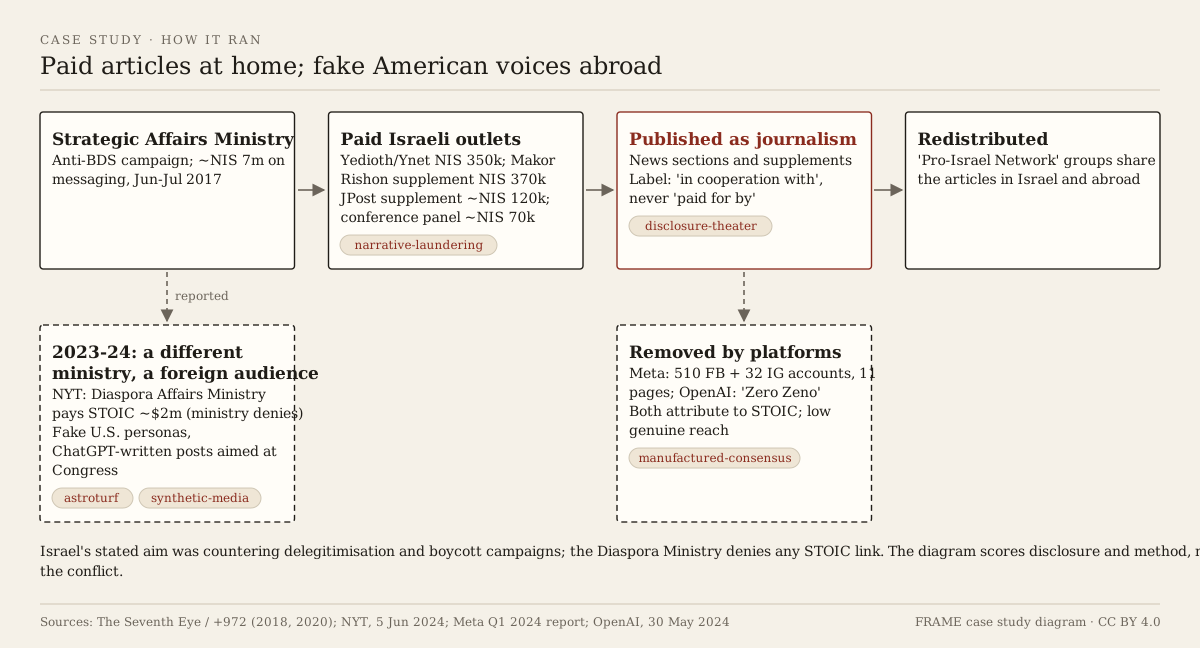
This page covers two episodes and keeps them separate. They involve two different ministries and two different audiences. The paid content ran in Israeli media for Israeli (and some foreign) readers, with a partial label. The STOIC operation aimed at Americans and used personas that hid their origin entirely. They sit together here because both show how Israeli government public-diplomacy budgets reached audiences through outside channels without the government's role being visible. The page makes no finding on BDS, the Gaza war or the Israeli-Palestinian conflict.
What happened
Part 1: paid content in Israeli media (Ministry of Strategic Affairs)
- Background. The Ministry of Strategic Affairs, created in 2006, was given the job of leading the government's campaign against the BDS movement. Its director-general, Sima Vaknin-Gil, put the ministry's 2016 anti-BDS budget at NIS 44 million (about $11 million), according to Ben White in the Journal of Palestine Studies.
- June-July 2017. According to documents obtained by the Israeli media watchdog The Seventh Eye (HaAyin HaShevi'it) and the Movement for Freedom of Information (Hatzlacha), the ministry spent nearly NIS 7 million (about $2 million) in these two months on spreading its message in Israel and abroad.
- From June 2017: Yedioth Ahronoth and Ynet. The Yedioth Ahronoth group received NIS 350,000 (about $100,000) to publish journalistic articles in the news section of its weekend magazine and on its website, Ynet. Member organisations of the ministry's "Pro-Israel Network" then circulated them in Israel and abroad. The ministry's own papers said the articles were meant to motivate Israelis to join the effort. The label: two Hebrew articles said they were made "in collaboration" with the ministry, and an English one said the ministry and the publisher had "joined forces". None said the ministry had paid. (+972 Magazine / The Seventh Eye, January 2018.)
- November 2017: Makor Rishon. Government Advertising Agency documents given to The Seventh Eye show NIS 370,000 paid for a ministry-funded supplement sent to Makor Rishon subscribers. The supplement promoted the ministry's senior officials and the advocacy groups it worked with. The Seventh Eye reported that the ministry refused to release some records on the arrangement, calling parts of them classified.
- Other outlets. The same reporting lists NIS 95,000 paid to the Times of Israel for state-sponsored articles, and says the ministry had spent hundreds of thousands of shekels buying content from the broadcaster Keshet and from Yedioth Ahronoth. Payments to the Jerusalem Post are covered in the next item.
- 2019: Jerusalem Post conference and supplement. The ministry paid about NIS 70,000 to "sponsor" the Jerusalem Post Diplomatic Conference in November 2019. In return it got a 30-minute panel on fighting the boycott movement, which included a screening of a film it had produced. The ministry's "public arena" head, Karin Peretz, wrote on a Finance Ministry form that the payment was also meant to promote the ministry's "sponsored content" (+972 / The Seventh Eye, 14 January 2020). +972 and The Seventh Eye also reported NIS 120,000 paid to the Jerusalem Post, and in October 2020 identified a payment of about that amount as the fee for a June 2019 Jerusalem Post supplement titled Unmasking BDS, in which ministry officials and U.S. Senator Ted Cruz were interviewed (+972 / The Seventh Eye, 4 October 2020).
- Change of leadership, 2020. The ministry's new leadership announced it would be more open, and some previously withheld documents were released. The ministry was closed in August 2021 and brought back in December 2022 under Ron Dermer with a different remit.
Part 2: the STOIC operation aimed at the United States (Ministry of Diaspora Affairs, as reported)
- October 2023 onward. According to officials and documents reviewed by the New York Times (Sheera Frenkel, 5 June 2024), Israel's Ministry of Diaspora Affairs set aside about $2 million for an influence campaign and hired STOIC, a political marketing firm in Tel Aviv, to run it. The campaign began after the 7 October 2023 attacks.
- The method, per the Times. At its peak, hundreds of fake accounts posing as Americans on X, Facebook and Instagram posted pro-Israel comments aimed at more than a dozen members of Congress, focusing on Black and Democratic lawmakers such as House minority leader Hakeem Jeffries and Senator Raphael Warnock. ChatGPT was used to write many of the posts. The campaign also ran three fake English-language news sites. The Israeli watchdog FakeReporter, which first flagged the network, tied five websites to STOIC (NPR).
- 29 May 2024: Meta. Meta's first-quarter 2024 Adversarial Threat Report says it removed a network of 510 Facebook accounts, 32 Instagram accounts, 11 pages and one group. The accounts posed as U.S. and Canadian citizens and posted mostly in English about the war in Gaza. Meta linked the network to STOIC, banned the firm and sent it a cease-and-desist letter. Meta attributed the network to STOIC; the New York Times, not Meta, reported the ministry link.
- 30 May 2024: OpenAI. OpenAI reports disrupting an operation it named "Zero Zeno", run by STOIC from Israel. The operators used OpenAI's models to write articles and comments for X, Facebook, Instagram, websites and YouTube, aimed at audiences in Canada, the United States and Israel in English and Hebrew, and from early May 2024 also at India. OpenAI found that its tools had not meaningfully increased the operation's reach.
- 5 June 2024: the ministry's response. The ministry denied the report. A spokesman said: "The Ministry of Diaspora Affairs and Combating Antisemitism does not engage in disinformation campaigns," and said any claim of a connection to STOIC was without foundation. Minister Amichai Chikli posted a denial and accused FakeReporter of "slander against IDF soldiers and the State of Israel". STOIC did not respond to NPR.

Givat Ram, Jerusalem, with the Knesset (centre right) and part of the government office district (Kiryat HaMemshala). Photo by Neukoln, 18 August 2013, CC BY-SA 3.0, via Wikimedia Commons. Shown for context; this is not a photo of either ministry's offices.
How it works
- Disclosure theater: the paid articles had a label, but it said "in collaboration with" or "joining forces", not "paid for by". The ministry's name appeared, so a disclosure existed, yet it did not tell readers the one thing they needed to know: that the ministry had paid for the article. The label also did not travel when network groups passed the articles along.
- Narrative laundering: the ministry's message was carried in a newspaper's news section, a subscriber supplement and a conference panel. Readers met it under a newspaper's masthead rather than a ministry's, which is the more trusted surface. With STOIC, the Times reports that the government's money passed through a private firm and then through personas and news sites with no visible link to either.
- Astroturfing (STOIC): accounts posed as ordinary Americans and Canadians. Meta removed them as fake. The Times reports that a foreign ministry paid for them.
- Synthetic media (STOIC): OpenAI and the Times both report that AI-generated comments and articles were presented as the words of real people and real news sites.
- Manufactured consensus (STOIC): hundreds of accounts sending similar comments to the same lawmakers can look like a crowd of separate constituents who each reached the same view. Meta and OpenAI both report low genuine engagement.
Then and now
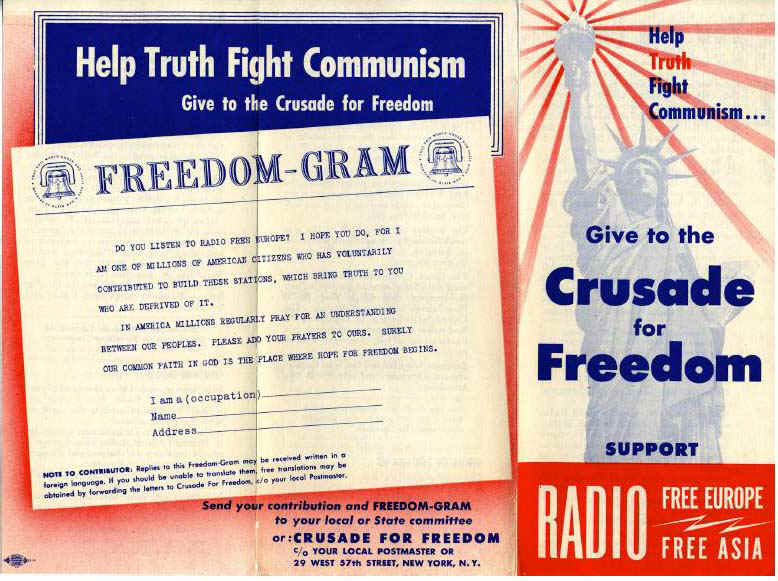
Freedom-Gram: Help Truth Fight Communism, Crusade for Freedom, 1952 (covertly funded by the CIA). Public domain.
In the 1950s the U.S. government funded Radio Free Europe through the CIA while a "citizens' crusade" gave it a private face. The Israeli paid articles used the same device on a smaller, domestic scale: government money, a trusted non-government surface, and a label that stops short of saying who paid. The later STOIC operation is closer to the Russian Internet Research Agency's fake U.S. community pages ('Russian Ads on Facebook' (House Intelligence Committee exhibit)): invented local voices aimed at another country's politics. That is a foreign-audience operation, and this archive scores it the same way whichever government pays for it.
The most recent Israeli case in this archive is The Hanover Institute: reports written for chatbots to cite (2026). There the state advertising agency LaPam paid, through Havas Media Germany and Piro, Inc., for an unsigned "institute" whose reports chatbots cited. That case had a FARA filing and a footer disclosure; the STOIC personas had none. The three cases differ in channel (newspapers, social accounts, retrieval chatbots) but share the pattern of state funding delivered through a surface that does not show it.
Positions on the record
- The Israeli government's stated rationale. The Ministry of Strategic Affairs described its mission as leading the campaign against "anti-Israel delegitimization and boycott campaigns", coordinating diplomatic, "consciousness", academic, economic, cultural and legal work (GOV.IL). On the specific payments, a ministry spokesperson told The Seventh Eye that Peretz was mistaken and that the Jerusalem Post conference payment did not cover a series of articles. The Jerusalem Post denied that its articles had been paid for. On STOIC, the Ministry of Diaspora Affairs and Combating Antisemitism said it "does not engage in disinformation campaigns" and denied any connection to the firm.
- Critics' position. The Seventh Eye and +972 Magazine argued that readers were shown state-funded material as journalism without being told it was bought. FakeReporter and the New York Times described the STOIC network as a covert foreign campaign aimed at U.S. lawmakers.
- This archive's reading. Documented: the payments and amounts reported from government records obtained under freedom-of-information requests, the "in cooperation with" labels, and Meta's and OpenAI's removals and attribution to STOIC. Attributed but denied: the Diaspora Ministry's funding of STOIC rests on the New York Times' sources and documents, and the ministry denies it. Not shown: that any specific paid article contained a false statement, or that the STOIC campaign changed any lawmaker's vote. Both platforms say its genuine reach was low. This page scores disclosure and method only.
Same-method test
Swap the flag and the finding should not change. The closest counterpart in another democracy is the U.S. Department of Education's No Child Left Behind contract. In January 2005, USA Today reported that commentator Armstrong Williams had been paid $240,000, through a subcontract under the Department's contract with the PR firm Ketchum, to promote the law on his syndicated TV show. On 30 September 2005 the Government Accountability Office (decision B-305368) found that the Department had paid Williams to comment on the law "without assuring that the Department's role was disclosed to the targeted audiences". It called this covert propaganda in breach of the publicity-or-propaganda ban in the 2004 appropriations act, and a violation of the Antideficiency Act. The Israeli newspaper payments carried a partial label, which the Williams arrangement did not. In both cases a government paid for commentary that its audience met as independent. For the STOIC side, the counterpart is the IRA's fake U.S. accounts: the same method with a different flag.
How to spot it
- "In cooperation with", "in partnership with" or "joining forces with" a ministry is a funding question to ask, not an answer. Look for the words "paid" or "sponsored" and for an amount.
- Check freedom-of-information and government-advertising records. In Israel the payments came to light through FOI requests and Government Advertising Agency documents, not through the published articles.
- For accounts that press lawmakers on foreign policy, look at account age, bursts of similar wording, and whether a platform threat report has already named the network.
- Keep the audiences apart. A government paying its own country's press is a domestic disclosure problem. A government running fake citizens of another country is a foreign influence operation. Score both, and label each one plainly.
Images
| Image | Source | Licence |
|---|---|---|
| Mechanism diagram (above) | Drawn for FRAME from the sourced facts on this page (make_diagrams.py) |
CC BY 4.0, FRAME |
| Givat Ram and Kiryat HaMemshala, aerial (2013) | Wikimedia Commons, Neukoln | CC BY-SA 3.0 |
| Freedom-Gram (1952) | FRAME gallery | Public domain (U.S. government work) |

Image gaps
- A paid Ynet or Yedioth article with its "in cooperation with" line, and the Jerusalem Post Unmasking BDS supplement. Not included: both are copyrighted newspaper pages. The supplement is hosted by The Seventh Eye (link below). Not fillable under this archive's licence rule.
- The Finance Ministry and Government Advertising Agency documents released to The Seventh Eye. These are Israeli government records, but their reuse licence could not be confirmed and the Seventh Eye site could not be reached from the environment used to build this page. Possibly fillable once the licence is checked.
- Examples of the STOIC accounts or sites. Not included: the screenshots in Meta's and OpenAI's reports are the companies' copyright, and the accounts carried stolen or generated profile images of people who are not the operators.
- A photo of either ministry's offices. None openly licensed was found; the aerial view of the government district stands in.
Sources
- +972 Magazine / The Seventh Eye, January 2018: The Israeli government is paying for anti-BDS journalism
- +972 Magazine / The Seventh Eye (Itamar Benzaquen), 14 January 2020: Israeli ministry paying for anti-BDS propaganda in major news outlets
- +972 Magazine / The Seventh Eye (Itamar Benzaquen), 4 October 2020: Jerusalem Post took government money to publish anti-BDS special
- The Seventh Eye, 19 December 2019 (Hebrew): the Jerusalem Post denies receiving money for a series of articles
- The Jerusalem Post, June 2019: Unmasking BDS supplement (PDF hosted by The Seventh Eye)
- Ben White, "Delegitimizing Solidarity", Journal of Palestine Studies 49:2 (2020)
- GOV.IL: Ministry of Strategic Affairs and Public Diplomacy (mission statement)
- Wikipedia: Ministry of Strategic Affairs (ministers, closure and re-establishment)
- The New York Times (Sheera Frenkel), 5 June 2024: Israel Secretly Targets U.S. Lawmakers With Influence Campaign on Gaza War
- Meta, May 2024: First Quarter Adversarial Threat Report
- OpenAI, 30 May 2024: Disrupting deceptive uses of AI by covert influence operations
- OpenAI: Operation "Zero Zeno", Israel-linked influence activity
- NPR, June 2024: How Israel tried to use AI to covertly sway Americans about Gaza
- The Jewish Chronicle, June 2024: Israeli minister denies reports the government ran covert influence campaign on US politicians
- CyberScoop, 5 June 2024: Israeli influence operation highlights global disinformation industry
- NBC News, May 2024: Meta, OpenAI say they disrupted Israeli company's influence campaign
- U.S. GAO, B-305368, 30 September 2005: Department of Education, Contract to Obtain Services of Armstrong Williams (govinfo copy)
- USA Today, 6 January 2005: Education Dept. paid commentator to promote law
- Related case: The Hanover Institute: reports written for chatbots to cite.