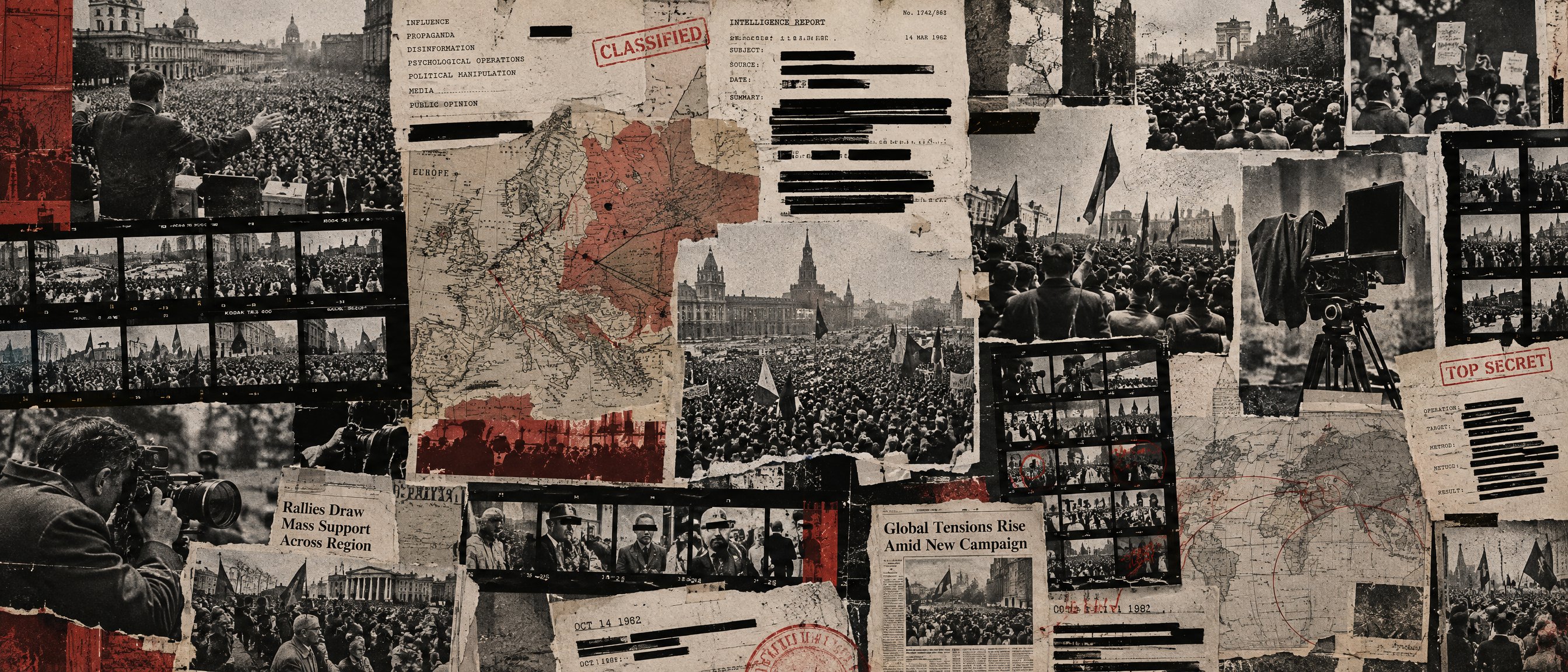
Also called Buried disclosure, Fine-print compliance
A technically present disclosure that does not travel with the content the audience actually sees.
The tell
Label on the website, absent on the social clip, the chatbot citation, or the meme.
Not this
A prominent, persistent, machine-readable provenance tag.
History and effect
A pattern documented in FARA compliance filings and "funded by" footers: a disclosure that technically satisfies a rule in a place the actual audience never reads.
It lets the speaker claim transparency while the audience that matters — the social clip, the chatbot citation, the meme — never sees the disclosure.
Lineage: FARA footnotes; buried 'About' pages; 'funded by' in gray type
How it works
Disclosure theater has three parts: a rule that says the audience must be told who is paying or speaking, a label that satisfies the rule somewhere, and a delivery path along which content and label come apart. The label is real, and a regulator or journalist who looks can find it. The pattern lies in where it sits: in a Justice Department filing rather than on the leaflet, in a website footer rather than in the paragraph a chatbot quotes, on a page's About tab rather than on the shared video, below the "show more" fold, in paperwork given to a newsroom rather than on the air.
It usually grows out of a legal design. The Foreign Agents Registration Act of 1938, passed after the McCormack-Dickstein committee investigated Nazi propaganda in the United States, works by disclosure: agents of foreign principals register, file copies of their "informational materials" and mark them with a conspicuous statement naming the principal. US election law requires "paid for by" disclaimers; the Federal Trade Commission's Endorsement Guides require paid endorsements to disclose the connection clearly and conspicuously; the Food and Drug Administration requires drug advertising to carry risk information. Each rule attaches the label to a unit of content (a pamphlet, a broadcast, a page). When the unit changes, as when a clip is cut, a sentence quoted or an insert styled like its host paper, the label can stay on the original while the copy people see goes without it. On enforcement, a 2016 audit by the Justice Department's Inspector General found that the National Security Division lacked a comprehensive FARA enforcement strategy and that registrants often filed late.
The documented variants are placement (below the fold, in a footer), format (grey type, fast audio, a label competing with vivid images), dilution ("#ad" buried among hashtags, which the FTC's 2019 influencer guide warns against), disclosure to an intermediary (the station is told, the viewer is not) and detachment by design (clips, embeds and citations that travel alone). The last step is often the defence: when origin is questioned, the speaker points to the filing or footer, which is accurate as far as it goes.
Why it works
Marian Friestad and Peter Wright's persuasion knowledge model (1994) holds that people process a message more critically once they recognise it as persuasion, and recognition depends on cues present at the moment of exposure. An unseen disclosure cannot trigger it. Sophie Boerman, Eva van Reijmersdal and Peter Neijens (2012) found that a longer on-screen sponsorship disclosure increased viewers' recognition of advertising, and Bartosz Wojdynski and Nathaniel Evans (2016) found that most readers of an online native advertisement did not identify it as advertising, with recognition depending on the label's position and wording.
A seen label also fades. The sleeper effect (Carl Hovland and Walter Weiss, 1951) describes a discounting source cue separating from the message in memory (see Sleeper effect); a detached clip produces that separation at once. Daylian Cain, George Loewenstein and Don Moore (2005) found that audiences told of an adviser's conflict of interest did not discount the advice enough, while advisers who disclosed gave more biased advice: a disclosure can license the speaker without protecting the listener.
Examples across eras and sides
- The prescription-drug "brief summary" (from 1962, United States, pharmaceutical industry). The Kefauver-Harris Amendments of 1962 required drug advertisements to include a "brief summary" of risks, which print ads commonly met with a page of dense small type after the persuasive pages. In 2004 the FDA issued draft guidance saying the format was hard for consumers to use, and in 2023 it required the spoken risk statement in broadcast ads to be clear, conspicuous and neutral, without distracting visuals (FDA, Brief Summary draft guidance, 2004; FDA, final rule on the major statement, 2023).
- Medicare video news releases (2004, United States, Department of Health and Human Services). HHS distributed prepackaged segments on the Medicare drug benefit narrated by a hired publicist who signed off "In Washington, I'm Karen Ryan reporting". Stations knew the source; some aired the segments as news without naming it. The GAO found them to be covert propaganda because the viewers, not the stations, needed to know the government's role (GAO, decision B-302710, 2004; David Barstow and Robin Stein, New York Times, 2005).
- "China Watch" supplements (2010s, United States and United Kingdom, China Daily). The Chinese state-owned China Daily paid papers including the Washington Post, the Wall Street Journal and the Daily Telegraph to carry "China Watch", laid out like a newspaper section. It carried a line naming China Daily, and China Daily's US distributor reported the payments under FARA, but the product was built to be read inside, and in the look of, the host paper (Louisa Lim and Julia Bergin, The Guardian, 2018; China Daily Distribution Corporation, FARA filings).
- Maffick video pages (2019, Facebook, majority-owned by a subsidiary of Russia's RT). CNN reported that In the Now and related pages aimed at young Western audiences were run by Maffick, majority-owned by RT's subsidiary Ruptly, without saying so. Facebook suspended the pages until the affiliation was disclosed, which was done in the About sections: a page-level label a viewer of a shared video had to click through to find (CNN, February 2019).
- Sponsorship below the fold (2016, United States, Warner Bros. Home Entertainment). The FTC charged that Warner Bros. paid YouTube creators, including PewDiePie, to promote a video game, and that sponsorship, where disclosed, sat in the description below the "show more" link. The settlement required clear and conspicuous disclosure (FTC, In the Matter of Warner Bros. Home Entertainment Inc., 2016).
- The Hanover Institute (2026, United States, contractors for Israel's Government Advertising Agency). Covered in The Hanover Institute: reports written for chatbots to cite. The FARA footer naming Piro, Havas Media Germany and LaPam was on the site, but chatbot answers citing the reports did not carry it. Israel's foreign ministry said the state follows American law (FARA registration 7732; the Guardian, Politico and 404 Media, 2026).
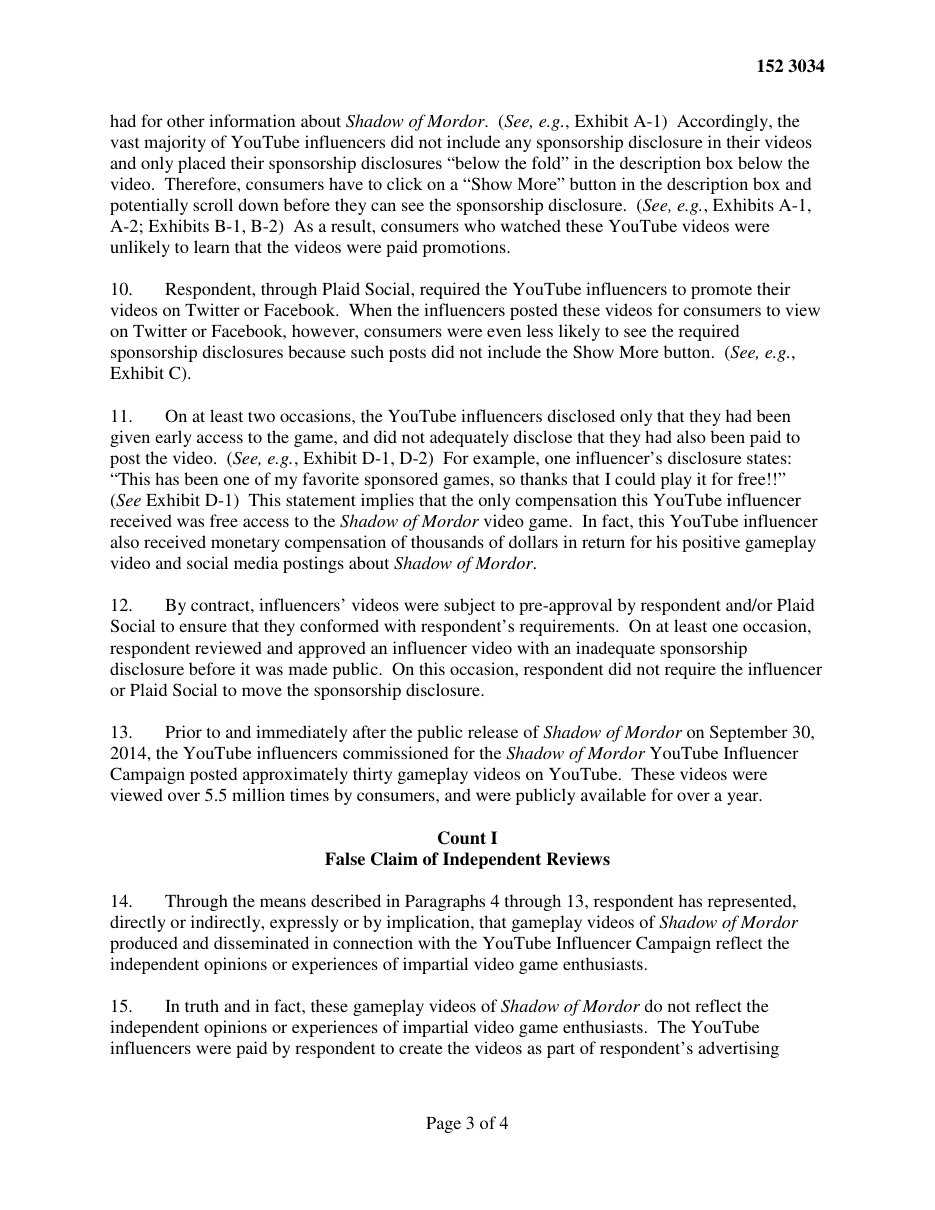
Page 3 of the FTC's complaint In the Matter of Warner Bros. Home Entertainment Inc. (2016). Paragraph 9 describes sponsorship disclosures placed "below the fold" in a video's description box, behind a "Show More" button. U.S. Federal Trade Commission.
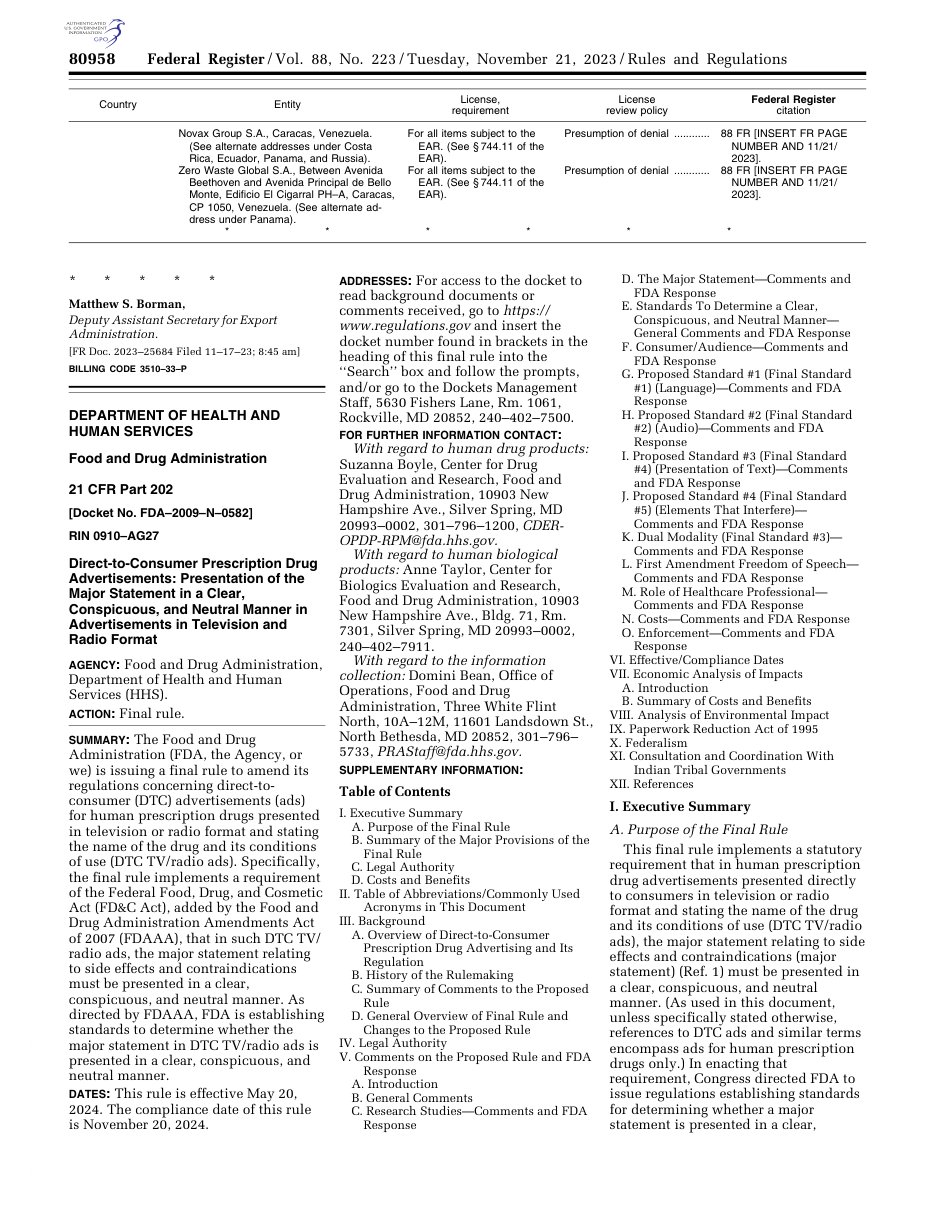
First page of the FDA final rule on presenting the "major statement" of drug risks in television and radio advertisements in a "clear, conspicuous, and neutral manner", Federal Register vol. 88, no. 223, 21 November 2023, p. 80958. The page also carries the end of an unrelated Commerce Department notice. U.S. Government Publishing Office.
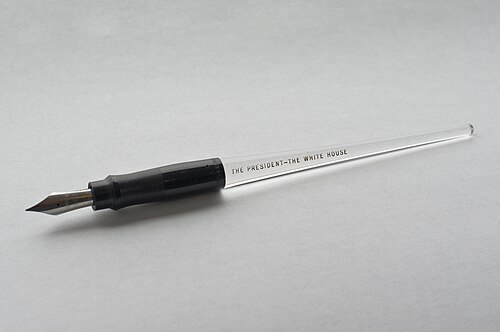
The pen President John F. Kennedy used to sign the 1962 Drug Amendments (the Kefauver-Harris Amendments) on 10 October 1962, photographed by the FDA in 2012. The 1962 law is the origin of the "brief summary" of risks that drug advertisements carry (see the first example above). U.S. Food and Drug Administration.
How to spot it
- If this clip, screenshot or quote were all you had, would you know who paid for or produced it?
- Is the disclosure in the thing you are looking at, or one click, scroll or filing away?
- Can the label be read at the size and speed you meet it?
- Does it name the real principal or only the nearest intermediary? Follow the chain.
- Was the label given to a gatekeeper (station, paper, platform) rather than to you?
- Is the content styled like its host or like independent work?
- Where a legal regime applies, check the record: FARA filings (efile.fara.gov), ad libraries, full drug labelling.
Where it ends: edge cases and legitimate persuasion
- No disclosure at all is a different case. The US military's 2005 paid placement, through the Lincoln Group, of articles by its information-operations staff in Iraqi newspapers (Los Angeles Times) is Astroturfing and Narrative laundering. Disclosure theater needs a disclosure that exists.
- Partial facts versus misplaced facts. A Limited hangout discloses some facts to protect others; disclosure theater puts the right fact in the wrong place.
- Who gets a label is a separate dispute. In Meese v. Keene (1987) the Supreme Court upheld FARA's term "political propaganda" for three Canadian documentaries over the objection that it prejudiced audiences. YouTube's 2018 funding notices covered PBS as well as RT; in 2023 Twitter labelled NPR "state-affiliated", then "government-funded", media. Contested labels are a fairness question, not burial.
- Third-party stripping. A speaker who labels at source is not doing this because someone else crops the label; the pattern applies when content is built to travel without it, or the buried label is offered as the answer about origin.
- Legitimate practice. The label travels and names the principal: an on-screen "paid for by" for the length of the ad, "Sponsored" at the top of an article, a spoken sponsorship statement at the start of a video, signed advocacy advertising such as Mobil's paid columns on the New York Times op-ed page from 1970, or provenance metadata that stays with the file.
Sources
- Foreign Agents Registration Act of 1938, 22 U.S.C. §§ 611-621; 28 C.F.R. Part 5.
- U.S. Department of Justice, Office of the Inspector General, Audit of the National Security Division's Enforcement and Administration of the Foreign Agents Registration Act, 2016.
- U.S. Food and Drug Administration, Brief Summary: Disclosing Risk Information in Consumer-Directed Print Advertisements (draft guidance), 2004; final rule on the major statement in television and radio advertisements, 2023.
- U.S. Government Accountability Office, decision B-302710 (HHS video news releases), 2004.
- David Barstow and Robin Stein, "Under Bush, a New Age of Prepackaged TV News", New York Times, 2005.
- Louisa Lim and Julia Bergin, "Inside China's audacious global propaganda campaign", The Guardian, 2018.
- China Daily Distribution Corporation, FARA filings.
- CNN, reporting on Maffick Media, February 2019.
- U.S. Federal Trade Commission, In the Matter of Warner Bros. Home Entertainment Inc., 2016; Endorsement Guides, 16 C.F.R. Part 255; Disclosures 101 for Social Media Influencers, 2019.
- Mark Mazzetti and Borzou Daragahi, reporting on paid placement in Iraqi newspapers, Los Angeles Times, 2005.
- Meese v. Keene, 481 U.S. 465 (1987).
- Marian Friestad and Peter Wright, "The Persuasion Knowledge Model", Journal of Consumer Research, 1994.
- Sophie C. Boerman, Eva A. van Reijmersdal and Peter C. Neijens, "Sponsorship Disclosure: Effects of Duration on Persuasion Knowledge and Brand Responses", Journal of Communication, 2012.
- Bartosz W. Wojdynski and Nathaniel J. Evans, "Going Native", Journal of Advertising, 2016.
- Carl I. Hovland and Walter Weiss, "The Influence of Source Credibility on Communication Effectiveness", Public Opinion Quarterly, 1951.
- Daylian M. Cain, George Loewenstein and Don A. Moore, "The Dirt on Coming Clean", Journal of Legal Studies, 2005.
The science
Research on the psychology this technique relies on, from the Learn library:
- Continued influence effect — Continued influence effect
- Illusory truth effect — Illusory truth effect
Case studies
- The Hanover Institute: reports written for chatbots to cite — The Hanover Institute: reports written for chatbots to cite
- The Pentagon's retired military analyst outreach programme (2002-2008) — The Pentagon's retired military analyst outreach programme (2002-2008)
- Israel's Strategic Affairs Ministry paid for news content, and a later ministry's STOIC campaign aimed at U.S. lawmakers — Israel's Strategic Affairs Ministry paid for news content, and a later ministry's STOIC campaign aimed at U.S. lawmakers
Images
| Image | Source | Licence |
|---|---|---|
| FTC complaint, Warner Bros. Home Entertainment Inc., p. 3, 2016 | FTC | Public domain (U.S. federal work) |
| FDA final rule, Federal Register 88 FR 80958, 21 November 2023 | GovInfo | Public domain (U.S. federal work) |
| Kefauver-Harris signing pen, FDA photograph, 2012 | Wikimedia Commons | Public domain (U.S. federal work) |
.jpg)
Image gaps
- GAO decision B-302710 (Medicare video news releases, 2004): a U.S. federal work, but gao.gov refused automated download from this environment, so no page image is hosted; linked in Sources.
- "China Watch" supplements, Maffick pages and Medicare video news release footage: commercial or third-party publications with no clear open licence, not hosted.
- A page of a prescription-drug "brief summary": drug advertisements are copyrighted and none was found in the public domain.