In one line: the best-known recruiting image in the English-speaking world began as a magazine cover on 5 September 1914, was not an official Parliamentary Recruiting Committee design, and is not shown by the surviving record to have recruited many men in 1914; its real influence was as a template that the United States, Germany and Soviet Russia later copied.
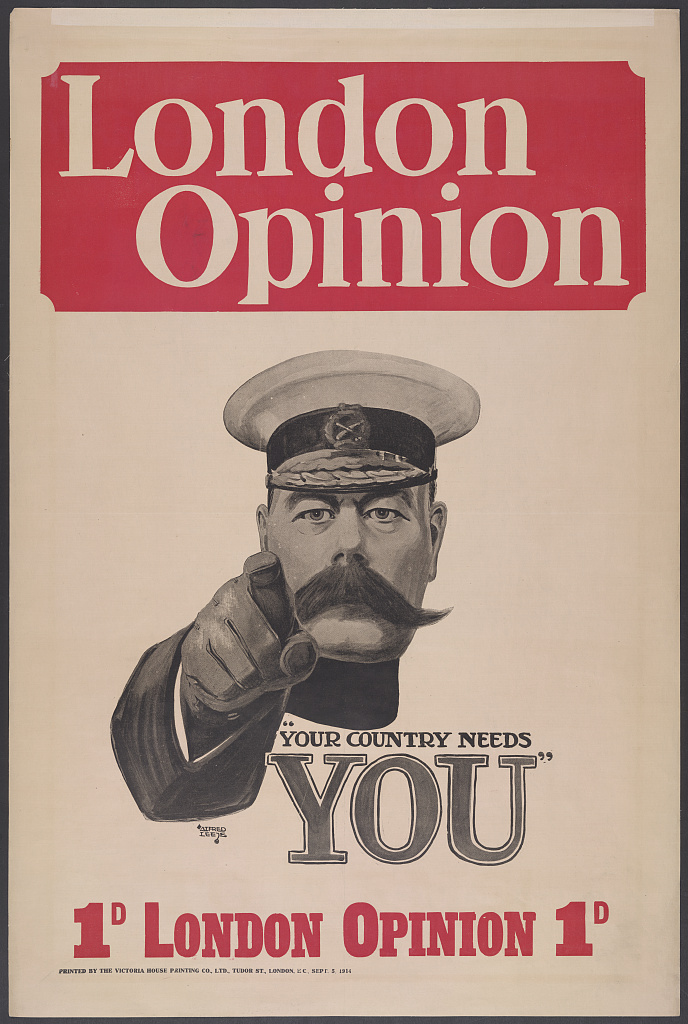
Alfred Leete, cover of London Opinion, 5 September 1914, printed by the Victoria House Printing Co. Library of Congress. Public domain (no known restrictions).
What happened
- 5 August 1914. Britain has been at war with Germany for a day. Lord Kitchener becomes Secretary of State for War and starts to raise a volunteer army alongside the small regular force and the part-time Territorials. On the same day Northcliffe-owned papers run a full-page advertisement drawn by Eric Field, "Your King and Country Need You" (Wikipedia summary of James Taylor's research).
- 11 August 1914. The first public call goes out for 100,000 volunteers, followed by a second 100,000 on 28 August (Wikipedia, Recruitment to the British Army during World War I).
- 23 to 30 August 1914. The British Expeditionary Force falls back from Mons. On Sunday 30 August a special edition of The Times prints Arthur Moore's "Amiens dispatch", which gave the public the first plain account of British losses (Stephen Badsey, "Strategy and propaganda: Lord Kitchener, the retreat from Mons and the Amiens Dispatch").
Show all 10Show fewer
- 3 September 1914. The highest single-day total of the war's first weeks, 33,204 men, is recorded in a transcription of the War Office weekly returns (blog transcription; a secondary source). One museum's monthly table gives about 299,000 enlistments in August and about 463,000 in September, then about 137,000 in October (King's Own Royal Regiment Museum). The Long, Long Trail says the early surge soon settled to roughly 100,000 men a month (Long, Long Trail).
- 5 September 1914. London Opinion, a penny weekly with a circulation of about 300,000, runs Alfred Leete's drawing of Kitchener pointing at the reader on its cover. The magazine also sold postcard-sized copies, 100 for 1s 4d (Wikipedia, citing Taylor). The cover is a magazine advertisement, not a government commission.
- September to November 1914. The design is printed as a poster in at least two commercial versions: a London Opinion poster from the Victoria House Printing Co. in September and a David Allen and Sons version in November, which James Taylor describes as "not an official publication, lacking a design number and the PRC endorsement". Sources differ on whether the Parliamentary Recruiting Committee (the cross-party body set up to run recruiting publicity) obtained permission to use the design in poster form; Taylor finds no PRC poster of it in the committee's records (see Positions on the record).
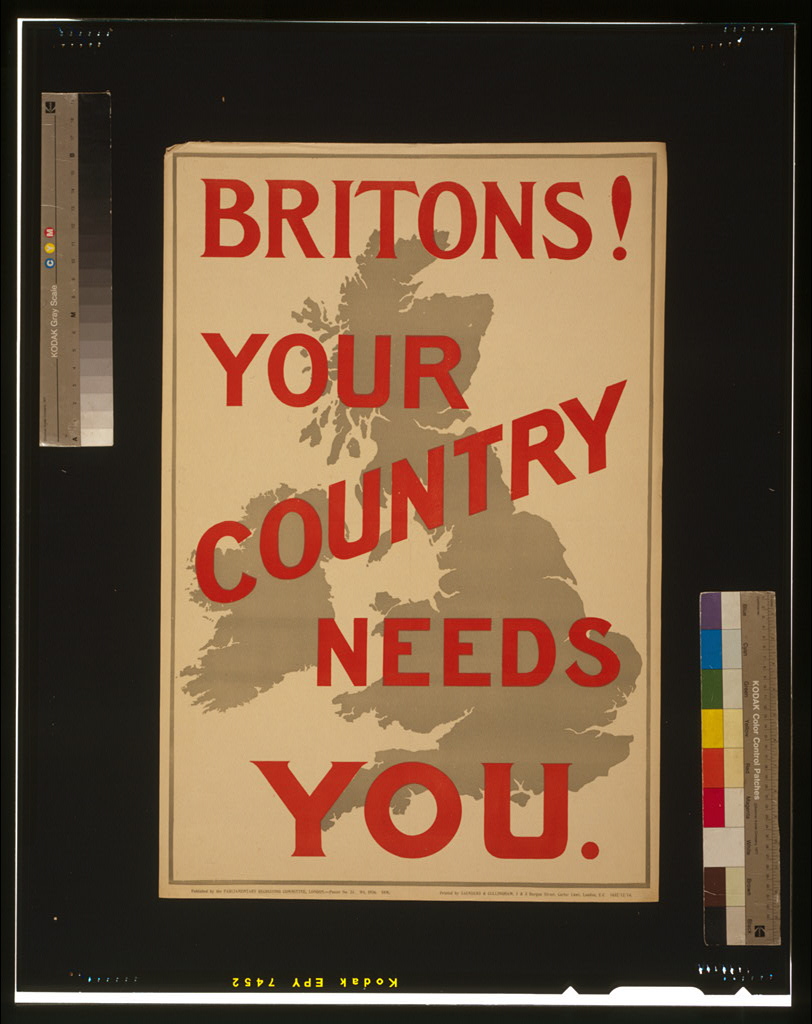
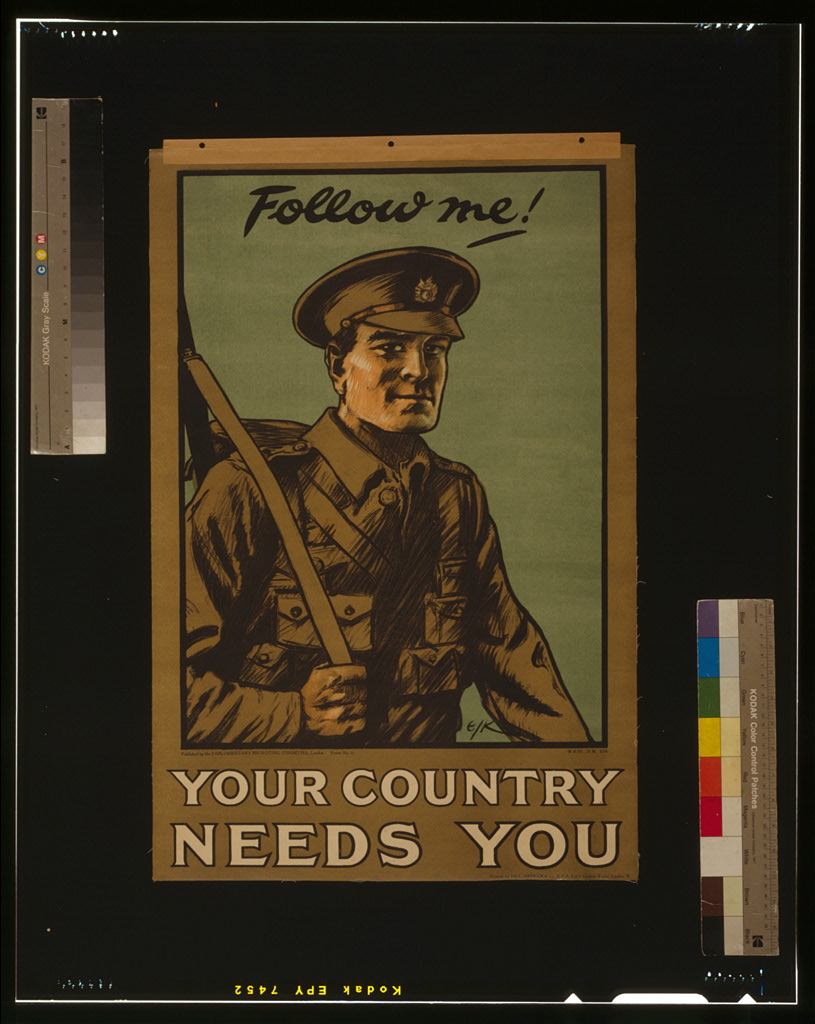
- Autumn 1914. The PRC's own posters carry the slogan in different forms. Poster no. 23 sets "Britons! Your country needs you." in red type over a map of the British Isles; poster no. 11 shows a soldier under "Follow me!" and the same words. Neither uses Leete's drawing.
- 15 December 1914 and 3 January 1915. A photograph of a Liverpool railway station on 15 December 1914 shows Leete's design among other recruiting posters, and The Times of 3 January 1915 describes Kitchener's pointing figure on posters across London (both reported in Wikipedia). Taylor reports that the committee's thirty-word Kitchener poster, which carried no pointing hand, was printed about ten times more than Leete's image.
- 1915 and after. Volunteering falls after January 1915. The Derby Scheme of November to December 1915 produced 318,553 medically fit single men (Wikipedia). The Military Service Act, passed on 27 January 1916, ends voluntary enlistment; unmarried men aged 19 to 41 are deemed enlisted from 2 March 1916 (Long, Long Trail).
- 1917 and later. The Imperial War Museum acquires Leete's original cover artwork in 1917 and catalogues it as a poster in error, which Taylor treats as one source of the later belief that it was an official poster. The IWM does not get a printed copy until the 1950s.
Explain moreShow less
"Britons! Your country needs you", Parliamentary Recruiting Committee poster no. 23, London, 1914, printed by Saunders & Cullingham. Scanned with the Library of Congress colour bars. Library of Congress. Public domain (no known restrictions).
How it works
- Transfer: the poster lends a man's standing to a request. Kitchener, who had commanded at Omdurman in 1898 and was now Secretary of State for War, was a national figure, and the pointing figure puts his standing behind the call. The same device is on a 1914 postcard of Kitchener ('Do your duty bravely. Fear God. Honour the King.' Lord Kitchener postcard (about 1914)) and on the Punch cartoon below, where "Recruiting-Sergeant Punch" stands beside a "Wanted 500,000 Men" notice signed "Kitchener".
- Testimonial: the face, not the argument, carries the message. The only words are "Your Country Needs You". The September poster form adds "Wants YOU. Join your Country's Army! God Save The King" (as described by Taylor, reported in Wikipedia); Kitchener had insisted that the official advertisements end with "God Save the King" (Gary Messinger, as cited there).
- Identity fusion: "Your country" and "you" put the man and the nation in one sentence. A man who does not enlist is made, by the grammar, a man whom his country has asked and who has refused. The PRC's map poster does the same with a picture: the red word YOU is laid across the outline of the islands themselves.
Show all 4Show fewer
- Appeal to emotion and Fear appeal: the pointing hand and the direct stare make the viewer feel personally singled out, a visual trick later used for shame as much as for duty. The PRC's Daddy, what did YOU do in the Great War? (Daddy, what did YOU do in the Great War?) adds the child's question to the finger.
Explain moreShow less
"Follow me! Your country needs you", Parliamentary Recruiting Committee poster no. 11, London, 1914 (printer's mark "11/14"). Library of Congress. Public domain (no known restrictions).
Then and now
I Want You for U.S. Army , James Montgomery Flagg, 1917.
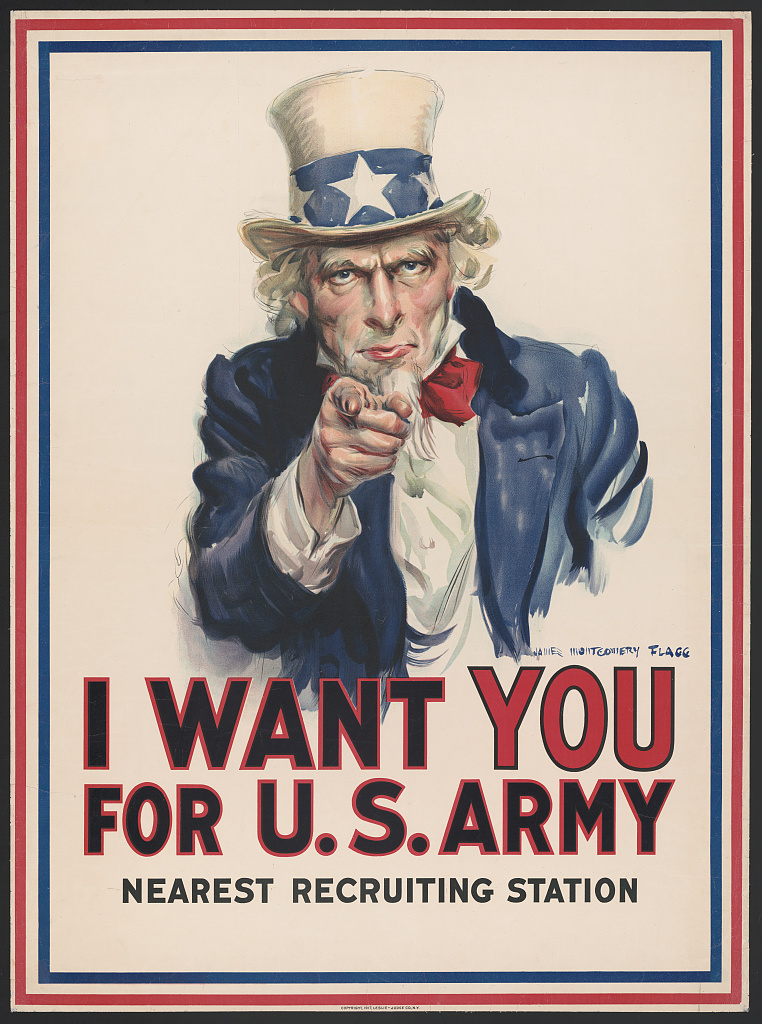
I Want You for U.S. Army, James Montgomery Flagg, 1917. Public domain.
James Montgomery Flagg's Uncle Sam first appeared on the cover of Leslie's Weekly on 6 July 1916 as "What Are You Doing for Preparedness?" and was reissued in 1917 as the Army's "I Want YOU" (Time). Time reports that Flagg used Leete's design as the basis and his own face as the model. More than four million copies were printed in 1917 and 1918 (Time, citing the Library of Congress), a larger print run than any figure on record for Leete's image. The two posters share a composition; they differ in who issued them. Flagg's version was a wartime government poster of the U.S. Army, while Leete's began as a commercial magazine cover.
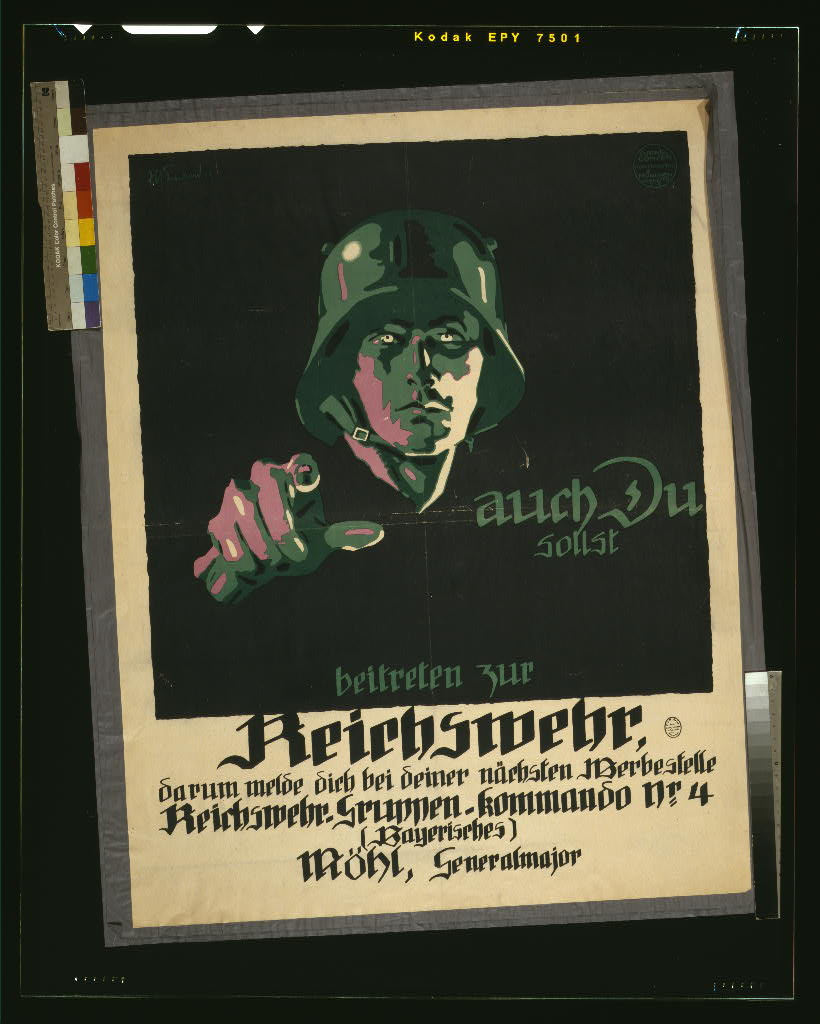
"Auch du sollst beitreten zur Reichswehr" ("You too should join the Reichswehr"), Julius Ussy Engelhard, Munich, Oscar Consée Kunstanstalt, 1919. Library of Congress. Public domain (no known restrictions).
Other governments and armies took up the pointing figure after the war. A 1919 Bavarian poster for the Reichswehr (above) used a helmeted soldier, and Dmitry Moor's 1920 Soviet poster Have you volunteered? shows a Red Army soldier pointing out of the frame; it is widely described as modelled on the Kitchener type, but this page has not verified that claim against a holding institution (see Image gaps). In 1997 the British Army reissued the pose with a Black non-commissioned officer in place of Kitchener, and a 2014 two-pound coin by the Royal Mint carried the design (Wikipedia). For the American government body that ran wartime publicity in 1917 and 1918, see The Committee on Public Information: how the U.S. government sold the First World War at home (1917-1919).
Positions on the record
6 items · The PRC and the War Office: the PRC, formed of the Prime Minister and the heads of the…
- The PRC and the War Office: the PRC, formed of the Prime Minister and the heads of the political parties, issued 164 poster designs and 65 pamphlets, and over 54 million pieces of advertising in all at a cost of £40,000 (Wikipedia summary of the committee's work). Its purpose was official advertising for recruits.
- James Taylor (Your Country Needs You: The Secret History of the Propaganda Poster, 2013): the idea that the Leete poster was the most popular design and recruited millions is "an urban myth". He found it absent from the PRC's records of its almost 200 official designs, found no surviving London Opinion postcards, and did not find it in the thousands of photographs of street scenes and recruiting offices he searched.
- Nick Hiley (Imperial War Museum, 1997): described the poster as a "non event" at the time that gained its fame through later advertising and publishing (as reported in Wikipedia).
- Stephen Badsey: the 1914 surge followed Kitchener's own call and the Times coverage of Mons and the Amiens dispatch; not every volunteer can be credited to a single appeal. He notes it is often stated as fact that Kitchener's call was the main driver.
- The artist and the magazine: the record contains no statement from Leete about his intentions, and London Opinion sold the image as a cover and as a postcard, so its owners had a commercial stake in it.
- This archive's reading: documented are the cover, the date, the PRC's own posters and their printing numbers, the monthly enlistment totals, the later copies, and the lack of a surviving London Opinion postcard. Not shown: that the Leete image recruited a specific number of men, or that any poster outweighed the news from France, other pressures such as employers, neighbours and pals battalions. Disputed: whether the PRC ever issued the Leete design as its own poster.
Same-method test
Had a German, French or Soviet recruiting office put a famous marshal's face and pointing hand on a poster with "Your country…
Had a German, French or Soviet recruiting office put a famous marshal's face and pointing hand on a poster with "Your country needs you", it would be scored the same: Transfer and Identity fusion. The U.S. Army's 1917 poster, the 1919 Reichswehr poster and the 1920 Soviet poster use the device identically. The scale differs: the PRC's official campaign was one of the largest in British history, but the Kitchener pointing image was a small part of it, whereas Flagg's Uncle Sam was a mass government print run.
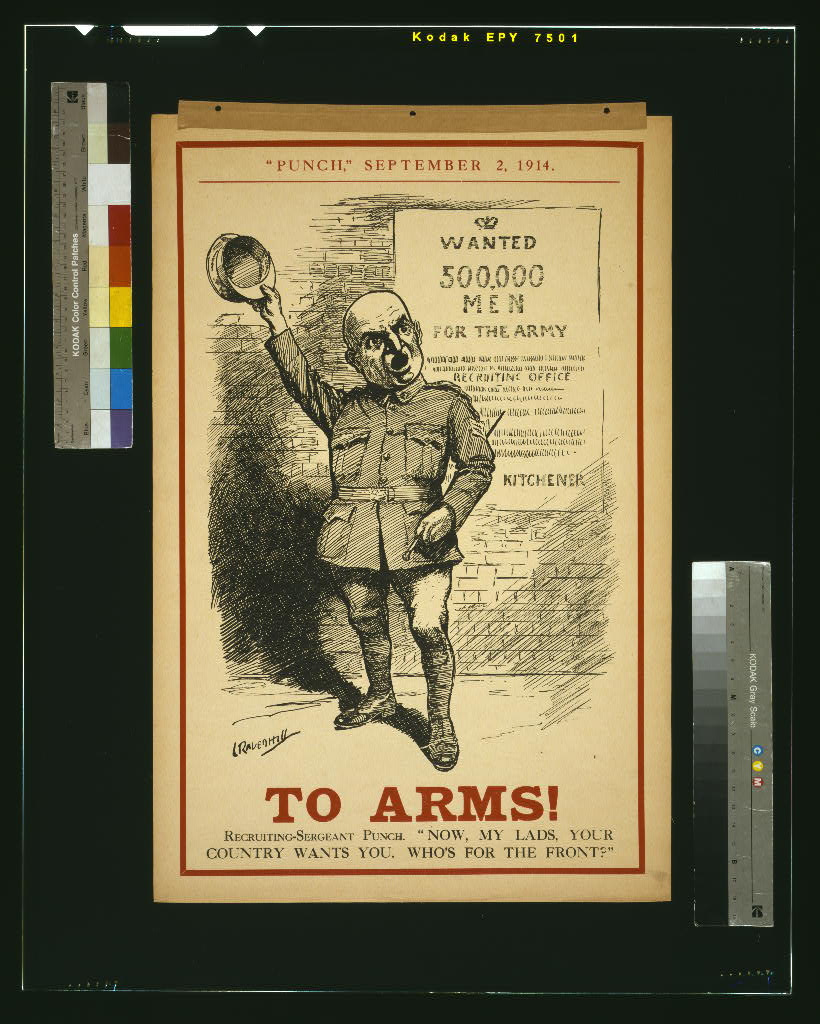
"To Arms!", L. Raven-Hill, Punch, 2 September 1914, caption: "Now, my lads, your country wants you. Who's for the front?" Library of Congress. Public domain (no known restrictions).
How to spot it
- Ask who issued it. A famous poster may have started as a magazine cover or a commercial advertisement, not a government order.
- Check the printing marks and the record. Official posters carry a committee name and a design number; Leete's image, in its commercial versions, did not.
- Treat "it recruited millions" as a claim that needs counts, not a feeling. Compare the enlistment figures month by month with the news from the front.
Show all 4Show fewer
- Look for the same device on every side. A pointing figure with "you" is a template, not a national signature.
Sources and further reading
Images
5 items · Leete's design as a stand-alone poster ("Britons, Lord Kitchener wants you" in its…
| Image | Source | Licence |
|---|---|---|
| London Opinion cover, Alfred Leete, 5 September 1914 | Library of Congress | Public domain (no known restrictions) |
| "Britons! Your country needs you", PRC poster no. 23, 1914 | Library of Congress | Public domain (no known restrictions) |
| "Follow me! Your country needs you", PRC poster no. 11, 1914 | Library of Congress | Public domain (no known restrictions) |
| "To Arms!", L. Raven-Hill, Punch, 2 September 1914 | Library of Congress | Public domain (no known restrictions) |
| "Auch du sollst beitreten zur Reichswehr", J. U. Engelhard, 1919 | Library of Congress | Public domain (no known restrictions) |
| I Want You for U.S. Army (1917), Kitchener postcard (about 1914), Daddy, what did YOU do (1915) | FRAME gallery | Public domain |
Image gaps
- Leete's design as a stand-alone poster ("Britons, Lord Kitchener wants you" in its commercial forms). The Commons API was rate-limited during this session, so no scan was checked and none is hosted. Fillable from Wikimedia Commons or the Imperial War Museum after a rights check.
- Dmitry Moor, "Have you volunteered?" (1920). Not verified on a holding institution's site in this session. Fillable from the Library of Congress, the Russian State Library or Commons.
- A photograph of the Liverpool station of 15 December 1914 showing Leete's poster, and any photograph from the Imperial War Museum collection. Rights not checked. Held.
- The PRC's 30-word Kitchener poster. Not identified with certainty among the Library of Congress items searched. Fillable from the Library of Congress or the Parliamentary Archives.
- A 1997 Army reissue or 2014 coin image. Under copyright; not hosted.
Sources
9 items · James Taylor, Your Country Needs You: The Secret History of the Propaganda Poster…
- James Taylor, Your Country Needs You: The Secret History of the Propaganda Poster (Glasgow: Saraband, 2013).
- Stephen Badsey, "Strategy and propaganda: Lord Kitchener, the retreat from Mons and the Amiens Dispatch, August-September 1914", University of Wolverhampton repository, https://wlv.openrepository.com/handle/2436/622587.
- "Lord Kitchener Wants You", Wikipedia, summarising Taylor, Hiley and Messinger: https://en.wikipedia.org/wiki/Lord_Kitchener_Wants_You.
- "Recruitment to the British Army during World War I", Wikipedia, citing the War Office's Statistics of the Military Effort of the British Empire (1922) and Rinaldi (2008): https://en.wikipedia.org/wiki/Recruitment_to_the_British_Army_during_World_War_I.
- The Long, Long Trail, "Enlisting into the army": https://www.longlongtrail.co.uk/soldiers/a-soldiers-life-1914-1918/enlisting-into-the-army/.
- King's Own Royal Regiment Museum, "Recruiting Kitchener's Army": http://www.kingsownmuseum.com/war1914-14.htm.
- Library of Congress catalogue records for the posters above, including Parliamentary Recruiting Committee nos. 11 and 23.
- Time, "Story behind the Uncle Sam poster": https://time.com/4725856/uncle-sam-poster-history/.
- Nick Hiley, in Imperial War Museum publications (1997), as reported in the Wikipedia article above.