Content note. This page quotes 1918 government copy that calls Germans "the Hun" and asks citizens to report neighbours to the Justice Department. The wording is quoted as the evidence under study.
In one line: A week after entering the war, the United States created a federal propaganda agency that ran posters, films, a daily newspaper and some 75,000 volunteer speakers, asked citizens to report people who "cries for peace", and in 1918 published as proof a set of Russian documents that were later judged forgeries.
What happened
- 6 April 1917. The United States declares war on Germany.
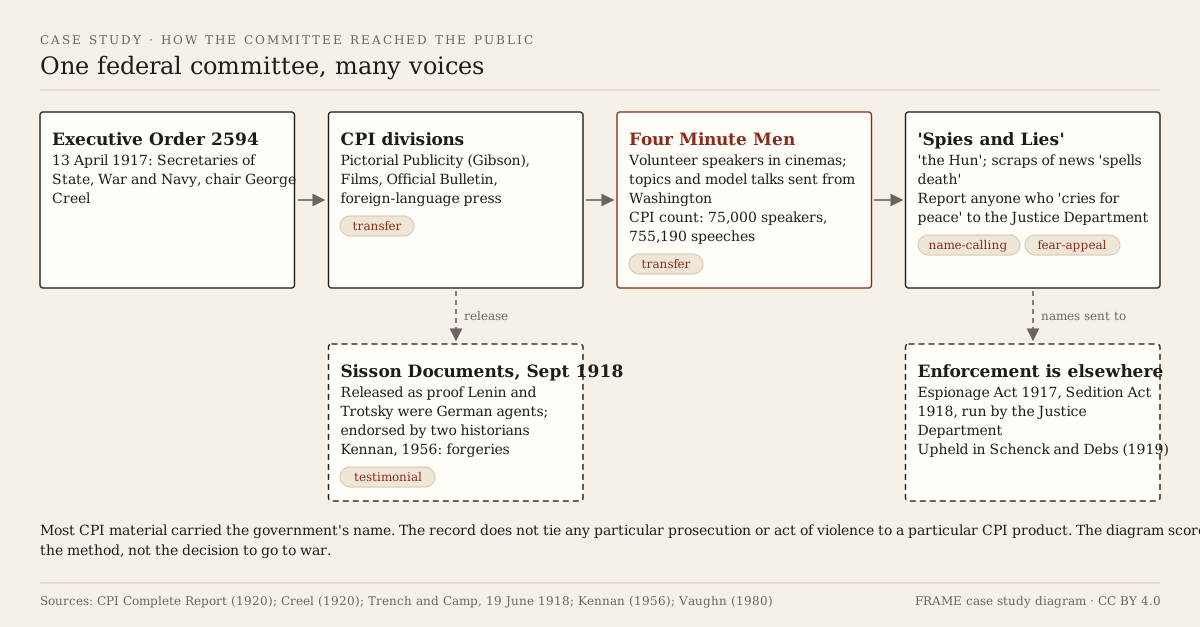
- 13 April 1917. Executive Order 2594 creates the Committee on Public Information (CPI): the Secretaries of State, War and the Navy, and a civilian chair, the journalist George Creel.
- May 1917. The CPI issues guidance asking newspapers to withhold military information voluntarily, and starts the Official Bulletin, a daily government newspaper.
- 1917. The Four Minute Men division starts. Volunteer speakers give four-minute talks in cinemas during reel changes, on topics and model talks sent from Washington. A standard slide introduced each speaker as speaking under the authority of the CPI. The CPI's final report counts 75,000 speakers and 755,190 speeches.
- 1917-1918. The Division of Pictorial Publicity, chaired by the illustrator Charles Dana Gibson, recruits commercial artists to design posters for the Army, the Navy, the Treasury's Liberty Loans, the Red Cross and the Food Administration. The Division of Films releases features such as Pershing's Crusaders (1918) under government auspices.
- 15 June 1917 and 16 May 1918. Congress passes the Espionage Act and the amendments known as the Sedition Act. The Justice Department, not the CPI, enforces them. Eugene Debs is sentenced to ten years in 1918 for an anti-war speech; the Supreme Court upholds convictions under the Espionage Act in Schenck v. United States and Debs v. United States (1919).
- 1918. The CPI's "Spies and Lies" copy runs in magazines and newspapers. The version printed in Trench and Camp (Augusta, Georgia) on 19 June 1918 tells readers: "Report the man who spreads pessimistic stories, divulges—or seeks—confidential military information, cries for peace, or belittles our efforts to win the war. Send the names of such persons, even if they are in uniform, to the Department of Justice, Washington."
- 5 April 1918. Robert Prager, a German-born coal miner, is lynched by a mob in Collinsville, Illinois; the defendants are acquitted. Historians place the killing in the wider anti-German climate of 1917-1918; the record does not tie it to any CPI product.
- 23 May 1918. Iowa's governor William L. Harding bans the public use of foreign languages, including on the telephone. The Supreme Court later strikes down a state ban on teaching foreign languages to young children (Meyer v. Nebraska, 1923).
- 15-16 September 1918. The CPI releases the "Sisson Documents" to the press, papers bought in Petrograd by its representative Edgar Sisson, as proof that Lenin and Trotsky were German agents. Newspapers run them under headlines such as "Lenine-Trotzky German Agents: Proof of Their Treachery to Russia is Found". In October the CPI publishes them as a pamphlet, The German-Bolshevik Conspiracy, with a report by the historians J. Franklin Jameson and Samuel N. Harper of the National Board for Historical Service judging most of them genuine.
- 1919. The CPI's domestic work stops after the Armistice and the committee is wound up. Creel publishes his account, How We Advertised America, in 1920.
- 1956. The diplomat and historian George F. Kennan examines the Sisson Documents and concludes that they were forgeries.
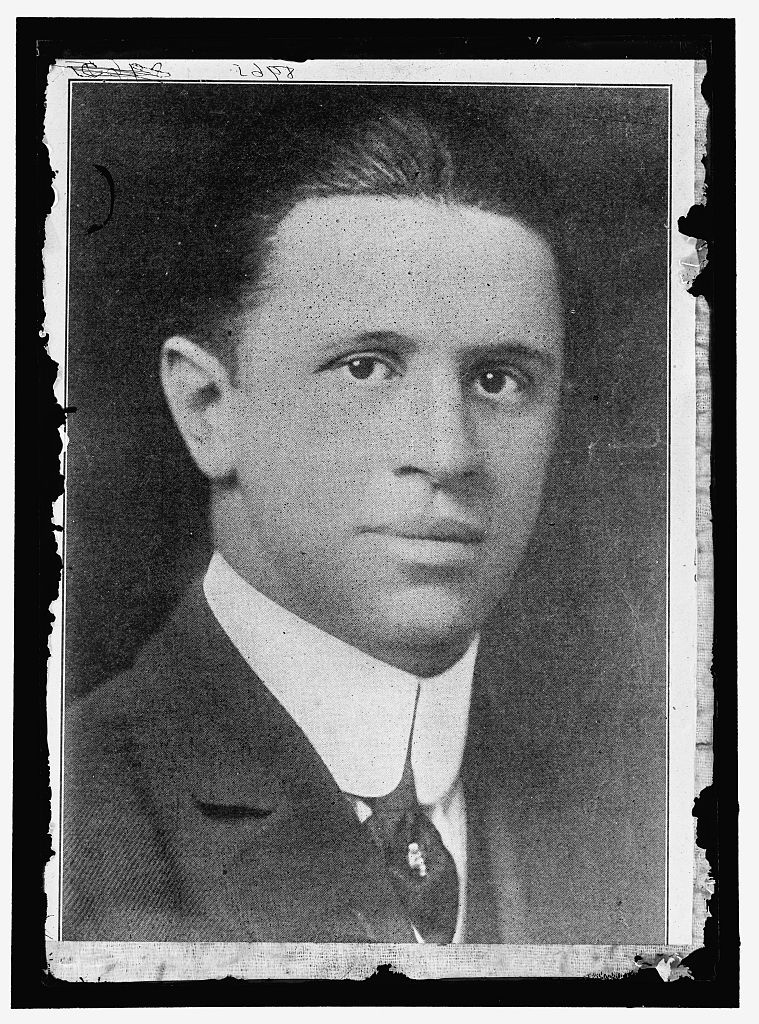
George Creel, chairman of the CPI. Harris & Ewing, Library of Congress. No known restrictions on publication.
How it works
- Transfer: the Four Minute Men took the name and look of the 1775 militia. On the CPI's poster a town crier in a tricorn hat rings a bell before Independence Hall under "A Message from Washington", so a federal bulletin arrives dressed as a citizens' call to arms. The poster for Pershing's Crusaders puts ghostly medieval knights with red-cross shields in the sky behind Pershing's troops.
- Name-calling: "Spies and Lies" calls the enemy "the Hun" twice, and the same label runs through the Liberty Loan and Marine Corps posters of the period ("Halt the Hun!"). The label arrives before any specific act.
- Fear appeal: "Spies and Lies" says that scraps of news, pieced together in Germany, make "a whole [that] spells death to American soldiers and danger to American homes", then offers one remedy: send names to the Justice Department. The list of reportable conduct runs from passing military secrets to "cries for peace" and belittling the war effort, so lawful dissent sits in the same sentence as espionage.
- Testimonial: the Sisson Documents reached the public with two vouches, the CPI's own release and the endorsement of two named historians under the National Board for Historical Service. The vouch did the work that testing the documents' provenance would have done.
The CPI's material was mostly white propaganda: posters, films and speakers carried the government's name, and the Four Minute Men slide said who sent them. Its method is in the framing, not in hidden sourcing.
Then and now
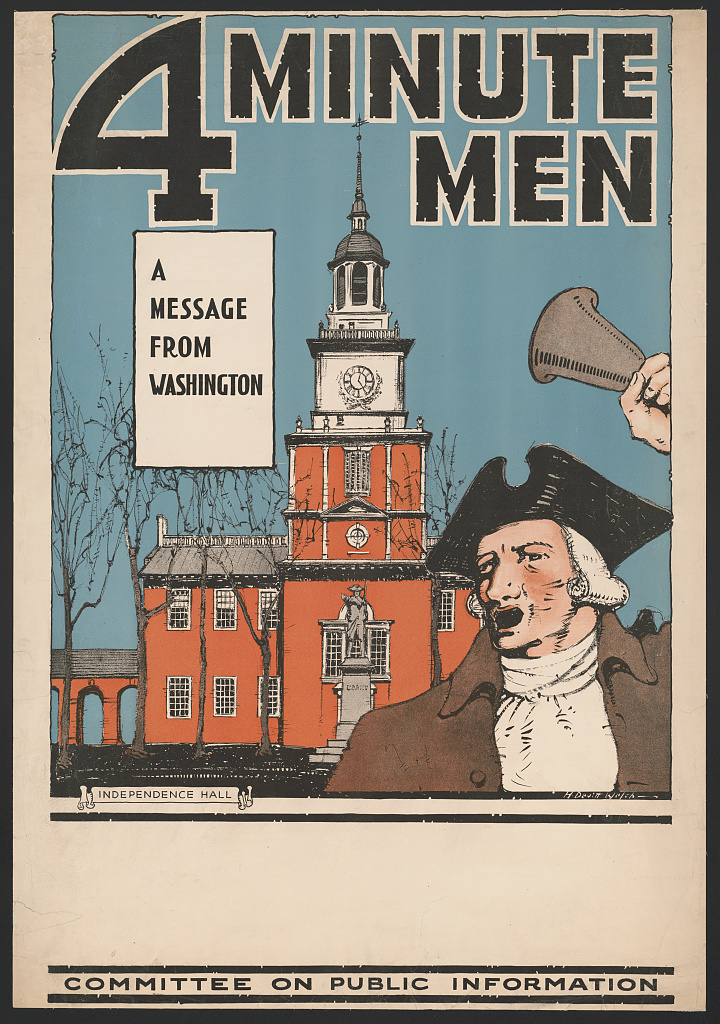
4 Minute Men: A Message from Washington, Committee on Public Information, 1917. Public domain.
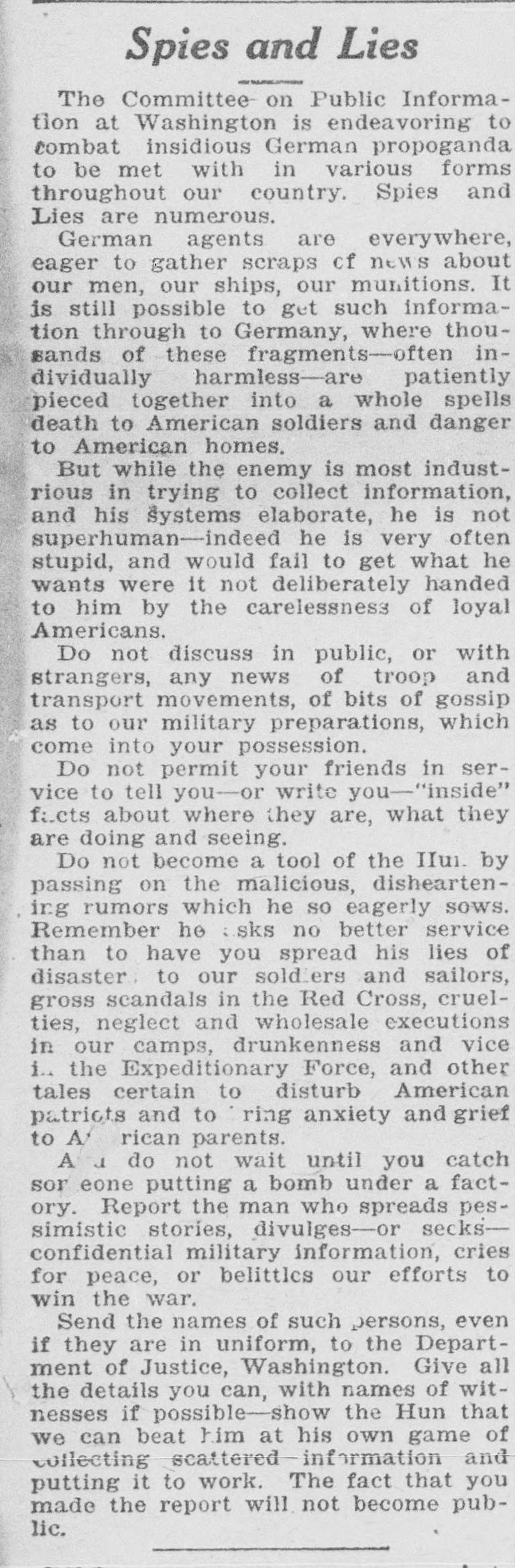
"Spies and Lies", CPI copy as printed in Trench and Camp (Augusta, Georgia), 19 June 1918, p. 15. Chronicling America, Library of Congress. Public domain; cropped to the column by FRAME.
In September 2026, Iranian state media promoted Alaj, a portal asking citizens to send in the names of Iranians abroad it called traitors, with a promise that informants' identities would stay confidential (Alaj: the portal Iranian state media promoted for reporting 'traitors abroad'). In 1918 the CPI asked Americans to send the Justice Department the names of people who spread "pessimistic stories" or "cries for peace", and promised that "the fact that you made the report will not become public." Both pair a loaded label with a confidential reporting channel.
The differences are as plain. The CPI's request ran in a declared war, went to a named federal department, and was tied to statutes that were debated in Congress and reviewed by the Supreme Court, which upheld them at the time. Alaj's operators and legal basis are not identified in the sources used here, and its campaign ran in peacetime rather than a declared war and was aimed at emigrants. The scale of what followed also differs, and this page does not claim to measure either.
Positions on the record
- The CPI's own account: Creel described the committee's work as "a plain publicity proposition", information rather than propaganda in the German sense, and called its method "expression, not suppression" (How We Advertised America, 1920).
- Critics at the time and after: Congress cut the CPI's funding in 1918 after disputes with Creel. Walter Lippmann, who served in wartime military intelligence propaganda, wrote in Public Opinion (1922) about the "manufacture of consent". Historians such as Vaughn (1980) describe how CPI copy encouraged citizens to watch and report their neighbours, and how it placed dissent close to disloyalty.
- Documented: the executive order, the CPI's divisions and reported figures, the "Spies and Lies" wording, the Espionage and Sedition Acts and the Supreme Court decisions, the release of the Sisson Documents and Kennan's 1956 finding.
- Not shown: that any particular prosecution, firing or act of violence was caused by a particular CPI product. The CPI's audience figures are its own counts.
Same-method test
A government of any country that, in wartime, asked citizens to send the names of people who "cry for peace" to its interior ministry, promised them secrecy and called the enemy by an animal label would be scored the same way. So would any state that released purchased foreign documents as proof of a rival's treason with scholars' endorsement and without testing their origin.
How to spot it
- Read the list of reportable conduct. When "spreads pessimistic stories" or "cries for peace" sits in the same sentence as espionage, the category has been widened.
- Ask who is speaking. A volunteer's talk written in Washington is a government message, whatever the costume; the CPI's slide said so, and that disclosure is what to look for.
- For leaked or purchased documents, look for provenance: who obtained them, from whom, how they were checked and whether originals exist. An endorsement is not a provenance.
Images
| Image | Source | Licence |
|---|---|---|
| Mechanism diagram (above) | Drawn for FRAME from this page's sourced facts (make_diagrams.py) |
CC BY 4.0, FRAME |
| George Creel, 1917 | Library of Congress, Harris & Ewing Collection | No known restrictions on publication |
| "Spies and Lies", Trench and Camp, 19 June 1918 | Chronicling America, Library of Congress | Public domain (U.S., published 1918); cropped by FRAME |
| "Lenine-Trotzky German Agents", Barre Daily Times, 16 September 1918 | Chronicling America, Library of Congress | Public domain (U.S., published 1918); cropped by FRAME |
| 4 Minute Men: A Message from Washington (1917) | FRAME gallery | Public domain in the U.S. (published before 1931) |
| Pershing's Crusaders (1918) | FRAME gallery | Public domain in the U.S. (published before 1931) |
| Halt the Hun! (1918) | FRAME gallery | Public domain in the U.S. (published before 1931) |
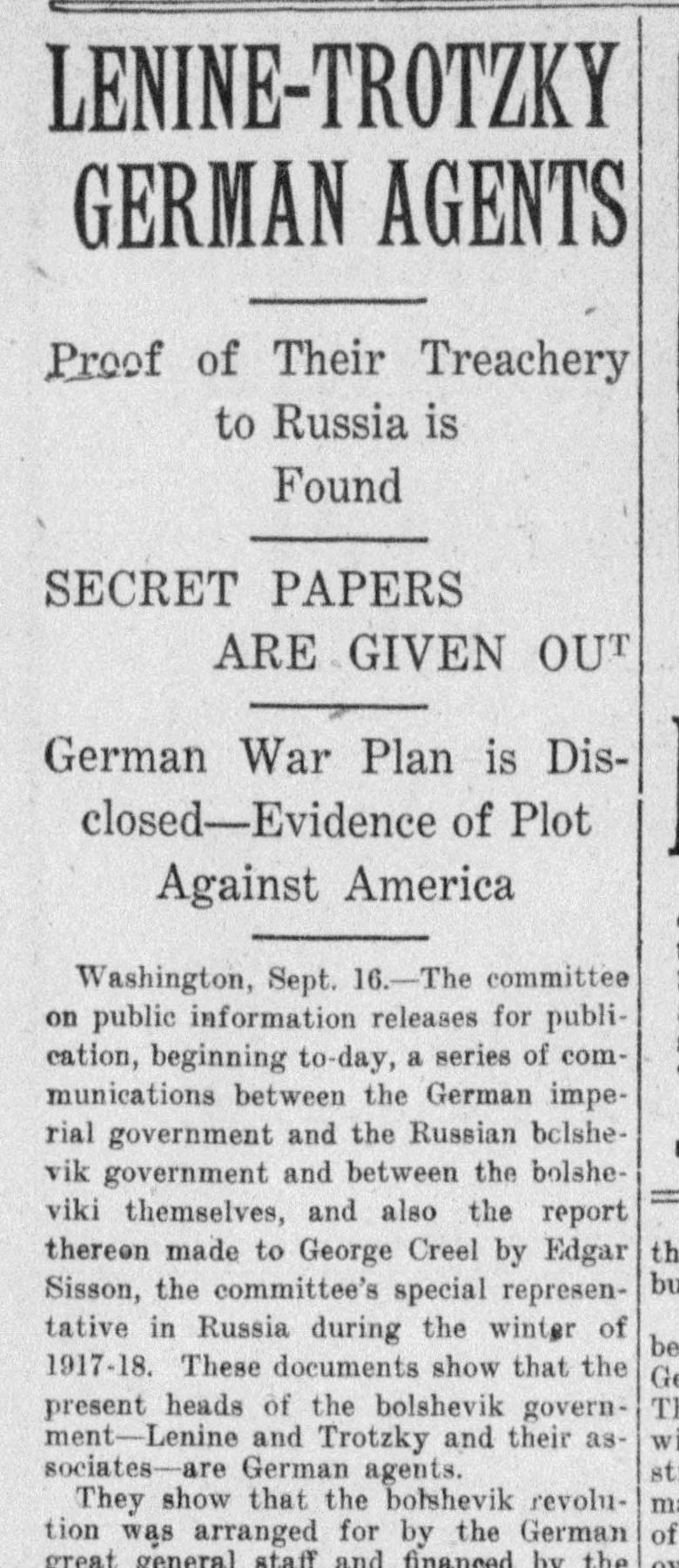
The CPI's release of the Sisson Documents as reported in The Barre Daily Times (Barre, Vermont), 16 September 1918, p. 3. Chronicling America, Library of Congress. Public domain; cropped by FRAME.
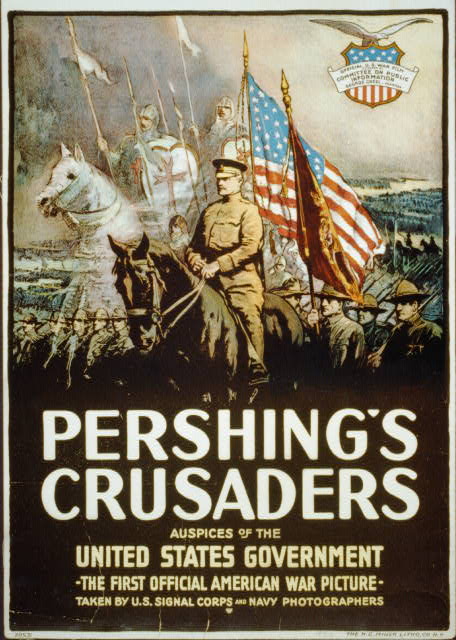
Pershing's Crusaders, CPI Division of Films, 1918. Public domain.
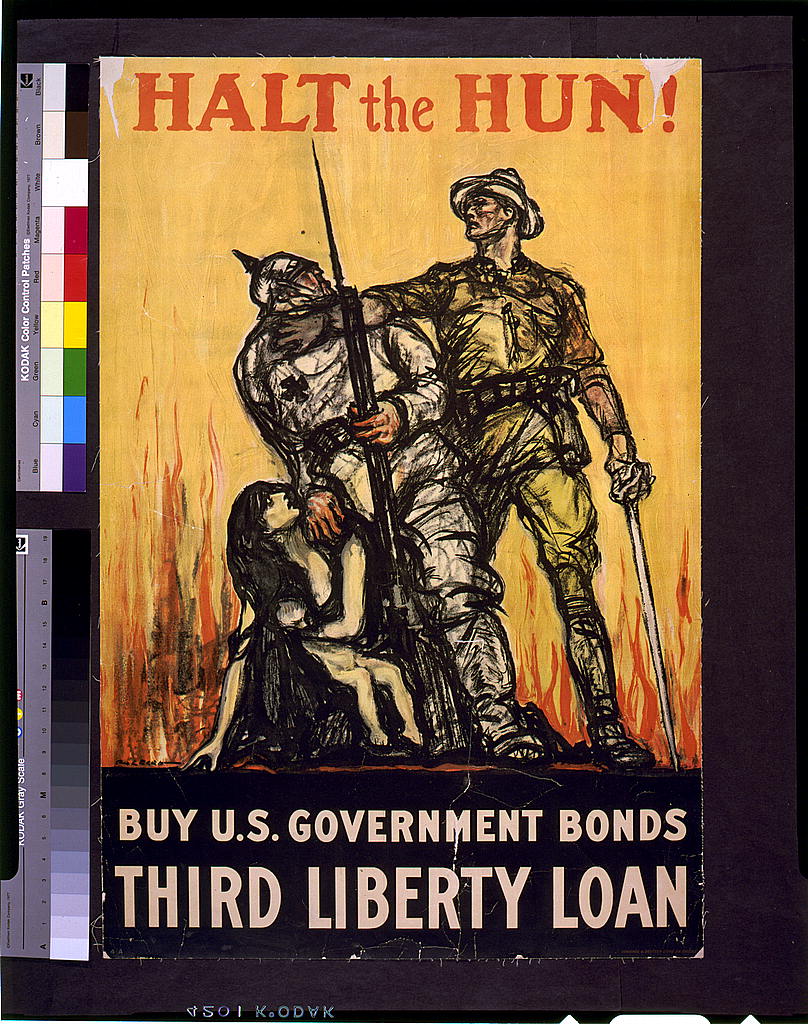
Halt the Hun! Buy U.S. Government Bonds, Third Liberty Loan, Third Liberty Loan, 1918. Public domain.
Image gaps
- The pamphlet The German-Bolshevik Conspiracy (War Information Series no. 20, 1918). A U.S. government publication, so public domain, but no scan was found on loc.gov, and archive.org and HathiTrust could not be reached from the build environment. Fillable.
- A Four Minute Men bulletin or the introductory cinema slide. Public domain; copies are in the CPI records at the National Archives (Record Group 63), which could not be reached from the build environment. Fillable.
- The Official Bulletin. Public domain; no page scan was reachable from the build environment. Fillable.
- Photographs of anti-German incidents in 1917-1918. Not included: none with a confirmed public-domain status was found, and a photograph would imply a link to the CPI that this page does not show.
Sources
Full text in this archive: Lippmann, Public Opinion (1922) and Wilson's war message of April 2, 1917.
- Executive Order 2594, 13 April 1917, establishing the Committee on Public Information.
- Committee on Public Information, Complete Report of the Chairman of the Committee on Public Information, 1917: 1918: 1919 (Washington: Government Printing Office, 1920).
- George Creel, How We Advertised America (New York: Harper & Brothers, 1920).
- Committee on Public Information, The German-Bolshevik Conspiracy, War Information Series no. 20 (Washington, October 1918).
- "Spies and Lies", Trench and Camp (Augusta, Ga.), 19 June 1918, p. 15. Chronicling America.
- "Lenine-Trotzky German Agents", The Barre Daily Times (Barre, Vt.), 16 September 1918, p. 3. Chronicling America.
- George F. Kennan, "The Sisson Documents", Journal of Modern History 28, no. 2 (June 1956): 130-154.
- James R. Mock and Cedric Larson, Words That Won the War: The Story of the Committee on Public Information, 1917-1919 (Princeton University Press, 1939).
- Stephen Vaughn, Holding Fast the Inner Lines: Democracy, Nationalism, and the Committee on Public Information (University of North Carolina Press, 1980).
- Alan Axelrod, Selling the Great War: The Making of American Propaganda (Palgrave Macmillan, 2009).
- Walter Lippmann, Public Opinion (New York: Harcourt, Brace, 1922).
- Schenck v. United States, 249 U.S. 47 (1919); Debs v. United States, 249 U.S. 211 (1919); Meyer v. Nebraska, 262 U.S. 390 (1923).
- Library of Congress, George Creel, Harris & Ewing photograph.