In one line: From 1923-24 the Soviet Union folded its youngest schoolchildren, aged about seven to nine, into the bottom rung of the party's youth ladder — the Little Octobrists (Oktyabryata) — who wore a red star pin bearing a portrait of Lenin as a small child, recited a short list of generic moral rules, were split into five-child "little star" groups under an older Pioneer's supervision, and moved up into the Young Pioneers at nine or ten as a matter of course, before the whole system was dissolved in 1991.
What happened
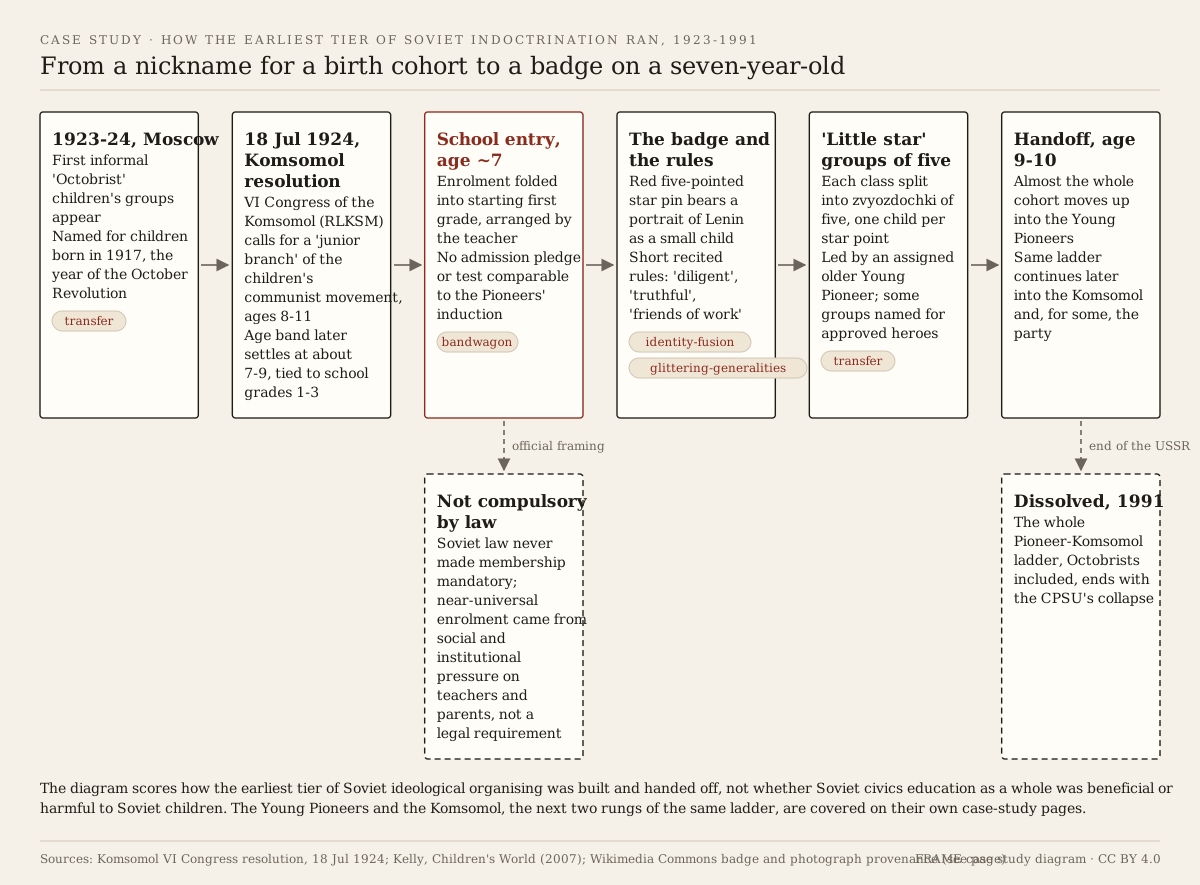
- 1923-24, Moscow. The first groups calling themselves "Octobrists" appear informally among schoolchildren, taking the name from Oktyabr (October) and from the fact that children born in 1917, the year of the October Revolution, were then reaching school age. The idea spreads through Komsomol-linked educators rather than by central decree.
- 18 July 1924. The VI Congress of the Komsomol (the RLKSM, the Russian Leninist Young Communist League) adopts a resolution "On the organisational development of children's groups," stating that the communist movement should extend to younger children, aged roughly 8-11, "by creating a junior branch of the children's communist movement." This is the first central party endorsement of what becomes the Little Octobrists; the age band it names is wider than the roughly 7-9 range the organisation eventually settles into, tied to the first three years of Soviet primary school.
- Through the interwar and postwar decades. The Little Octobrists become a fixture of Soviet primary education rather than a separate voluntary club: children are organised by school class, one Octobrist group per grade 1-3 classroom, itself divided into subgroups of five called zvyozdochki ("little stars"), with each class assigned an older child from the local Young Pioneer detachment as its supervising "leader." Enrolment becomes near-automatic for an entering first-grade class, arranged through the teacher rather than applied for by the family, unlike the Young Pioneers' own induction, which kept a more visible pledge ceremony.
- The badge. Every Octobrist wears a small red five-pointed star pin, produced in the millions in aluminium, brass, plastic and enamel versions, most bearing a reproduction of a well-known 19th-century portrait of Lenin as a small curly-haired child, painted by Ivan Parkhomenko; some later mass-produced versions carry a stylised relief profile instead of the painted image. Children typically received the badge at or soon after school entry, at a brief classroom ceremony rather than the more elaborate Pioneer induction.
- The rules. Octobrists were taught a short list of recited rules, commonly rendered in English translation along the lines of: Octobrists are diligent children who love school and respect their elders; only those who love work are called Octobrists; Octobrists are truthful and brave; Octobrists are friendly children who read, draw, play and sing. The content is generic good-child behaviour — diligence, honesty, respect, industriousness, cheerfulness — with no overt political argument in the child-facing text itself; the political content sits in the badge, the star-shaped grouping and the destination the rules point toward, not in the words of the rules.
- The star groups. Each zvyozdochka of five children was conventionally understood to correspond to the five points of the star badge and flag; groups were sometimes given names drawn from approved child or revolutionary role models, following the same naming convention used one rung up in Pioneer detachments (themselves often named for figures such as Pavlik Morozov or other officially sanctioned exemplars).
- The handoff. At around age nine or ten, in third grade, Octobrists were "accepted" into the Young Pioneers in a more formal ceremony — see the photograph below, taken 1 May 1981 at Moscow's Central Lenin Museum — receiving the red neckerchief and continuing up the same ladder that led, in adolescence, into the Komsomol, covered on The Komsomol: youth pipeline, mass mobilization and internal discipline, 1918-1991, and for a much smaller fraction eventually into full CPSU membership. The Young Pioneer stage itself is covered in depth on The All-Union Pioneer Organization: scouting rebuilt as a communist pipeline, 1922-1991 and is not repeated here.
- 1991. The Little Octobrists were dissolved along with the rest of the Pioneer-Komsomol system as the CPSU's institutional authority collapsed with the Soviet Union itself. No single decree is commonly cited as the organisation's death certificate; it simply stopped being convened in schools as the party apparatus that ran it ceased to exist.
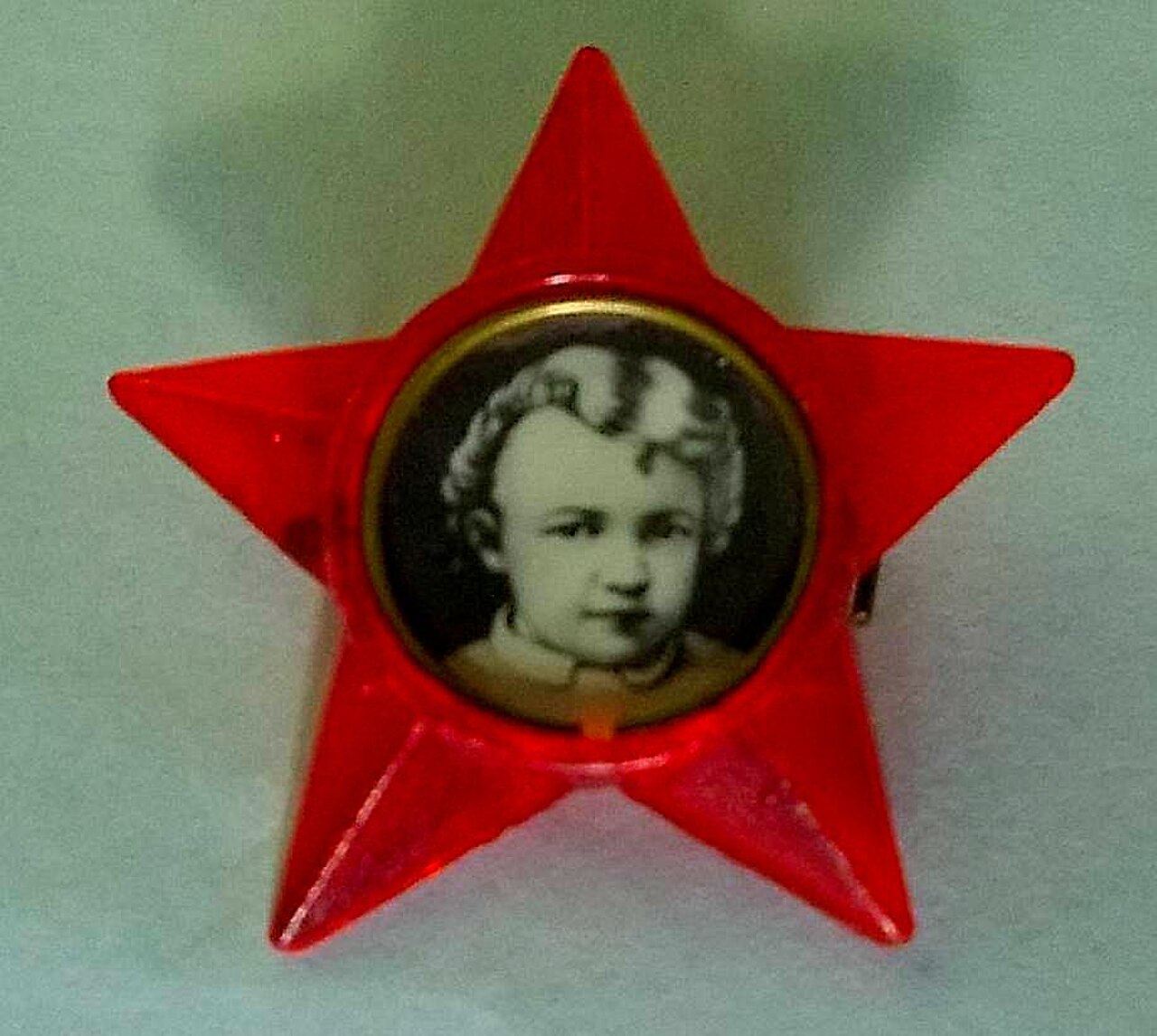
A Little Octobrist badge, plastic red star with a reproduction of Ivan Parkhomenko's portrait of Lenin as a small child at its centre. Wikimedia Commons, uploaded by Uz1awa, CC BY-SA 4.0.
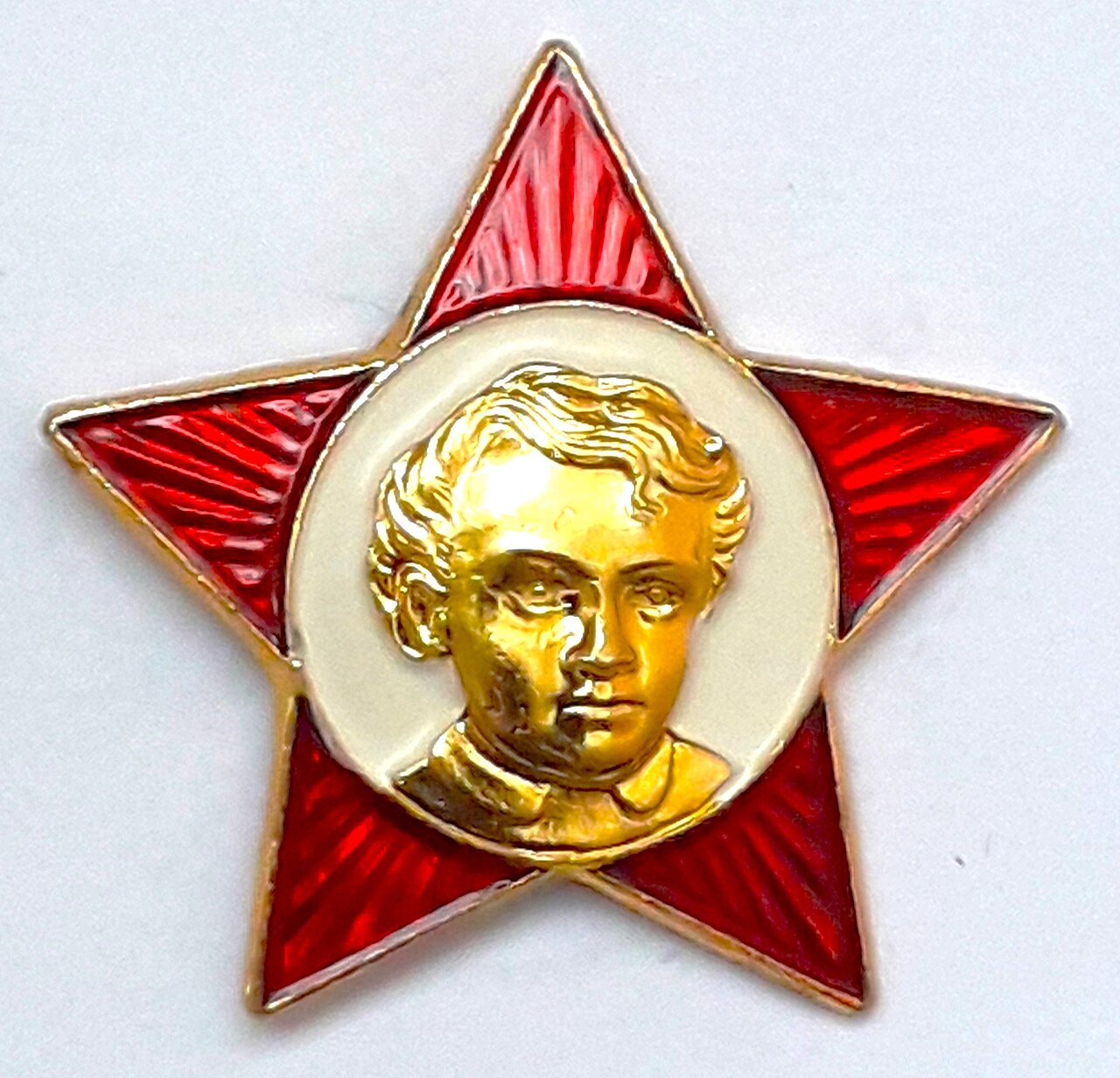
A second, enamelled Octobrist badge design, with a raised gold-toned relief profile in place of the photographic portrait: the two designs show the badge was mass-produced in more than one finish rather than issued as a single fixed object. Wikimedia Commons, uploaded by Vasilich53, CC0.
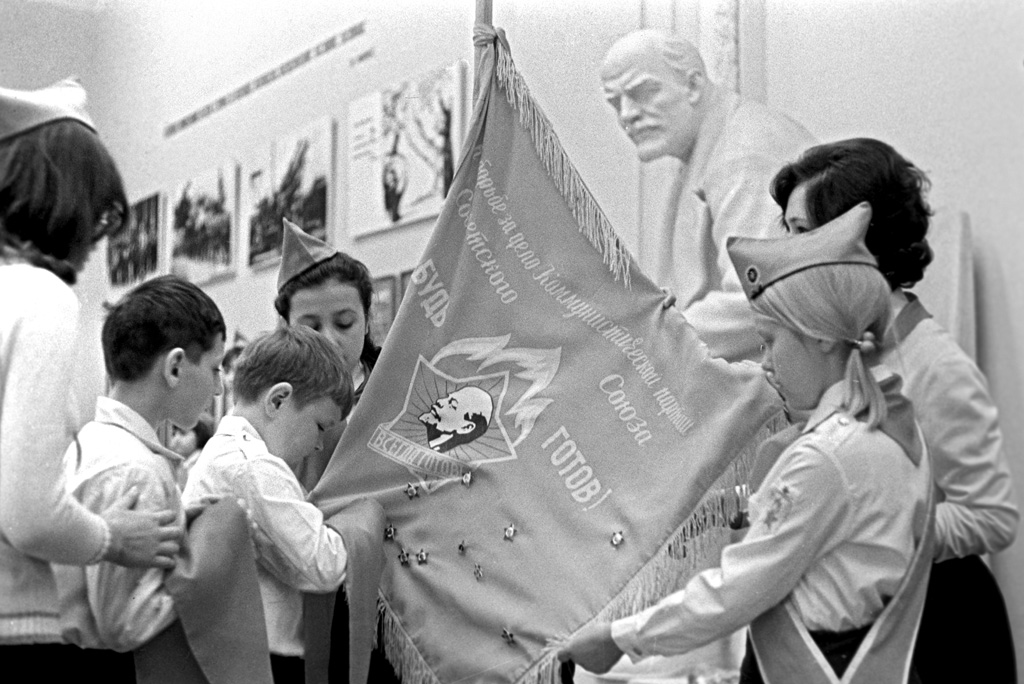
"Little Octobrists becoming Pioneers," the Central Lenin Museum, Moscow, 1 May 1981. Photo by Alexander Lyskin, RIA Novosti archive image #848863. Wikimedia Commons, CC BY-SA 3.0.
How it works
- Identity fusion: the badge is worn on the chest, at school, from about age seven — years before a child can meaningfully evaluate the political system it represents — so that being "a good student" and being marked as a small communist become the same visible fact from the earliest point the state has regular access to the child. The five-child star grouping folded ordinary classroom friend groups into the same red-star geometry that structured the whole youth ladder above it.
- Transfer: the badge borrows the standing of the adult Lenin cult (covered in depth on The Lenin cult after 1924: an embalmed body, a mausoleum and a doctrine called "Leninism") and attaches it to a portrait of Lenin as a child specifically, inviting a seven-year-old to see the founder of the state as a version of themselves; naming individual star groups after approved child or revolutionary heroes did the same at the small-group level.
- Glittering generalities: the recited rules ask for diligence, truthfulness, respect and cheerfulness — universally agreeable virtues that carry no specific, checkable political content on their own — so that the actual work the rules do (building an early habit of collective recitation and group identity under the party's youth apparatus) sits underneath language no parent could plausibly object to.
- Bandwagon: unlike the Young Pioneers' more visible induction pledge, Octobrist enrolment for an entire first-grade class was ordinarily arranged by the teacher as a routine part of starting school, not sought out child by child; a child who was Sasha's classmate and was not enrolled would have been a conspicuous, rare exception rather than one choice among normal-seeming options.
- Narrative laundering: official and popular description of the Little Octobrists framed the organisation as ordinary moral and civic education for young children — good behaviour, tidiness, collective play — rather than as the first rung of a party recruitment ladder that fed, at the far end, into Komsomol and CPSU membership; the generic-virtue language of the rules is itself part of how that framing was carried.
Then and now
Russia has not reconstituted the Little Octobrists by that name, but the same logic — organising the youngest school grades into a state-sponsored collective identity before the Pioneer-Komsomol system's replacement takes over for older children — reappeared after 2022. The federal "Movement of the First" (Dvizhenie Pervykh), created by a law President Putin signed on 14 July 2022 and formally launched at a founding congress in Moscow that December, is open from age six and was widely and explicitly compared in Russian and Western reporting to the Pioneer organisation it echoes, a comparison Kremlin officials have both invited (with references to their own Pioneer and Komsomol childhoods) and periodically downplayed. Russian schools have separately run an "Orlyata Rossii" ("Little Eagles of Russia") programme for grades 1-4 since 2022, aimed at exactly the Little Octobrists' former age band and reported in Russian media as a conscious revival of that model; independent verification of its day-to-day content is thinner than for the older, well-documented Soviet organisation, and this page does not claim more precision about it than that. An earlier, smaller 2015 initiative, the Russian Movement of School Students, drew the same comparison at the time and is documented in contemporary reporting (RFE/RL, "Putin's Pioneers: Push For Russian Youth League Stirs Debate, Doubt," 2016).
The mechanism is comparable — a state-sponsored, near-default collective identity introduced at the earliest school age, ahead of any capacity for informed consent — but the political stakes differ: post-2022 Russia is not a one-party state administering a single legal children's organisation as the only option, and family opt-out, while socially costly in some settings, is not equivalent to Soviet-era near-universality inside a system with no legal alternative organisation to join.
Positions on the record
- The Soviet Union's own stated position. Official Soviet pedagogy and party literature described the Little Octobrists as elementary moral and civic education appropriate to young children's development — instilling diligence, honesty, collectivism and respect for elders — and denied that this amounted to political indoctrination as such, even though the same texts were explicit that the organisation existed to prepare children for the Young Pioneers and, ultimately, the Komsomol and the party.
- Scholarly consensus. Catriona Kelly's Children's World: Growing Up in Russia, 1890-1991 (Yale University Press, 2007) is the standard English-language academic treatment of Soviet childhood and covers the Little Octobrists' badges, rituals and star-group structure in detail, treating the organisation as part of a deliberately engineered system for building collective, party-aligned identity from the earliest years of school rather than as incidental moral instruction. Jenny Brine, Maureen Perrie and Andrew Sutton's edited volume Home, School and Leisure in the Soviet Union (George Allen & Unwin, 1980) covers the same ground from a contemporary, late-Soviet vantage point.
- What is documented. The 1923-24 Moscow origin of the name, the 18 July 1924 Komsomol resolution, the roughly 7-9 age band tied to primary grades 1-3, the red star badge bearing Lenin's child portrait, the five-child zvyozdochka structure, the recited rules (in substance, if not in a single canonical translation), the handoff into the Young Pioneers at nine or ten, and the 1991 dissolution alongside the wider Soviet party-youth system.
- What is contested or under-documented. Exactly how uniform the "five rules" wording was across decades and regions, how commonly individual star groups were formally named after specific historical figures as opposed to informally nicknamed, and how much regional or period variation existed in how strictly non-membership was tolerated, are not settled by a single canonical Soviet-wide document; secondary sources describe the general pattern with more confidence than they can supply a single fixed text.
- Not ruled on here. Whether Soviet primary education as a whole, or moral instruction in the Octobrist rules specifically, was good or bad pedagogy considered apart from its political function; that is a separate question from the propaganda mechanism this page describes. The Young Pioneers and Komsomol stages of the same pipeline are also not covered in depth here, and are addressed on their own pages.
Same-method test
The same definitions apply outside the Soviet case. Nazi Germany's Hitler Youth system, covered on The Hitler Youth: from a party wing to a legal duty, 1926-1945, had its own early-tier organisation for boys aged ten to fourteen, the Deutsches Jungvolk ("German Youth"), which used a comparable logic one age tier up from the Little Octobrists: a distinct uniform and badge, small-group structure under older-boy leadership, and a graduated path into the main Hitler Youth and eventually the party apparatus. The age gap is real and matters — the Jungvolk's ten-to-fourteen intake sat a Little Octobrists-equivalent age tier for very young children underneath it in the German system's own structure (the Nazi party's Jungvolk had no true equivalent of a seven-year-old's badge organisation, since German compulsory schooling and party youth work targeted a slightly older starting age than the Soviet Octobrists did) — but the underlying techniques recur: Identity fusion through a badge and uniform worn well before political maturity, Transfer of an adult ideological cult's standing onto child-facing symbols, and small groups organised and named to build collective identity under supervision by slightly older children.
Communist China's Young Pioneers of China (Zhongguo Shaonian Xianfengdui), still active today, admits children from around age six to seven, at first grade, with a red-scarf induction ceremony that begins closer to the Little Octobrists' own starting age than the Soviet Young Pioneers' own nine-to-ten intake did; it is the clearest working comparison for "how young does state-sponsored ideological organising of children start" outside the Soviet case, though its post-Mao content and political stakes differ from the high-Stalinist and Brezhnev-era Soviet Union covered here, and it is not analysed in depth on this page.
The differences that matter: neither modern comparison operates inside a system with the near-total absence of a legal alternative youth organisation that the Little Octobrists occupied for most of Soviet history, and the specific device examined here — a red star badge bearing the founder's portrait as a small child, handed to seven-year-olds as a matter of course rather than sought by them — is a distinctly Soviet artefact, not a universal one.
How to spot it
- Ask at what age a symbol of political or ideological loyalty is first placed on a child, and whether that age falls well before the child could meaningfully evaluate what the symbol stands for.
- Check whether enrolment is framed as an opt-in achievement (an induction pledge, a test of merit) or as a routine, near-automatic part of starting school arranged by adults on the child's behalf; the second pattern is harder for a family to visibly decline without becoming conspicuous.
- Look at the content of any child-facing rules or pledge. Generic, universally agreeable virtue language (diligence, honesty, cheerfulness) is not itself evidence of indoctrination, but ask what organisational structure and political apparatus the words sit inside, and where the ladder the child is being placed on leads.
- Notice when a founder's or leader's adult cult of personality is adapted specifically for children — a youthful portrait, a simplified biography, an age-matched version of the same symbol used for adults — since this is a deliberate design choice, not an accident of what images happened to be available.
- Ask who supervises the smallest organisational unit a child belongs to. Supervision by an older child one rung up the same ladder (as with the Pioneer-led Octobrist star groups) builds the pipeline's continuity into the everyday social structure of the group, not just its formal ceremonies.
Images
| Image | Source | Licence |
|---|---|---|
| Mechanism diagram (above) | Drawn for FRAME from the sources below (make_diagrams_youth_octobrists.py) |
CC BY 4.0, FRAME |
| Little Octobrist badge, plastic red star with Lenin child portrait | Wikimedia Commons, "Октябрятский значок.JPG", photowork by Uz1awa; badge reproduces a PD-Russia-1996 painting by Ivan Parkhomenko | CC BY-SA 4.0 |
| Little Octobrist badge, enamelled star with relief Lenin profile | Wikimedia Commons, "Звёздочка октябрёнка.jpg", uploaded by Vasilich53 | CC0 |
| "Little Octobrists becoming Pioneers," Central Lenin Museum, Moscow, 1 May 1981 | Wikimedia Commons, "RIAN archive 848863 Little Octobrists becoming pioneers.jpg", photo by Alexander Lyskin / Александр Лыскин, RIA Novosti archive | CC BY-SA 3.0 |


Image gaps
- A classroom Octobrist-induction ceremony itself (as opposed to the later Pioneer-induction ceremony shown above). No openly licensed photograph specifically of a first-grade Octobrist badge-pinning ceremony, as distinct from the Pioneer neckerchief ceremony, was found on Wikimedia Commons during this build; the Commons "Little Octobrists" and "Badges of Little Octobrists" categories were searched directly and this specific scene was not present in them.
- The original printed text of the "Rules of the Little Octobrists" as displayed on a period classroom banner or poster. A period banner is known to be held by an academic archive (Toronto Metropolitan University's Archives & Special Collections, "Little Octobrists' Rules banner"), but that institution's own site was not reachable from this build environment (network egress to it was blocked), so no image or verified transcription of the banner itself is included here; the rules text on this page is instead given as a commonly reproduced English translation drawn from secondary sources, without a single fixed canonical wording.
- Several general searches of Wikimedia Commons for this topic returned intermittent HTTP 429 rate-limit responses from the Wikimedia media-serving domain during this build (a known, shared-environment issue also noted on The Lenin cult after 1924: an embalmed body, a mausoleum and a doctrine called "Leninism"); the searches were retried successfully, but a systematic further search for additional Little Octobrists imagery (e.g. period posters, additional badge variants, archival classroom photographs) was not exhaustively completed and may turn up more on a retry.
Sources
- Komsomol (RLKSM), VI Congress resolution, "On the organisational development of children's groups," 18 July 1924 (cited via secondary Russian-language sourcing; no direct primary-text link was verified from this build environment).
- Kelly, Catriona. Children's World: Growing Up in Russia, 1890-1991. Yale University Press, 2007 (standard academic treatment of Soviet childhood, including the Little Octobrists' badge, rules and star-group structure).
- Brine, Jenny, Maureen Perrie and Andrew Sutton, eds. Home, School and Leisure in the Soviet Union. George Allen & Unwin, 1980.
- English Wikipedia, "Little Octobrists".
- Encyclopaedia Britannica, "Little Octobrist".
- RFE/RL, "Putin's Pioneers: Push For Russian Youth League Stirs Debate, Doubt", 2016 (on the 2015 Russian Movement of School Students and its explicit comparison to the Soviet Pioneer legacy).
- Wikimedia Commons, Category:Little Octobrists and Category:Badges of Little Octobrists (consulted for image provenance).
- Wikimedia Commons, "Октябрятский значок.JPG"; "RIAN archive 848863 Little Octobrists becoming pioneers.jpg".
- For the adult Lenin cult that the child-facing badge portrait draws on, see The Lenin cult after 1924: an embalmed body, a mausoleum and a doctrine called "Leninism" and its sources.