Content note. This page shows swastika insignia and Nazi-era uniforms as documentary evidence of how the organization presented itself, and describes its 1945 conscription of children as young as twelve into combat and paramilitary roles. The Holocaust itself, and the organizations covering specifically Nazi girls' and elite-cadre schooling, are covered in FRAME's other case studies, not repeated here.
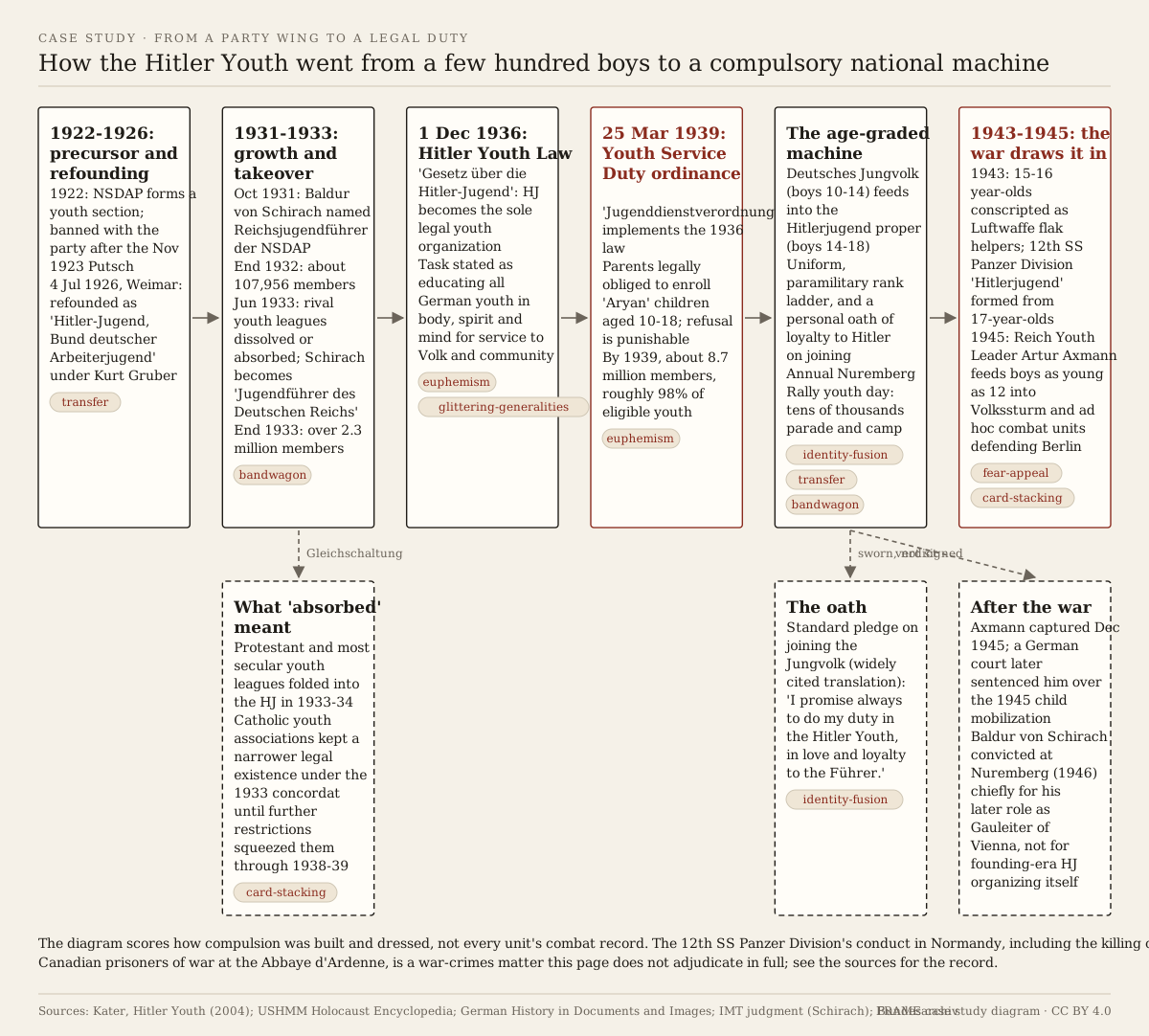
In one line: founded in 1926 as a small party auxiliary, the Hitler Youth grew during the Nazi seizure of power from about 108,000 members at the end of 1932 to over 2.3 million a year later as rival youth associations were dissolved or absorbed, became Germany's only legal youth organization under a December 1936 law, was turned into an individual legal duty for nearly every German child aged 10 to 18 by a March 1939 ordinance, and ended the war with its last Reich Youth Leader, Artur Axmann, sending boys as young as twelve into the defense of Berlin.
What happened
A party wing, twice founded (1922-1926)
- 1922. The NSDAP forms a youth section, the Jugendbund der NSDAP. It is banned along with the party itself after the failed Beer Hall Putsch of November 1923.
- 4 July 1926, Weimar. At the NSDAP's party congress, the youth wing is refounded as "Hitler-Jugend, Bund deutscher Arbeiterjugend" ("Hitler Youth, League of German Worker Youth"), under its first Reichsführer, Kurt Gruber, and placed under the authority of the SA (Sturmabteilung). It stays small through the late 1920s, a marginal auxiliary of a marginal party.
Growth into Schirach's national office (1929-1933)
- 1929. The Hitler Youth marches at the Nuremberg Rally in visible numbers for the first time. FRAME's separate case study covers the rally's own 1923-1933 build-up (Before Triumph of the Will: staging scale for a fringe party at Nuremberg, 1923-1933); this page covers what the Hitler Youth itself did there in the years that followed.
- October 1931. Baldur von Schirach, then 24, is appointed Reichsjugendführer der NSDAP (Reich Youth Leader of the NSDAP), reporting directly to Hitler rather than through the SA chain of command.
- End of 1932. About 107,956 members: a real but still small organization, months before the seizure of power.
- 30 January 1933. Hitler is appointed chancellor.
- June-July 1933. Inside the broader Gleichschaltung ("coordination") of German civil society, the Reich Committee of German Youth Associations and most Protestant and secular youth leagues are dissolved or forced to merge into the Hitler Youth. Schirach is named "Jugendführer des Deutschen Reichs" (Youth Leader of the German Reich), turning a party post into a state one as well. Catholic youth associations keep a narrower legal existence, notionally protected by the July 1933 Reich Concordat with the Vatican, until further administrative pressure squeezes their activity through 1936-1939.
- End of 1933. Over 2.3 million members: roughly a twenty-fold jump on the 1932 figure, with no comparable change in the number of German children. The jump measures the removal of alternatives and the pressure to conform, not a wave of individual choices.
From a monopoly law to an individual legal duty (1936-1939)
- 1 December 1936. The Gesetz über die Hitler-Jugend (Law on the Hitler Youth) makes the Hitler Youth the only legally recognized youth organization for German boys and girls outside the family and the school. The law states its purpose as educating all German youth physically, intellectually and morally in the spirit of National Socialism, for service to the people and the community. This law abolishes the legal standing of any remaining alternative; it does not yet compel any individual child to join.
- 25 March 1939. An implementing ordinance, the Jugenddienstverordnung (Youth Service Duty Ordinance), turns that structural monopoly into an individual legal duty. Parents become legally responsible for enrolling children classified "Aryan" under the regime's racial law from age ten, and for keeping them enrolled to eighteen; failure to comply is punishable. Standard accounts (see Sources) give Hitler Youth structures roughly 8.7 million members by 1939, on the order of 98 percent of eligible German youth — a figure this page treats as an order-of-magnitude estimate rather than an audited count; see Positions on the record.
The age-graded structure
- Boys aged 10 to 14 belonged to the Deutsches Jungvolk (DJ, "German Youth Folk"), then transferred at 14 into the Hitlerjugend proper, which held them to 18. (FRAME covers the parallel girls' organizations, and the separate Napola/Adolf Hitler Schools elite-cadre system and the wartime Kinderlandverschickung evacuation programme, on their own pages; this one does not repeat their material.)
- A paramilitary rank ladder ran from an ordinary Hitlerjunge through Rottenführer, Kameradschaftsführer, Scharführer, Gefolgschaftsführer, Stammführer, Bannführer and Gebietsführer up to the Reichsjugendführer, with insignia and a chain of command modeled on the SA and the army rather than on any prior scouting or youth-movement model.
- The uniform was a brown or tan shirt, black shorts or trousers, a swastika armband, and a black neckerchief held by a woven leather "Knotentuch" toggle. A boy promoted from the Jungvolk into the Hitlerjugend at 14 received a ceremonial dagger, the Hitlerjugend-Fahrtenmesser, inscribed "Blut und Ehre" ("Blood and Honor").
- On joining, each boy swore a personal oath. A standard wording of the Jungvolk pledge, as commonly given in English-language accounts: "Ich verspreche, in der Hitlerjugend allzeit meine Pflicht zu tun in Liebe und Treue zum Führer" ("I promise always to do my duty in the Hitler Youth, in love and loyalty to the Führer"). The oath named Hitler personally, not the German state, a constitution or an office.
The annual demonstration: Nuremberg
- From 1933, one day of the NSDAP's annual Nuremberg Rally was set aside as a dedicated Hitler Youth demonstration. Special trains brought tens of thousands of Deutsches Jungvolk and Hitler Youth boys to Nuremberg, where they camped in tent cities, paraded in massed columns on the Luitpoldhain and Zeppelinfeld grounds, and were addressed directly by Hitler. The rally gave the organization's numbers a yearly staged display that ordinary attendance figures could not.
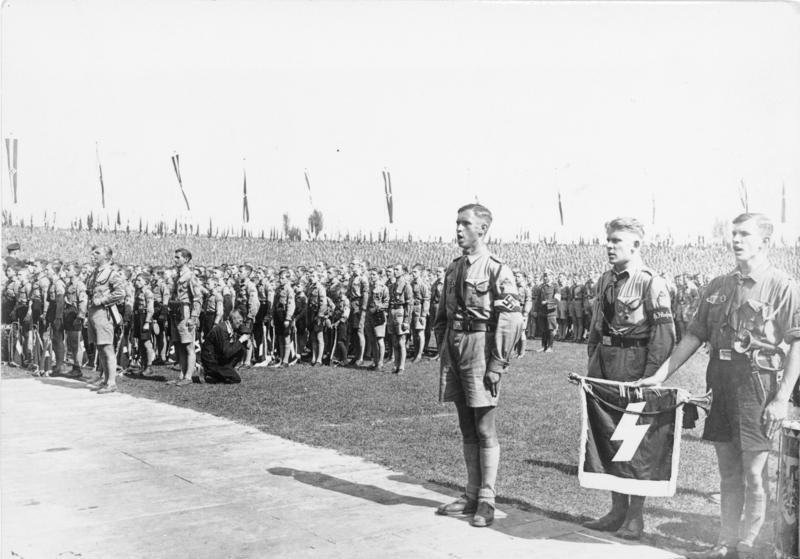
Hitler Youth members in formation for a roll call ("HJ-Appell") at the Nuremberg Rally grounds. Bundesarchiv, Bild 146-1981-160-05, CC BY-SA 3.0 DE.
Curriculum: race, body, loyalty
- Weekly meetings combined drill, sport and ideological instruction. "Geländesport" (terrain sport: map-reading, orienteering, mock field exercises) and marksmanship practice were presented as physical education while doubling as pre-military conditioning (Wehrertüchtigung, "military fitness training"); glider training (Segelflug) fed directly into the wartime Luftwaffe's pilot pipeline.
- Racial-biology instruction taught antisemitic and eugenic doctrine as settled science, using material produced or approved by the Reichsjugendführung's own publishing apparatus.
- Personal loyalty to Hitler, not to any written program, was the organizing theme: the joining oath, songs and flag ceremonies all named him individually.
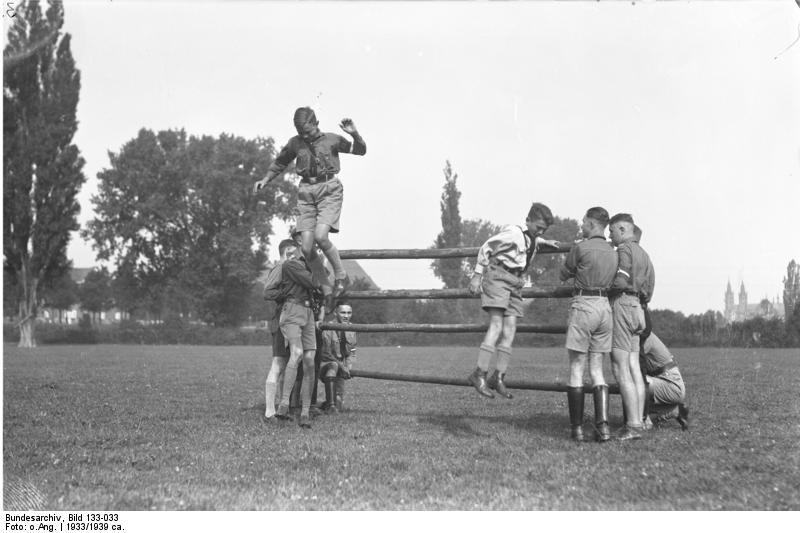
Hitler Youth members practicing "Geländesport" (terrain sport) exercises, presented as physical training. Bundesarchiv, Bild 133-033, CC BY-SA 3.0 DE.
The war absorbs it (1940-1945)
- August 1940. Schirach, appointed Gauleiter of Vienna, hands the Reichsjugendführer post to his deputy, Artur Axmann, who holds it to the war's end.
- From 1943. Fifteen- and sixteen-year-old Hitler Youth members still enrolled in school were conscripted as Luftwaffenhelfer (air-force auxiliaries) to crew anti-aircraft batteries. The same year the Waffen-SS formed the 12th SS Panzer Division "Hitlerjugend" from Hitler Youth volunteers and conscripts, most of them seventeen; it fought in Normandy in 1944. Its record there, including the killing of captured Canadian soldiers at the Abbaye d'Ardenne, is a documented war-crimes matter this page does not adjudicate in full; see Sources.
- 1945. As the Wehrmacht collapsed, Axmann organized the Hitler Youth's oldest boys, and in the war's final weeks boys as young as twelve, into Volkssturm units and ad hoc combat groups. On 20 March 1945, Hitler personally decorated child soldiers with the Iron Cross in the garden of the Reich Chancellery, an event photographed and filmed for newsreel use. Hitler Youth units fought, and many died, in the Battle of Berlin in April and May 1945.
- Axmann was present near the Führerbunker in the war's last days, attempted to escape Berlin after Hitler's suicide, and was captured by American forces in December 1945.
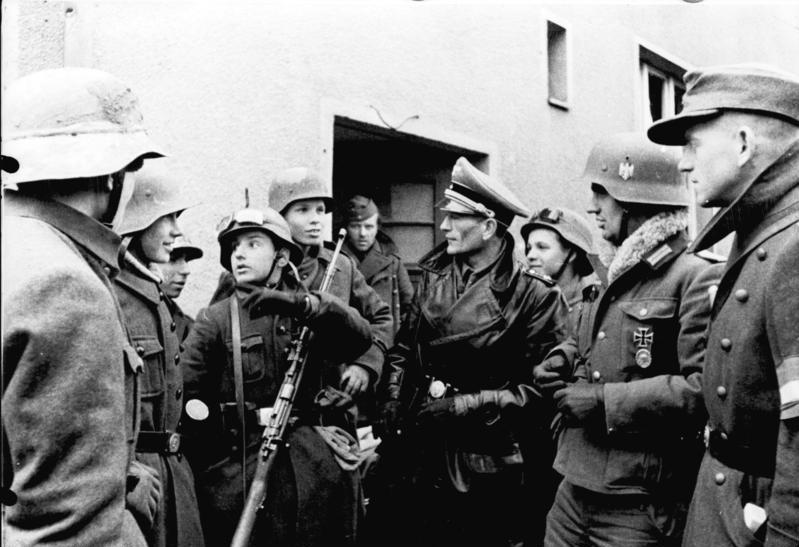
A Hitler Youth company committed to combat duty as part of the Volkssturm, 1945. Bundesarchiv, Bild 183-J28536, CC BY-SA 3.0 DE.
How it works
- Identity fusion: the joining oath fused a ten-year-old's identity with personal loyalty to Hitler by name, not to a program, a flag or a constitution. The taxonomy's tell for this technique — "people like us don't ask that" — describes what a compulsory, uniformed, age-graded organization did to any question a child might otherwise have asked about any part of it.
- Bandwagon: the jump from about 108,000 members at the end of 1932 to over 2.3 million a year later, and the yearly staged column of massed formations at Nuremberg, presented as spontaneous popularity what the dissolution of rival organizations, then after 1939 legal compulsion, had actually produced. The 1936 law's own framing, treating near-universal coverage as evidence of a movement youth wanted, is the same move written into statute.
- Transfer: the paramilitary rank ladder, shoulder insignia and the "Blood and Honor" dagger borrowed the prestige of the SA and the army for an organization of children years before any of its members could legally enlist in either.
- Glittering generalities: the 1936 law's stated purpose — educating youth "in body, spirit and mind" for "service to people and community" — and the movement's own slogan, "Jugend muss von Jugend geführt werden" ("youth must be led by youth"), offered virtue words with no testable content; the organization's actual chain of command ran upward to an adult-appointed Reichsjugendführer who answered to Hitler, not sideways among peers.
- Euphemism / doublespeak: "Dienstpflicht" ("service duty") named the 1939 ordinance's compulsion in the vocabulary of an ordinary civic obligation, like jury service or fire-watch duty, rather than in the vocabulary of a state assigning a child's evenings and weekends to a party organization under threat of penalty for parents who refused.
- Card stacking: the organization's own photographs and postcards — camping, gliding, singing around fires, massed flags at Nuremberg — supplied its public image. The machinery behind that image (the 1936 monopoly law, the 1939 compulsion ordinance, and by 1943 an organization feeding fifteen-year-olds into anti-aircraft crews) sat outside the frame.
- Plain folks: "youth led by youth" cast teenage troop leaders, themselves selected and trained inside an adult-run hierarchy that answered to Hitler, as ordinary peers rather than as the bottom rung of a state chain of command.
Then and now
North Korea runs a state youth structure built on the same age-graded, uniformed, loyalty-oath model, though FRAME's sourcing on it is necessarily thinner than on the Hitler Youth's own well-documented records, since North Korea does not publish comparable primary legal texts or independently audited membership figures. The Korean Children's Union enrolls children from around age nine to early teens with a red scarf and a pledge of loyalty to the leadership, feeding into the Socialist Patriotic Youth League (successor to the Kim Il Sung Socialist Youth League) for older teenagers, and near-universal membership is reported by outside researchers rather than confirmed by an independent count. The parallels: an age-graded ladder, a uniform marker, a personal loyalty oath to the leader by name, and coverage close enough to universal that non-membership itself becomes conspicuous. The differences: the Hitler Youth's compulsion was written into a specific, dated, publicly promulgated statute (the 1939 Jugenddienstverordnung) whose text names the legal duty and the penalty for parents; North Korea's equivalent pressure is not shown, in the sources available to this archive, to rest on a comparably explicit membership-compulsion law, and North Korea's youth structure has run for close to eight decades under one family's rule, far longer than the Hitler Youth's nineteen years from refounding to collapse. FRAME's separate case study on North Korean leader-cult messaging (The Kim leader cult, the anti-US month and the leaflets sent back) covers the wider system this youth structure sits inside.
Positions on the record
- The organization's own stated rationale. The 1936 law and the Reichsjugendführung's own publications presented the Hitler Youth as completing a single national youth movement that any German child would naturally want to join, uniting body, mind and spirit in service to the community; Schirach's own wartime writings describe leading German youth as the historic task of his generation.
- Contemporary and later criticism. Families of the Protestant, secular and Catholic youth associations absorbed or restricted in 1933-1939 objected at the time, with limited effect once the 1936 law removed any legal alternative; Catholic clergy in particular protested the pressure on Church youth groups through the later 1930s. After the war, survivors' and historians' accounts (see Sources) describe the 1945 conscription of children as young as twelve as a deliberate last-resort use of minors in combat by a collapsing state.
- Baldur von Schirach at Nuremberg. Tried by the International Military Tribunal in 1945-46, Schirach was convicted chiefly for crimes against humanity arising from his later role as Gauleiter of Vienna, where he was found to have assisted the deportation of the city's Jews, not for organizing the Hitler Youth itself as a separate count. His own trial testimony is widely described in the secondary literature as expressing remorse for the part his youth organizing played in preparing a generation for the ideology the tribunal was then reckoning with; this page does not quote that testimony directly, since FRAME could not verify an exact wording against a primary transcript during this build, and it does not dispute the organization's structure or purpose as described above.
- This archive's reading. Documented: the founding and refounding dates, the 1936 and 1939 legal texts and what each one changed, the age-graded structure, the uniform and rank system, Schirach's and Axmann's tenures, the 1943 conscription into flak duty and the 12th SS Panzer Division, and the 1945 Volkssturm mobilization of children. Given as standard figures in the secondary literature, not as an independently audited count FRAME verified against a primary register: the exact 1932-1933 and 1939 membership numbers and the "about 98 percent" enrollment estimate. The precise wording of the joining oath appears in slightly different forms across secondary sources; this page gives the wording most commonly cited in English-language accounts and does not claim it was the only version used across the organization's history and regions.
Same-method test
Every twentieth-century one-party state that outlasted its founding generation built an age-graded youth organization; the Soviet Union and Maoist China are the clearest comparisons on the same technique definitions.
- Soviet Union: the Young Pioneers and Komsomol. The Young Pioneer Organization (from 1922, ages roughly 9-14) and the Komsomol (Young Communist League, from 1918, older teens and young adults) used a red neckerchief, an age-graded ladder into the adult party, and a personal pledge — the Pioneer's Solemn Promise swore loyalty to "the cause of the Communist Party," later to the Soviet motherland and Lenin's teaching rather than to a single living leader by name for most of the Soviet period. Membership was formally voluntary throughout; in practice it became close to universal for ordinary advancement in school and career, and Komsomol membership was a de facto precondition for university admission and many jobs by the postwar decades.
- Maoist China: the Young Pioneers of China and the Communist Youth League. The Young Pioneers of China (from 1949, ages roughly 6-14, red scarf) and the Communist Youth League (from 1922, older teens and young adults) followed the same red-scarf, age-graded, pledge-swearing pattern, feeding into Communist Party membership. During the Cultural Revolution the personal loyalty element sharpened further: Red Guard units, drawn heavily from these structures, swore fervent personal loyalty to Mao and recited his sayings from the Little Red Book in ritual settings resembling the Hitler Youth's own flag ceremonies.
- What is the same. In all three states, Identity fusion (a personal or quasi-personal pledge), Bandwagon (near-universal enrollment cited as proof of a movement's popularity) and Transfer (a uniform and rank system borrowed from the adult party or army) do the same work on children in all three systems, at comparable ages, feeding an equivalent adult party or paramilitary structure.
- What is genuinely different. The Hitler Youth's compulsion was written into a specific, publicly promulgated statute naming the legal duty and the penalty for a parent who refused (the 1939 Jugenddienstverordnung); the Soviet and Chinese organizations stayed formally voluntary throughout their existence, with career and educational pressure, not a membership-compulsion law, producing their near-universal enrollment. The Hitler Youth's joining oath named a single living leader personally from its earliest, pre-1933 form; the Soviet Pioneer pledge named the Party and, later in the Brezhnev era, Lenin as a historical figure rather than a living ruler, and the cult of personal loyalty to one living leader was a Stalin-era and, separately, a Cultural Revolution-era intensification rather than the organization's founding design in either country. And only the Hitler Youth was, in its final eighteen months, systematically converted into a Reich-wide combat and anti-aircraft conscription pipeline for a state at the point of military collapse; neither the Komsomol nor the Communist Youth League of China was put to that specific use.
How to spot it
- Ask whether membership is legally required and, if so, find the actual statute and the date it took effect; "near-universal" and "compulsory" are different facts, and only one of them needs a citable law.
- Check whether the joining ritual asks for loyalty to a program, a flag, a constitution — or to one living person by name. The last of these makes leaving, or even asking a question, feel like a betrayal rather than a policy disagreement.
- Look at what the organization's own photographs show (camps, sport, songs, massed parades) against what its legal structure requires (attendance, enrollment penalties, an adult-appointed command chain); the gap between the two is the propaganda.
- Watch what an age-graded youth structure is repurposed for under pressure. A pipeline built for camping and drill can become a conscription pipeline once the state that runs it needs bodies; the Hitler Youth's 1943-1945 trajectory is the clearest documented case of that conversion completing.
- When a "youth led by youth" claim is made, ask who appointed the youth leaders and who they answer to. A command chain with an adult-appointed head at the top is not peer leadership, whatever its slogan says.
Images
| Image | Source | Licence |
|---|---|---|
| Mechanism diagram (above) | Drawn for FRAME from this page's sourced facts (make_diagrams_youth_hitlerjugend.py) |
CC BY 4.0, FRAME |
| Hitler Youth roll call at the Nuremberg Rally grounds | Wikimedia Commons, Bundesarchiv, Bild 146-1981-160-05 | CC BY-SA 3.0 DE |
| Hitler Youth "Geländesport" exercises | Wikimedia Commons, Bundesarchiv, Bild 133-033 | CC BY-SA 3.0 DE |
| Hitler Youth company committed to Volkssturm combat, 1945 | Wikimedia Commons, Bundesarchiv, Bild 183-J28536 | CC BY-SA 3.0 DE |


Image gaps
- Hitler Youth roll call, Worms, 1933 (Bundesarchiv, Bild 133-101). Identified and licence-checked (CC BY-SA 3.0 DE, no restriction template on its Commons page) but the download failed repeatedly against a rate-limited connection during this build; no corrupt file was kept. This gap can be filled.
- Deutsches Jungvolk tent camp (Bundesarchiv, Bild 146-1981-052-31A). Identified and licence-checked (CC BY-SA 3.0 DE, no restriction template) but the download failed repeatedly against a rate-limited connection during this build; no corrupt file was kept. This gap can be filled.
- A portrait of Artur Axmann. Identified and licence-checked (a public-domain Wikimedia Commons file,
File:Artur Axmann.jpg) but the download failed repeatedly against a rate-limited connection during this build; no corrupt file was kept. This gap can be filled. - Baldur von Schirach. No image of Schirach is hosted on this page; FRAME's separate Nuremberg-rally case study already carries a Schirach-era Nuremberg photograph, and this page avoids duplicating it. A dedicated Schirach portrait, and photographs of the 1936 or 1939 legal texts themselves, were not sourced in the time available for this build.
- The 20 March 1945 Iron Cross ceremony in the Reich Chancellery garden. Newsreel stills of this event exist and are widely reproduced, but an openly licensed copy with a clear rights status was not found on Wikimedia Commons or loc.gov in the time available.
- The 12th SS Panzer Division "Hitlerjugend" in the field (1944). Not included: wartime unit photographs of this kind on Commons were not checked for licence and restriction status in the time available for this build, and the division's documented conduct makes careful sourcing important; this is left as a gap rather than included unverified.
- The Hitlerjugend-Fahrtenmesser (ceremonial dagger) and insignia. Museum object photographs exist but were not licence-checked in the time available.
Sources
- U.S. Holocaust Memorial Museum, Holocaust Encyclopedia: "Hitler Youth" (encyclopedia.ushmm.org/content/en/article/hitler-youth).
- German History in Documents and Images (GHDI): translated text of the "Law Concerning the Hitler Youth" (Gesetz über die Hitler-Jugend), 1 December 1936, and related Nazi-era youth-policy documents (germanhistorydocs.org).
- Michael H. Kater, Hitler Youth (Harvard University Press, 2004) — the standard English-language academic history of the organization, its membership figures and its wartime conscription.
- H. W. Koch, The Hitler Youth: Origins and Development, 1922-1945 (Macdonald and Jane's, 1975; Cooper Square Press, 2000).
- International Military Tribunal, Trial of the Major War Criminals before the International Military Tribunal, Nuremberg (1947-49), judgment section on Baldur von Schirach; trial record hosted by the Avalon Project, Yale Law School (avalon.law.yale.edu/subject_menus/imt.asp).
- Deutsches Historisches Museum, LeMO (Lebendiges Museum Online): entries on the Hitlerjugend and Deutsches Jungvolk (dhm.de/lemo).
- Hugh Trevor-Roper (ed.) and other standard Third Reich reference histories for the 1943 Luftwaffenhelfer conscription and the formation of the 12th SS Panzer Division "Hitlerjugend."
- Beevor, Antony, Berlin: The Downfall 1945 (Viking, 2002), for the 1945 Volkssturm mobilization of Hitler Youth boys and Artur Axmann's role in the Battle of Berlin and its aftermath.
- Wikimedia Commons: Bundesarchiv Bild 146-1981-160-05, 133-033 and 183-J28536 (hosted on this page), and Bild 133-101 and 146-1981-052-31A (identified and licence-checked but not yet downloaded; see Image gaps), all CC BY-SA 3.0 DE.