Content note. This page quotes the labels McCarthy applied to named and numbered people ("card-carrying" Communist, "top Russian espionage agent"). They are quoted as evidence of the method. They are not this archive's description of anyone.
In one line: in February 1950 Senator Joseph McCarthy said he held a list of Communists in the State Department; the number changed from 205 to 57 to 81 within eleven days and the category changed from Party members to "risks", while the headline claim stayed in circulation. This page scores the numbers and the method. Soviet espionage in the U.S. government in the 1940s is documented separately and is not in dispute here.
What happened
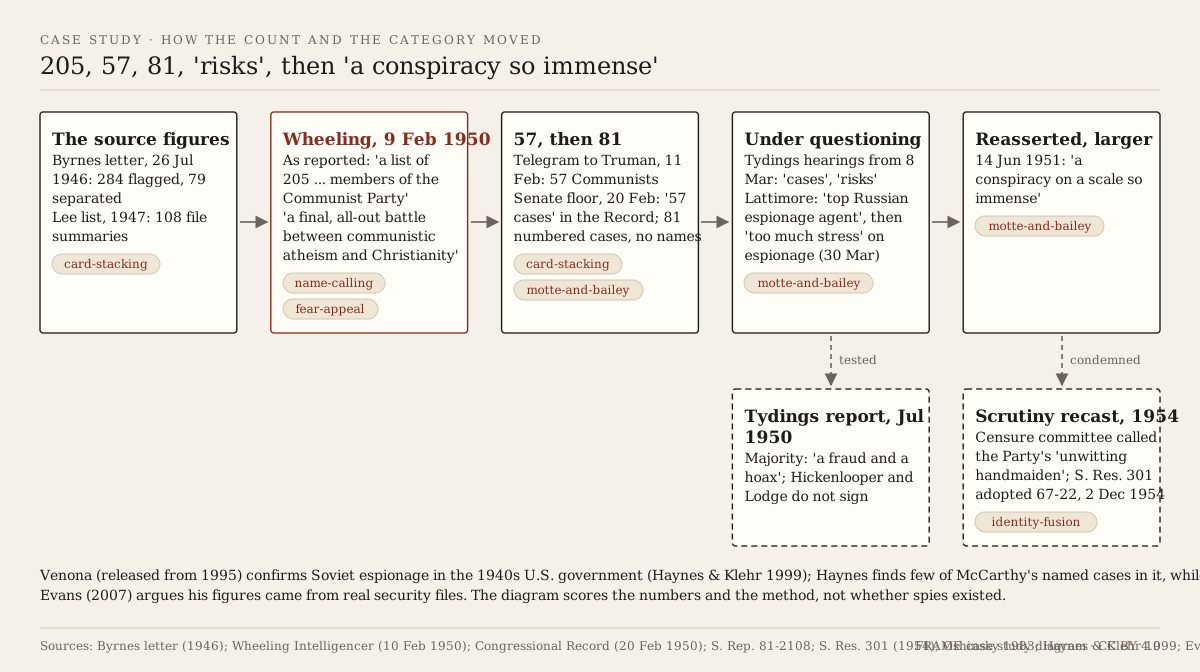
- 26 July 1946. Secretary of State James F. Byrnes writes to Representative Adolph Sabath that security screening had flagged 284 employees as unfit for permanent employment, for Communist connections and other reasons, and that 79 had been separated. The arithmetic difference is 205. Byrnes gives no finding that the remainder were Party members.
- 1947. Investigators for the House Appropriations Committee, led by Robert E. Lee, compile summaries of 108 State Department security files (the "Lee list"). The reasons for flagging vary; many of those listed had left the department or been cleared by 1950.
- 9 February 1950, Wheeling, West Virginia. McCarthy speaks to the Ohio County Women's Republican Club. No recording survives. The Wheeling Intelligencer reporter Frank Desmond, who later said he worked from the advance text, reports: "I have here in my hand a list of 205 ... that were known to the Secretary of State as being members of the Communist Party and who nevertheless are still working and shaping policy in the State Department."
- 10-11 February. In a Salt Lake City radio interview McCarthy speaks of "57 card-carrying members of the Communist Party". His telegram to President Truman on 11 February says he has the names of 57 Communists in the State Department and asks the President to give Congress a full accounting. Truman drafts, but does not send, a reply saying McCarthy is not fit to serve.
- 20 February. On the Senate floor McCarthy reads the text he says he gave at Wheeling. The Congressional Record version says: "I have in my hand 57 cases of individuals who would appear to be either card carrying members or certainly loyal to the Communist Party". The same day he presents 81 numbered "cases", without names, described as loyalty or security risks. Most correspond to the Lee list.
- 8 March - July 1950. A Foreign Relations subcommittee chaired by Millard Tydings (D-Maryland) holds hearings. The first person McCarthy names is Dorothy Kenyon, a former New York judge. On 21-26 March McCarthy tells reporters he will name "the top Russian espionage agent" in the country; he names Owen Lattimore, a Johns Hopkins scholar of China. On 30 March he tells the Senate: "I fear that in the case of Lattimore I may have perhaps placed too much stress on the question of whether he is a paid espionage agent", and argues instead about Lattimore's influence on Far East policy.
- 1 June 1950. Senator Margaret Chase Smith (R-Maine) and six Republican colleagues issue the "Declaration of Conscience" without naming him.
- July 1950. The Tydings majority report (S. Rep. No. 2108, 81st Cong.) calls the charges "a fraud and a hoax". Republicans Bourke Hickenlooper and Henry Cabot Lodge Jr. do not sign it; Lodge files individual views calling the inquiry inadequate. The Senate votes on the report along party lines. In November Tydings loses his seat after a campaign in which McCarthy's staff helped produce a tabloid carrying a composite photograph of Tydings beside Communist Party leader Earl Browder.
- 14 June 1951. In a Senate speech on George C. Marshall, McCarthy calls U.S. policy "the product of a great conspiracy, a conspiracy on a scale so immense as to dwarf any previous such venture in the history of man."
- 9 June 1954. At the Army-McCarthy hearings McCarthy raises the past National Lawyers Guild membership of Fred Fisher, a young lawyer in the firm of Army counsel Joseph Welch. Welch replies: "Until this moment, Senator, I think I never really gauged your cruelty or your recklessness ... Have you no sense of decency, sir, at long last? Have you left no sense of decency?"
- 2 December 1954. By 67 to 22 the Senate adopts S. Res. 301, condemning McCarthy for his non-cooperation with the 1951-52 elections subcommittee that examined his conduct, and for calling the Watkins select committee the "unwitting handmaiden", "involuntary agent" and "attorneys-in-fact" of the Communist Party.
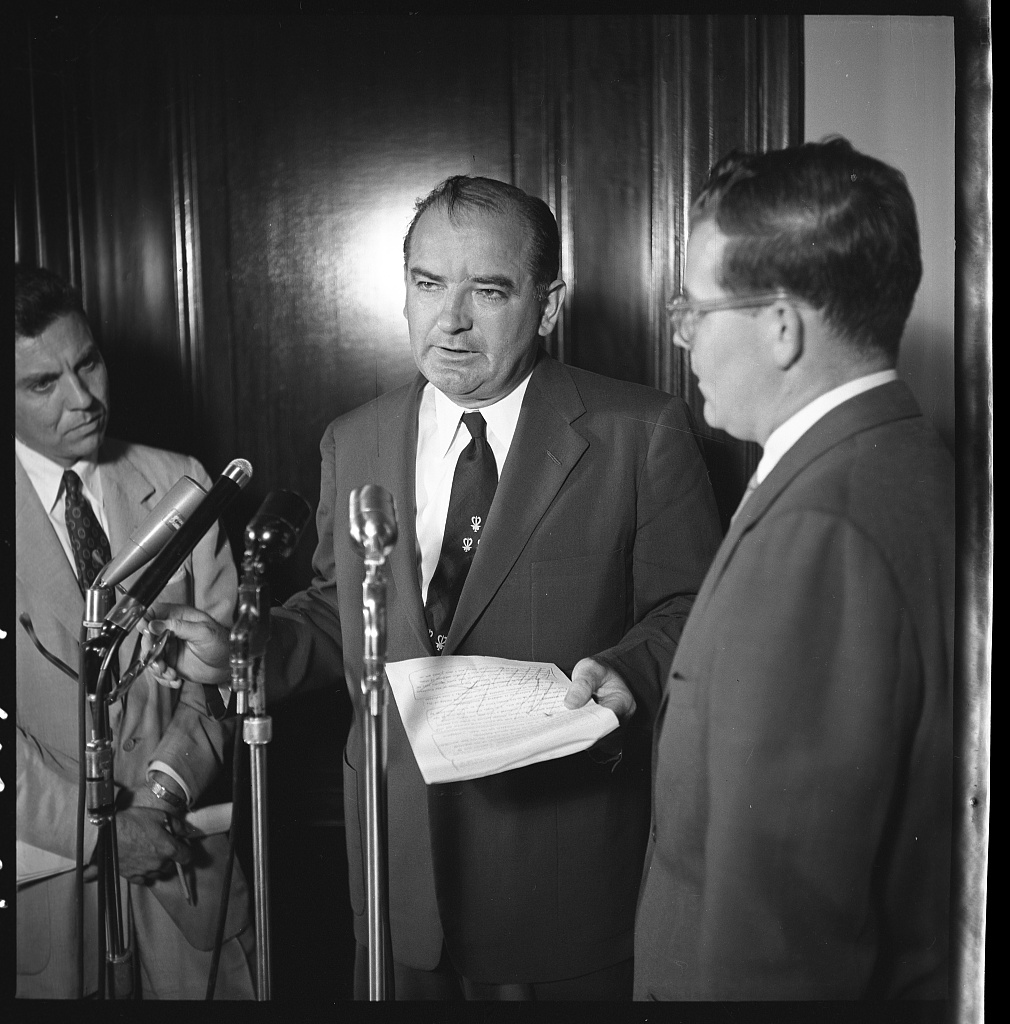
Senator Joseph McCarthy speaking to the press with papers in hand, 1954. U.S. News & World Report Magazine Photograph Collection, Library of Congress, no known restrictions on publication. The Library's caption links it to the Watkins censure committee but dates it June 1954, before that committee was formed; the exact occasion is uncertain.
How it works
- Motte and bailey: the bold claim ("205 ... members of the Communist Party", "57 card-carrying") travelled in headlines. Under questioning the claim McCarthy defended was narrower: "cases", "risks", people who "would appear to be" Communists "or certainly loyal" to the Party, and for Lattimore, policy influence rather than espionage. The bold claim was then reasserted at larger scale ("a conspiracy so immense"). The documented sequence of statements, not the tag itself, is the evidence; readers can check each quoted step against its date.
- Card stacking: 205 is the difference between two numbers in a 1946 letter about people flagged for several kinds of reason; the 81 cases came mostly from 1947 file summaries. Presented in 1950 as current Party members, the figures omitted when they were compiled, why each person was flagged, and what had happened to each since.
- Name-calling: "card-carrying" is a label of Party membership. Applied to numbered cases with no names, and then to named people such as Kenyon and Lattimore before any formal charge was brought, the label arrived first. At the 1954 hearing, a lawyers' association membership was offered in place of any act by Fisher.
- Identity fusion: S. Res. 301 records that McCarthy called the Senate committee examining his conduct the Communist Party's "unwitting handmaiden" and said its report "imitated Communist methods". Scrutiny of the method was recast as service to the enemy the method targeted.
- Fear appeal: the Wheeling text frames the moment as "a final, all-out battle between communistic atheism and Christianity" in which "the chips are down", and states that people "under the absolute domination of Soviet Russia" had grown to 800,000,000, "an increase of over 400 percent" in six years. The offered remedy is removing the listed people.
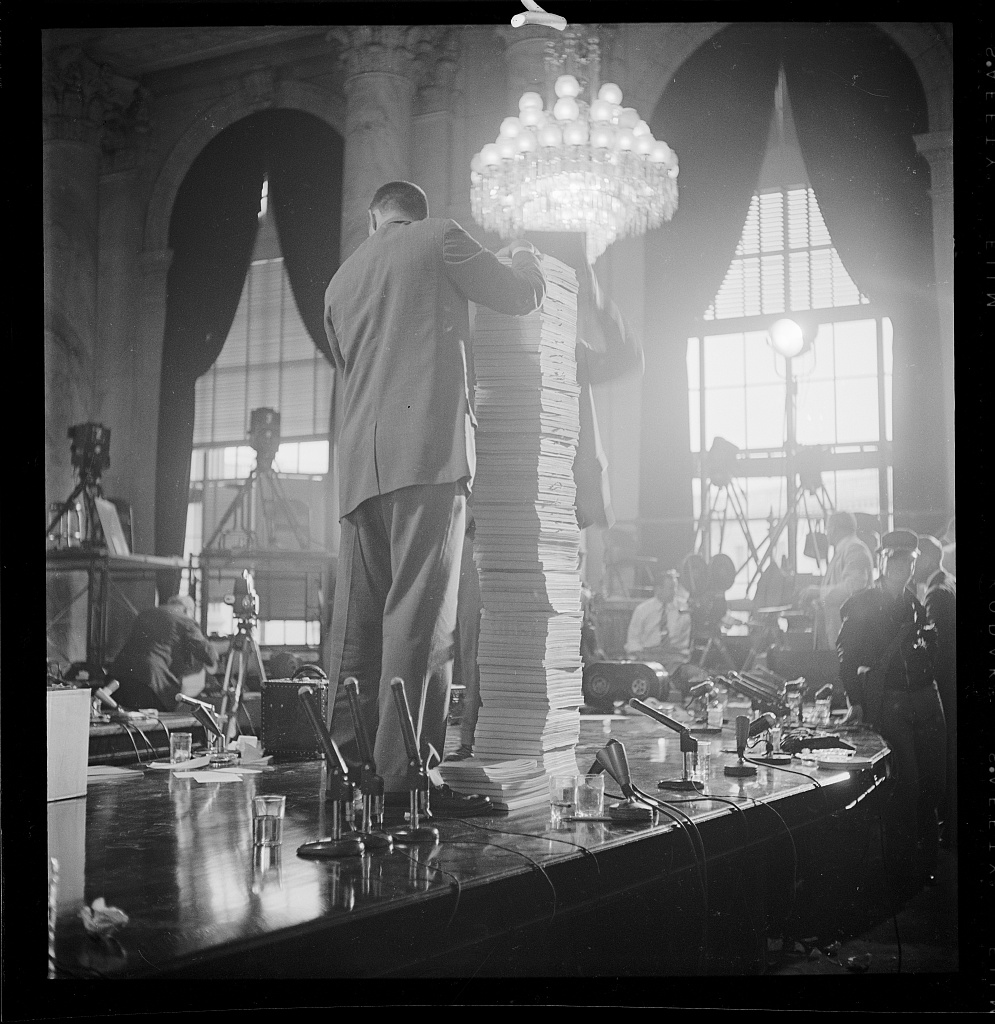
Army-McCarthy hearings, 1954: a man stands on the committee table beside a stack of documents, with newsreel and television cameras behind. U.S. News & World Report Magazine Photograph Collection, Library of Congress, no known restrictions. The Library does not identify the man or the documents.
Then and now
The same move, a label that arrives before a charge, appears in Alaj: the portal Iranian state media promoted for reporting 'traitors abroad' (Iranian state media, 2026), where Iranians abroad were labelled "traitors" and citizens were invited to submit names, and, more loosely, in the sentence in The Justice Department's FARA release and public demonstrations (U.S. Justice Department, 2026), which placed "public demonstrations" next to foreign "propaganda" and prison without naming anyone.
The differences are as large as the likeness. McCarthy was one elected legislator speaking in public under his own name, and every figure he used can be traced. Alaj asked for anonymous reports and attached civil penalties. The 2026 DOJ release named no one. In 1950 the claim was also tested in public within weeks: by a Senate subcommittee, by the press, by members of his own party, and finally by a Senate vote. Neither 2026 case has had a comparable public test on the record so far.
Positions on the record
- McCarthy's own position. He said the State Department had failed to remove security risks, that the files existed, and that the executive branch withheld them. He rejected the Tydings findings, and in 1954 he said the committee reviewing his conduct had served the Communist Party's purposes (the words quoted in S. Res. 301).
- Critics at the time. The Tydings majority called the charges "a fraud and a hoax". Margaret Chase Smith said she did not want her party to win on "the Four Horsemen of Calumny—Fear, Ignorance, Bigotry, and Smear". Welch challenged the method at the 1954 hearing, and the Senate condemned McCarthy in December 1954.
- Defenders. M. Stanton Evans (Blacklisted by History, 2007) argues that McCarthy's numbers were not invented but taken from real State Department security data (the Byrnes letter and the Lee list), that the Tydings inquiry did not examine complete files, and that many people McCarthy raised were real security problems. Haynes, who disagrees with Evans's conclusions, wrote that Evans's research is so comprehensive that historians should consult it.
- Later scholarship. The Venona decrypts, released from 1995, confirmed Soviet espionage inside the U.S. government in the 1940s; Haynes and Klehr (1999) document it in detail. They also conclude that Venona does not vindicate McCarthy: few of the people he named appear in it, and by their account the main Soviet networks had already been disrupted in the late 1940s, after Elizabeth Bentley's defection in 1945. Oshinsky (1983) and Rovere (1959) describe the shifting numbers as characteristic of his method. Schrecker (1998) treats McCarthy as one part of a wider anti-Communist apparatus and argues its damage outweighed the security gains.
- What is documented. The Byrnes letter, the Wheeling report, the telegram, the Congressional Record text, the 81 cases, the Lattimore statements, the Tydings report, the Welch exchange and S. Res. 301.
- What is contested. Exactly what McCarthy said at Wheeling (205 or 57) and how many individuals on his lists were security risks by the standards of the time.
- Not ruled on here. Whether Soviet penetration was a serious problem, and the conduct of any individual named. This page scores how the numbers and labels were used.
Same-method test
The finding does not depend on the flag. Big-character posters: how the opening labels of China's Cultural Revolution did the work of charges (1966-68) scores China's 1966-68 labels ("capitalist roader", "China's Khrushchev") with the same Name-calling and Identity fusion tags used here: a category label standing in for a charge, and objection to the process recast as loyalty to the enemy. The scale was very different. McCarthy's targets faced dismissal, blacklisting and publicity; courts sat, the press reported, and the Senate itself condemned him. The Cultural Revolution's labels were followed by deaths in the hundreds of thousands or more. Same technique; very different order of harm.
How to spot it
- Track the number. When a count changes between the speech, the telegram and the record, ask which one the speaker will defend under oath.
- Track the noun. "Members", "card-carrying", "loyal to", "cases" and "risks" are different claims. The one in the headline and the one in the testimony should match.
- Ask where the figure comes from and when it was compiled. A 1946 difference between two totals is not a 1950 membership list.
- Watch for scrutiny being renamed. When a committee checking the claims is called the other side's "handmaiden", the argument has moved from the evidence to loyalty.
- Keep two questions apart: whether espionage existed (Venona shows it did) and whether a particular list was accurate.
Images
| Image | Source | Licence |
|---|---|---|
| Mechanism diagram (above) | Drawn for FRAME from the sources below (make_diagrams.py) |
CC BY 4.0, FRAME |
| McCarthy at the microphones, 1954 | Library of Congress, LC-DIG-ds-07186, U.S. News & World Report Magazine Photograph Collection | No known restrictions on publication |
| Army-McCarthy hearings, 1954 | Library of Congress, LC-DIG-ppmsca-51684, U.S. News & World Report Magazine Photograph Collection | No known restrictions on publication |
Image gaps
- Wheeling, 9 February 1950, and the Senate floor, 20 February. No photograph with clear rights was found. No recording of the Wheeling speech survives.
- The telegram to Truman (11 February 1950). A U.S. government record held by the National Archives and shown in its education pages; public domain, but archives.gov could not be reached from the environment used to build this page. This gap can be filled.
- Dorothy Kenyon testifying (1950), McCarthy with Roy Cohn, the censure hearing (31 August 1954). The Library of Congress holds these in the New York World-Telegram & Sun collection, but they are Associated Press or United Press photographs marked "Publication may be restricted". Not hosted.
- Joseph Welch and McCarthy on 9 June 1954. The Senate Historical Office shows a photograph, but its rights status could not be checked (senate.gov and the Wikimedia Commons API were unreachable or rate-limited). Not hosted.
- The 1950 Maryland composite photograph of Tydings and Browder. A campaign publication, not a government work; U.S. copyright status not established. Not hosted, and no gallery entry was made.
- Herblock's cartoons, including "I have here in my hand--" (1954). Copyrighted (Herb Block Foundation). Not hosted.
Sources
- U.S. Senate Historical Office, "'Communists in Government Service,' McCarthy Says".
- U.S. Senate Historical Office, "Have You No Sense of Decency?".
- U.S. Senate Historical Office, "A Declaration of Conscience".
- U.S. Senate, Censure case 133: Joseph McCarthy (1954); National Archives, Milestone Documents: Censure of Senator Joseph McCarthy.
- National Archives, "Telegram from Senator Joseph McCarthy to President Harry S. Truman" (with Truman's unsent reply).
- McCarthy, Wheeling speech as entered in the Congressional Record, Senate, 81st Cong., 2d sess., 20 February 1950, vol. 96, pt. 2, pp. 1954-57; text at History Matters (George Mason University), "Enemies from Within".
- U.S. Senate, Committee on Foreign Relations, State Department Employee Loyalty Investigation, S. Rep. No. 2108, 81st Cong., 2d sess. (1950), with the individual views of Senator Lodge.
- McCarthy, "The History of George Catlett Marshall", Senate speech, 14 June 1951: text via Encyclopedia.com.
- Ohio County Public Library, "U.S. Sen. Joseph R. McCarthy Speaks in Wheeling".
- U.S. Department of State, Bureau of Diplomatic Security, "McCarthyism and Cold War: Diplomatic Security in the 1950s", ch. 4 of History of the Bureau of Diplomatic Security (2011): PDF.
- David M. Oshinsky, A Conspiracy So Immense: The World of Joe McCarthy (Free Press, 1983; Oxford University Press, 2005).
- Richard H. Rovere, Senator Joe McCarthy (Harcourt, Brace, 1959).
- Ellen Schrecker, Many Are the Crimes: McCarthyism in America (Little, Brown, 1998).
- John Earl Haynes and Harvey Klehr, Venona: Decoding Soviet Espionage in America (Yale University Press, 1999).
- John Earl Haynes, "Senator Joseph McCarthy's Lists and Venona" (name-by-name comparison of the Lee list with Venona).
- M. Stanton Evans, Blacklisted by History: The Untold Story of Senator Joe McCarthy and His Fight Against America's Enemies (Crown Forum, 2007): publisher page.
- History News Network: John Earl Haynes on Evans's book; David Oshinsky on Evans's book.
- Library of Congress, Prints and Photographs Division, U.S. News & World Report Magazine Photograph Collection (items above).