Content note. This page quotes denunciation labels from 1966-68 ("ox-demons and snake-spirits", "black gang", "renegade, traitor and scab") and describes beatings and killings that followed them. The labels are quoted as evidence of the method. They are not this archive's description of anyone.
In one line: In summer 1966 a campus wall poster, a People's Daily editorial and a poster by Mao Zedong set out labels ("ox-demons and snake-spirits", "capitalist roaders", "bourgeois headquarters") that named kinds of people rather than acts; they were used against millions, the head of state included, until the Communist Party of China itself reversed the verdicts in 1980-81.
What happened
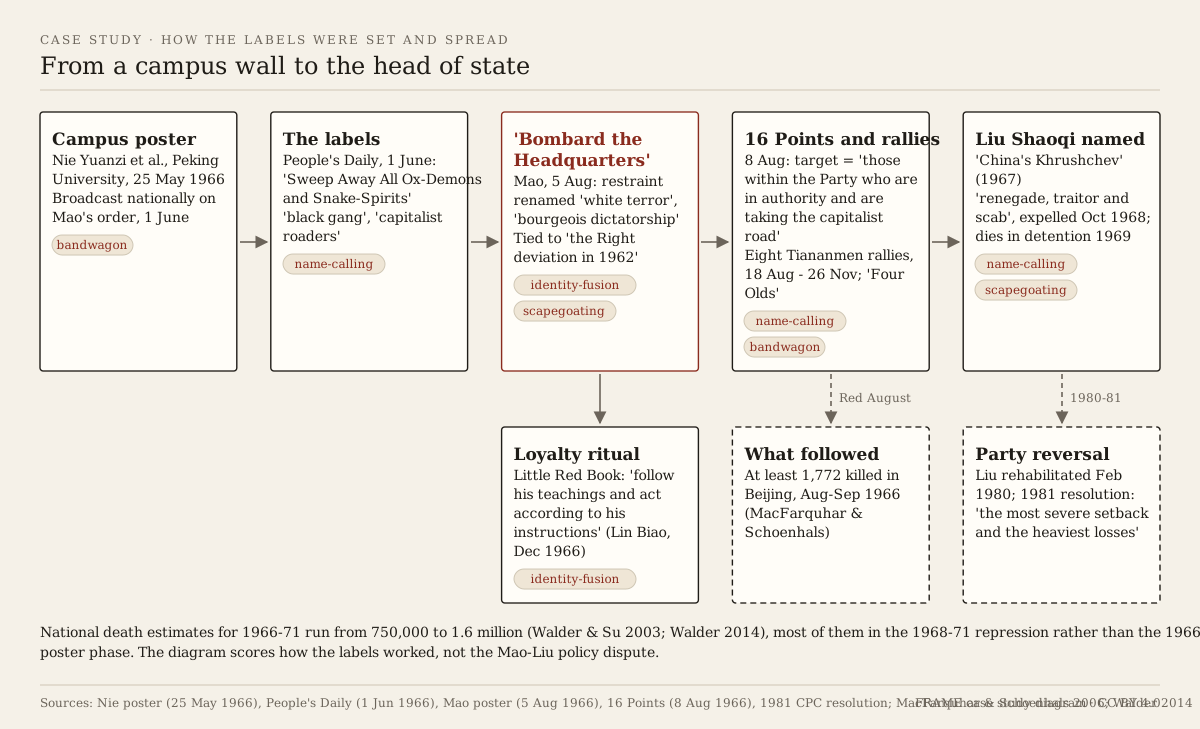
- 16 May 1966. A Central Committee circular (the "May 16 Notification") warns that "representatives of the bourgeoisie" have "sneaked into the Party, the government, the army", including "persons like Khrushchev, for example, who are still nestling beside us". It names no one.
- 25 May. Nie Yuanzi, party secretary of Peking University's philosophy department, and six colleagues put up a dazibao (big-character poster: a handwritten sheet pasted on a public wall) titled "What Are Song Shuo, Lu Ping and Peng Peiyun Really Doing in the Cultural Revolution?" It calls the university's leaders "Khrushchev-type revisionist elements" for discouraging posters and mass meetings, and ends (in the English translation circulated as "Ignite the Cultural Revolution!") by calling on readers to "resolutely, thoroughly, totally and completely wipe out all ghosts and monsters and all Khrushchevian counter-revolutionary revisionists". MacFarquhar and Schoenhals report that Nie wrote it after encouragement from a central investigation team led by Cao Yi'ou, wife of Kang Sheng.
- 1 June. On Mao's instruction, the poster is read out on national radio that evening and printed in the People's Daily the next day. The same morning, the paper's editorial, "Sweep Away All Ox-Demons and Snake-Spirits" (Hengsao yiqie niugui sheshen; the Peking Review translation is "Sweep Away All Monsters"), says that "hundreds of millions of workers, peasants and soldiers", armed with "Mao Tse-tung's thought", are "sweeping away a horde of monsters that have entrenched themselves in ideological and cultural positions".
- June-July. Work teams sent by Liu Shaoqi and Deng Xiaoping try to keep campus movements under party control. Posters, "black gang" labels and struggle meetings (a target stands bowed before a crowd shouting accusations) spread through schools.
- 5 August. At the Eleventh Plenum, Mao writes "Bombard the Headquarters — My Big-Character Poster". He praises Nie's poster as "China's first Marxist-Leninist big-character poster" and says that "some leading comrades", in the past fifty days, "have enforced a bourgeois dictatorship", "encircled and suppressed revolutionaries, stifled opinions differing from their own, imposed a white terror". "How poisonous!" He links this to "the Right deviation in 1962". It names no one; it was first printed in the People's Daily a year later, on 5 August 1967. The same day, 5 August 1966, students at the girls' middle school attached to Beijing Normal University beat their deputy principal, Bian Zhongyun, to death.
- 8 August. The plenum adopts the "Decision ... Concerning the Great Proletarian Cultural Revolution" (the "16 Points"). It states that "the main target of the present movement is those within the Party who are in authority and are taking the capitalist road", and that the bourgeoisie is using "the old ideas, culture, customs, and habits of the exploiting classes" to stage a comeback. It also says the minority should be protected and that debate "should be conducted by reasoning, not by coercion or force".
- 18 August - 26 November. Mao reviews Red Guards at eight mass rallies in Tiananmen Square, attended by an estimated 12 to 13 million people in all. At the first, Lin Biao calls for smashing the "Four Olds" (old ideas, culture, customs and habits). Red Guards rename streets, smash shop signs, raid homes and burn books. In Beijing, at least 1,772 people are killed in August and September ("Red August"), according to figures cited by MacFarquhar and Schoenhals.
- 1966-67. The Quotations from Chairman Mao (first issued by the People's Liberation Army's General Political Department in 1964) becomes the movement's handbook. Lin Biao's foreword to the second edition (December 1966) tells readers to "study Chairman Mao's writings, follow his teachings and act according to his instructions", and calls Mao's thought, once grasped by the masses, "a spiritual atom bomb of infinite power". Official printings ran to more than a billion copies, by most estimates.
- 1967. Qi Benyu's Red Flag article "Patriotism or National Betrayal?" (April) attacks "the top Party person in authority taking the capitalist road", read everywhere as Liu Shaoqi; the press then calls Liu "China's Khrushchev". On 5 August 1967, the first anniversary of Mao's poster, Liu and his wife Wang Guangmei are subjected to a struggle meeting inside the leadership compound, Zhongnanhai.
- October 1968. The Twelfth Plenum declares Liu "a renegade, traitor and scab hiding in the Party" and "a lackey of imperialism, modern revisionism and the Kuomintang reactionaries" (the Guomindang), and expels him from the party "once and for all". He dies in detention in Kaifeng on 12 November 1969.
- February 1980 and June 1981. The party's Fifth Plenum rehabilitates Liu and annuls the charges. The 1981 "Resolution on Certain Questions in the History of Our Party" states that the Cultural Revolution "was responsible for the most severe setback and the heaviest losses suffered by the Party, the state, and the people since the founding of the People's Republic".
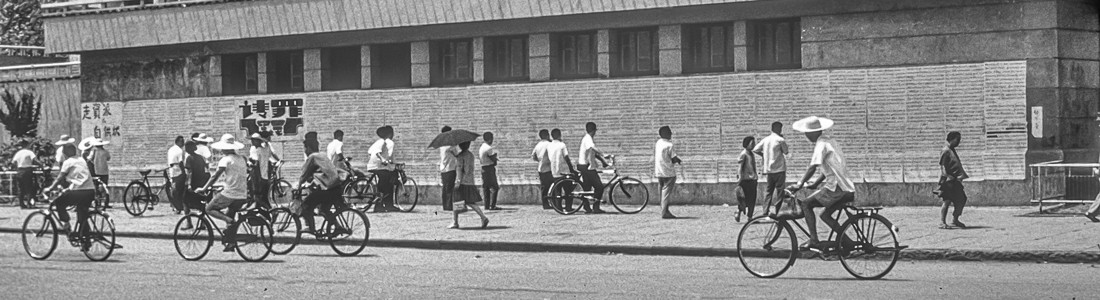
Big-character posters in Beijing, 22 August 1976. Photo by Heinz Bunse, CC BY-SA 2.0, cropped by FRAME to the poster wall. The posters date from 1976, not 1966; the picture shows the form: a public wall of handwritten sheets anyone could read and add to.
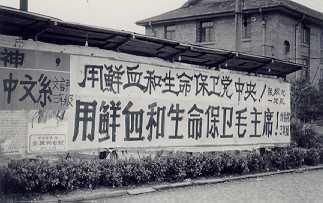
Red Guard slogan, Fudan University, Shanghai, spring 1976: "Defend the Party Central Committee with blood and life! Defend Chairman Mao with blood and life!" (用鲜血和生命保卫党中央!用鲜血和生命保卫毛主席!). Photo by Wikimedia user Villa Giulia, public domain. It dates from the end of the Cultural Revolution and is shown for the form of the loyalty slogan.
How it works
- Name-calling: the labels name kinds of people, not acts. "Ox-demons and snake-spirits" (niugui sheshen, spirits from Buddhist folklore), "black gang" (heibang), "capitalist roader" and "China's Khrushchev" arrive before any stated charge, and the 16 Points define the main target as a category ("those within the Party who are in authority and are taking the capitalist road") without saying what act puts someone in it. Who fitted was settled on walls and at struggle meetings. The party's own 1980 rehabilitation of Liu and its 1981 resolution later treated the charges against him as false, a reversal reached without the label ever having been tied to specific acts.
- Identity fusion: Nie's poster treats the university's limits on posters and mass meetings as opposition to the Central Committee and Chairman Mao. Mao's poster renames the work teams' restraint "white terror" and "bourgeois dictatorship". Once the movement's method is fused with loyalty to Mao, objecting to the method places the objector among the targets. The Little Red Book ritual ("follow his teachings and act according to his instructions") and slogans such as "Defend Chairman Mao with blood and life!" carry the same fusion into daily life.
- Scapegoating: the May 16 Notification places a diffuse danger, the restoration of capitalism, on hidden "representatives of the bourgeoisie" inside the party. Mao's poster then ties "the fifty days", "the Right deviation in 1962" (the policy retreat after the Great Leap Forward famine) and "the wrong tendency of 1964" to one "headquarters" of "some leading comrades". Down the chain, the "five black categories" (landlords, rich peasants, counter-revolutionaries, "bad elements" and rightists, and their children) gave every school and village a ready-made out-group.
- Bandwagon: the 1 June editorial announces that "hundreds of millions" are already "sweeping away" the monsters when the movement is days old, and a single campus poster becomes national news by radio. The eight Tiananmen rallies then made the scale visible. Scale is presented as proof that the campaign is right.
Then and now
The same move, a loaded label that takes the place of a charge and invites people to hand in names, appears in Alaj: the portal Iranian state media promoted for reporting 'traitors abroad': in September 2026 Iranian state media promoted a portal for reporting Iranians abroad it called "traitors", with penalties attached to the label rather than to a stated offence.
The differences are large. The 1966 labels were posted in public, often signed, endorsed from the top of the party, and followed by struggle meetings, imprisonment and killings across a country of about 750 million people. Alaj's informants are promised secrecy, its stated penalties are civil, the record shows no violence tied to the portal, and the site went offline a day after launch.
Positions on the record
- The Maoist position at the time. The 16 Points call the Cultural Revolution "a great revolution that touches people to their very souls" and a struggle against those "taking the capitalist road" who would restore capitalism. They say the masses must "liberate themselves", that big-character posters and great debates are the method, that the minority should be protected, and that debate "should be conducted by reasoning, not by coercion or force". The 1968 plenum verdict on Liu states the party's position on him at the time.
- The party's later position. In February 1980 the Fifth Plenum of the 11th Central Committee rehabilitated Liu Shaoqi. The 1981 resolution says the Cultural Revolution was "initiated and led by Comrade Mao Zedong", "did not in fact constitute a revolution or social progress in any sense", and was "responsible for the most severe setback and the heaviest losses" since 1949. The same resolution keeps Mao's standing: his "merits are primary and his errors secondary".
- Scholarship. MacFarquhar and Schoenhals (2006) trace the campaign to decisions taken by Mao and a small central group, and document the Beijing killings of 1966. Walder's Fractured Rebellion (2009) argues that Beijing's Red Guard factions formed around political choices made under uncertainty in 1966, not around pre-existing social groups; his Agents of Disorder (2019), built on more than 2,000 local annals, argues that party cadres seizing power from their superiors and a mishandled army intervention drove the violence. Dikötter (2016) writes the period from below, using party archives, and describes how people used the campaign's categories against one another.
- What is documented. The texts and dates of Nie's poster, the 1 June editorial, Mao's poster, the 16 Points, the 1968 verdict on Liu, the 1980 rehabilitation and the 1981 resolution; the Beijing figure of at least 1,772 killed in August-September 1966.
- What is contested. The national death toll. Walder and Su (2003), using 1,520 county annals, estimate 750,000 to 1.5 million deaths in rural China; Walder (2014) estimates 1.1 to 1.6 million deaths and 22 to 30 million victims of political persecution for 1966-71. Both find that most deaths came in 1968-71, during the repression that rebuilt state authority, not in the 1966 poster phase. How far the 1966 labels caused later killings, as opposed to supplying their vocabulary, is a matter of interpretation.
- Not ruled on here. The political and economic arguments between Mao and Liu. This page scores how the labels were built and used.
Same-method test
The same scoring applies to loyalty campaigns elsewhere, the United States included. The federal loyalty program under Executive Order 9835 (1947) and the McCarthy-era investigations used labels such as "disloyal", "subversive" and "card-carrying Communist", sometimes before any specific act was charged. A label doing the work of a charge there is tagged Name-calling here; a loyalty test that made questioning the process look disloyal is tagged Identity fusion.
The scale was not comparable. U.S. sanctions were mostly dismissal, blacklisting, passport denial and, for some witnesses, prison for contempt of Congress; courts kept sitting, and the Senate censured Senator Joseph McCarthy in December 1954. The Cultural Revolution's labels were followed by deaths estimated at 750,000 to 1.6 million (Walder and Su 2003; Walder 2014) and persecution of tens of millions. Same technique; very different order of harm.
How to spot it
- Ask what act, on what date, the label refers to. "Capitalist roader" and "black gang" name a kind of person. A charge names a deed.
- Watch for restraint being renamed. When limits on a movement's methods are called "white terror" or "suppression", objecting to the method has become disloyalty.
- Check the crowd numbers against the calendar. "Hundreds of millions" a week after the first campus poster is a claim about momentum, not a count.
- Ask who can assign the label and who can remove it. In 1966-68 a label could be pinned from below, by a poster, but only the centre could lift it, as it did for Liu in 1980, eleven years after his death.
Images
| Image | Source | Licence |
|---|---|---|
| Mechanism diagram (above) | Drawn for FRAME from the sources below (make_diagrams.py) |
CC BY 4.0, FRAME |
| Big-character poster wall, Beijing, August 1976 | Wikimedia Commons, photograph by Heinz Bunse via Flickr | CC BY-SA 2.0 (cropped by FRAME; the crop is shared under the same licence) |
| Red Guard slogan, Fudan University, spring 1976 | Wikimedia Commons, photograph by Villa Giulia | Public domain (released by the photographer, PD-self); the slogan is short text |
.jpg)

Image gaps
- Nie Yuanzi's poster, Mao's "Bombard the Headquarters" poster and 1966-67 dazibao walls. Wikimedia Commons holds 1966-67 photographs of posters, rallies and the 1 June and 8 August People's Daily front pages from China Pictorial (Renmin Huabao), tagged public domain in China. They are not used here: Chinese works still protected on 1 January 1996 had their U.S. copyright restored under the URAA, and at least one of these files carries the Commons warning "Not PD in the US (URAA)". Unclear U.S. status, so not hosted.
- Cultural Revolution posters themselves, such as the Shanghai Red Guards' "Liu Shaoqi, Deng Xiaoping and Tao Zhu must get out of the Central Committee!" (1966, on Commons as PD-China) and the Library of Congress copies of "Eliminate the four old - establish the four new" (Canton, 1967, LC-DIG-ds-13310) and "Politically, intellectually, and ideologically, thoroughly criticize China's Khrushchev" (1967). The Library of Congress gives no rights clearance for these ("Publication may be restricted"). Unclear U.S. status, so not hosted. Stefan Landsberger's chineseposters.net shows many of them but is not openly licensed, and it could not be reached from the environment used to build this page.
- The Mao portrait above the Beijing poster wall. Cropped out of Heinz Bunse's photograph: the portrait is a PRC artwork with the same unclear U.S. status.
- A photograph of the Little Red Book. A CC BY-SA museum photograph exists on Commons, but the book's cover and contents are a 1964-66 PRC publication with the same URAA question, so it was not added.
- The 18 August 1966 rally. No U.S. government or openly licensed photograph was found; the Commons photographs are Chinese press photographs with unclear U.S. status.
- Struggle meetings and Red August. No openly licensed photographs found. Photographs of identifiable victims would also raise dignity concerns.
Sources
- Central Committee of the Communist Party of China, Circular of 16 May 1966 (the "May 16 Notification"), English translation: Alpha History.
- Nie Yuanzi et al., "What Are Song Shuo, Lu Ping, and Peng Peiyun Really Doing in the Cultural Revolution?", 25 May 1966, English translation: Wilson Center Digital Archive. A second translation, "Ignite the Cultural Revolution!", is the source of the closing line quoted above: marxists.org (PDF).
- People's Daily editorial, 1 June 1966, "Sweep Away All Monsters", Peking Review 9, no. 23 (3 June 1966): marxists.org transcription.
- Mao Zedong, "Bombard the Headquarters — My Big-Character Poster", 5 August 1966: Wilson Center Digital Archive; Selected Works vol. 9, marxists.org.
- "Decision of the Central Committee of the Chinese Communist Party Concerning the Great Proletarian Cultural Revolution" (16 Points), 8 August 1966, Peking Review 9, no. 33: marxists.org transcription.
- "Communique of the Enlarged 12th Plenary Session of the 8th Central Committee of the Communist Party of China", October 1968, Peking Review 11, no. 44 (1968): massline.org transcription.
- Communist Party of China, "Resolution on Certain Questions in the History of Our Party since the Founding of the People's Republic of China", 27 June 1981: marxists.org; USC US-China Institute.
- Roderick MacFarquhar and Michael Schoenhals, Mao's Last Revolution (Belknap Press of Harvard University Press, 2006): publisher page.
- Andrew G. Walder, Agents of Disorder: Inside China's Cultural Revolution (Belknap Press of Harvard University Press, 2019): publisher page.
- Andrew G. Walder, Fractured Rebellion: The Beijing Red Guard Movement (Harvard University Press, 2009).
- Andrew G. Walder and Yang Su, "The Cultural Revolution in the Countryside: Scope, Timing and Human Impact", The China Quarterly 173 (2003): 74-99: PDF, Stanford.
- Andrew G. Walder, "Rebellion and Repression in China, 1966-1971", Social Science History 38, nos. 3-4 (2014): Cambridge Core.
- Frank Dikötter, The Cultural Revolution: A People's History, 1962-1976 (Bloomsbury, 2016).
- Stefan R. Landsberger, Chinese Posters: Monsters and Demons (1966-1967); Liu Shaoqi.
- Lin Biao, "Foreword to the Second Edition" of Quotations from Chairman Mao Tse-tung, 16 December 1966: marxists.org.
- Alexander C. Cook (ed.), Mao's Little Red Book: A Global History (Cambridge University Press, 2014).
- "Quotations from Chairman Mao Tse-tung", Encyclopaedia Britannica: britannica.com.
- Library of Congress, Prints and Photographs: "Eliminate the four old - establish the four new" (1967); "Politically, intellectually, and ideologically, thoroughly criticize China's Khrushchev" (1967).
- Ellen Schrecker, Many Are the Crimes: McCarthyism in America (Little, Brown, 1998), for the same-method test.