Content note. This case quotes official labels applied to named people and describes former detainees' allegations of ill-treatment in detention, which the government denied. The labels are quoted as evidence of the method, not as this archive's description of anyone.
In one line: in 1987 Singapore's government detained 22 people without trial as a "Marxist conspiracy" and put their accounts on television; in 1988 nine of them publicly denied the plot and alleged ill-treatment, eight were detained again, and the question of who was telling the truth has never been tested in court.
What happened
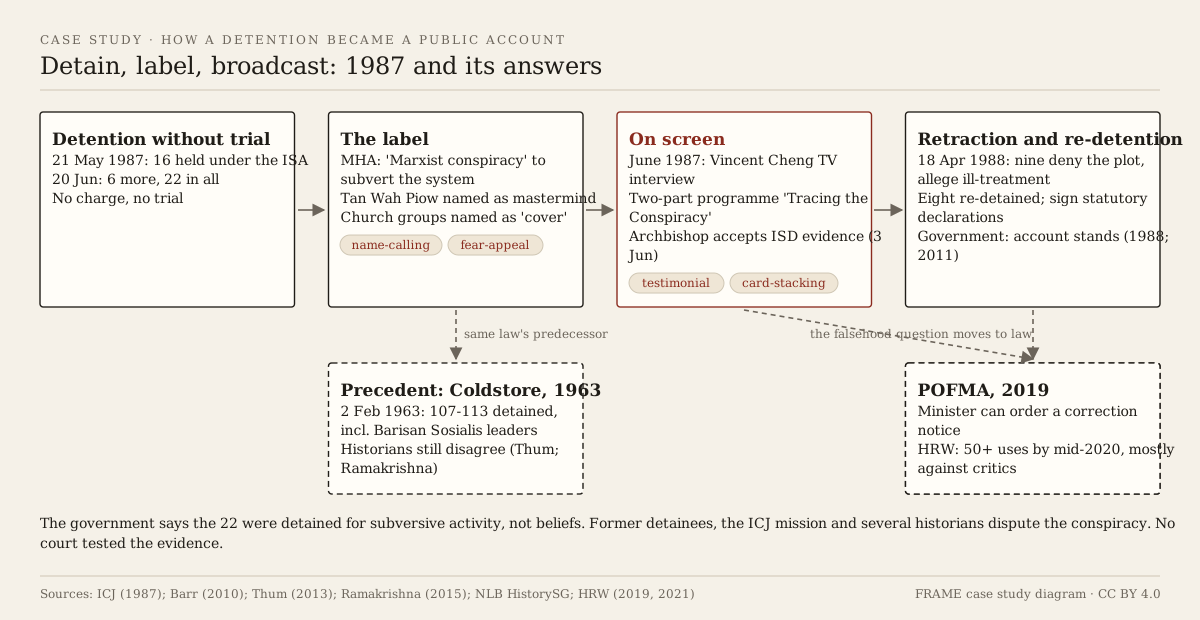
- Precedent, 2 February 1963. Operation Coldstore, authorised by an Internal Security Council of British, Singapore and Malayan representatives, detains left-wing activists without trial, among them Lim Chin Siong, secretary-general of the opposition Barisan Sosialis. The National Library Board gives 107 arrests in the first sweep; the total usually given is 113. The stated aim was to "safeguard against any attempt by the Communists to mount violence or disorder" before Malaysia was formed (NLB HistorySG).
- 21 May 1987. The Internal Security Department (ISD) detains 16 people under the Internal Security Act (ISA); six more follow on 20 June. The 22 include Catholic church workers and volunteers, social workers, theatre practitioners, lawyers and other graduates (NLB Infopedia; Barr 2010).
- The official account. The Ministry of Home Affairs (MHA) describes "a Marxist conspiracy" to subvert the system using communist united-front tactics. The Straits Times runs "Marxist plot uncovered" and "Wah Piow, the mastermind" (27 May 1987), naming Tan Wah Piow, a former student leader living in London, as organiser and church worker Vincent Cheng as his man in Singapore.
- The church. On 2 June Prime Minister Lee Kuan Yew meets Archbishop Gregory Yong and church representatives. The next day's headlines read "PM: Not our practice to take subversives to court" and "Archbishop accepts evidence" (Straits Times, 3 June 1987). Barr (2010) reads the whole episode as Lee Kuan Yew's campaign against Catholic social-justice activists.
- On television, June 1987. A long interview with Vincent Cheng is broadcast and extracted in the press. At the end of June a two-part programme, Tracing the Conspiracy, shows other detainees describing their roles (Straits Times, 29 June 1987: "12 talk about their roles in Marxist plot").
- Critics abroad. A mission led by the International Commission of Jurists (ICJ) visits on 5-9 July. Its report finds no evidence that justified calling the detainees Marxists or communists, and calls the detention without charge or trial and the treatment in interrogation "clear and grave violations of the human rights of those detained" (ICJ 1987). Amnesty International sends its own mission (Amnesty International 1987).
- 18 April 1988. Nine released detainees issue a joint statement. They deny any conspiracy and say they were deprived of sleep, threatened and physically intimidated during interrogation, and told that release depended on how they performed on television (Global Asia review of the 2017 book; Straits Times, 19 April 1988).
- 19 April-May 1988. Eight of the nine are detained again; the ninth, Tang Fong Har, is abroad. Their lawyer Francis Seow is detained on 6 May. The eight sign statutory declarations reaffirming their original statements (Straits Times, 29 April 1988). A commission of inquiry into their allegations is not set up; Home Affairs Minister S. Jayakumar says the declarations have made one unnecessary (Straits Times, 1 June 1988).
- The courts, 1988-1990. In Chng Suan Tze v Minister for Home Affairs (8 December 1988) the Court of Appeal holds that ISA detentions are open to objective judicial review. In January 1989 Parliament amends the Constitution and the ISA to restore the earlier subjective test. The last detainee, Vincent Cheng, is released in June 1990.
- Later accounts. Former detainees publish That We May Dream Again (2009; 2nd ed. 2012) and 1987: Singapore's Marxist Conspiracy 30 Years On (2017); Jason Soo's documentary 1987: Untracing the Conspiracy (2015) is built on their interviews. Tharman Shanmugaratnam, then Senior Minister of State, told The Straits Times in 2001 that, from what he knew of them, most were social activists "not out to subvert the system" (quoted in Hong and Huang 2008).
- The government's position. In 2011 the MHA restated that the 22 "were not detained for their political beliefs, but because they had involved themselves in subversive activities which posed a threat to national security" (quoted in Waging Nonviolence 2012).
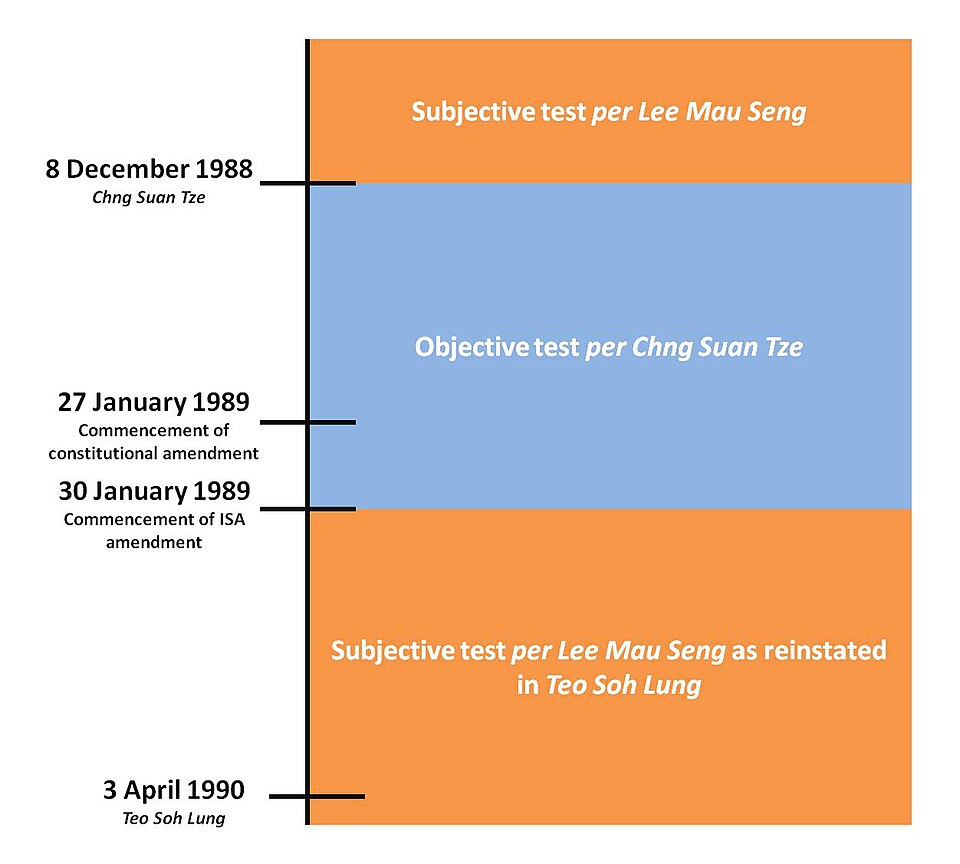
Chart of the ISA's review test: Chng Suan Tze (8 December 1988), the constitutional and ISA amendments (dated here 27 and 30 January 1989), and Teo Soh Lung (3 April 1990), the case a re-detained former detainee lost. By Wikimedia user Jiaxinho, 2011, CC BY-SA 3.0.
How it works
- Name-calling: "Marxist conspiracy", "mastermind" and "hybrid pro-communist types" (the phrase in The Straits Times' coverage) reached the public before any charge, and no charge followed. The ICJ mission's finding is directly about the labels: it found no evidence that justified them.
- Testimonial: two kinds of vouching carried the account. First, the Archbishop's public acceptance of the ISD's evidence after the Istana meeting. Second, detainees narrating the plot on television, presented as first-person admissions. The primary-witness carve-out does not settle this: the detainees later said the statements were made under pressure, then reaffirmed them while detained again. What the record shows is the format: statements recorded in detention, never cross-examined, used as public proof. The nine's 1988 statement, a primary-witness account made out of custody, is not tagged.
- Card stacking: the public saw what the state chose to publish: confessions, extracts, photographs. The evidence was never tested in court, the inquiry was dropped, and the ISD archive is still closed. After Kumar Ramakrishna was given access to classified Coldstore files, the historian Tan Tai Yong asked that access "should not hinge on who is asking" (Straits Times, 13 April 2015). The 2018 Select Committee report, for its part, accused the critic Thum Ping Tjin of picking evidence to fit his thesis. This archive does not rule on either.
- Fear appeal: the 1963 and 1987 statements put the danger in the future: violence or disorder in 1963, and in 1987 a conspiracy "with a view to establishing a Marxist state" (MHA, 1987, quoted in NLB Infopedia). The evidence behind the forecast was never put to a court. POFMA's rationale, as the law minister framed it in 2017, adds foreign actors using falsehoods to destabilise Singapore.
Then and now
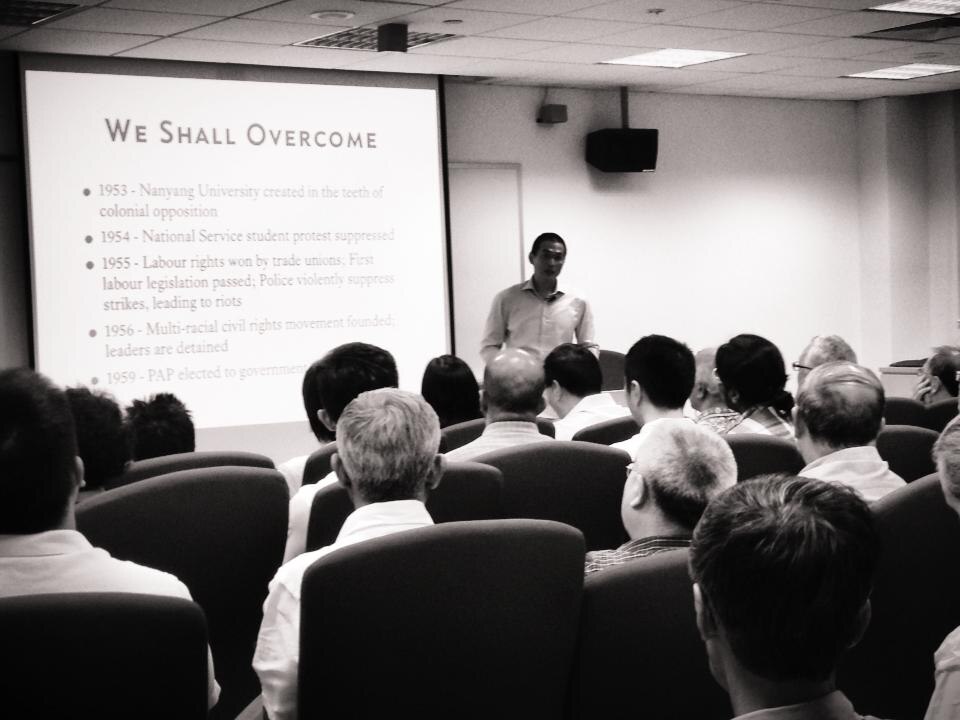
Historian Thum Ping Tjin lecturing on the consequences of Operation Coldstore, Asia Research Institute, National University of Singapore, 17 September 2013. The slide is his. Photo by Wikimedia user Adsfghj, CC BY-SA 4.0.
From detention to a falsehoods law. The same question, whose account of 1963 and 1987 is false, reached Parliament in 2018. In his submission to the Select Committee on Deliberate Online Falsehoods, Thum wrote that politicians had told Singaporeans detentions since Coldstore were about communist conspiracies, and that "Declassified documents have proven this to be a lie." Law and Home Affairs Minister K. Shanmugam questioned him for almost six hours on 29 March 2018 (Mothership; Yahoo News Singapore). The committee's September report gave his views "no weight" and said he had misrepresented his credentials. It also reported that he agreed under questioning that the British had made an honest security assessment (Yahoo News Singapore; Malay Mail). On Coldstore itself, Ramakrishna (2015) argues the communist united-front threat was real; Thum (2013) argues the operation removed a legitimate left opposition.
POFMA. The Protection from Online Falsehoods and Manipulation Act was tabled on 1 April 2019. It passed on 8 May by 72 votes to 9, with the Workers' Party's nine MPs voting against, and took effect on 2 October 2019. A minister can order a "correction direction": a notice attached to a post saying it contains false statements of fact. The Ministry of Law says the law targets false statements of fact, "not opinions and criticisms, nor satire or parody" (SCL; HKFP). It was first used on 25 November 2019, against a Facebook post by Brad Bowyer of the opposition Progress Singapore Party about Temasek and GIC (Mothership; Malay Mail). Human Rights Watch called the bill "a disaster for human rights" (2019). It counted more than 50 uses by mid-2020, "primarily against people or publications that criticized the government" (2021). The Straits Times' five-year review (15 June 2024) counted 163 orders, over a quarter of them about COVID-19. The ICJ called in 2021 for repeal or substantial amendment. One difference from 1987: POFMA orders a correction notice, not a detention, and can be appealed to the High Court.
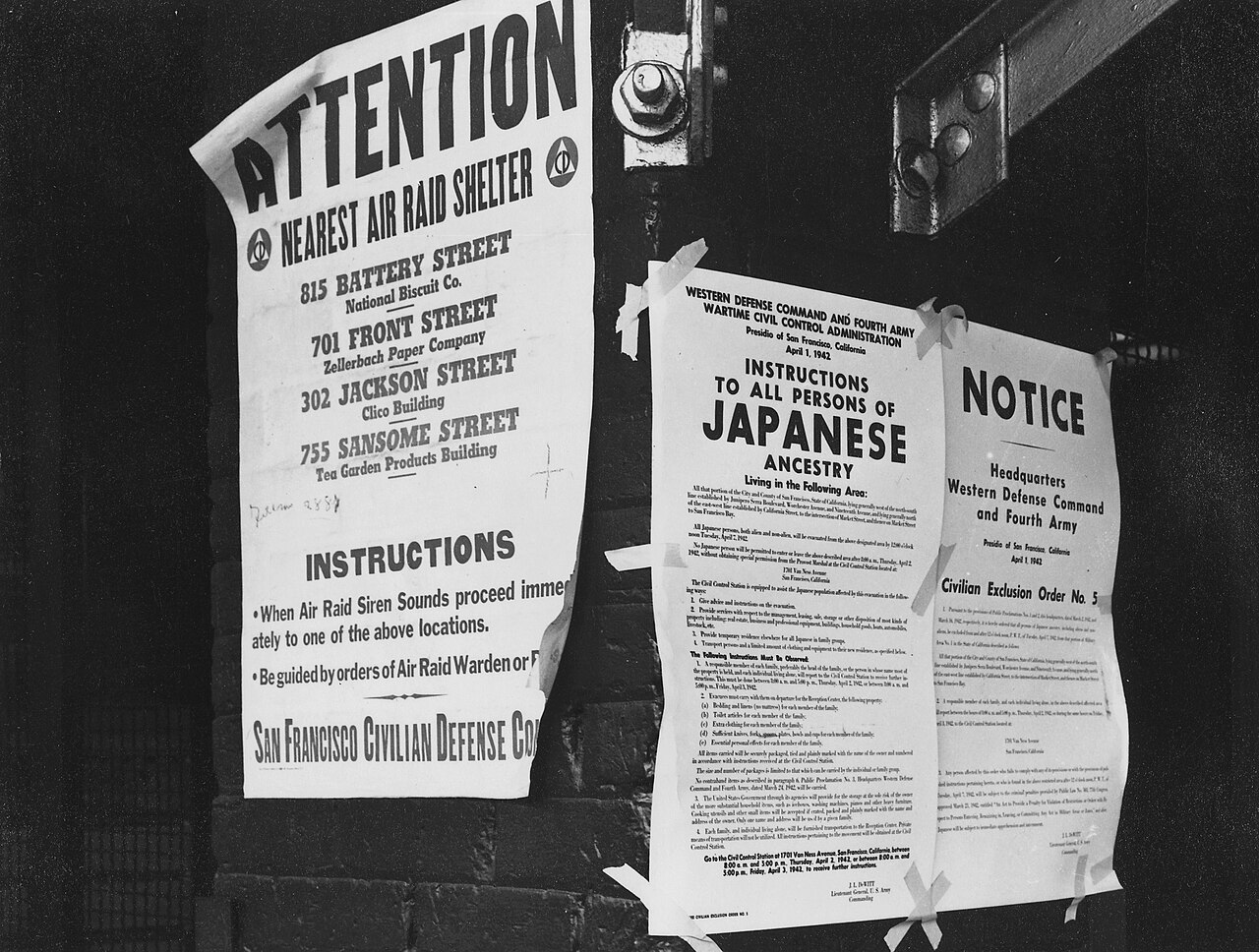
'Instructions to All Persons of Japanese Ancestry' (exclusion order posted in San Francisco), U.S. Army Western Defense Command, photographed by Dorothea Lange, 1942. Public domain.
The same move elsewhere. The United States detained about 120,000 people of Japanese ancestry without trial on security grounds. The differences are large: that detention was by ancestry and at mass scale, not of 22 named people for alleged activity. The US government later rejected its own rationale, through a 1983 commission and a 1988 apology. Singapore's government maintains its 1987 account.
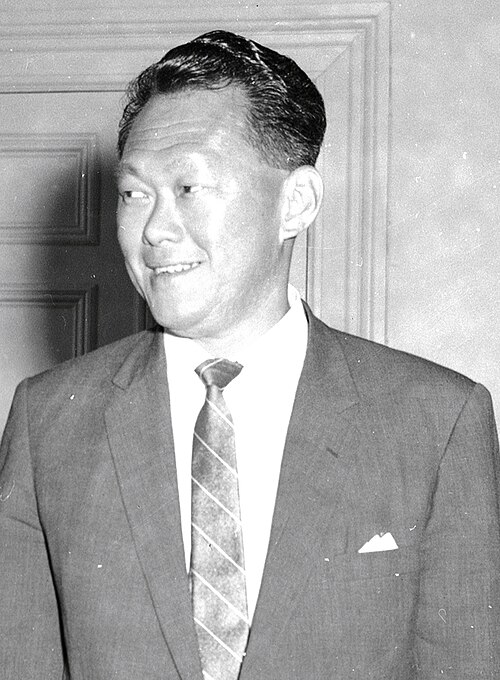
Lee Kuan Yew, prime minister of Singapore from 1959 to 1990, in Wellington, 1965. He was head of government during both Coldstore and Spectrum. Photo by A.K. Bristow, Wellington City Archives, CC BY-SA 4.0.
Positions on the record
- Government of Singapore: the 1963 and 1987 detentions answered real subversive threats. In this account, echoed by Ramakrishna (2015), communists worked through open united-front groups, so the threat did not need visible violence to be real. The 22 were detained for activity, not beliefs (MHA, 2011). The 1988 statement was a political move, and the signatories reaffirmed their original statements. POFMA corrects false facts and leaves opinion alone.
- Former detainees, the ICJ mission and several historians (Turnbull, Barr, Thum): there was no conspiracy; the confessions were obtained under pressure; the detentions removed critics. Human-rights groups and the Workers' Party say POFMA gives ministers too much discretion.
- What is documented: the arrests, the MHA's wording, the broadcasts, the 1988 statement, re-detentions and declarations, the court rulings and 1989 amendments, the 2018 exchange, and POFMA's text and uses.
- What is not shown / disputed: whether any conspiracy existed. The ISD's evidence has never been tested at trial or released. Whether the 1987 confessions or the 1988 retraction reflect the detainees' views cannot be settled from the public record. The ill-treatment allegations were not examined by any inquiry. For Coldstore, the extent of communist control of the left is still argued among historians. Counts of POFMA orders differ by date and source.
Same-method test
The finding would read the same with the flag swapped. On 9-10 August 1971 the British Army interned 342 people in Northern Ireland without trial under a security label (Operation Demetrius). In Ireland v. United Kingdom (1978) the European Court of Human Rights found the "five techniques" used on some internees to be inhuman and degrading treatment. The differences: internment came during an armed IRA campaign and reached far more people, and the UK did not broadcast confessions.
How to spot it
- Ask whether a label ("conspiracy", "mastermind", "subversive") came with a charge a court could test, or only with the label.
- Treat statements recorded in custody, with no cross-examination, as evidence about the custody as much as about the plot.
- When a government rules on what is false, check who can appeal, to whom, and whose posts its orders have been used against.
Images
| Image | Source | Licence |
|---|---|---|
| Mechanism diagram (above) | Drawn for FRAME from the sourced facts on this page (make_diagrams.py) |
CC BY 4.0, FRAME |
| ISA timeline chart (2011) | Wikimedia Commons, Jiaxinho | CC BY-SA 3.0 |
| Thum Ping Tjin lecturing (2013) | Wikimedia Commons, Adsfghj | CC BY-SA 4.0 |
| Lee Kuan Yew (1965) | Wikimedia Commons, A.K. Bristow, Wellington City Archives | CC BY-SA 4.0 |
| Exclusion order (1942) | FRAME gallery | Public domain (U.S. government work) |
.jpg)

.jpg)
Image gaps
- The 1987 television broadcasts and Straits Times front pages. Not included: Singapore broadcast and newspaper copyright; no free copies found. A 3 February 1963 Straits Times front page on Commons is tagged only with a Singapore edition-copyright rationale, which does not cover the US.
- A 1956 photo with Lee Kuan Yew and Lim Chin Siong together (UK Central Office of Information). Not included: tagged PD-UKGov, but likely restored in the US under the URAA.
- The 1988 joint statement, the ICJ report cover and the ex-detainees' books. Not openly licensed. The ISD building and Whitley Road detention centre could be covered by Singapore's freedom of panorama for buildings, but no suitable Commons photo was found.
Sources
- Barr, Michael D. "Marxists in Singapore? Lee Kuan Yew's Campaign against Catholic Social Justice Activists in the 1980s." Critical Asian Studies 42, no. 3 (2010): 335-362. doi:10.1080/14672715.2010.507389.
- International Commission of Jurists, "ICJ mission to Singapore dismisses allegations of 'Marxist conspiracy'", 1987; fact-finding report (PDF).
- Amnesty International. Singapore: Detentions without Trial under the Internal Security Act. London, 1987.
- The Straits Times (via NewspaperSG): "Marxist plot uncovered" and "Wah Piow, the mastermind", 27 May 1987, p. 1; "PM: Not our practice to take subversives to court" and "Archbishop accepts evidence", 3 June 1987; "12 talk about their roles in Marxist plot", 29 June 1987, p. 1; "9 ex-detainees deny being involved in Marxist plot", 19 April 1988, p. 37; "Eight detainees change their story", 29 April 1988, p. 1; "Why no inquiry – Jayakumar explains", 1 June 1988, p. 16.
- NLB Infopedia, "Marxist conspiracy"; NLB HistorySG, "Special Branch mounts Operation Coldstore".
- Waging Nonviolence, "25 years on, Singaporeans remember the 'Marxist conspiracy'", May 2012 (quotes the 2011 MHA statement).
- Salil Tripathi, "A Wound That Still Festers in Singapore", Global Asia 12, no. 3 (2017), review of 1987: Singapore's Marxist Conspiracy 30 Years On (2017).
- Fong Hoe Fang, ed. That We May Dream Again. Singapore: Ethos Books, 2009; 2nd ed. 2012.
- 1987: Untracing the Conspiracy, dir. Jason Soo, 2015 (IMDb).
- Hong Lysa and Huang Jianli. The Scripting of a National History: Singapore and Its Pasts. Hong Kong University Press, 2008, p. 145 (Tharman interview, Straits Times, 14 December 2001).
- Chng Suan Tze v Minister for Home Affairs [1988] 2 SLR(R) 525 (Court of Appeal, 8 December 1988); Teo Soh Lung v Minister for Home Affairs (Court of Appeal, 1990).
- Thum Ping Tjin, "'The Fundamental Issue is Anti-colonialism, Not Merger'", ARI Working Paper 211 (2013).
- Kumar Ramakrishna, "Original Sin"? Revising the Revisionist Critique of the 1963 Operation Coldstore in Singapore, ISEAS, 2015.
- Lim Yan Liang, "Revisiting Operation Coldstore", The Straits Times, 13 April 2015 (Tan Tai Yong on archive access).
- Yahoo News Singapore, "K Shanmugam: 'Serious allegations' about Lee Kuan Yew by Thum Ping Tjin on Operation Coldstore", March 2018; Mothership, March 2018.
- Yahoo News Singapore, "Thum Ping Tjin lied to Select Committee, concludes fake news panel", September 2018; Malay Mail, 21 September 2018.
- Tan, Judith. "Shanmugam: Law to combat fake news to be introduced next year." The Business Times, 19 June 2017 (on his keynote at the "Keep It Real: Truth and Trust in the Media" conference that day).
- Society for Computers & Law, "POFMA: Singapore's anti-fake news law"; Hong Kong Free Press, 24 May 2019; Parliament of Singapore, Official Report, 8 May 2019 (division 72-9).
- Mothership, "Govt invokes POFMA Act for first time against post made by PSP's Brad Bowyer", November 2019; Malay Mail, 25 November 2019.
- Human Rights Watch, "Singapore: Reject Sweeping 'Fake News' Bill", 3 April 2019; Human Rights Watch, "Singapore: 'Fake News' Law Curtails Speech", 13 January 2021.
- ICJ, "Singapore: ICJ calls on government to repeal or substantially amend the POFMA", 2021.
- The Straits Times, "Five years of Pofma: How has the law been used to combat fake news?", 15 June 2024 (copy hosted by the NUS Institute of Policy Studies); index entry.
- The Irish Times, "Internment explained: When was it introduced and why?"; Ireland v. the United Kingdom, European Court of Human Rights, no. 5310/71, judgment of 18 January 1978.
- Turnbull, C. Mary. A History of Modern Singapore, 1819-2005. NUS Press, 2009, p. 339.