Content note. This page quotes broadcasts and a speech that called for, or praised, the burning of people labelled informers ("necklacing"), and describes those killings. The words are quoted as evidence of the method, as the Truth and Reconciliation Commission recorded them.
In one line: in the 1970s South Africa's Department of Information secretly spent about R64 million of defence money on some 180 projects, including a daily newspaper presented as independent and front groups that placed advertisements in Western papers; in the 1980s the ANC's exile station Radio Freedom called on listeners to make the country "ungovernable" and, in at least one broadcast, praised the burning of "sell-outs". The Truth and Reconciliation Commission later found the state responsible for most gross human-rights violations of the period, and also found the ANC accountable for violations committed in its name.
What happened
The government: the Department of Information's secret projects
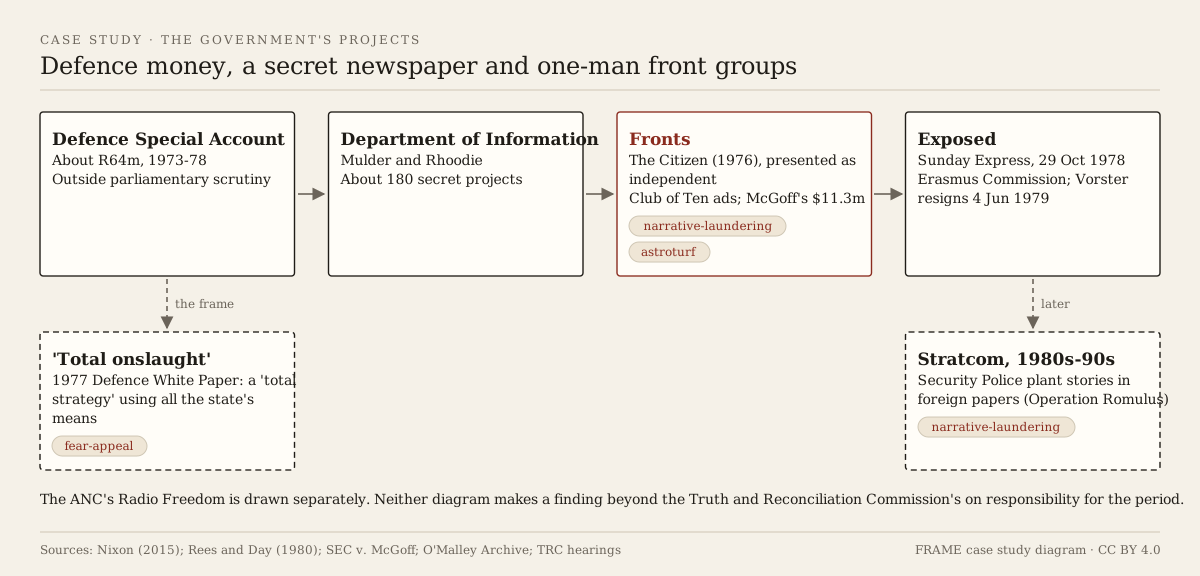
- 1972 to 1978. Connie Mulder is Minister of Information and Eschel Rhoodie Secretary for Information. With the head of the Bureau for State Security, General Hendrik van den Bergh, they run a programme of secret projects funded from the Defence Special Account, which Parliament does not scrutinise. About R64 million is redirected from defence between 1973 and 1978 to some 180 projects. (Some sources give 160.)
- 1976. The Citizen, an English-language daily, is launched by the businessman Louis Luyt. It presents itself as independent. It is funded from the Department's secret fund.
- 1974 to 1979. The U.S. publisher John McGoff receives more than $11.3 million from the South African government, according to U.S. court records, for a failed attempt to buy the Washington Star. He uses about $6 million to buy the Sacramento Union. The relationship is hidden through secret accounts and dummy companies.
- Front groups. The "Club of Ten", presented as a group of British, South African and American businessmen, places advertisements in the Daily Telegraph, The Times and The Guardian; the historian Ron Nixon reports that in practice it was run by one man, Gerald Sparrow, a former judge. Other fronts include the Foreign Affairs Association and the SA Freedom Foundation. The magazine To the Point is covertly funded.
- 1977. A Defence White Paper, under Defence Minister P.W. Botha, says South Africa faces a "total onslaught" requiring a "total strategy" using "all the means available to the state" in military, economic, psychological, political, cultural and ideological fields. The onslaught is framed as Soviet-led, carried by Cuba, Angola, Mozambique, the ANC and SWAPO.
- 29 October 1978. Kitt Katzin's report in the Sunday Express, confirmed with Judge Anton Mostert, reveals that The Citizen was paid for with state money. Mervyn Rees and Chris Day of the Rand Daily Mail follow with a six-day series. Mostert releases his evidence in early November.
- September 1978 to June 1979. B.J. Vorster steps down as prime minister on health grounds and becomes State President; P.W. Botha beats Mulder for the premiership on 28 September 1978. The Erasmus Commission reports in December 1978 and 1979. Vorster resigns as State President on 4 June 1979 after the commission finds he knew of the misuse of funds. Mulder leaves Parliament and the National Party. Rhoodie is convicted of fraud in 1979; the conviction is overturned on appeal on 29 September 1980.
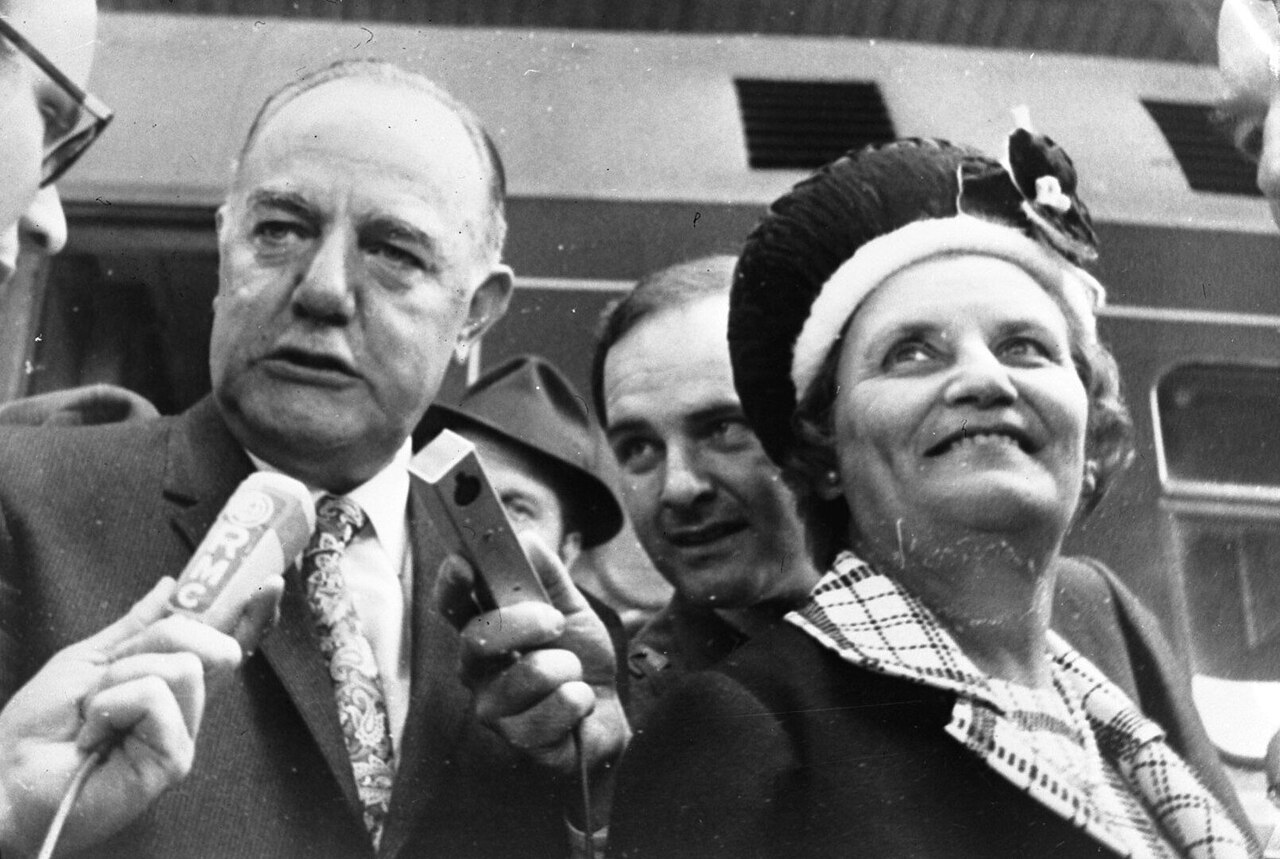
Prime Minister B.J. Vorster, 1974, under whom the Department of Information's secret projects operated and who resigned as State President in 1979 over the scandal. Photo: Nationaal Archief / Anefo, CC0. - 1980s and early 1990s. A Security Police strategic-communications unit, Stratcom, runs disinformation against opponents of the government. At the Truth and Reconciliation Commission on 28 November 1997, its former head Vic McPherson describes campaigns to discredit the ANC and split it from the South African Communist Party. One project, Operation Romulus, sent a "veritable mass of material" to foreign media "with the specific objective of using Winnie Mandela... to discredit the ANC as a whole".
The ANC: Radio Freedom
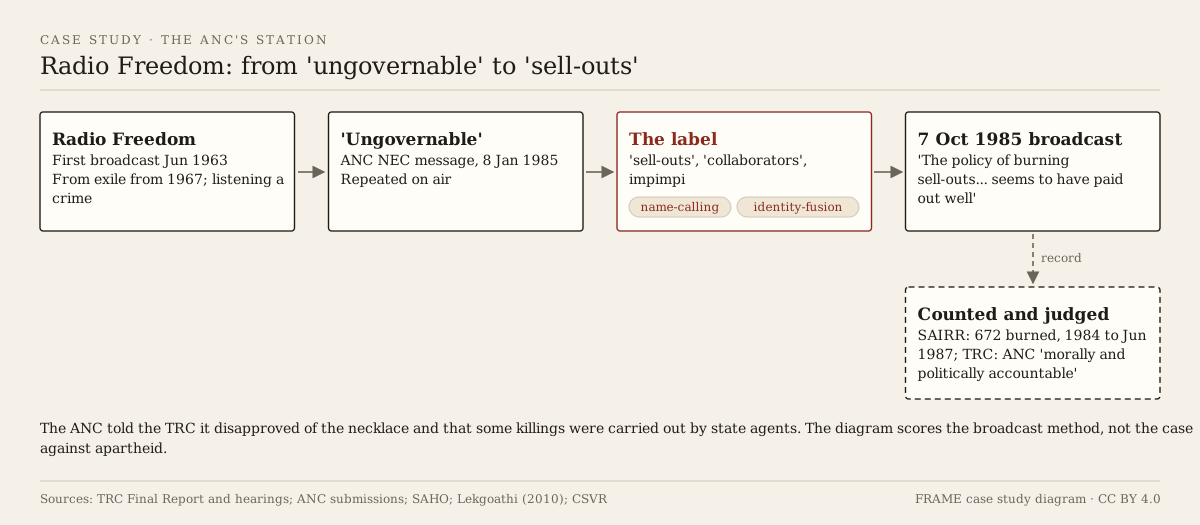
- June 1963. Radio Freedom's first 15-minute broadcast goes out from Liliesleaf farm in Rivonia, shortly before the farm is raided. From 1967 it broadcasts from exile, carried by the state radio services of Zambia, Tanzania, Angola, Ethiopia and Madagascar. Its call sign opens with machine-gun fire. Listening inside South Africa is a criminal offence.
- 8 January 1985. The ANC National Executive Committee's anniversary message, delivered by Oliver Tambo, is titled "Render South Africa Ungovernable!". Radio Freedom repeats the call through 1984 and 1985.
- The label. In the townships, impimpi means a police informer or collaborator. Radio Freedom and speakers use "sell-out" and "collaborator" for township councillors, police and suspected informers.
- 20 July 1985. Maki Skosana is burned to death at a funeral in Duduza, the first "necklace" killing (a petrol-filled tyre set alight around the victim) caught on film. Later evidence given to the TRC suggested that a security-police agent had helped turn suspicion on her; this is disputed.
- 7 October 1985. Radio Freedom broadcasts: "The policy of burning sell-outs of the system seems to have paid out well in the ultimate end."
- 13 April 1986. At Munsieville, Winnie Madikizela-Mandela says: "Together, hand in hand, with our boxes of matches and our necklaces we shall liberate this country." (Reports differ slightly on the wording.) On 4 May 1986 Radio Freedom broadcasts her call to "take all our weapons, both rudimentary and sophisticated, our necklacers [sic], our grenades, our machine guns".
- Scale. The South African Institute of Race Relations counted 672 people burned to death between early 1984 and June 1987, about half of them by necklace.
- September 1986. Tambo says the ANC is "not happy with the necklace" but will not condemn those who use it.
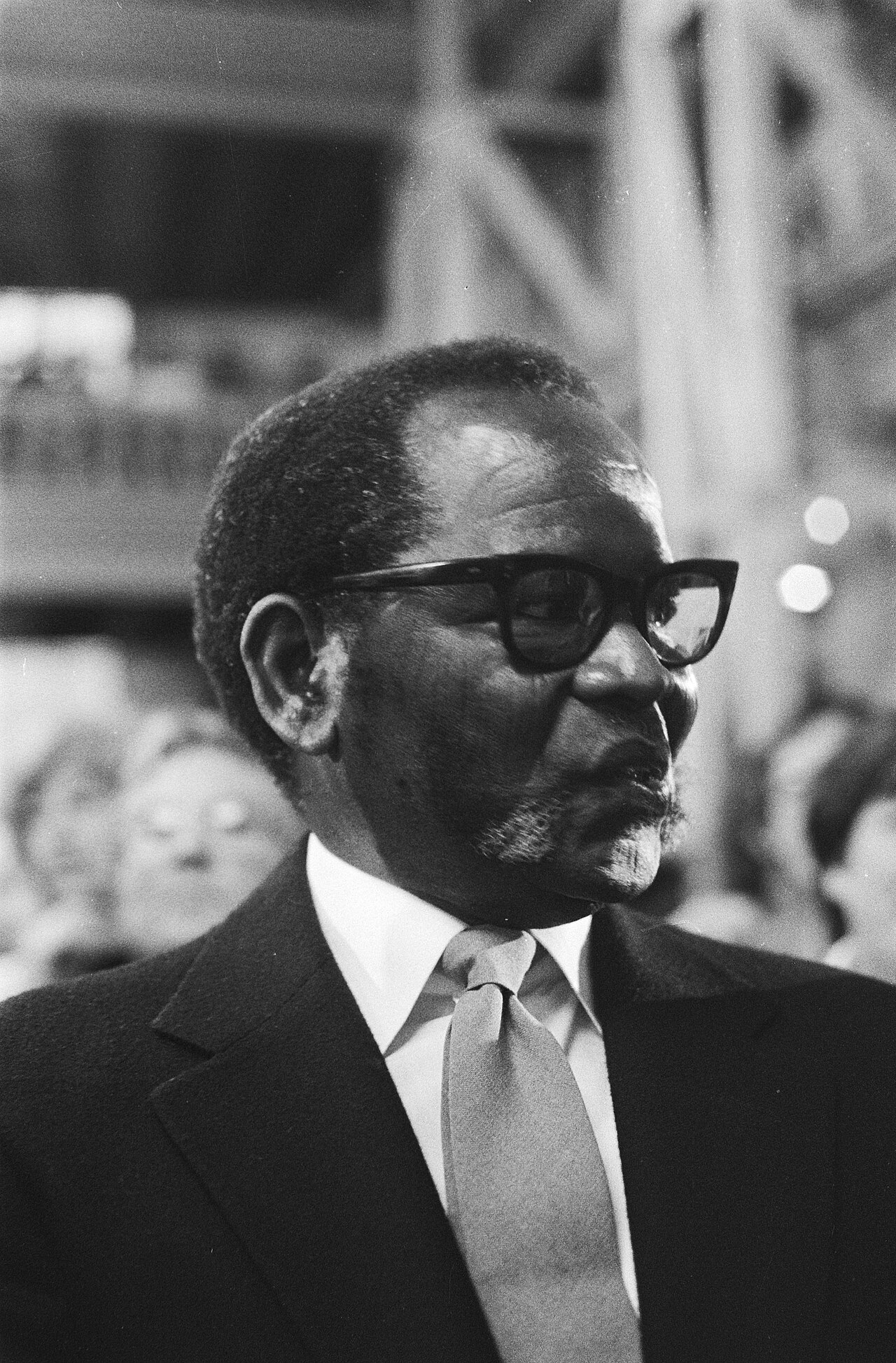
ANC President Oliver Tambo speaking in Amsterdam, 1983. Photo: Nationaal Archief / Anefo, CC0.
The Truth and Reconciliation Commission (1996 to 1998)
- The TRC's Final Report finds the state responsible for most gross human-rights violations of the period, and hears Stratcom testimony about planted stories and a network of journalists. It also finds the ANC "morally and politically accountable" for gross violations committed in its name, and that the United Democratic Front's campaigns and slogans "helped create a climate" in which supporters felt "morally justified in taking unlawful action".
How it works
- Narrative laundering: The Citizen carried a government message under an independent masthead, and McGoff's bid tried to do the same through an American newspaper. Operation Romulus fed security-police material to foreign papers so it would appear as independent reporting.
- Astroturfing: the Club of Ten presented one man's government-funded advertising as the voice of a group of businessmen in three countries.
- Fear appeal: "total onslaught" presented every opponent, from Soviet advisers to domestic protesters, as one threat that justified a "total strategy" using all the state's means.
- Name-calling: "sell-out", "collaborator" and impimpi marked a person before any charge or evidence, and in the 1985 broadcast the label came with praise for burning.
- Identity fusion: in a movement framed as the people against the system, being labelled a sell-out placed a person outside the people. Questioning the label could itself look like siding with the system.
Then and now
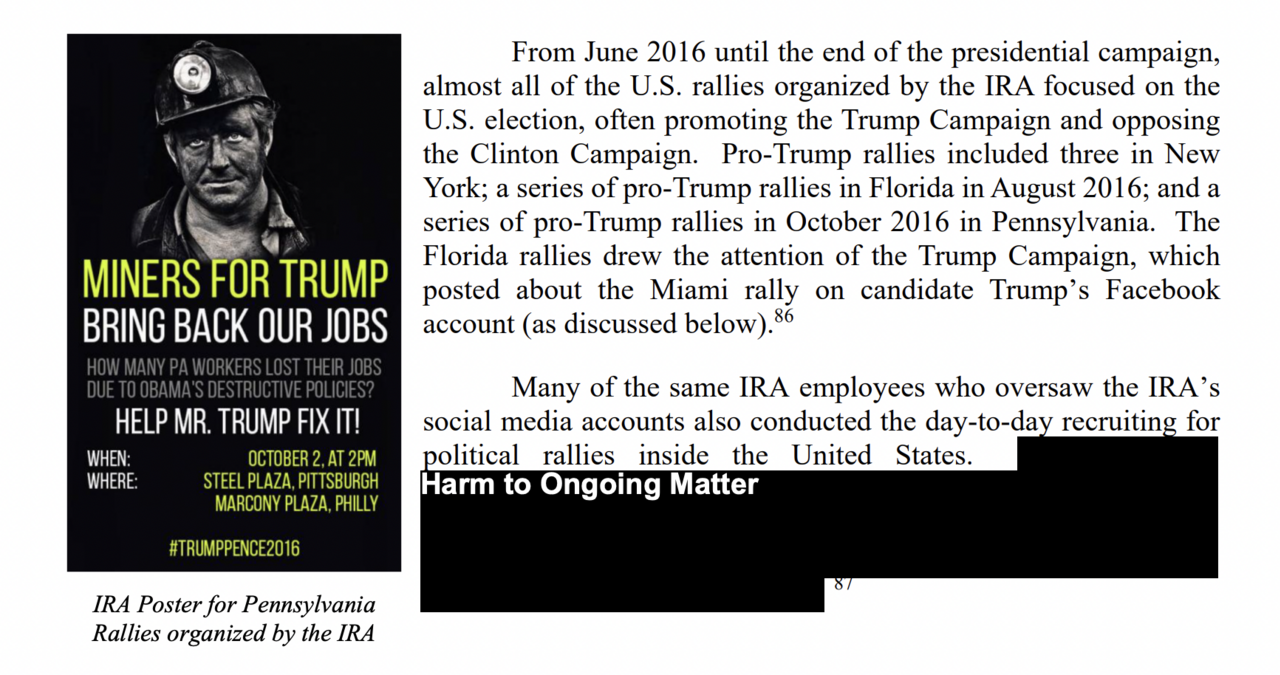
'Miners for Trump' rally poster (Internet Research Agency), Internet Research Agency, 2016. Public domain (reproduced in a U.S. government report).
Forty years after the Club of Ten bought advertising space in London papers under a businessmen's name, the St Petersburg-based Internet Research Agency promoted U.S. rallies through accounts posing as American activists. The method is the same: a paid state or state-linked message presented as a group of independent locals. The tools differ (newspaper advertising then, social accounts now), and so does the purpose: the Club of Ten argued for a government, while the IRA posters promoted rallies for a U.S. candidate. The informer labels in this case have a modern parallel in Alaj: the portal Iranian state media promoted for reporting 'traitors abroad'.
Positions on the record
- The government at the time: presented the secret projects as a response to an international campaign against South Africa that it said was unfair and Soviet-backed. Rhoodie gave his own account in The Real Information Scandal (1983).
- The ANC: in its 1997 submissions to the TRC, said it "strongly disapproved of... particularly the 'necklace'", but refused to condemn those who believed they were acting in the struggle, and said some necklacings were carried out by state agents. It disputed the TRC's findings against it.
- The UDF: its leaders told the TRC in 1998 that necklacing had been condemned.
- What is documented: the secret fund's scale, The Citizen's funding, the McGoff payments, the front groups, the exposure and resignations, Stratcom testimony, the Radio Freedom broadcasts and speeches quoted, the SAIRR count and the TRC findings.
- What is not shown here: exact TRC paragraph references, which the build environment could not retrieve, and how many necklace killings followed any particular broadcast. This page takes no position on apartheid's opponents beyond what the TRC found, and does not treat the state and its opponents as morally equivalent: the TRC held the state responsible for most gross violations of the period.
Same-method test
A newspaper secretly funded by any government, a one-man front presented as a business group, or a broadcast praising the killing of people labelled informers would be scored the same way here, whether it came from a government, a liberation movement, or anyone else.
How to spot it
- Ask who owns a new publication and where its first money came from, especially when it appears suddenly with a view close to a government's.
- Check whether an advertising "group" has named members, an address and more than one person behind it.
- When a movement's broadcasts label people "sell-outs" or "traitors", ask what the person is accused of doing, who decided, and what happens next to people so labelled.
Images
| Image | Source | Licence |
|---|---|---|
| Mechanism diagrams (above) | Drawn for FRAME from the sources below (make_diagrams_regions.py) |
CC BY 4.0, FRAME |
| B.J. Vorster (1974) | Wikimedia Commons (Nationaal Archief / Anefo) | CC0 |
| Oliver Tambo, Amsterdam (1983) | Wikimedia Commons (Nationaal Archief / Anefo) | CC0 |
| Whites-only beach signs, Muizenberg (1985) | Wikimedia Commons | Public domain (released by photographer) |
| Miners for Trump (2016) | FRAME gallery | Public domain (U.S. government work) |
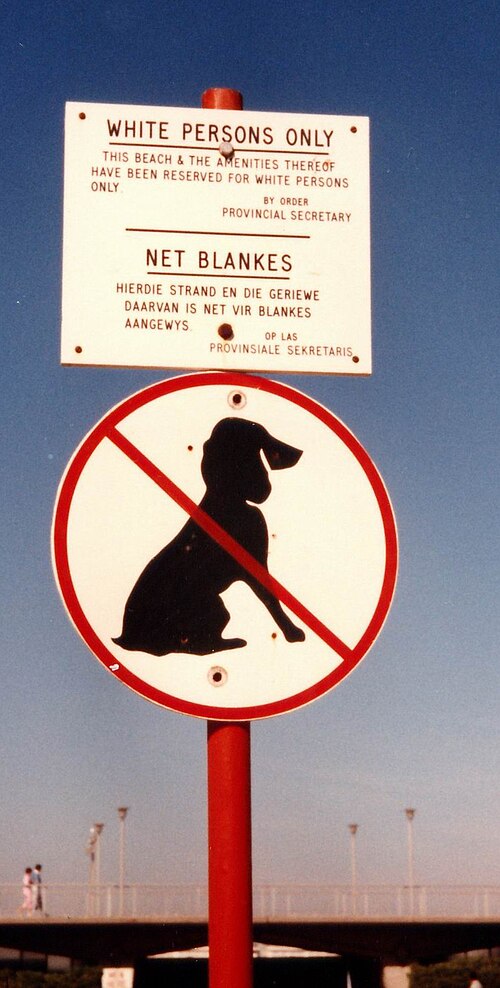
Signs enforcing racially segregated beach access, Muizenberg, 1985. Public domain, released by the photographer. An apartheid-era legal notice, documenting the system the information war above was fought around.
Image gaps
- Front pages of The Citizen and the 1978 Sunday Express and Rand Daily Mail stories. Copyrighted.
- Club of Ten advertisements. No openly licensed scans found.
- Radio Freedom recordings, and photographs of Mulder, Rhoodie or Winnie Madikizela-Mandela. No openly licensed copies were found; a Mulder photograph on Commons is tagged public domain in South Africa only, with unclear U.S. status.
Sources
- Truth and Reconciliation Commission of South Africa, Final Report (1998), vols 2, 4 and 5.
- TRC SAPA report, 28 November 1997: Stratcom testimony of Vic McPherson.
- TRC SAPA report, 28 November 1997: testimony on the Munsieville speech.
- ANC, further submissions to the TRC (1997).
- Ron Nixon, Selling Apartheid: South Africa's Global Propaganda War (Pluto, 2015).
- Mervyn Rees and Chris Day, Muldergate: The Story of the Info Scandal (Macmillan South Africa, 1980).
- SEC v. John P. McGoff and Global Communications (U.S. court opinion).
- Washington Post, 30 September 1980: Rhoodie's fraud conviction reversed.
- South African History Online, "Render South Africa Ungovernable" (ANC NEC message, 8 January 1985).
- O'Malley Archive (Nelson Mandela Foundation), the 1977 Defence White Paper and "total strategy".
- Sekibakiba Peter Lekgoathi, on Radio Freedom and its audiences, Journal of African Media Studies 2(2), 2010, pp. 139-153.
- Riedwaan Moosage, "A Prose of Ambivalence", Kronos 36, 2010.
- Centre for the Study of Violence and Reconciliation, "The Ritual of the Necklace".