Content note. This case quotes the insulting labels each government used for the other ("bandits", "bandit spies") and refers to political imprisonment and executions. The labels are quoted as evidence of the method. They are not this archive's description of anyone.
In one line: for four decades the two Chinese governments aimed loudspeakers, shells full of leaflets, radio and giant slogans at each other across a few kilometres of water around Kinmen, while at home the Republic of China under martial law taught that spotting "bandit spies" was everyone's duty and kept the 1947 killings out of public view.
What happened
Inside Taiwan (ROC government).
- 28 February 1947. A crackdown on island-wide protests follows the beating of a tobacco vendor in Taipei by government investigators on 27 February. A government-commissioned report released in 1992 estimated 18,000 to 28,000 dead; Focus Taiwan reports that more recent studies suggest the range may be on the high side.
- 19 May 1949. The ROC government declares martial law on Taiwan. It lasts until 15 July 1987, 38 years. Political cases in this period are known as the White Terror. Estimates of the numbers imprisoned and executed vary; figures often given in reference works are about 140,000 imprisoned and 3,000 to 4,000 executed.
- Slogans of daily life. Posters, signs and school and workplace notices carry lines such as 保密防諜,人人有責 ("keeping secrets and guarding against spies is everyone's responsibility"), 匪諜就在你身邊 ("bandit spies are right beside you") and 知匪不報,與匪同罪 ("failing to report a bandit is the same crime as being one"). The National Museum of Taiwan History holds a Taiwan Sugar Corporation sign with the first of these. Official usage calls the Chinese Communist Party and PRC government 共匪 ("Communist bandits"). A 1983 presidential message is the first to say 中共 ("Chinese Communists") instead, and the term drops out of official use after the mobilisation-period provisions are abolished in 1991.
- "Recover the mainland". 反攻大陸 ("counter-attack the mainland") is a state slogan from 1950. Planning for an invasion, Project National Glory, is dropped in 1972.
- The 228 silence. Government records of 1947 stay classified and the subject is taboo in public until after martial law ends. The Taiwan Association for Human Rights holds a public discussion in 1986. President Lee Teng-hui apologises in 1995, the year a compensation act passes.
- The opposition's press. In 1979 Formosa Magazine (美麗島) gathers the tangwai ("outside the party") opposition. Its Human Rights Day rally in Kaohsiung on 10 December 1979 ends in clashes with police. Eight opposition leaders are tried by a military court; one receives life, the others 12 or 14 years. Amnesty International's trial observer found the violence charges unsubstantiated and adopted the eight as prisoners of conscience.
- Afterwards. The Transitional Justice Commission sits from 31 May 2018 to 30 May 2022 and delivers a final report. The Ministry of Justice, which took over redress after the commission was dissolved, reported 5,275 cases redressed as of December 2024 (Taipei Times).
The Kinmen-Xiamen front (both governments).
- Early 1950s. According to NewsChina, the PRC side had five stations broadcasting toward Kinmen by 1953; the ROC answered with stations at Mashan and on Dadan Island, the points nearest the mainland. Both sides broadcast day and night. NewsChina describes a large PRC speaker array on the eastern shore of Dadeng island, the "Nine-headed Bird".
- 23 August 1958. The PLA begins heavy shelling of Kinmen. On 6 October a message to "compatriots in Taiwan", drafted by Mao Zedong and issued under Defence Minister Peng Dehuai's name, calls the shelling punitive, urges a common front against the United States and announces a seven-day pause. On 25 October a second message limits shelling to alternate days.
- 1958-1978. Both sides settle into alternate-day firing. The shells are increasingly filled with propaganda leaflets, and the exchange stops in late 1978 (Foundation for Strategic Research). Both sides also send leaflets, gifts and small goods by balloon and floating package (Friedman).
- 1967. The ROC army builds the Beishan broadcasting wall on Kinmen: a three-storey concrete block with 48 loudspeakers, audible about 25 km away, broadcasting news, appeals and surrender calls in Mandarin and Hokkien (Kinmen County tourism office). Mashan station, 1.8 to 2.1 km from the mainland depending on tide, uses women announcers, among them Men Wan-jhen and Chen Jyuan-jyuan (Kinmen National Park).
- Defection offers. The ROC publicises rewards in gold for PLA defectors, graded by rank (Friedman), and separate offers for pilots who fly their planes to Taiwan. From 1979 an ROC radio host surnamed Chen plays Teresa Teng's songs to listeners in China for an hour a day. Chen told NPR the idea was that listeners would learn "how prosperous and free a place Taiwan is" and "want to defect". NPR reports that a PLA pilot, Wu Ronggen, who had listened to the show in secret, flew his plane to Taiwan in 1982.
- 1 January 1979. On the day the PRC and the United States establish relations, the NPC Standing Committee issues a new "Message to Compatriots in Taiwan" proposing an end to military confrontation and direct links. Defence Minister Xu Xiangqian announces the end of the shelling.
- August 1986. The ROC puts up 三民主義統一中國 ("Unite China under the Three Principles of the People") on Dadan Island, facing Xiamen (Mirror Media; NOWnews). On Xiamen's shore road a PRC sign answers: 一國兩制 統一中國 ("One country, two systems: unite China").
- End of the broadcasts. Accounts differ. NewsChina says the loudspeakers fell silent at the start of 1979. Other accounts date the end of the Xiamen front-line station to 24 April 1991; Kinmen's stations then cut back, and military administration of Kinmen ended on 7 November 1992.
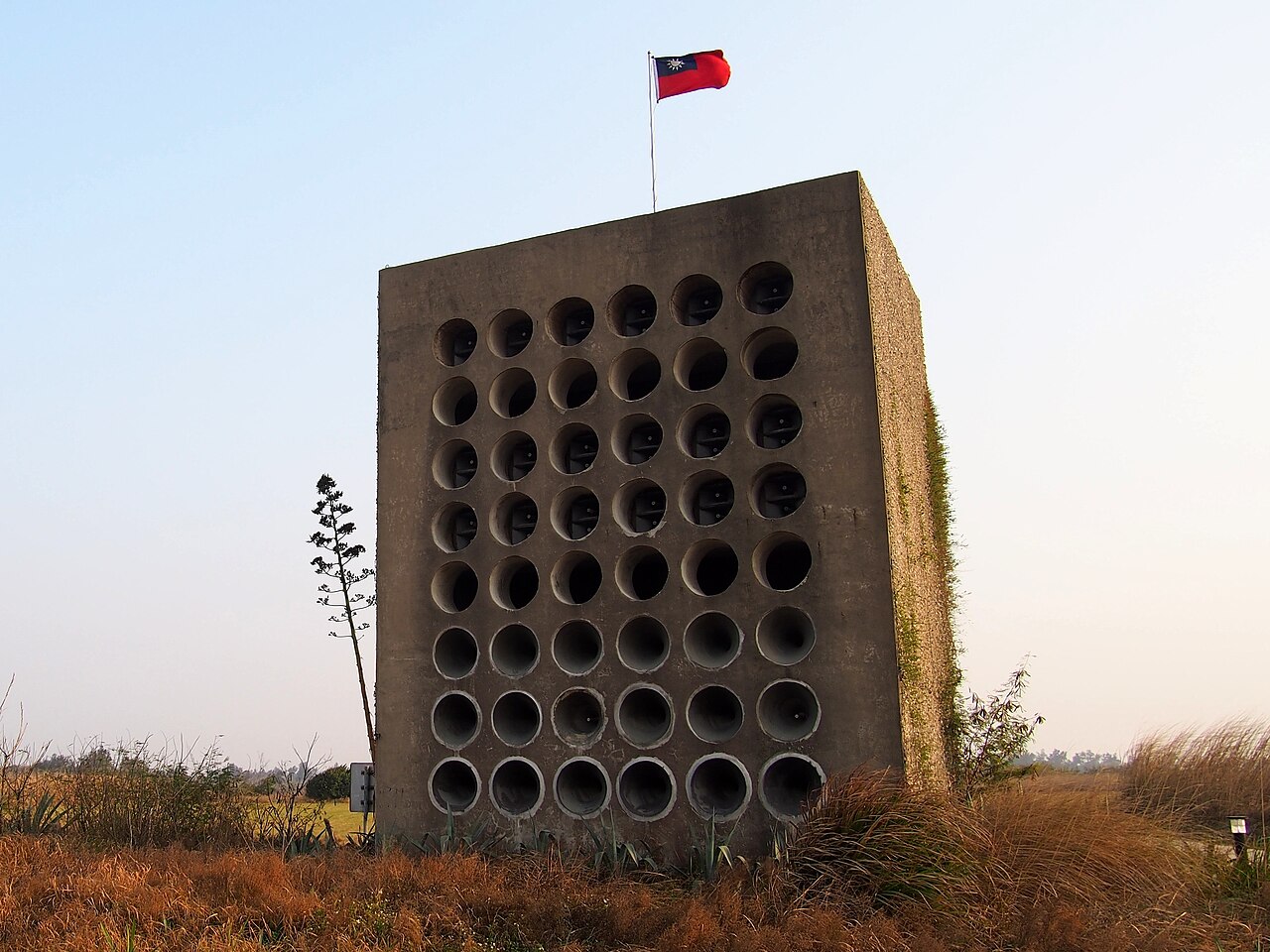
The Beishan broadcasting wall on Kinmen, built by the ROC army in 1967, with 48 loudspeaker openings facing Xiamen. Photo by rheins, January 2015, via Panoramio and Wikimedia Commons, CC BY 3.0 (cropped version). Taiwan's freedom of panorama covers permanent outdoor buildings.
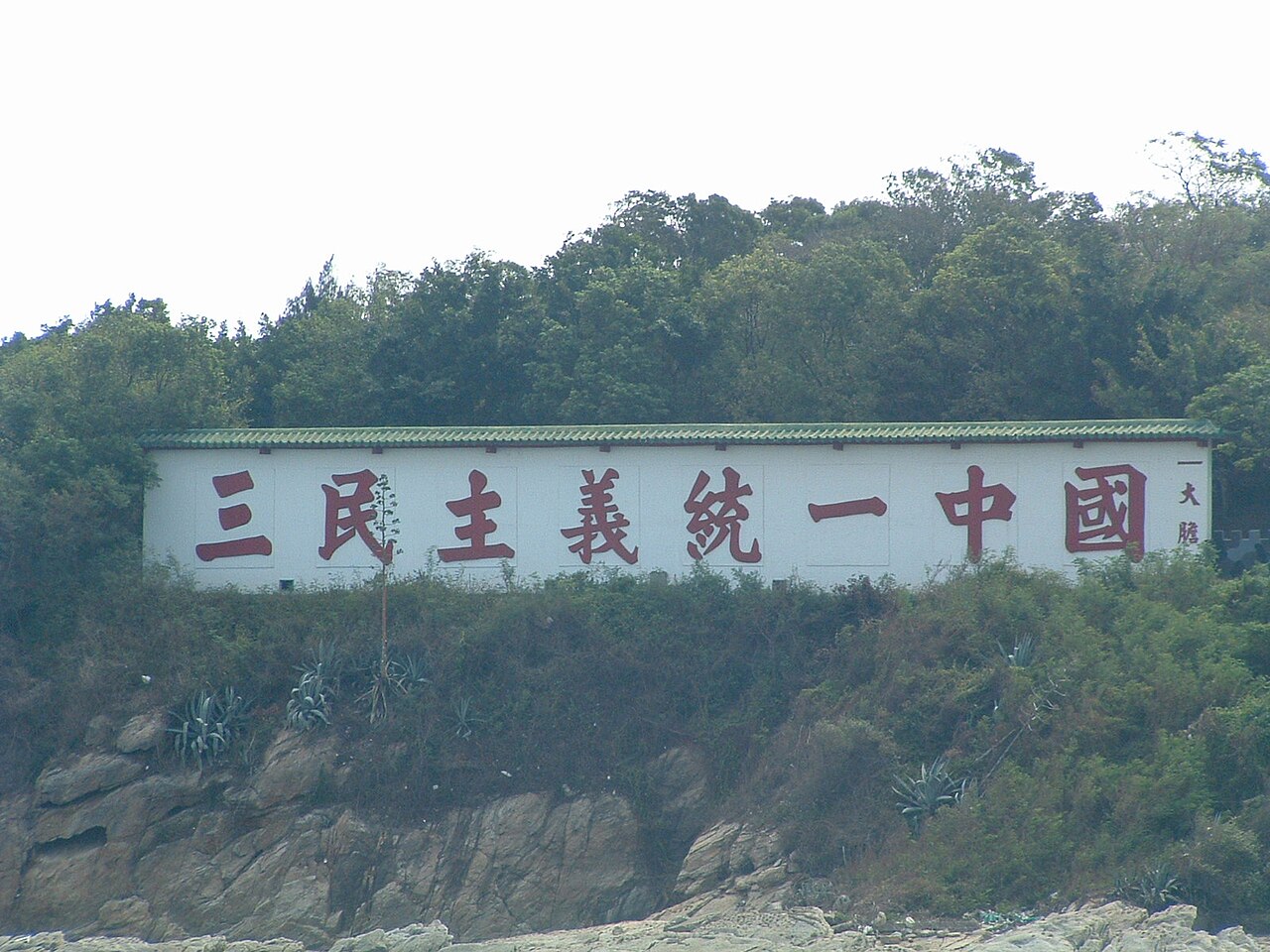
ROC sign on Dadan Island facing Xiamen: 三民主義統一中國, "Unite China under the Three Principles of the People". Photo by Minsc (Chinese Wikipedia), October 2003, via Wikimedia Commons, CC BY-SA 3.0.

PRC sign on Huandao Road, Xiamen, facing Kinmen: 一国两制 统一中国, "One country, two systems: unite China". Photo by Tyg728, July 2017, via Wikimedia Commons, CC BY-SA 4.0. Shown as the answer to the Dadan sign; the Commons description dates it to 1999, which this page has not confirmed elsewhere.
How it works
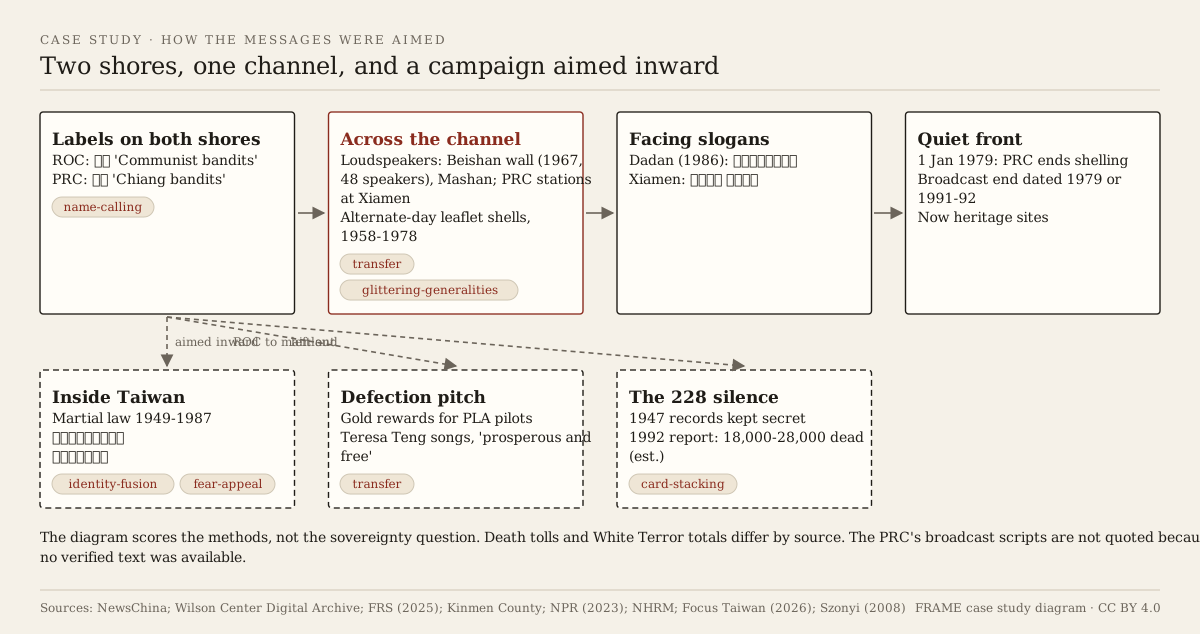
- Name-calling: both governments open with a crime label before any argument. The ROC's 共匪 ("Communist bandits") and 匪諜 ("bandit spies") make the other state a gang and a suspect a criminal. The PRC's matching term for the ROC side was 蔣匪 ("Chiang bandits"). In Taiwan, official use of 共匪 faded from the 1980s as the confrontation eased.
- Identity fusion: 保密防諜,人人有責 makes watching one's neighbours a civic duty. 知匪不報,與匪同罪 goes further: not reporting is itself the crime. Doubting an accusation becomes a sign of disloyalty.
- Fear appeal: 匪諜就在你身邊 says the enemy is already at your side, with no scale or evidence given. The implied protection is vigilance and reporting.
- Glittering generalities: the ROC's Teng broadcasts urge defection with virtue words, a Taiwan that is "prosperous and free", in place of anything a soldier could check from the other shore. The facing signs are a closer call and are not the basis for this tag: each names a defined programme (Sun Yat-sen's Three Principles of the People; the PRC's one country, two systems), though both put it in the same "... unite China" frame without saying how.
- Transfer: the ROC borrows Teresa Teng's popularity on the mainland. Her voice and songs carry the defection appeal; per NPR, the aim was that affection for the singer would turn into interest in the place she came from.
- Card stacking: at home, the 228 killings are kept out of the pile. Records stay secret and the subject is taboo, so the martial-law account of the island's recent past can only be read one way.
Then and now
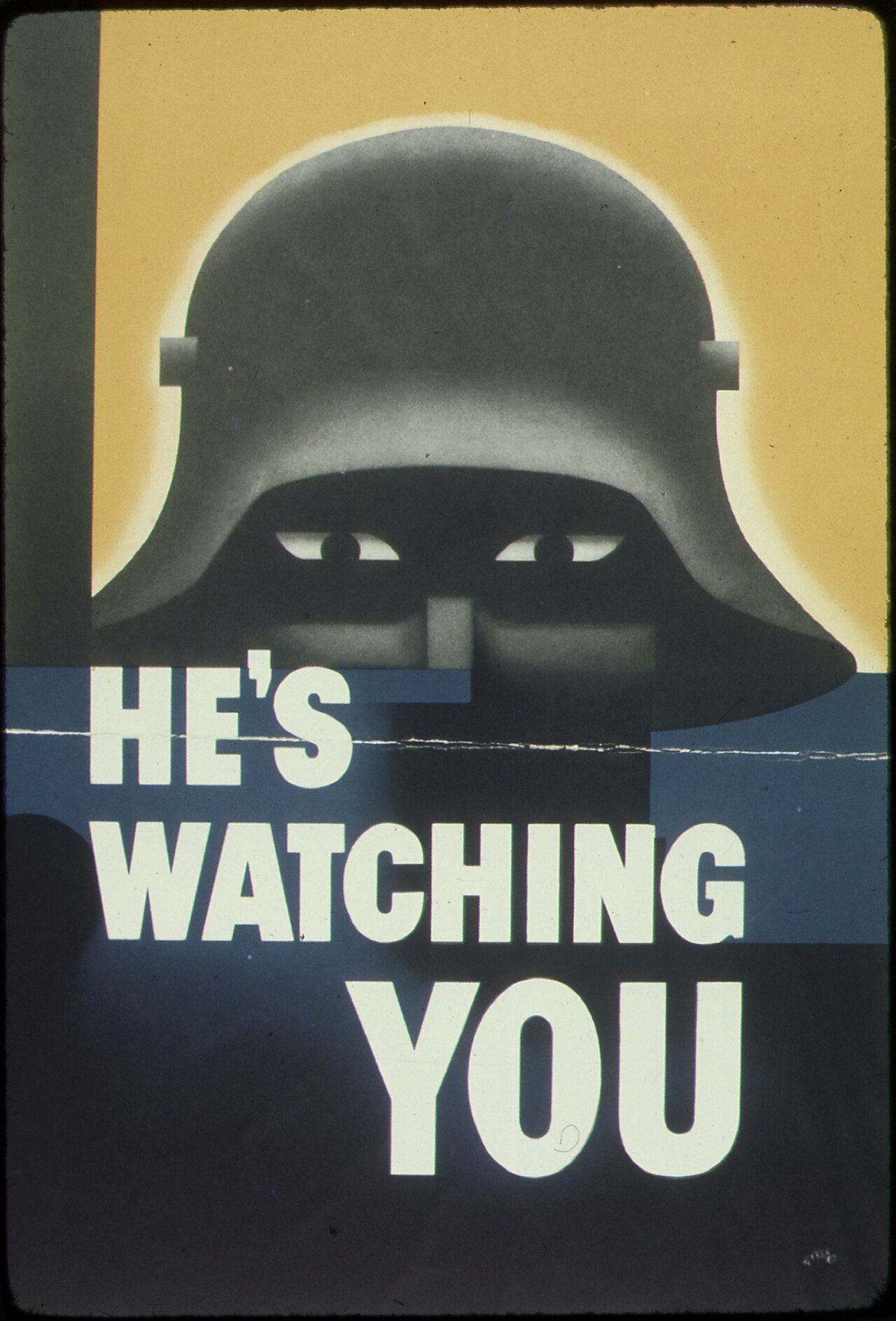
He's Watching You, U.S. government, 1942. Public domain.
The U.S. wartime security poster and the ROC's 匪諜就在你身邊 make the same move: an unseen enemy is close by, so the viewer should stay silent and watchful. The differences are large. The U.S. campaign ran for a few years of declared war and asked people to guard their own talk. The ROC campaign ran for decades under martial law, asked people to report others, and sat alongside military trials of civilians and executions estimated in the thousands.
On the front line the hardware is now heritage. Beishan's wall plays recordings of Teresa Teng's voice at set times for visitors, and the Dadan sign is a stop for tourists, including visitors from the mainland (Mirror Media). The contest itself has moved. V-Dem's expert survey rated Taiwan the country most exposed to false information from foreign governments for the 11th year running in 2024 (Taipei Times). In the same survey China ranks among the governments rated most active in spreading false information abroad, and V-Dem separately tracks domestic political disinformation inside Taiwan.
Positions on the record
- ROC government (then): martial law and anti-spy vigilance were needed against a real communist threat and infiltration; recovery of the mainland was national policy; the front-line broadcasts offered PLA soldiers freedom and rewards.
- PRC government (then and now): Taiwan is part of China; the October 1958 message called the shelling punitive and named the United States as the common enemy; the 1979 message proposed ending military confrontation, and later policy framed reunification as one country, two systems.
- ROC government (since democratisation): presidents have apologised for 228 and the White Terror; the state set up compensation, the Transitional Justice Commission and exoneration procedures.
- What is documented: martial-law dates, the 228 report and its estimate, the Kaohsiung trial outcome, the 1958 and 1979 PRC messages, the Beishan wall, the Dadan sign, the alternate-day shelling with leaflet shells, and the gold-reward and Teng broadcasts.
- What is not shown / disputed: the 228 death toll (18,000-28,000 in the 1992 report; some later studies suggest fewer); White Terror totals, which vary by source; the end date of the loudspeaker broadcasts (1979 in one account, 1991-1992 in others); the construction date of the Xiamen sign (1999 per its Commons description, not independently confirmed); the exact gold amounts; and how many defections the broadcasts caused. The PRC side's own broadcast scripts are not quoted here because no verified text was available.
Same-method test
If a U.S. Army loudspeaker team in Korea borrowed a star singer's voice to tell Chinese soldiers how free and prosperous life would be after surrender, it would be tagged Transfer and Glittering generalities exactly as Beishan's appeals are. A Western government that ran a decades-long "everyone must report spies" campaign, with non-reporting treated as a crime, would be tagged Identity fusion exactly as the ROC is here, and the PRC's "bandit" labels get the same Name-calling tag as the ROC's.
How to spot it
- When a slogan says a duty belongs to "everyone", ask what happens to the person who declines, and whether a law stands behind it.
- Look for the matching slogan on the other shore. Rival governments often use the same frame and change only the virtue word.
- Ask what the official history leaves out. A gap of forty years in public discussion of a mass killing is itself evidence of selection.
Images
| Image | Source | Licence |
|---|---|---|
| Mechanism diagram (above) | Drawn for FRAME from the sourced facts on this page (make_diagrams.py) |
CC BY 4.0, FRAME |
| Beishan broadcasting wall (2015) | Wikimedia Commons, rheins | CC BY 3.0 (building: Taiwan freedom of panorama) |
| Dadan Island sign (2003) | Wikimedia Commons, Minsc | CC BY-SA 3.0 (text sign; Taiwan freedom of panorama) |
| Xiamen sign (2017) | Wikimedia Commons, Tyg728 | CC BY-SA 4.0 (plain-text sign; PRC freedom of panorama for outdoor works) |
| He's Watching You (1942) | FRAME gallery | Public domain (U.S. government work) |
.jpg)


Image gaps
- Leaflets from either side. Leaflets fired or floated across the strait survive in museums and collections, but PRC and ROC leaflets from after 1930 are not safely public domain in the United States. Not filled; fillable only with a leaflet carrying a clear free licence.
- Mashan broadcasting station. Free photos exist on Commons (e.g. the 2022 entrance photo, CC BY-SA 4.0), but they show a tunnel entrance, not the broadcasting. Left out for relevance; fillable if a photo of the speakers or studio is found.
- PRC loudspeaker installations facing Kinmen (including the "Nine-headed Bird"). No free-licence photo was found. Gap open.
- The Taiwan Sugar Corporation anti-spy sign in the National Museum of Taiwan History. The museum holds it, but its image licence was not checked. Fillable if the museum's open-data terms allow reuse.
- Teresa Teng on Kinmen. Photos of her with soldiers exist, but none with a verified free licence was found.
Sources
- Focus Taiwan, 28 February 2026: transitional justice and 228 (1992 report's 18,000-28,000 estimate)
- National Human Rights Museum: White Terror Period
- Britannica: White Terror (Taiwan)
- National Human Rights Museum memory bank: 匪諜
- National Museum of Taiwan History: Taiwan Sugar anti-spy sign 5, 保密防諜,人人有責
- United Daily News 報時光: 60年代最流行的標語
- Language Log (University of Pennsylvania): "communist bandit"
- South China Morning Post: details of Chiang Kai-shek's plans to retake the mainland
- Taipei Times, 24 February 2019: "Taiwan in Time: 228, after the apology"
- Taipei Times, 10 December 2019: "The Formosa Incident: a look back"
- TaiwanPlus, May 2022: Transitional Justice Commission delivers final report
- Taipei Times, 5 January 2025: "More than 5,200 victims of injustice exonerated"
- NewsChina: "A War of Shells and Words"
- Wilson Center Digital Archive: Peng Dehuai, message to Taiwan compatriots, 6 October 1958
- Wilson Center Digital Archive: Wu Lengxi memoir on the 1958 shelling decisions
- Foundation for Strategic Research (2025): Kinmen's geostrategic significance, past and present
- China Daily, 25 March 2011: 1 January 1979, China and the United States establish relations
- Kinmen County tourism: Beishan Broadcasting Wall
- National Park Service of Taiwan: opening of Mashan Broadcasting Station
- NPR (Emily Feng), 29 May 2023: "How Taiwan used women's voices to send secret messages into China and woo defectors"
- SGM Herbert A. Friedman: Nationalist and Communist Chinese propaganda leaflets
- Mirror Media, 2 June 2019: 兩岸統戰標語大對決
- NOWnews: 大膽島開放觀光「三民主義統一中國」心戰牆
- Taipei Times, 25 March 2024: "Taiwan most affected by disinformation"
- V-Dem: Disinformation in Taiwan, international versus domestic
- Michael Szonyi, Cold War Island: Quemoy on the Front Line (Cambridge University Press, 2008).
- Denny Roy, Taiwan: A Political History (Cornell University Press, 2003).