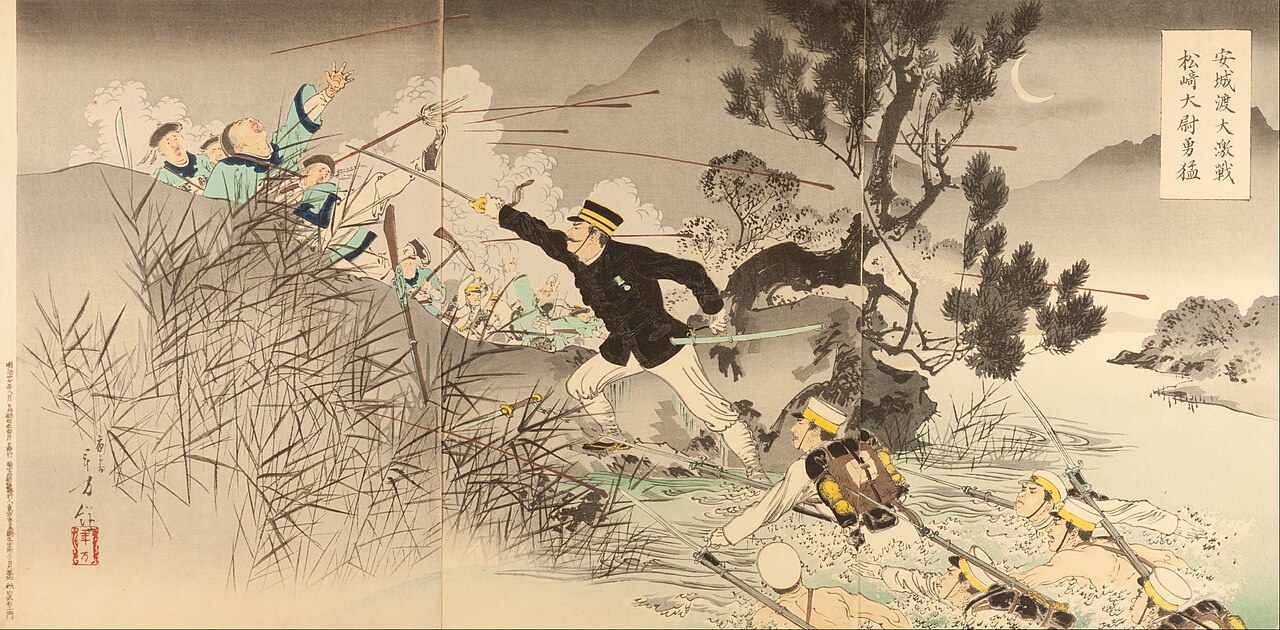
The Great Battle of Ansong Ford: The Valor of Captain Matsuzaki
A nishiki-e woodblock print titled 'The Great Battle of Ansong Ford: The Valor of Captain Matsuzaki' shows a Japanese officer leading a bayonet charge against fleeing Chinese soldiers during the First Sino-Japanese War. Mass-produced war prints like this one turned individual battlefield episodes into heroic set pieces for a home audience that had no other way to see the front.
An 1894 nishiki-e woodblock print by Mizuno Toshikata, titled "The Great Battle of Ansong Ford: The Valor of Captain Matsuzaki", made as a First Sino-Japanese War print for the home audience. A Japanese officer leads a bayonet charge against fleeing Chinese soldiers. It belongs to a genre of commercial war prints that presented battlefield episodes for commemoration. Glittering generalities appear in the heroic set piece and the title's praise of valor.
Propaganda techniques used in this print
- Date
- 1894
- Period
- Pre-1914
- Made by
- Empire of Japan (First Sino-Japanese War home-front print); artist Mizuno Toshikata
Full record
Region, Country, Medium, Issuer type, Regime, Leader, Audience, Purpose, Themes, Event, Source, Rights
- Region
- East Asia
- Country
- Empire of Japan
- Medium
- Issuer type
- State
- Regime
- Meiji Japan
- Leader
- Ito Hirobumi
- Audience
- Domestic public
- Purpose
- Commemorate
- Themes
- War and the military, Home front
- Event
- First Sino Japanese War
- Source
- Identified Openly sourced: the speaker is who they say they are
- Source
- Wikimedia Commons, retrieved September 28, 2026
- Rights
- Public domain (per Wikimedia Commons)
1AE-wzzCmlXXDQ at Google Cultural Institute maximum zoom level
Text on the object
Original (Japanese) · read from the image, not independently checked
安城渡大激戦

松崎大尉勇猛

[illegible — small printed publisher's colophon (date and printer/publisher line), bottom left margin]
[artist seal, bottom left margin]
The Great Battle of Ansong Ford

The Valor of Captain Matsuzaki

[illegible — small printed publisher's colophon]
[artist seal]
The title cartouche (top right) is clearly legible and matches the record title. A vertical colophon line in the bottom-left margin (beginning with what appears to be a Meiji-era date) and the artist's red seal beside it are too small/low-contrast in this scan to transcribe confidently; not guessed at.