Content note: Sample images on the chart include caricatures of Axis leaders, shown as printed. This object is shown as it was published. Why
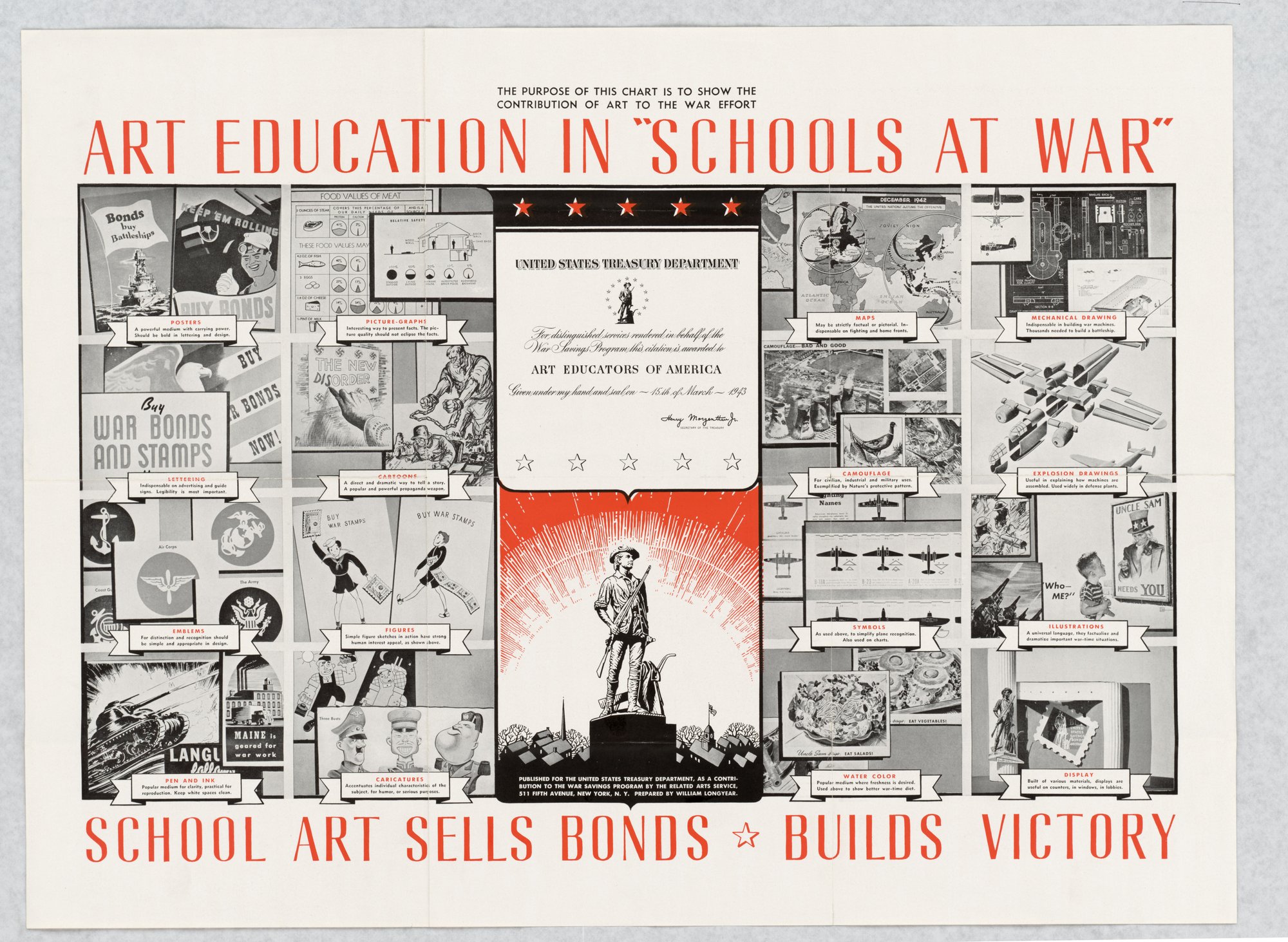
Art education in "Schools at War"
Wall chart of photographed sample artwork (posters, cartoons, maps, camouflage, caricatures) around a Treasury citation to 'Art Educators of America' and a Minuteman figure, closing with 'School art sells bonds, builds victory.' It ties classroom art to bond sales through slogan and patriotic symbol; its sample images include war-bond posters and caricatures of Axis leaders.
Propaganda techniques used in this poster
- Date
- 1943
- Period
- Second World War
- Made by
- U.S. Treasury Department, War Savings Program (Related Arts Service, prepared by William Longyear)
- Region
- North America
- Country
- United States
- Medium
- Poster
- Issuer type
- State
- Regime
- Roosevelt Administration
- Leader
- Franklin D. Roosevelt
- Audience
- Domestic public
- Purpose
- Fundraise
- Themes
- Home front, Economy and finance, Media and information
- Event
- World War II
- Regime
- Roosevelt administration
- Leader
- Franklin D. Roosevelt
- Source
- Identified Openly sourced: the speaker is who they say they are
- Source
- U.S. National Archives and Records Administration, Record Group 44, World War II Posters, retrieved October 4, 2026
- Rights
- Public domain (U.S. government work)
U.S. Treasury Department, War Savings Program (Related Arts Service, prepared by William Longyear). National Archives and Records Administration, RG 44, 44-PA-423 (NAID 513882).
Text on the object
THE PURPOSE OF THIS CHART IS TO SHOW THE
CONTRIBUTION OF ART TO THE WAR EFFORT
ART EDUCATION IN "SCHOOLS AT WAR"
POSTERS: A powerful medium with carrying power. Should be bold in lettering and design.
PICTURE-GRAPHS: Interesting way to present facts. The picture quality should not eclipse the facts.
LETTERING: Indispensable on advertising and guide signs. Legibility is most important.
CARTOONS: A direct and dramatic way to tell a story. A popular and powerful propaganda weapon.
EMBLEMS: For distinction and recognition should be simple and appropriate in design.
FIGURES: Simple figure sketches in action have strong human interest appeal, as shown above.
PEN AND INK: Popular medium for clarity, practical for reproduction. Keep white spaces clean.
CARICATURES: Accentuates individual characteristics of the subject, for humor, or serious purposes.
MAPS: May be strictly factual or pictorial. Indispensable on fighting and home fronts.
CAMOUFLAGE: For civilian, industrial and military uses. Exemplified by Nature's protective pattern.
SYMBOLS: As used above, to simplify plane recognition. Also used on charts.
WATER COLOR: Popular medium where freshness is desired. Used above to show better war-time diet.
MECHANICAL DRAWING: Indispensable in building war machines. Thousands needed to build a battleship.
EXPLOSION DRAWINGS: Useful in explaining how machines are assembled. Used widely in defense plants.
ILLUSTRATIONS: A universal language, they factualize and dramatize important war-time situations.
DISPLAY: Built of various materials, displays are useful on counters, in windows, in lobbies.
UNITED STATES TREASURY DEPARTMENT
For distinguished services rendered in behalf of the War Savings Program this citation is awarded to
ART EDUCATORS OF AMERICA
Given under my hand and seal on - 15th of March - 1943
[signature: Henry Morgenthau Jr., Secretary of the Treasury]
PUBLISHED FOR THE UNITED STATES TREASURY DEPARTMENT, AS A CONTRIBUTION TO THE WAR SAVINGS PROGRAM BY THE RELATED ARTS SERVICE, 511 FIFTH AVENUE, NEW YORK, N. Y. PREPARED BY WILLIAM LONGYEAR
SCHOOL ART SELLS BONDS ★ BUILDS VICTORY
[Text within the sample images is partly illegible.]