Atoms for Peace poster, Philippines p. 5: Hospital and Factory (English photo sheet distributed in the Philippines)
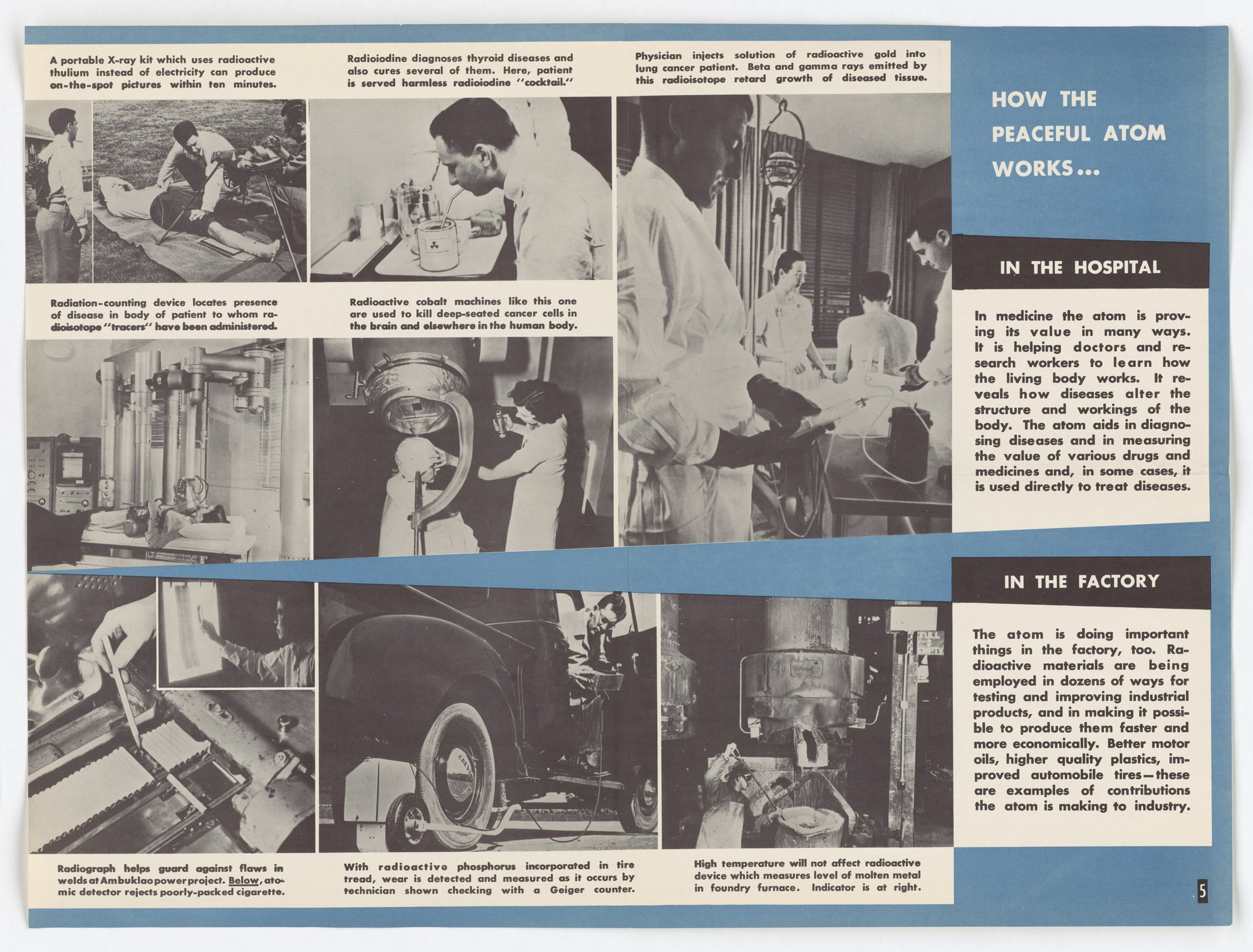
Page 5 of an English-language folded photo sheet, 'How the Peaceful Atom Works...', in two bands, 'In the Hospital' and 'In the Factory'. Photographs show radioisotope diagnosis and cancer treatment, then weld radiography, tyre-wear testing and a foundry level gauge, including the Ambuklao power project. The tell is glittering-generalities: the atom is presented only through beneficial uses ('wonder-working', 'proving its value') and the page shows no risks.
Propaganda techniques used in this poster
- Date
- April 10, 1956
- Period
- Cold War
- Made by
- U.S. Information Agency (predecessor: State Department International Information and Educational Exchange Program), Propaganda Posters Distributed in Asia, Latin America and the Middle East series
- Region
- North America
- Country
- United States
- Medium
- Poster
- Issuer type
- State
- Regime
- Eisenhower Administration
- Leader
- Dwight D. Eisenhower
- Audience
- Foreign public
- Purpose
- Persuade or win support
- Themes
- Science and technology, Health
- Event
- Cold War
- Source
- Unidentified Source blurred: contractors, cutouts, buried disclosure
- Source
- U.S. National Archives (NARA), RG 306, Propaganda Posters Distributed in Asia, Latin America and the Middle East, retrieved October 4, 2026
- Rights
- Public domain (U.S. government work; NARA RG 306)
U.S. Information Agency / Department of State, April 10, 1956. National Archives, Record Group 306 (NAID 6948914, 306-PPB-81e).
Text on the object
A portable X-ray kit which uses radioactive
thulium instead of electricity can produce
on-the-spot pictures within ten minutes.

Radioiodine diagnoses thyroid diseases and
also cures several of them. Here, patient
is served harmless radioiodine "cocktail."

Physician injects solution of radioactive gold into
lung cancer patient. Beta and gamma rays emitted by
this radioisotope retard growth of diseased tissue.

HOW THE
PEACEFUL ATOM
WORKS...

Radiation-counting device locates presence
of disease in body of patient to whom ra-
dioisotope "tracers" have been administered.

Radioactive cobalt machines like this one
are used to kill deep-seated cancer cells in
the brain and elsewhere in the human body.

IN THE HOSPITAL

In medicine the atom is prov-
ing its value in many ways.
It is helping doctors and re-
search workers to learn how
the living body works. It re-
veals how diseases alter the
structure and workings of the
body. The atom aids in diagno-
sing diseases and in measuring
the value of various drugs and
medicines and, in some cases, it
is used directly to treat diseases.

IN THE FACTORY

The atom is doing important
things in the factory, too. Ra-
dioactive materials are being
employed in dozens of ways for
testing and improving industrial
products, and in making it possi-
ble to produce them faster and
more economically. Better motor
oils, higher quality plastics, im-
proved automobile tires—these
are examples of contributions
the atom is making to industry.

Radiograph helps guard against flaws in
welds at Ambuklao power project. Below, ato-
mic detector rejects poorly-packed cigarette.

With radioactive phosphorus incorporated in tire
tread, wear is detected and measured as it occurs by
technician shown checking with a Geiger counter.

High temperature will not affect radioactive
device which measures level of molten metal
in foundry furnace. Indicator is at right.

5