Atoms for Peace poster, Philippines p. 6: Farm and Power (English photo sheet distributed in the Philippines)
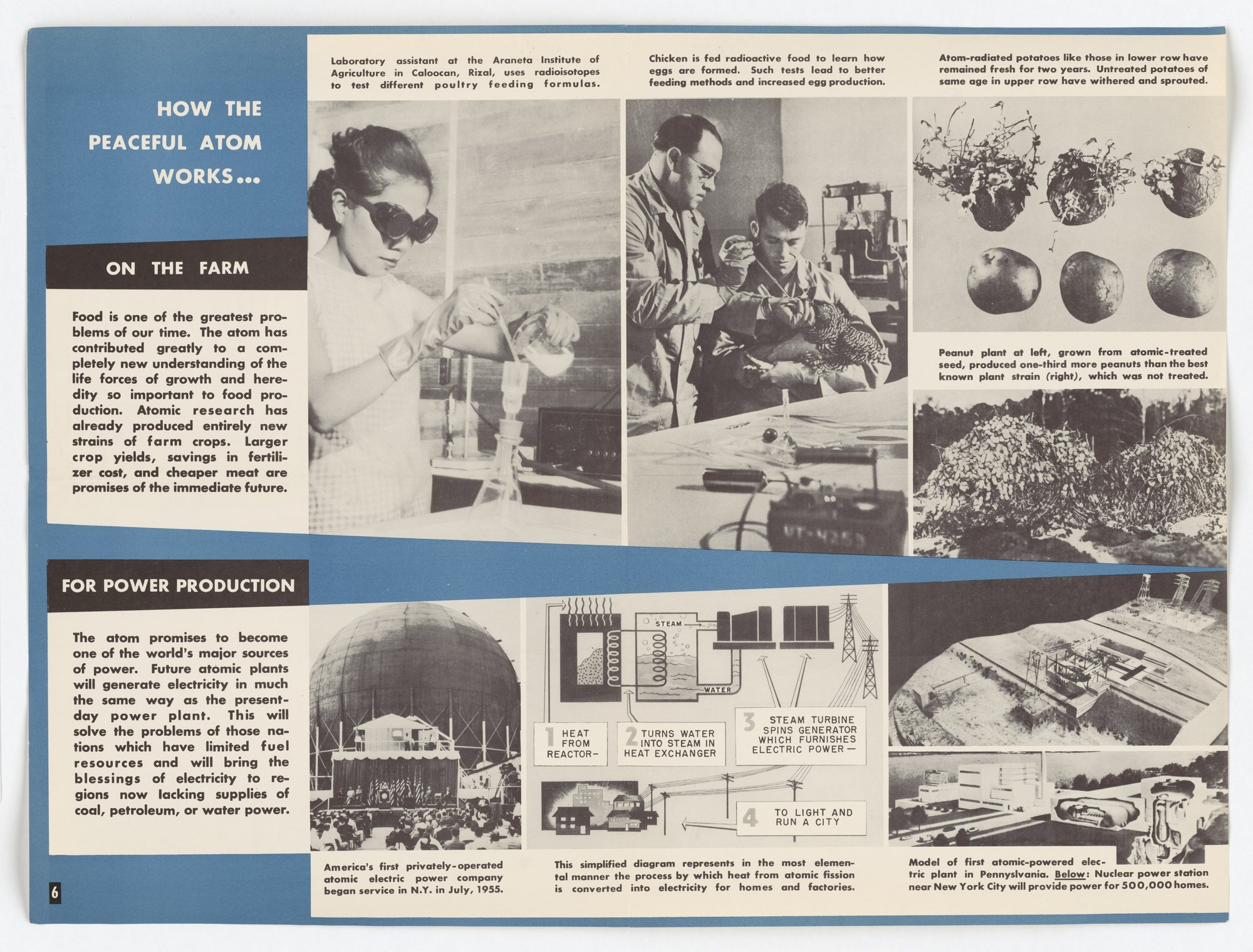
Page 6 of an English-language folded photo sheet, 'How the Peaceful Atom Works...', with bands 'On the Farm' and 'For Power Production'. Photographs show radioisotope poultry tests at a Rizal institute, treated potatoes and peanuts, a New York atomic power company opening, a four-step reactor diagram and plant models. The tell is glittering-generalities: 'promises of the immediate future' and 'blessings of electricity' frame atomic power as a remedy for food and fuel scarcity.
Propaganda techniques used in this poster
- Date
- April 10, 1956
- Period
- Cold War
- Made by
- U.S. Information Agency (predecessor: State Department International Information and Educational Exchange Program), Propaganda Posters Distributed in Asia, Latin America and the Middle East series
- Region
- North America
- Country
- United States
- Medium
- Poster
- Issuer type
- State
- Regime
- Eisenhower Administration
- Leader
- Dwight D. Eisenhower
- Audience
- Foreign public
- Purpose
- Persuade or win support
- Themes
- Science and technology, Economy and finance
- Event
- Cold War
- Source
- Unidentified Source blurred: contractors, cutouts, buried disclosure
- Source
- U.S. National Archives (NARA), RG 306, Propaganda Posters Distributed in Asia, Latin America and the Middle East, retrieved October 4, 2026
- Rights
- Public domain (U.S. government work; NARA RG 306)
U.S. Information Agency / Department of State, April 10, 1956. National Archives, Record Group 306 (NAID 6948915, 306-PPB-81f).
Text on the object
HOW THE
PEACEFUL ATOM
WORKS...

ON THE FARM

Food is one of the greatest pro-
blems of our time. The atom has
contributed greatly to a com-
pletely new understanding of the
life forces of growth and here-
dity so important to food pro-
duction. Atomic research has
already produced entirely new
strains of farm crops. Larger
crop yields, savings in fertili-
zer cost, and cheaper meat are
promises of the immediate future.

Laboratory assistant at the Araneta Institute of
Agriculture in Caloocan, Rizal, uses radioisotopes
to test different poultry feeding formulas.

Chicken is fed radioactive food to learn how
eggs are formed. Such tests lead to better
feeding methods and increased egg production.

Atom-radiated potatoes like those in lower row have
remained fresh for two years. Untreated potatoes of
same age in upper row have withered and sprouted.

Peanut plant at left, grown from atomic-treated
seed, produced one-third more peanuts than the best
known plant strain (right), which was not treated.

FOR POWER PRODUCTION

The atom promises to become
one of the world's major sources
of power. Future atomic plants
will generate electricity in much
the same way as the present-
day power plant. This will
solve the problems of those na-
tions which have limited fuel
resources and will bring the
blessings of electricity to re-
gions now lacking supplies of
coal, petroleum, or water power.

STEAM  WATER
1 HEAT FROM REACTOR—
2 TURNS WATER INTO STEAM IN HEAT EXCHANGER
3 STEAM TURBINE SPINS GENERATOR WHICH FURNISHES ELECTRIC POWER—
4 TO LIGHT AND RUN A CITY

America's first privately-operated
atomic electric power company
began service in N.Y. in July, 1955.

This simplified diagram represents in the most elemen-
tal manner the process by which heat from atomic fission
is converted into electricity for homes and factories.

Model of first atomic-powered elec-
tric plant in Pennsylvania. Below: Nuclear power station
near New York City will provide power for 500,000 homes.

6