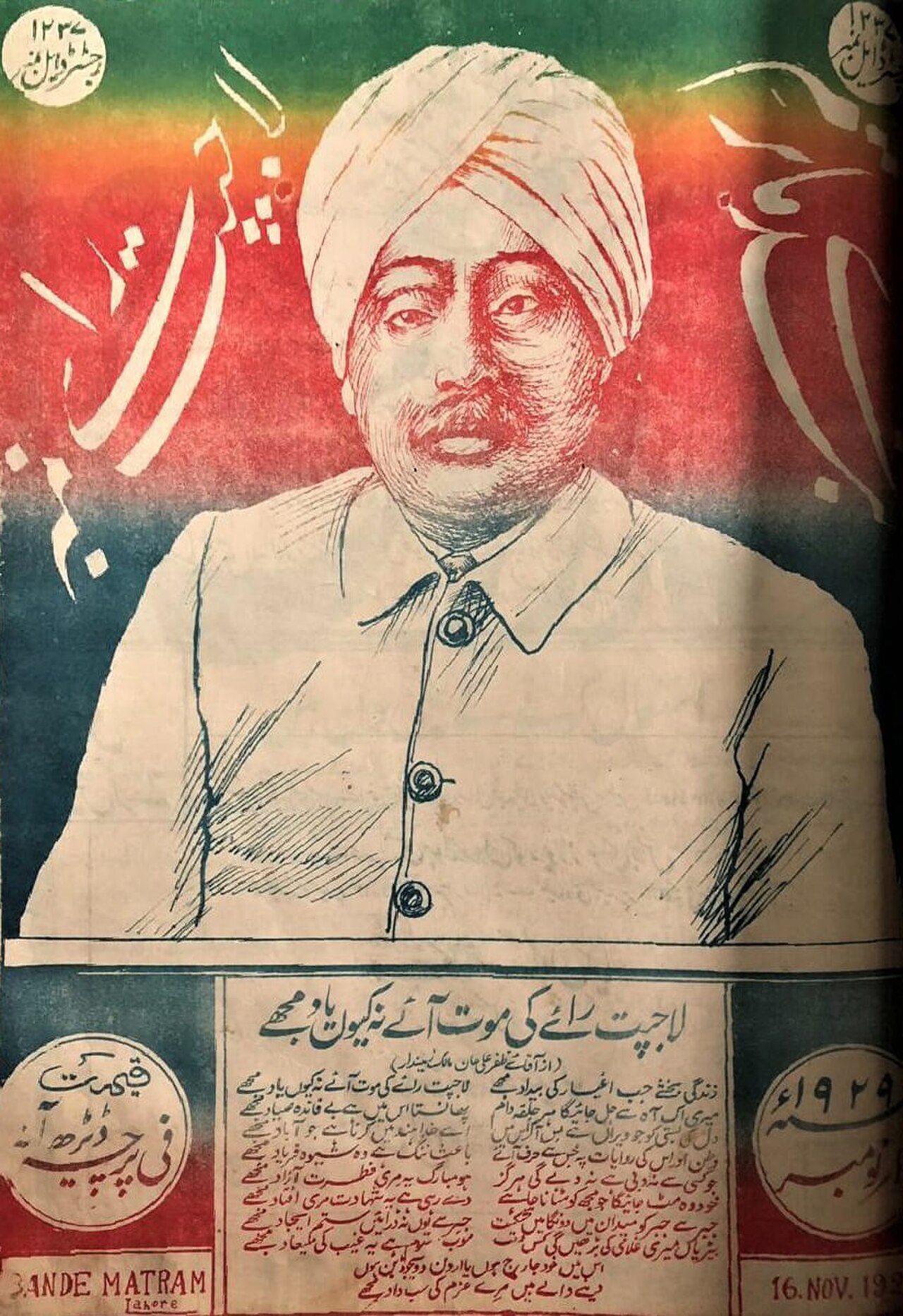
Bande Mataram (Lahore), commemorative page for Lala Lajpat Rai, 16 November 1929
A three-colour front page dominated by a large engraved portrait of Lala Lajpat Rai, with a boxed Urdu elegy below headed 'Why should the death of Lajpat Rai not come to my mind'. Tells: the portrait-and-elegy format and the verse's use of the word for martyrdom (shahadat) make the dead leader a symbol whose prestige attaches to the movement.
- Date
- November 16, 1929
- Period
- Interwar
- Made by
- Daily Bande Mataram, Lahore; elegy credited on the page to Zafar Ali Khan, proprietor of the Zamindar
- Region
- South Asia
- Country
- British India
- Medium
- Newspaper pages
- Issuer type
- Media
- Regime
- British Raj
- Leader
- Edward Wood
- Audience
- Domestic public
- Purpose
- Commemorate
- Themes
- Empire and colonialism, Media and information
- Event
- Simon Commission Boycott
- Techniques
- Transfer
- Source
- Identified Openly sourced: the speaker is who they say they are
- Source
- Wikimedia Commons (image courtesy of the Research Society of Pakistan, University of the Punjab), retrieved September 29, 2026
- Rights
- Public domain (published in Lahore, 16 Nov 1929, before 1931; US public domain by publication date)
Daily Bande Mataram, Lahore, 16 November 1929; image courtesy of the Research Society of Pakistan, University of the Punjab, via Wikimedia Commons
Text on the object
[masthead calligraphy in the upper corners, mostly hidden behind the portrait; illegible]

لاجپت رائے کی موت آئے نہ کیوں یاد مجھے
(از آقائے ظفر علی خاں مالک زمیندار)

[verse in two columns, about a dozen couplet lines; not transcribed]

قیمت فی پرچہ ڈیڑھ آنہ

BANDE MATRAM
Lahore
16. NOV. 192[9]
Why should the death of Lajpat Rai not come to my mind
(By Zafar Ali Khan, proprietor of the Zamindar)

[verse not transcribed]

Price per copy: one and a half annas
Headline, price line and Latin-script imprint are clear; the attribution line is small and partly obscured, so the name reading is uncertain. The date roundel at lower right (Urdu, November 1929) is not transcribed. Urdu read by Claude, not verified by a fluent reader.
.jpg)