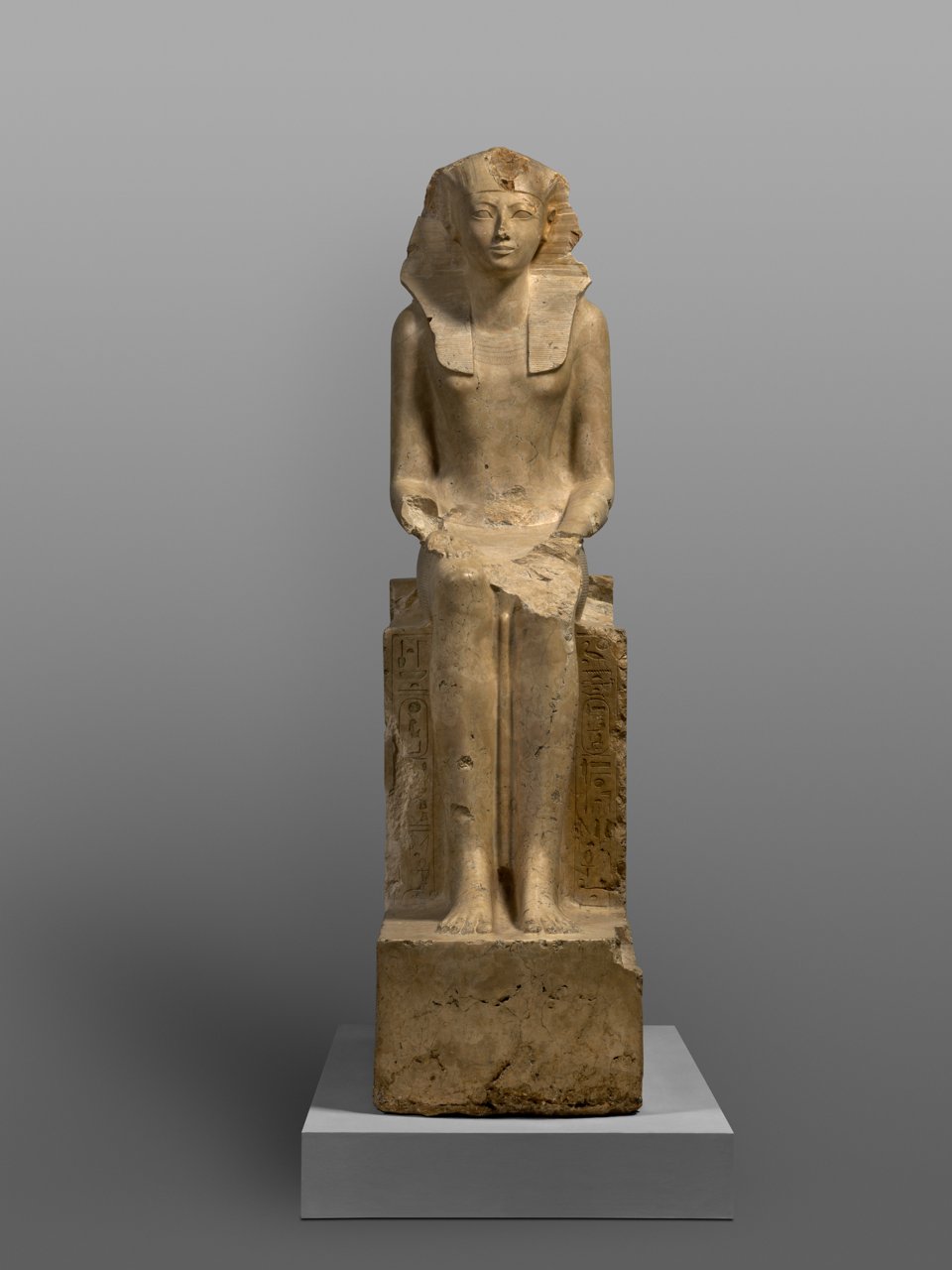
Seated limestone statue of Hatshepsut as king, with feminine royal titles on the throne, reassembled from fragments broken up at Deir el-Bahri
A painted, polished limestone statue of Hatshepsut seated as king: the male royal kilt, bull's tail and nemes headcloth, with small breasts and feminine titles inscribed on the throne, and the Nine Bows incised under the feet. It stood in her temple at Deir el-Bahri until it was smashed and thrown into a nearby pit; the Metropolitan Museum's excavators rejoined the pieces in the 1920s.
- Date
- 0000
- Period
- Pre-1914
- Made by
- Hatshepsut and her court at Thebes; the statue was later broken up and dumped, under Thutmose III
- Country
- New Kingdom Egypt
- Medium
- Artwork
- Issuer type
- State
- Regime
- New Kingdom Egypt
- Leader
- Hatshepsut
- Audience
- Domestic public
- Purpose
- Persuade or win support
- Techniques
- TransferTestimonial
- Regime
- New Kingdom Egypt
- Leader
- Hatshepsut
- Source
- Identified Openly sourced: the speaker is who they say they are
- Source
- The Metropolitan Museum of Art (Open Access), retrieved October 2, 2026
- Rights
- Public domain (The Met Open Access, CC0; isPublicDomain true in the Met API; object about 3,400 years old)
The Metropolitan Museum of Art, Rogers Fund, 1929 (29.3.2), Open Access
Text on the object
[Hieroglyphic inscriptions run down the front of the throne, one along each leg; they are not transcribed in the original script in this entry.]
Along the proper left leg: "The Perfect Goddess, Lady of the Two Lands, Maatkare, beloved of Amun-Re, Lord of the Thrones of the Two Lands, may she live forever!" Along the right: "The bodily daughter of Re, Khenemet-Amun-Hatshepsut, beloved of Amun-Re, King of the Gods, may she live forever!"
Translation as given in the Met catalogue entry for this statue (Roehrig, Dreyfus and Keller eds., 2005, cat. 96). It is a published translation, not one made from the image; the hieroglyphs were not read here.